An insurance adjuster looks for proof that a loss happened, that it was caused by the event you reported, that the damaged item was in the condition you say it was, and that your policy actually covers it. In practice that means the visible damage, the cause behind it, records that back up your account, and a repair cost tied to real market prices.
Below is what that looks like on a home claim and an auto claim, how the estimate gets built, and what you can do the week before an inspection so the visit is quick and the record is complete.
Table of Contents
- What an Insurance Adjuster Looks For
- How an Insurance Adjuster Evaluates a Claim
- How to Prepare Before the Adjuster Arrives
- What If the Evidence Is Unclear or the Offer Seems Low?
- Frequently Asked Questions
- What does an insurance adjuster actually look for during an inspection?
- Does an adjuster decide whether my claim is covered?
- Is the adjuster’s repair estimate the final amount my insurance will pay?
- What should I photograph or prepare before the adjuster visits?
- What can I do if the adjuster missed damage or offered too little?
- Conclusion: Start With Clear Evidence
What an Insurance Adjuster Looks For
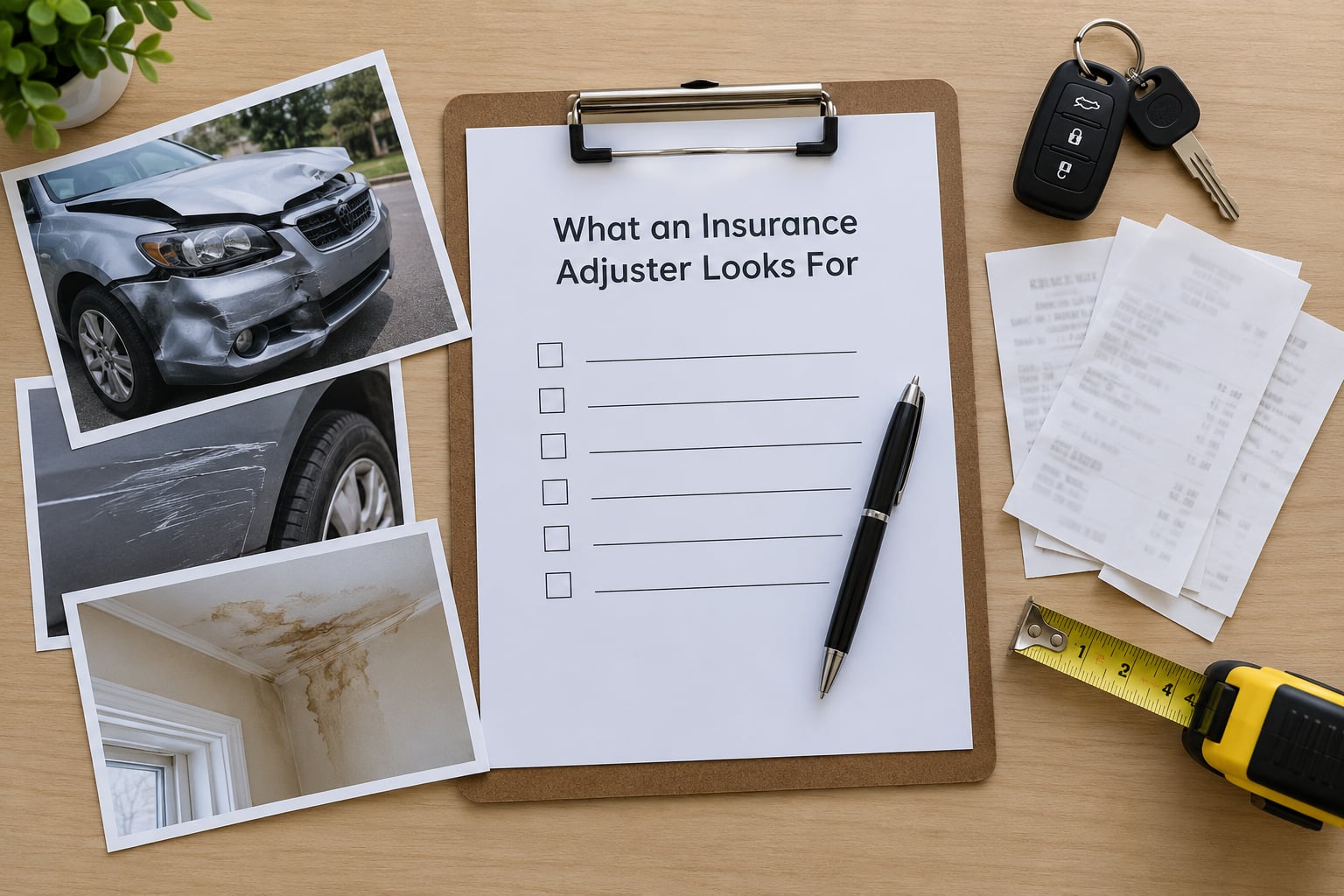
Eight things come up on nearly every claim file, no matter how big or small:
- The reported loss — what you said happened, in your own words and in the notice of loss form.
- Visible damage — what can be seen and photographed at the scene, including damage you did not report.
- Condition before the event — age, wear, maintenance history, and anything that was already damaged.
- Cause — whether the mechanism you described could produce the damage pattern present.
- Ownership and insurable interest — that you own the vehicle, structure, or contents being claimed.
- Coverage fit — which part of your policy responds, what the limits are, and what the deductible does.
- Documentation — photos, measurements, receipts, prior repair records, police or fire reports, medical records.
- Repair or replacement cost — labor, materials, parts, and market rates for the work involved.
That list is the adjuster’s frame for the whole claim. Everything else — recorded statements, supplemental inspections, estimate revisions — feeds back into one of those eight.
How an Insurance Adjuster Evaluates a Claim
The sequence is fairly consistent. You report the loss, the carrier opens a file and assigns an adjuster, the adjuster reviews the policy and the notice of loss, then inspects or requests photographs. From there they price the damage, compare that price against coverage, and pass a recommendation up the chain.
One point to hold onto: the adjuster investigates the loss, but they usually do not make the final coverage call alone. Field adjusters typically work with a settlement authority figure set by the carrier, and a supervisor or a claims committee reviews anything unusual, denied, or large. On injury claims a separate unit may handle the medical evaluation entirely.
How an Insurance Adjuster Looks for Damage, Cause, and Condition
Cause and condition are judged together, because the damage pattern has to fit the story. A rear-end collision produces crush damage concentrated at the point of impact, bumper deformation, and matching scrape lines. If the file instead shows damage to the hood and roof, the estimate gets questioned.
On the property side, a water stain gets checked for cause. An active leak, a failed supply line, and a roof shingle letting water in are three different claims with three different responses. Adjusters also scan for signs of previous damage — a repaired crack, a patched section of siding, a stain that has already dried at the edges — because a loss that happened before the policy period may not be covered at all.
Appearance alone does not prove anything. A photo showing a cracked foundation can come from settling, from a tree root, or from a recent freeze. What the adjuster is really doing is narrowing the list until one explanation fits the evidence.
Evidence, Documentation, and Ownership
Records get requested because each one closes a specific gap in the file.
| Record | What it establishes |
|---|---|
| Notice of loss statement | Your account of timing, cause, and damage, in your own words |
| Photographs and video | The condition and extent of damage before any cleanup |
| Police or fire report | Independent account of the incident and who was involved |
| Prior repair records and receipts | Age, condition, and what has already been replaced or repaired |
| Proof of ownership | Title, registration, deed, or purchase records for the item claimed |
| Photo identification | Confirms who you are and connects you to the policy |
| Contractor or shop estimates | An outside price for the same scope of work |
| Medical records and bills | Treatment, cost, and recovery timeline on injury claims |
Missing documentation is the most common reason a claim slows down. Not because the adjuster doubts you, but because the file has to stand on its own later, possibly years later.
How Repair or Replacement Costs Are Estimated
Estimates are built from parts, labor, and materials, priced for your area. Labor rates vary by market, as do material and part costs. Beyond that, the policy terms matter: replacement cost coverage pays to replace with like kind and quality, while actual cash value subtracts depreciation for age and wear. Salvage value, sublimits, and coinsurance can also change the number.
| Claim type | Information used to price it |
|---|---|
| Auto collision | Vehicle year, make, model, options, mileage, labor hours per panel, parts pricing |
| Hail or wind damage | Scope of impact across roof, gutters, screens; material and layer count on the roof |
| Water damage | Source of the leak, affected area, drying and remediation scope, finishes replaced |
| Fire or smoke | Extent of heat, flame, and soot damage, contents inventory, cleaning versus rebuild |
| Theft or vandalism | Proof of ownership, receipts or valuations, police report, replacement value of contents |
| Total loss | Actual cash value versus replacement cost, comparable sales, condition before the loss |
The first number you receive is rarely the final one. It is an opening position built from what was visible at inspection, and it is priced against coverage terms rather than against the full scope you may actually need.
How to Prepare Before the Adjuster Arrives
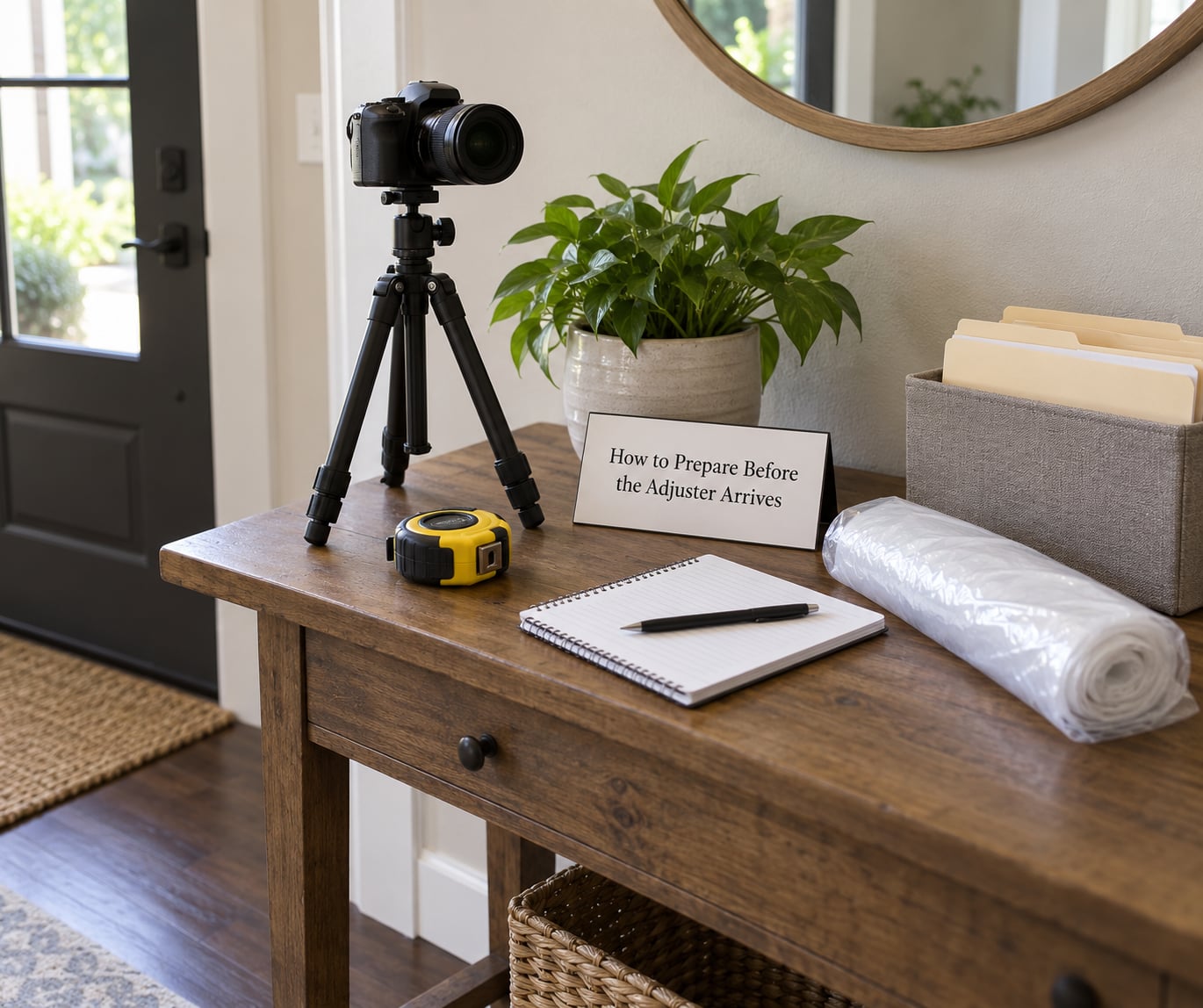
This list is short and unglamorous, and it makes a measurable difference on the estimate.
- Photograph everything from several angles, wide shots for context and close shots for detail, before anything moves.
- Take measurements — room dimensions, damaged panel sizes, the area of a stain. Estimates go faster when the scope is already known.
- Assemble records in one folder, including the policy number, claim number, and every receipt or report you have.
- Write down a clear account of what happened, in order, while it is fresh.
- Keep damaged items until the adjuster has seen them, or until you have been told in writing they are not needed.
- Make safe temporary repairs — tarps, dry-out equipment, boarding up — and save every invoice.
- Skip permanent repairs until the scope is settled. Work done before the inspection can create an argument about what the damage looked like beforehand.
Temporary mitigation to stop further damage is normally treated differently from permanent repair work, and expenses for it are commonly reimbursable once documented. Keep the receipts and ask before you start anything structural or electrical.
What If the Evidence Is Unclear or the Offer Seems Low?
Claims stall for ordinary reasons. The photos did not show the water damage behind the drywall. The estimate priced parts for a base trim instead of the one you have. The recorded statement and the police report describe the collision differently. Each of those has a routine fix.
Ask for the written estimate rather than a phone summary, and go through it line by line against the scope you know. Missing labor items and wrong part specifications are common and worth flagging. Send additional photographs or measurements that address the specific gap, and request a supplemental inspection if something could not be seen the first time.
If the carrier’s response still does not make sense, escalate in order: the adjuster first with the missing evidence, then the adjuster’s supervisor with a written request for reconsideration, then the carrier’s internal appeals or complaint process. Your state insurance department handles complaints and can confirm that a public adjuster is properly licensed before you hire one. Rules on licensing, deadlines, and bad faith vary by state, so treat this as a general description of the process and get local advice for your specific claim.
Frequently Asked Questions
What does an insurance adjuster actually look for during an inspection?
They look for visible damage, the cause behind it, and the condition of the item before the loss. On a home that means the roof, exterior, plumbing, electrical panel, HVAC, water damage signs, foundation, and safety devices. On a vehicle it means the point of impact, panel damage, glass and lights, mileage, options, and any pre-existing wear. They also photograph and measure so the file supports the estimate later.
Does an adjuster decide whether my claim is covered?
Usually not on their own. The adjuster investigates, documents, and prices the loss, then passes a recommendation to a supervisor or claims committee. Larger claims, denials, and anything outside settlement authority go up for review. The coverage decision itself comes from your policy language, which is why understanding your limits and exclusions matters as much as the damage report.
Is the adjuster’s repair estimate the final amount my insurance will pay?
No. The first estimate reflects what was visible at the first inspection, priced with local labor rates and coverage terms. Once repairs are opened up or hidden damage appears, the scope can grow, and a supplemental estimate is normal. If your policy is written on a replacement cost basis, the first payment may also be actual cash value with depreciation held back until the work is done.
What should I photograph or prepare before the adjuster visits?
Photograph damage wide and close, from several angles, before anything is moved or cleaned. Take measurements of affected areas, gather receipts and repair records, keep the policy and claim numbers handy, and write down what happened while it is fresh. Make safe temporary repairs to prevent further damage and save every invoice, but hold off on permanent work until the scope is agreed.
What can I do if the adjuster missed damage or offered too little?
Ask for the written estimate and compare it against the scope you know, flagging missing labor items or wrong part specifications. Send photographs or measurements that fill the specific gap and request a supplemental inspection if something could not be seen. If the response still falls short, escalate to the adjuster’s supervisor, then the carrier’s complaint process, and finally your state insurance department.
Conclusion: Start With Clear Evidence
Knowing what an insurance adjuster looks for changes how you handle the first week. Photograph the damage from every angle, keep receipts and records together, track any expense you pay to prevent further loss, and ask for a written copy of the estimate so you can read the numbers instead of hearing them.
When coverage language or a calculation does not make sense, ask the adjuster to explain it, put the request in writing, and escalate through the carrier if the answer stays unclear. The claim file is the record that decides the outcome, and a well-documented one gives you the stronger position every time.