
Why a claim can raise your premium comes down to one mechanism: insurers price on predicted future losses, and a claims history is the strongest single signal they have. A claim is not a punishment, it is evidence. The change also almost never lands the day you file. It shows up at your next renewal, and most carriers carry the effect for three to five years.
Here is what turns a claim into a higher number:
- Fault. Was the claim coded at-fault or not-at-fault, and did anyone get a citation?
- Severity. A 900-dollar bumper repair and a totaled vehicle are not the same event to an underwriter.
- Coverage type. Collision and liability claims generally count harder than a glass-only claim.
- Frequency. Two claims inside three years is a very different file than one claim in a decade.
- Classification. Carriers code claims as chargeable or non-chargeable, and that code drives the surcharge.
- Discounts. A claims-free or accident-free discount can disappear even when the base rate barely moves.
Everything below is general information. Surcharge rules, filing deadlines and rating plans vary by state and by carrier, so treat this as a framework for asking your own questions rather than a prediction about your next bill.
Table of Contents
- How a Claim Changes Your Insurance Record
- How Claim History Affects Your Rate at Renewal
- What Kinds of Claims Are Most Likely to Affect Your Premium?
- Can a Claim Raise Your Premium If You Were Not at Fault?
- What Determines How Much the Premium May Increase?
- Does a Denied or Unpaid Claim Still Count?
- How to Reduce the Impact of a Claim on Future Premiums
- 1. Shop before renewal, not after
- 2. Ask for the rate-change explanation in writing
- 3. Check your driving record for errors
- 4. Use accident forgiveness if your carrier offers it
- 5. Never let coverage lapse
- 6. Run the file-or-pay math before you report
- 7. Keep a reserve if you raise your deductible
- 8. Have a replacement lined up before a non-renewal notice
- 9. Treat property claims like auto claims
- Frequently Asked Questions
- Will my insurance premium increase immediately after I file a claim?
- Can another driver’s accident claim increase my premium?
- Does a claim always stay on my insurance record forever?
- Should I report a minor accident to my insurance company?
- Can I get a lower premium from another insurer after a claim?
- Why does one insurer quote more than another after the same accident?
- Conclusion: Check the Next Renewal First
How a Claim Changes Your Insurance Record
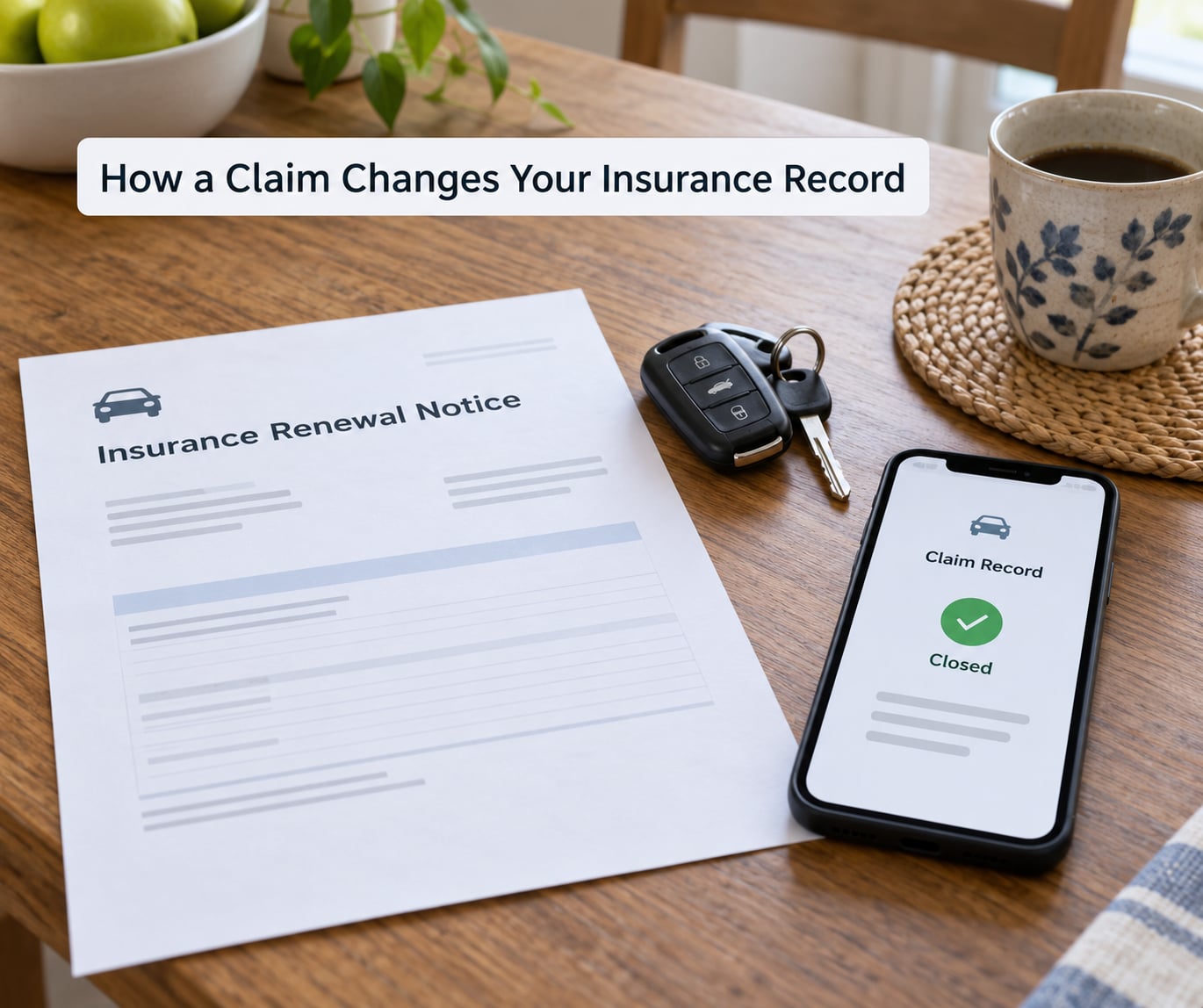
When a claim is reported, it does not stay inside the company that paid it. It is coded and passed into a shared loss history that other carriers can pull, most commonly the CLUE report, the Comprehensive Loss Underwriting Exchange. That report keeps roughly seven years of records.
This matters more than it sounds. You are not being judged once by one insurer at one moment. You are being re-judged by every insurer you shop in the years after the accident.
Why a Claim Can Raise Your Premium After an Accident
Insurers sell a promise to pay a future loss at a price that covers the losses they expect. The expected cost of that promise is built from claims data, and the biggest input is what you personally have already claimed.
Think about it from the carrier’s side. A household with no claims in six years costs the pool very little. A household with two claims in two years costs it a great deal. Pricing separates those two households, and the separation is the surcharge.
The distinction between the risk pool and you matters too. A single severe claim can push a policy up because the payout was large, and because the claim signals to an underwriter that your specific tier now carries more expected loss than the tier you were in.
How Insurers Review Fault, Damage, and Driving Risk
Underwriters rarely just add a flat penalty. They look at a combination of signals:
- Liability determination. A police report, citation, or the other party’s insurer accepting fault drives the chargeable or non-chargeable code.
- Injury severity. Medical payments and personal injury liability claims sit in a different risk category from property damage only.
- Property damage and vehicle value. Repair cost relative to the car’s value changes how expensive the loss was to replace or fix.
- Accident frequency. The count over three to five years is weighted heavily, sometimes more heavily than the dollar amount.
- Everything else in the file. Violations, credit-based rating factors, changes in coverage, and a lapse in coverage all get reviewed in the same pass.
An underwriter reviewing your renewal sees all of it at once. That is why two people with identical repairs can get two very different renewal quotes.
How Claim History Affects Your Rate at Renewal
The rate you are paying right now is locked. Filing a claim does not change your current policy period, and your premium does not jump the week the adjuster visits.
At renewal, the carrier recalculates your price from scratch. Your new premium can change for a dozen reasons at once, which is why the increase so often feels mysterious.
Two separate things can happen at renewal
The first is a surcharge, an added amount tied to the claim itself. The second is the loss of your claims-free discount, sometimes also called accident-free savings. This second one catches people out because the base rate barely moved and the discount vanished.
Ask which one you are dealing with before you assume the worst. A carrier that removes a 90-dollar-a-year discount has done something very different from one that adds 300 dollars a year of surcharge.
How long the effect lasts
Three to five years is the range most carriers use for a chargeable claim, and the effect often decays rather than switching off in year four. The size of the change differs by carrier and by file, which is why a figure from someone else’s renewal tells you very little about yours.
The database record itself runs longer, around seven years, so a claim from six years ago may sit in the report without being part of your current rate.
What happens if you switch insurers
Moving carriers does not reset anything. The new carrier pulls the same shared history and prices you with it. What shopping can do is find a company whose rating plan treats your file differently, which is a real but limited lever.
What Kinds of Claims Are Most Likely to Affect Your Premium?
Not every claim weighs the same. Roughly, the categories below run from most to least likely to move your renewal price, though state rules and carrier practice can reorder them.
| Claim type | Typical impact on your premium | Why |
|---|---|---|
| Liability or personal injury | Highest | Large payouts, long tails, and a direct signal about future claims |
| At-fault collision with injury | Very high | Chargeable, expensive, and treated as a change in your risk tier |
| At-fault collision, property damage only | High | Chargeable code plus a frequency count |
| Water damage or mold (home) | High | Open-ended cost, mold investigations attract underwriter attention |
| Hail, roof or storm damage (home) | Moderate to high | Often coded non-chargeable for the policyholder, but frequency matters |
| Comprehensive: theft or vandalism | Moderate | Not fault-based, but still a reported loss |
| Animal strike | Moderate | Comprehensive claim, frequently coded non-chargeable |
| Glass or windshield only | Low | Cheap to repair, often covered by separate glass provisions |
| Minor dent or missing shingles | Lowest | Repair cost is far below any deductible, so filing usually nets nothing |
Notice that the two lowest rows are also the two where the payout rarely justifies the record. That is the whole file-or-pay argument in one table.
Can a Claim Raise Your Premium If You Were Not at Fault?
Usually not, and the reason is that at-fault status drives the chargeable classification. If the other driver was cited, their insurer paid, and your own carrier recorded the loss as non-chargeable, most companies will not surcharge you for it.
When the loss was never cited and nothing was ever paid out of your own policy, your rate usually stays where it was. Three exceptions keep that from being a clean rule.
- State law. Some states restrict or prohibit surcharges tied to not-at-fault or catastrophe losses. Others do not.
- Frequency. The claim may be coded non-chargeable and still sit next to another one, which affects how the file is read.
- The carrier’s own rating plan. A company can weigh third-party loss history differently. Ask yours directly rather than assuming.
Third-party claims also work differently. If someone sues you for a liability loss, that is a claim on your record regardless of what you believe about it, and it stays open far longer than a collision claim.
What Determines How Much the Premium May Increase?
There is no universal percentage, and any number you read without your carrier’s rating plan is decoration. The size of the change comes from a stack of factors.
- Claim severity. Totaled vehicle versus a replaced bumper panel.
- Fault and chargeable coding. The single biggest fork in the road.
- Frequency. Two or more claims in the surcharge window compound.
- Your tier inputs. Driving record, violations, credit-based factors, mileage, vehicle and location.
- Coverage choices. Limits, deductibles, and anything you added or removed since last term.
- Carrier loss experience. If a carrier’s book performed badly in your area, everyone’s rate moves regardless of claims.
That last point explains the version of the question that gets the most airtime on personal finance boards: the premium that jumps with no claim on file at all. When that happens, the answer is usually sitting in the list above, and coverage and deductible changes are usually the first two places to look.
A deductible change is a common culprit. People often move from a 500-dollar deductible to a 1,000-dollar deductible at renewal without connecting it to the higher premium, then meet a smaller payout on the next claim. Raising a deductible lowers the premium because it lowers what the insurer expects to pay. It is a trade, not a gift.
Does a Denied or Unpaid Claim Still Count?
It depends on what happened, and this is where the questions get sharp.
A denied claim can still appear in your record as reported. The claim was opened, and some carriers code it and keep it even when the payment is refused. Ask the carrier in writing whether a denied claim is classified chargeable, and for how long.
A claim you cancelled does not reliably disappear. A cancelled claim can keep showing in the carrier’s system with a status nobody can explain cleanly. Treat a filed claim as permanent and ask about the consequences before you file.
An open claim can affect your renewal before any money moves. If a claim is still unresolved at renewal, the underwriter prices on the possibility. This is the detail almost no explainer mentions.
A claim paid by someone else through subrogation or the other party’s insurer still appears as a loss event. Whether it is coded chargeable is the question to ask.
How to Reduce the Impact of a Claim on Future Premiums
None of this undoes a claim. All of it limits what happens next.
1. Shop before renewal, not after
Get three or four quotes through an independent agent who can see multiple carriers’ rating plans. A captive agent can only quote one company. Start shopping 60 to 90 days before renewal, because the agent will want time to see the loss history process.
2. Ask for the rate-change explanation in writing
Most carriers can break down a renewal into components. If the increase is a lost discount rather than a surcharge, you know what you are dealing with and you can ask whether any other discount or a coverage change offsets it.
3. Check your driving record for errors
A mistaken violation on a motor vehicle report can cost more than a claim did. Ordering your own record is cheap, and correcting an error removes it from the file before renewal.
4. Use accident forgiveness if your carrier offers it
Accident forgiveness credits your first at-fault collision against your rate, or applies a declining surcharge on subsequent claims. It is not universal, so ask whether yours applies to the claim type you filed.
5. Never let coverage lapse
A lapse is a rating factor and a red flag to underwriting. Continuous coverage, sometimes including with a different carrier, protects your discount eligibility.
6. Run the file-or-pay math before you report
Three worked scenarios, using a 1,000-dollar deductible and a three-year surcharge estimate:
| Scenario | Repair cost | Your net payout | Likely verdict |
|---|---|---|---|
| Scratched bumper | 480 dollars | 0 dollars | Pay it. You are under the deductible. |
| Front-end collision with a 1,400-dollar repair | 1,400 dollars | 400 dollars | Ask first. A 200-dollar-a-year surcharge over three years costs more than the payout. |
| Side-impact with injuries and a 6,500-dollar repair | 6,500 dollars | 5,500 dollars | File it. Insurance exists for this. |
Get the repair estimate before you decide, and remember that a partial payment without a full repair can trigger an adjustment at claim close.
7. Keep a reserve if you raise your deductible
Moving to a higher deductible only makes sense if you could absorb the full amount of a covered loss without the policy. People who raise it for the discount and then cannot pay the deductible end up paying more than the discount ever saved.
8. Have a replacement lined up before a non-renewal notice
A carrier is allowed to decline to renew a policy in most states, and one serious chargeable claim is occasionally the reason. The fear of a non-renewal is what makes that notice land so hard, and it is also the easiest to prepare for.
Start a quote with an independent agent as soon as the claim closes, not when the notice arrives. If the notice comes, you are choosing from a real set of options rather than accepting whatever is left on the last day.
9. Treat property claims like auto claims
Home and roof claims follow the same logic, with two differences worth knowing. First, weather losses often get coded non-chargeable because no one is at fault, yet a cluster of them in one hail season can still affect renewal. Second, a home claim carries coverage details most people have never read, and water damage interacts with mold exclusions in ways that can keep a claim open far longer than expected.
Check your policy language for how water and mold are described before a storm season, not after.
Frequently Asked Questions
Will my insurance premium increase immediately after I file a claim?
Almost never. Your current policy period is priced and locked, so filing does not change what you pay this term. The claim is recorded, then evaluated at renewal. That is when an underwriter can add a surcharge, remove a claims-free discount, or both. Some carriers do re-rate mid-term in limited situations, such as a material change in exposure, so ask yours directly if timing matters to your decision.
Can another driver’s accident claim increase my premium?
Usually not, if you were not at fault. Most carriers code a third-party claim as non-chargeable and do not surcharge the policyholder. Exceptions do exist: some states limit surcharges for not-at-fault losses, and some carriers weigh loss frequency regardless of fault. If your claim was recorded as non-chargeable, get that in writing before your renewal.
Does a claim always stay on my insurance record forever?
No, but it stays a long time. Claims reports generally hold roughly seven years, and the surcharge effect at most carriers runs three to five years from the loss. A claim can remain visible after it stops affecting your rate. Switching carriers does not clear it, since the new company pulls the same shared history. Age the claim down, and focus shopping on carriers whose rating plan treats your file gently.
Should I report a minor accident to my insurance company?
Usually not, when the repair runs close to or below your deductible, because you net nothing and gain a record. File it when the loss is well above the deductible, when anyone is injured, when liability is disputed, or when the other party has no coverage. Get a written estimate first, and ask about accident forgiveness before deciding.
Can I get a lower premium from another insurer after a claim?
Sometimes. The claim record travels with you, but rating plans differ, so one carrier may price your file higher than another would. Shop through an independent agent who can compare several companies, and quote before your renewal rather than after. Expect the increase to follow you to most quotes; the goal is finding the plan that adds the least, not finding a company that pretends the claim did not happen.
Why does one insurer quote more than another after the same accident?
Because each carrier runs its own rating plan, weighting severity, fault, frequency and discounts differently. Two companies can also be in different loss positions in your ZIP code, which moves every quote in that area. Credit-based rating factors, coverage limits and deductibles differ too. The claim sets the floor; the carrier’s plan, book and territory set how far above it you land.
Conclusion: Check the Next Renewal First
Start with the record itself. Pull your own claims history, read the renewal notice line by line, and ask the carrier in writing whether your increase came from a surcharge or a lost discount.
Then get competing quotes through an independent agent before the renewal date, not after. If you have an open or unresolved claim, resolve it, because an unfinished file can be priced as though the worst case is still possible.
A claim changes what an insurer expects from you for a few years. It does not decide what you pay, and it does not follow you in a straight line. How you handle the next two policy years is up to you.