
A good job ad does two jobs at once: it convinces the right person to apply, and it quietly filters out everyone who is not. If you know the role before you open a blank page, write a standard title people actually search for, state the pay, and describe a normal week in the role, you will get fewer applications and better ones. That is the whole idea, and it takes about an hour the first time.
Most weak postings fail on honesty, not on effort. They promise a career, hide the pay, list twelve requirements for a job that needs four, and then the hiring manager spends a week reading applications that were never going to work out.
Below is the process I would hand a first-time employer: what to gather first, then seven steps, then the mistakes that cost the most applications.
Table of Contents
- What You Need
- How to Write a Job Ad That Attracts Good Applicants
- Step 1: Define the role before you write a word
- Step 2: Write a clear, accurate job title
- Step 3: Lead with the reason to apply
- Step 4: Describe the work in concrete terms
- Step 5: Separate must-have skills from preferred skills
- Step 6: Be transparent about pay, benefits, and conditions
- Step 7: Make the application process easy to complete
- Common Mistakes
- Frequently Asked Questions
- How specific should a job ad be?
- Should I include the salary range in my job ad?
- How do I attract applicants if I cannot match the biggest employers on pay?
- Is it legal to ask for years of experience in a job ad?
- How do I screen applicants without discriminating?
- How long should a job ad be?
- Conclusion
What You Need
You cannot write this ad until you can describe the job to someone else in two minutes. Gather these seven things first, and the drafting gets fast.
- The role title — the one candidates will recognise from job boards, not an internal rebrand.
- Essential duties — the five or six things this person genuinely does most weeks.
- Must-have qualifications — what you would actually reject someone over.
- Preferred qualifications — genuinely useful, but not deal-breakers.
- Pay and benefits — the hourly range or salary band, plus real perks with numbers or names attached.
- Schedule and location — days, hours, on-site, hybrid or remote, and the commute reality.
- Workplace expectations — pace, travel, customer contact, physical demands, who they report to.
- Application instructions — what to submit, where to send it, what happens next, and a real contact.
If you cannot fill in one of those lines, you have a decision to make before you write a single sentence of copy. Sorting that out first prevents the classic mess of an ad that attracts applicants you then have to disappoint.
How to Write a Job Ad That Attracts Good Applicants
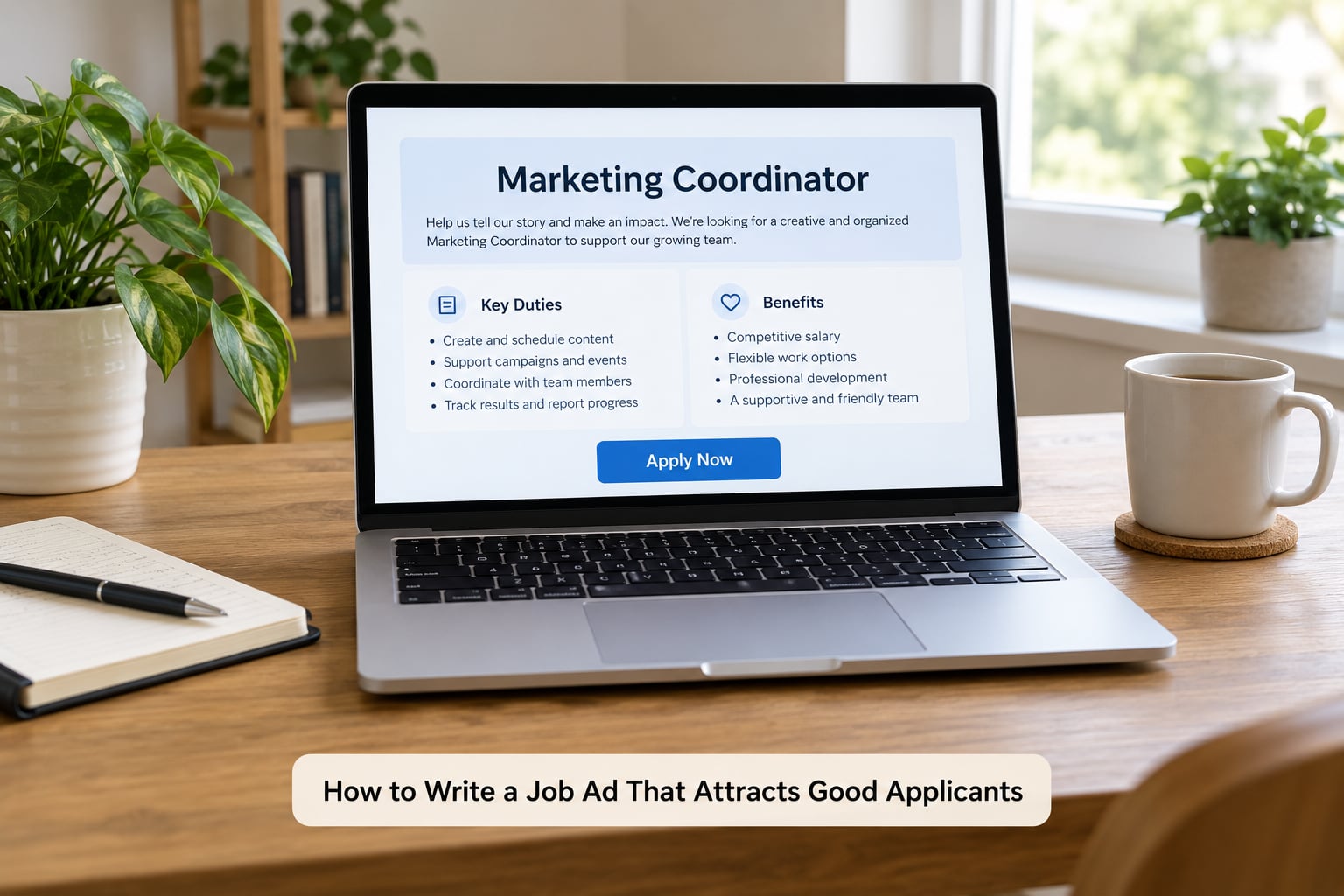
Step 1: Define the role before you write a word
Start with the outcome, not the duties. If this hire works out, what is different in six months? For a counter role it might be that the shop runs smoothly through the Saturday rush without an owner standing behind the till. For an office role it might be that invoicing stops needing a second person to fix it.
Then list the three to five activities that fill most of the week. If you cannot name them, the problem is the job design, not the ad. Recruitment professionals on LinkedIn keep repeating the same point: ads written from what the manager needs get skimmed, while ads written from what the person gets read carefully.
Step 2: Write a clear, accurate job title
Use the title people search for, then add the detail that separates your opening from the forty others. “Barista” is fine. “Weekend Barista — Morning Shifts, Pay Range Listed in the Ad” tells a candidate what they need to know before clicking.
Skip the invented titles. Ninja, rockstar, wizard and guru filter out capable people who do not perform the jargon, and hiring managers on small-business forums say the same thing in different words: vague titles are the fastest way to get a mailbox full of wrong applicants. If you know how to write a job ad title that a human would actually type into a search box, this step takes two minutes instead of an afternoon.
Step 3: Lead with the reason to apply
Open with two or three sentences about the role’s practical value — the work, the schedule, the team, the growth — and one honest reason to believe you are worth their time. Not a mission statement about your legacy. Something a candidate can picture themselves doing.
This is the part hiring managers most often get wrong. The first thirty seconds of a job ad decide whether the rest gets read. Fill in this skeleton and you will not stall:
- You will be doing: [three specific activities]
- Day to day you will work with: [team or customer type]
- The part people like most: [one real, specific thing]
- What we offer: [pay range, schedule, named benefits]
Borrow one concrete line from someone who currently does the job if you can. “You will never close a Saturday alone again” tells a candidate more than any paragraph about culture.
Step 4: Describe the work in concrete terms
Replace every vague verb with an observable action. “Support the team” becomes “restock the front counter and help the shift lead during peak hours”. “Manage customer relationships” becomes “answer inbound email within one business day and follow up on open quotes”.
Then separate daily duties from occasional ones. Applicants want to know what Tuesday looks like, and they also want to know whether the role includes the unglamorous work nobody mentions in an ad — the early starts, the inventory counts, the weekend deployments. Naming it early saves you both time and a resentful first week.
Say where the work happens too. Desk, van, warehouse floor, client site or home office. If travel is part of the job, give the realistic percentage and the typical radius rather than the phrase “as needed”.
Step 5: Separate must-have skills from preferred skills
Two short lists, clearly labelled, each kept to about four items. Anything that would not stop you from making the hire does not belong in the must-have list.
Preferences for must-haves are the most expensive mistake in job ads. Every extra requirement removes people, and the removals are rarely the ones you wanted. A forklift licence matters for a warehouse role. For a customer service role it removes half your applicants and none of them were your target.
A useful test: could a competent person learn this on the job within their first three months? If yes, it is a nice-to-have. That single question trims most ad drafts noticeably.
Step 6: Be transparent about pay, benefits, and conditions
Put the pay range near the top, not buried in a footer. In several US states and cities, pay ranges in job ads are now a legal requirement rather than a courtesy, and beyond that, candidates treat an ad without one as a red flag. On small-business forums, salary stated honestly up front is described as table stakes.
Fill in the conditions block the same way:
- Pay: [range], paid [weekly or biweekly]
- Hours: [days and times], [full-time, part-time, or contract]
- Location: [on-site at address, hybrid with x days in, or remote within state]
- Benefits: [named items — health plan, paid leave, tuition help, gear provided]
- Employer: [legal name], [equal employment opportunity statement]
Replace “competitive package” with the actual things. Two weeks of paid leave, a 400-dollar annual tool allowance and a four-day summer week are concrete. Competitive is a shrug in a job description, and readers recognise it as one.
Step 7: Make the application process easy to complete
Close with one call to action, not three. Tell applicants exactly what to send, where, and what happens next in three steps. If you want a resume and two short questions, say so. If you want them to walk in, give the address and the hours.
Keep it short. Longer forms lose candidates, and the loss is silent — people just stop clicking. A visible name and a direct email or phone line on the ad also cut the volume of unserious applications, because it signals a real person reads every one.
Finish with a clear note on timing: when you review, when you reply, and who they will hear from. Applicants who know the shape of the next two weeks are far more willing to wait for you.
Common Mistakes
Vague responsibilities. “Hard-working team player wanted” tells a candidate nothing about the work. Fix: every bullet names an action and an object.
Inflated requirements. Asking for five years of experience in a role where the last hire managed it in one is a filter with no upside. Fix: check each must-have against your current best employee.
Missing pay information. Leaving it out does not protect you. It pushes the negotiation later and shrinks your pool. Fix: publish the range.
Employer-centred language. “You will work hard to support our mission” describes your needs. Fix: rewrite from the applicant’s side — what they do, learn and get.
Requirement pile-ups. Twenty bullets make a two-page ad nobody finishes. Fix: four must-haves, four preferred, and let the schedule and pay do the remaining filtering.
Unclear apply instructions. “Send resume” with no address is the most common wasted click on the internet. Fix: name the documents, the destination, and the response window.
An unedited ad. Typos, a company name from last year, and a phone number nobody answers. Fix: read it aloud once, then have one person outside the business check it for anything confusing.
On the language side, a few swaps do real work: salesperson to sales representative, chairman to chair, man hours to work hours, his to their, and family-friendly to describes the schedule. Words like aggressive, nurturing and culture fit quietly signal who you expect to walk through the door.
One legal note for US businesses. Requirements tied to a protected characteristic, requests for a photo, salary history questions and blanket degree requirements are the areas where ad wording attracts complaints. Keeping requirements to skills you can defend with actual job duties is the simplest way to stay on the right side of that line.
Frequently Asked Questions
How specific should a job ad be?
Specific enough that a candidate can picture a normal week and recognise themselves in it. Name the actual tasks, the schedule, the location and the pay. Abstract descriptions filter out the wrong people without helping the right ones, so vagueness costs you twice. If you cannot describe the week honestly, fix the role before you advertise it.
Should I include the salary range in my job ad?
Yes, and put it near the top. Several US states and cities now require pay ranges in postings, and candidates treat a missing range as a reason to look elsewhere. Publishing a range also filters: applicants who cannot meet it will self-select out before they apply, which saves everyone an interview.
How do I attract applicants if I cannot match the biggest employers on pay?
Compete on the things you can control honestly: schedule predictability, a short commute or fully remote work, no unpaid overtime, a named mentor, faster answers, and real responsibility early. Small-business owners on hiring forums say those specifics do more work than a slightly higher number, especially for entry-level and trade roles.
Is it legal to ask for years of experience in a job ad?
It is legal in many places but risky and often counterproductive, since some US states now limit or prohibit pay-history questions and others regulate experience requirements. Practical advice: replace years with a skills test, a portfolio sample or a named tool, and describe the task rather than the tenure. Job-related, measurable requirements are much safer.
How do I screen applicants without discriminating?
Score every application against the same published must-haves, written down before you read the first one, and keep decisions tied to those criteria rather than to similarity to yourself. Avoid questions about age, family plans, health, religion or national origin. A short, consistent rubric is both fairer and faster than an intuitive read.
How long should a job ad be?
Around 400 to 600 words is the useful range for most roles: long enough to be honest about the work, short enough that a candidate on a phone finishes it. Front-load the title, pay and the opening three sentences, use short bullets, and cut any paragraph that would not change whether someone applies.
Conclusion
Start on paper. Write down the outcome this hire produces, the four things someone must be able to do, the pay range and the named benefits, the schedule and location, and the exact steps to apply. Everything else on the page follows from those five lines.
Then draft, cut the adjectives, read it out loud, and post it. Once the ad is live, judge it on the qualified applications, not the total count. A smaller pile of people who actually fit is the result you were after.