
Pricing services starts with one number most owners never calculate: what the work actually costs you per hour once overhead, unpaid admin, and your own time are counted. Add a target profit margin, check what comparable providers charge, pick a structure like hourly, flat rate, or tiered packages, then test the result on a real prospect. That is the whole method, and it takes an afternoon to run through properly.
Most small businesses do not lose money on materials or wages. They lose it on pricing that was guessed, copied from a competitor’s website, or set once in year one and never touched again. Busy seasons arrive, revenue looks healthy, and the bank account still tells a different story at the end of the year.
The fix is a repeatable process rather than a lucky guess. Below is the exact method I would walk any service business through: define what you sell, total the true costs, find your minimum hourly rate, add profit, check the market, build tiers, write the quote, and then raise prices on a schedule instead of hoping demand drags them up.
Table of Contents
- What You Need to Price Services as a Small Business
- Step-by-Step: How to Price Services as a Small Business
- Step 1: Define the Service and Its Deliverables
- Step 2: Calculate Your Direct and Indirect Costs
- Step 3: Estimate the Time and Set a Minimum Rate
- Step 4: Add a Profit Margin
- Step 5: Check Market Position and Customer Value
- Step 6: Create Packages, Tiers, and Add-Ons
- Step 7: Write the Price and Send the Quote
- Step 8: Know When to Price Services Higher
- Common Mistakes That Keep Service Prices Too Low
- Frequently Asked Questions
- How much should I charge for my services?
- What is the difference between markup and profit margin?
- Should I charge hourly or project-based pricing?
- How do I raise my rates without losing clients?
- How do I price services when I have no competitors?
- Why do small businesses charge so much compared to the cost?
- Conclusion
What You Need to Price Services as a Small Business
You need seven things before you set a single rate. Missing one of them is usually the reason a number feels wrong later.
- Twelve months of expenses. Bank statements, invoices, and a profit and loss statement if you have one. Twelve months matters because annual costs like insurance and software hide seasonality.
- Time data. A rough timesheet for two to three weeks, even on a scrap of paper. Without it you are estimating how long work takes, and estimating is where margins quietly disappear.
- A list of every service you sell. Written as a deliverable, not a category. Brand identity is a category. A logo, one primary mark, two color variants, and a one-page usage guide is a deliverable.
- A billable-hours estimate. More on this in Step 3, because it is the number that trips up almost everyone.
- A competitor sample. Five to ten nearby providers with public prices, plus what each one includes at that price.
- An owner pay target. The salary you need to draw before any profit stays in the business. This is a separate line, not a leftover.
- A place to keep the price sheet. One document that lists every service, tier, and add-on with its price. Owners on r/smallbusiness keep asking how to stop rebuilding a quote from scratch every time; a price sheet is the answer.
You do not need a bigger spreadsheet or new software. You need your own numbers written down in one place.
Step-by-Step: How to Price Services as a Small Business
Step 1: Define the Service and Its Deliverables
A price needs something to attach to. Before any math, write the offer as a package a client could hand to someone else and understand without you in the room.
Include what they receive, how many revision rounds are included, the turnaround time, what is explicitly excluded, and the result they can expect. A monthly bookkeeping package for a service business that includes reconciliation, a one-page summary, and one scheduled review call is priceable. Bookkeeping is not, because every bookkeeper’s books are different sizes and the same word covers a monthly close and a messy year-end cleanup.
Scope written before the quote saves you later. Revisions, rush turnaround, and data migration are the three words that turn a fixed project quote into a loss, and they only stay manageable if the quote says where they end.
Step 2: Calculate Your Direct and Indirect Costs
Split your costs into two buckets. Direct costs belong to a specific job: materials, subcontractors, shipping, project-specific software, mileage. Indirect costs, or overhead, keep the doors open whether or not you are working: rent, insurance, software subscriptions, accounting, phone, website hosting, and the admin work that never appears on an invoice.
The indirect bucket is where most small businesses underprice themselves. Owners price the materials, add their own hours at a modest rate, and send the quote. Then the bookkeeper, the sales calls, the invoicing, and the three hours of proposals that turned into nothing all come out of the same shrinking account.
Two categories get left out almost every time:
- Acquisition time. If you spend ten hours a month bidding on work, that is a real cost of being in business. Divide it across the jobs you win and it belongs in the price of each one.
- Admin and delivery overhead. Scheduling, invoicing, file handoffs, and the software that does the work for you. Small amounts, constantly recurring, and they compound.
Add your own unpaid hours at a real rate here, before you calculate profit. If you are doing $40,000 of work a year yourself, your time is a cost of that work even though no invoice ever arrived for it.
Once the totals are in front of you, the conversation shifts from guessing to arithmetic, which is where it should have started.
Step 3: Estimate the Time and Set a Minimum Rate
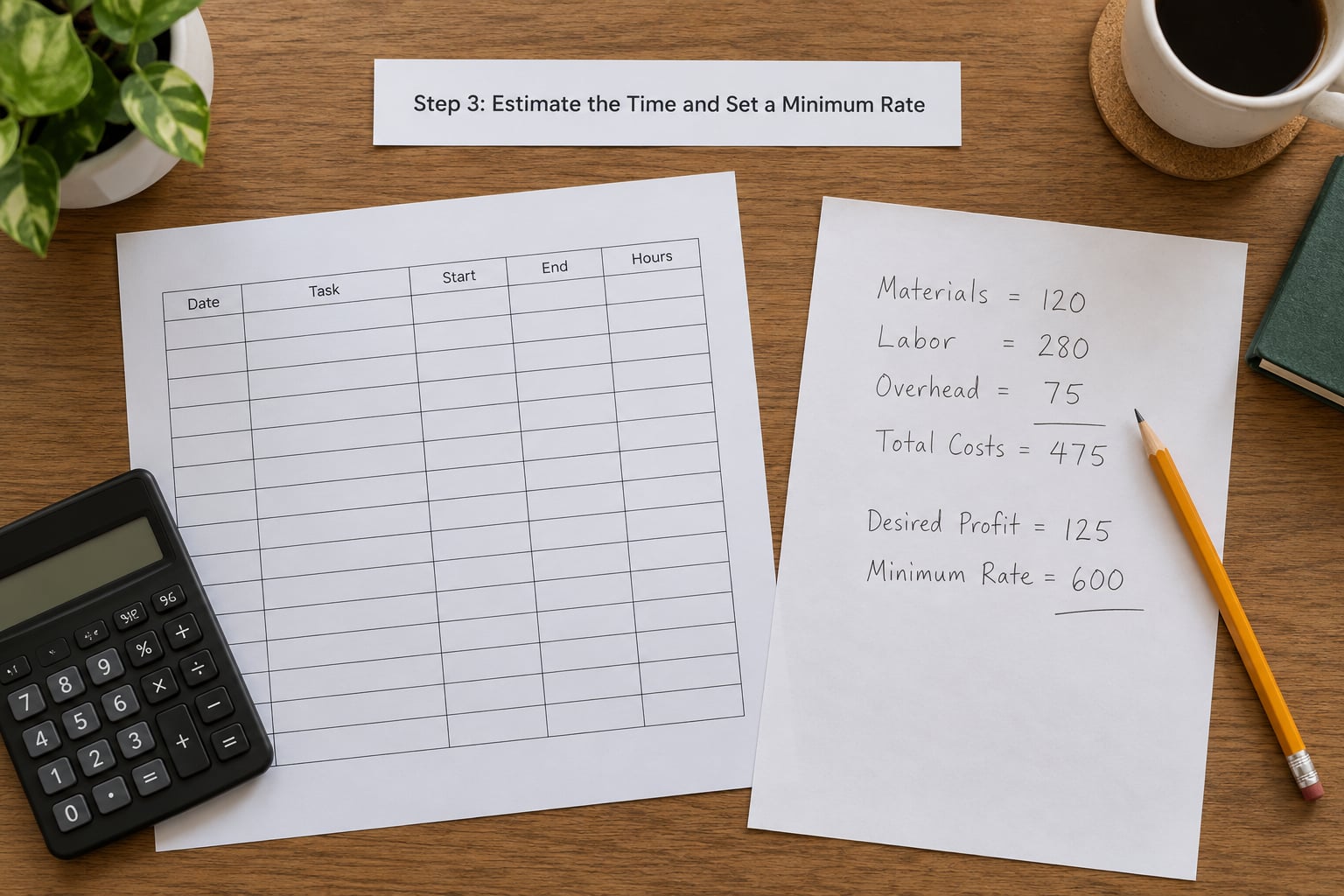
Most owners estimate how long the work takes them, then price every hour of the week at that number. The problem is that a full week of selling and delivery contains maybe 25 to 30 hours of work a client is actually paying for. Call that your billable hours, and it is the denominator for the most important number in your business.
Here is the formula in plain text:
Minimum viable hourly rate = (annual personal expenses + annual business expenses + profit goal) divided by realistic billable hours
Worked example. Say your personal expenses run 34,000 dollars a year, your business expenses run 21,000, and you want 45,000 left as business profit after your salary. That is 100,000 dollars of annual target. Your honest billable-hours estimate is 1,100. Divide and you land at roughly 91 dollars an hour as your floor.
Check that floor against reality before you panic. At 91 dollars an hour, a 25-hour job bills 2,275. If a client says no, the answer is not to drop to 60. The answer is to ask whether the job fits a cheaper tier, whether the estimate was too conservative, or whether this work is a one-off loss leader for a relationship that is worth it.
For a business with staff, the same idea becomes a fully-loaded rate. Take the crew’s wages, add payroll taxes, benefits, insurance, the truck, the fuel, and the office, then divide by the hours that crew can actually bill. A two-person crew costing 120,000 dollars a year to keep on the road, with each person billing about 1,000 hours, needs to sell at 120 dollars an hour just to stand still. Crews that price off the hourly wages of the person in the truck lose money while looking busy.
Track billable hours by project name for one quarter. Most owners find their real utilization runs well below what they assume, and that gap is the reason a good revenue month still ends thin.
Step 4: Add a Profit Margin
Profit is not what is left over after you pay yourself. If you treat every remaining dollar as income, you will spend it on a slow quarter and have nothing to absorb a bad month. Profit gets its own line in the price, and you decide what it is before you quote.
There is no magic number, but there is a useful range. A new owner with a young book of business may target 10 to 20 percent, and an established operator with steady demand and low churn often runs 25 to 40 percent. Industry benchmarks vary widely by sector and by region, so treat these as sanity checks rather than rules.
Cost-plus pricing means one thing: total your costs, then add a percentage on top. Take a job with 1,200 dollars of direct cost and a 300 dollar share of allocated overhead. That is 1,500 in total cost. A 20 percent target margin needs a 25 percent markup, so you quote 1,875.
| Markup on cost | Profit margin you actually keep |
|---|---|
| 10% | 9.1% |
| 20% | 16.7% |
| 25% | 20.0% |
| 30% | 23.1% |
| 40% | 28.6% |
| 50% | 33.3% |
| 75% | 42.9% |
| 100% | 50.0% |
| 150% | 60.0% |
| 200% | 66.7% |
Most people confuse the two columns and end up believing they have a 20 percent margin when they have 10. The conversion runs both ways: markup equals margin divided by one minus the margin. A 40 percent margin requires a 66.7 percent markup. Getting this backwards is one of the quietest ways a service business stays busy and broke.
One warning about cost-plus: it is a floor, not a ceiling. If your costs rise, so does the price, but your margin never improves. On a website redesign, a $2,000 quote built on time and hosting can carry the same profit as a $9,000 one built on outcomes. Treat the cost-plus number as the number you refuse to go under.
Step 5: Check Market Position and Customer Value
Your costs tell you the minimum. The market tells you the range. Look at five to ten comparable providers and record the price, what is included, turnaround, and anything that signals a different tier of work. Search the exact service plus your city, and read the pricing page rather than the home page.
You are not copying them. A quote lower than every competitor usually reads as a risk rather than a bargain, especially when the client cannot tell what was cut. Growthforce makes the same point about competitive pricing: matching the field keeps you inside it, and it never lifts your margin.
Value is the other half. What does the client get that they would not get elsewhere: a turnaround they can plan around, work they do not have to manage, a result they can report to their own boss, a warranty on the outcome. Write that in plain terms and the price stops being an arbitrary number on a page.
When there are no competitors, the signals shift. Ask what the alternative is: doing nothing, hiring an employee, using a template, or paying the rework cost later. That alternative is priced, and your quote should sit under it. The most common mistake in an uncontested market is pricing off your own discomfort rather than the client’s alternative.
Step 6: Create Packages, Tiers, and Add-Ons

One rate for everything forces clients to pick a price without a way to trade scope for cost. Three tiers give them a decision instead of a yes or no, and they raise your average project value without a single difficult conversation.
A workable structure runs basic, standard, and premium. Basic covers the smallest sensible version of the outcome. Standard is the one you want most clients to take and the one you will quote by default. Premium includes speed, extra rounds, or a deeper engagement that only some clients need. Tiered pricing is repeatedly recommended on r/smallbusiness for exactly this reason: an entry point plus a natural upgrade.
Set the middle tier first and design around it. Basic should be visibly thinner and premium visibly richer, otherwise people take the cheap option and leave you the hardest work at the lowest rate.
Add-ons carry the requests that do not belong in a package: rush delivery, an extra revision round, a second location, additional pages, a monthly report. Price each one on the price sheet so nobody has to negotiate it in the middle of a project. When scope creeps, the change order is a line item you already wrote down, not an argument you have to win.
Then save it. One price sheet, dated, with every package and add-on, is what turns quoting into a two-minute task instead of a fresh negotiation each time.
Step 7: Write the Price and Send the Quote
A quote that gets read is a short document. Present the deliverable, the timeline, the inclusions and exclusions, the price, the deposit, and how long the price stays valid. Then stop talking.
Validity dates matter more than new owners expect. Sixty days is a reasonable default on most service work, because a client who waits four months to say yes is usually not coming back to you. Put the date on the quote and move on.
Deposits do two jobs at once. They fund the work and they screen intent, since a client unwilling to commit to a deposit rarely commits to the project. Half up front is normal on projects, with the balance due on delivery.
Have three responses ready before you need them:
- That is more than I expected. That is a fair reaction to an unpriced service, so answer it with scope rather than discount. Offer a smaller tier with a smaller deliverable and keep the standard tier intact.
- Another quote was lower. Ask what was included. If the difference is a thinner deliverable, that is the whole conversation, and you can stop it there.
- Can you do it for less if I commit now? You can, by narrowing the scope to a tier. Discounting the same scope teaches the client to wait for the next discount.
Owners on r/smallbusiness describe the pattern clearly: raise the rate, and the clients who walk away were not the right fit for the work anyway. A quiet month is cheaper than a year of undercharging.
Step 8: Know When to Price Services Higher
Prices set once are wrong within a year. Your costs change, your experience compounds, and your calendar fills. Review pricing on a schedule rather than waiting for a slow month to force the issue.
Four numbers tell you when it is time. First, the gap between your quoted hours and actual hours, which shows whether your estimates are honest. Second, utilization: how many of your available hours are billable, and whether that number has been falling. Third, how many jobs you turned down or never quoted because you were already full, which is the clearest sign your price is below the market. Fourth, profit per job, not revenue per month.
When those signals line up, a 10 to 15 percent increase is safe. Give ongoing clients 60 to 90 days written notice, which is a reasonable professional courtesy and removes most of the friction. Owners who report a steady climb in effective hourly earnings typically attribute it to raising rates a couple of times, not to working longer hours.
A notice does not have to be long:
Hi [Name], a quick note about rates. Effective [date], my new-project rate moves to [new rate], a change of about [percentage]. This keeps me available at the turnaround times you have come to expect. Work already in progress is unaffected. If you would like to talk through what this means for your next project, I am happy to set up a call.
The first-year version of this is worth saying out loud. Plenty of owners deliberately price low to build a customer base, knowing they will raise rates later. That is a legitimate strategy only if you actually do the later part, and you set the expectation in writing at the start so the increase is a scheduled step rather than a surprise.
Once a year, add your cost increases to the sheet. A new insurance renewal or a software price change belongs in the rates whether or not the market moved, because a business that never prices its cost increases quietly absorbs them for as long as it can.
Common Mistakes That Keep Service Prices Too Low
Nearly every pricing mistake I see comes from treating a number as a feeling. These six account for most of the lost margin, and each has a straightforward correction.
1. Pricing on materials only. You cost out the parts and add a feeling for labor. The fix is to price every hour, including the hours that never get billed, at your minimum viable rate from Step 3.
2. Confusing markup with margin. A 50 percent markup gives you a 33 percent margin, and owners who assume otherwise raise prices believing they are richer than they are. Fix: use the conversion table, and convert your target margin back into the markup you need.
3. Cost-plus as the only method. Cost-plus protects you from a loss and does nothing for upside, because your margin stays flat while your work improves. Fix: keep it as a floor, then price the upper tiers on the outcome the client gets.
4. Racing to the bottom. Discounting to win the first three clients of a brand new business is a reasonable short move. Doing it at month three with ten references and a full calendar is not. Fix: undercut deliberately on a narrow introductory offer with a defined end, and compete on scope elsewhere.
5. Building a fresh quote every time. Feels faster, produces inconsistent prices, and quietly anchors clients to whatever number you mentioned last time. Fix: the price sheet, dated, with everything on it.
6. Waiting to feel ready to raise rates. Confidence is not a prerequisite, and it never arrives first. Fix: schedule the review, pick a percentage, and send the notice.
Two habits do more for pricing than any tactic. Track time per project so your estimates improve, and track profit per job so you know which services actually fund the business. Owners often discover that their most requested service is their least profitable, and that one afternoon of data is worth more than another year of guessing.
Frequently Asked Questions
How much should I charge for my services?
There is no single number, because the right price depends on your costs, your target profit, and what the market will pay. Start with your minimum viable hourly rate: add your annual personal expenses, annual business expenses, and profit goal, then divide by realistic billable hours, usually 1,000 to 1,250 a year. That figure is your floor. Market research tells you the range, and the client tells you which tier they need.
What is the difference between markup and profit margin?
Markup is the percentage you add on top of your costs. Profit margin is the percentage of your final selling price that you keep as profit. They are not the same number. A 50 percent markup on a cost of 100 gives you a price of 150, and 50 out of 150 is a 33 percent margin. Convert one to the other by dividing the margin by one minus the margin.
Should I charge hourly or project-based pricing?
Hourly suits work with unpredictable scope, and it rewards you when the client adds requests. Project pricing suits work with a clear deliverable, and it rewards you when you get faster. Many service businesses offer both: hourly for open-ended support or advisory work, fixed price for defined projects, and a retainer for ongoing coverage. Pick per engagement rather than declaring one model for the whole business.
How do I raise my rates without losing clients?
Raise the rate, give 60 to 90 days written notice, and keep the scope identical. Send the increase to your entire client list at once rather than negotiating case by case, which signals that the old number was an exception. Expect a few clients to leave; on r/smallbusiness the common pattern is that the ones who walk away were the least profitable. New business at the new rate fills the gap faster than most owners expect.
How do I price services when I have no competitors?
Price against the alternative, not against other sellers. The alternative is doing nothing, hiring an employee, hiring a larger firm, or using a template and living with the rework. Price your offer under the cost of that alternative and above your cost-plus floor. In a market with no established rates, the first business to publish a clear price sheet tends to become the reference point.
Why do small businesses charge so much compared to the cost?
Because the visible cost is a fraction of the real one. The client sees materials or hours, but never the equipment, insurance, software, unpaid admin, sales time, or the years of mistakes behind the finished work. A business that shows you a breakdown of what is included behind the price is usually the honest one, and an unusually cheap quote often means thinner scope, faster corners, or a business that has not priced its overhead yet.
Conclusion
Pricing services is arithmetic with a market check attached, and it is not complicated. Total your direct and indirect costs, divide by realistic billable hours to get your minimum rate, add a profit margin you actually intend to keep, then confirm the range against comparable providers before you write the quote.
If you do one thing this week, pull twelve months of expenses into a single page and divide the total by your honest billable hours. The number that comes out is the one your prices have been ignoring, and it is where a business either starts keeping money or keeps getting busy without growing.
Then take your most requested service, write it as a scoped package with three tiers, and test one clear price with the next qualified prospect. How to price services as a small business stops being a question once the formula exists. Keeping that formula current is the part that pays.