How to write a business description that converts comes down to four answers in a fixed order: who you help, what you do for them, why you are the safer choice, and what single action to take next. Most small-business descriptions answer none of these, which is why they get polite reads and no calls.
A business description is a short block of copy that tells a potential customer what the business does, who it serves, why it is different, and what to do next. Its job is to move a reader from “I don’t know this company” to one specific action: calling, requesting a quote, booking a slot, or asking for a sample.
Written well, it also saves you work. The wrong-fit customer reads it and leaves instead of booking a consult you’ll spend forty minutes on. The right-fit customer stops researching competitors and picks you.
Here is the formula the rest of this guide fills in:
[Who you help] + [What you do for them] + [Proof or differentiator] + [Location or service area] + [One next step]
Filled in for a mobile detailing business, it reads something like: “We detail family SUVs and minivans at owners’ homes across the north county, using a waterless steam process that protects leather and leaves no water spots, and we book same-week appointments.” That is one sentence, and every clause earns its place.
Table of Contents
- What You Need to Write a Business Description That Converts
- Step-by-Step
- How to write a business description that converts: identify the customer and their problem
- State what the business offers and why it is different
- Turn features into customer benefits
- Add specific proof and useful details
- Write a clear call to action
- Edit for clarity, trust, and natural keyword use
- Common Mistakes
- Frequently Asked Questions
- How long should a business description be?
- Should I include keywords in my business description?
- How do I write one description for multiple audiences?
- Do I need a different business description for each location?
- How do I adapt one business description for a website, directory, and social profile?
- Conclusion
What You Need to Write a Business Description That Converts
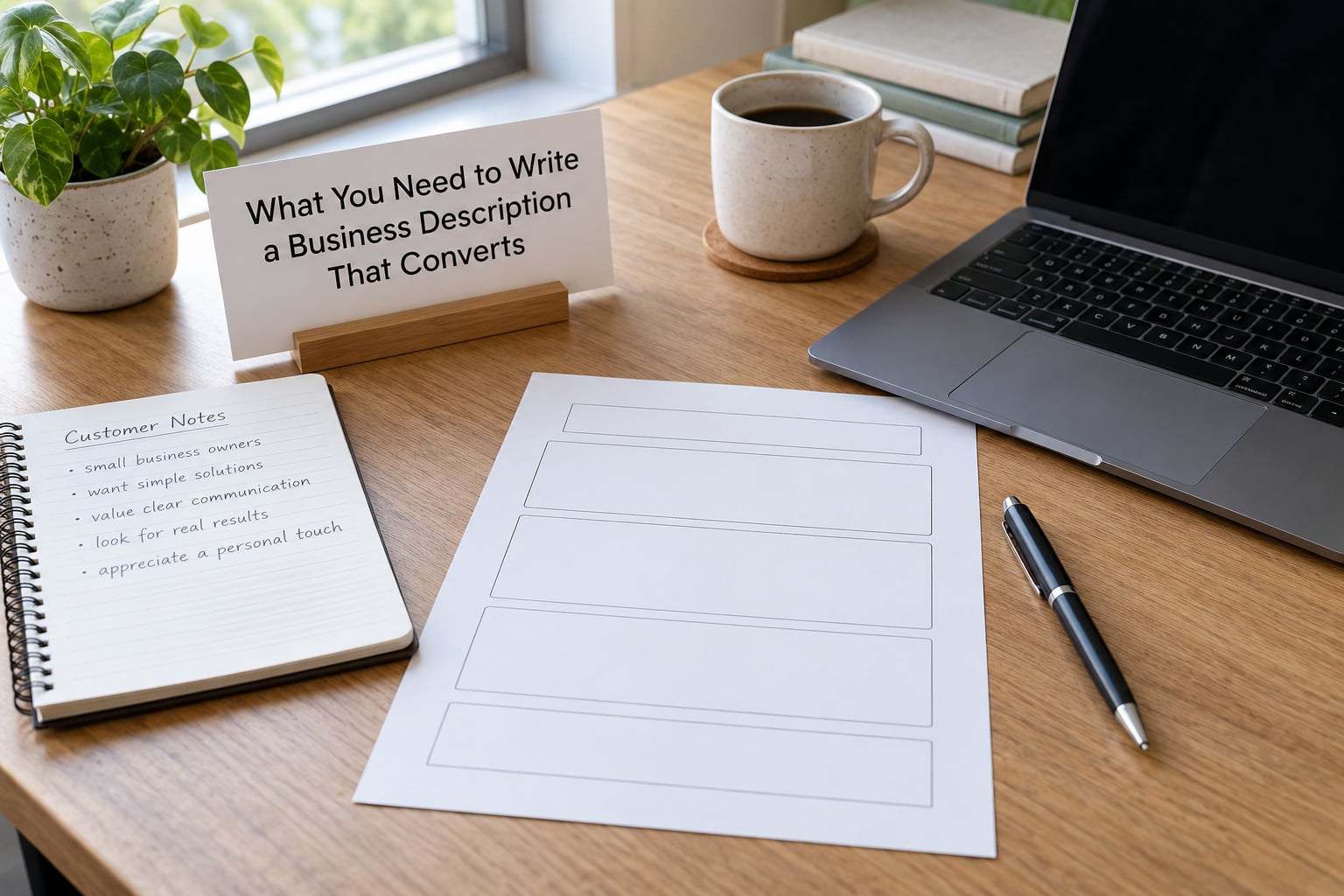
Six things, and you probably already have five of them in your head or in a drawer somewhere. Gathering them first takes twenty minutes and saves an hour of rewrites. Scrape the answers onto one page before you draft a single sentence.
- One primary audience. Not “everyone.” “First-time homeowners in duplexes” or “restaurant owners needing monthly bookkeeping.” If you cannot pick, your customers are not one group and your copy will sound like it is talking to all of them at once.
- The problem they came with. In their words. “The office chairs are held together with tape and the landlord won’t fix them” beats “ergonomic seating solutions.”
- Your differentiator. The one thing you do that the next three competitors do not: a process, a niche, a guarantee, a speed, a credential.
- Proof you can actually claim. Years in business, licenses, certifications, review counts, named owner, service area, same-day availability. Only true facts go in this slot.
- The one action you want. One. A phone call, a quote form, a booking link. Two competing CTAs split the decision and halve the response rate.
- Your voice. Two or three adjectives that describe how you talk: plain and technical, warm and chatty, no-nonsense and fast.
If you stall on any one of these, that is the gap to fix before writing. A description cannot convert around a missing differentiator.
Step-by-Step
How to write a business description that converts: identify the customer and their problem
Start with a sentence that names one specific person and the situation that made them go looking. Broad audience labels waste the first line, because “small business owners” tells the reader nothing about their Tuesday. A concrete situation tells them you already know the problem.
Weak: “Serving the community with quality solutions since 2010.”
Strong: “For landlords who keep getting flooded tenants and midnight maintenance calls.”
Checkpoint: Read the sentence alone. If it would fit a competitor’s website unchanged, it is still too broad.
State what the business offers and why it is different
Say what you do in plain language, then attach the reason to choose you over the shop down the road. The differentiator comes from your actual operation, not from adjectives like dedicated, comprehensive, or innovative. Anyone can claim those; only a real process or a real niche limits the claim to you.
Weak: “We offer a full range of dental services with a team of caring professionals.”
Strong: “We place and repair same-day dental crowns, which means one root canal and one visit instead of three appointments.”
Checkpoint: The sentence contains a number, a process, a timeframe, or a limit that a competitor could not honestly copy.
Turn features into customer benefits
Most descriptions list features because listing is easy. Buyers do not purchase features, they purchase what the feature produces. Make the translation in your head, then write the outcome. A ten-year warranty is a feature; nobody replaces their transmission because of a warranty, they replace it because they are not stuck paying for labor twice.
Weak: “Equipped with a 40-gallon tank and dual filtration.”
Strong: “A full day of filtering without a refill stop, so you finish the job in one visit instead of two.”
Checkpoint: Every feature you kept can be tied to a moment the customer will actually have. If it cannot, cut it.
Add specific proof and useful details
Proof is what converts a claim into a reason. Numbers, credentials, and named details do the work here: years in business, licensed and insured, rated 4.8 out of 5 across 312 reviews, family-owned, serving specific neighborhoods, free estimates before 5 p.m. Add the details a buyer has to ask for anyway, and that question disappears before it is asked.
Two rules. Every proof point must be verifiable today, and every one should sit next to the claim it supports rather than dumped in a closing paragraph. Proof about reliability does nothing sitting under a paragraph about parking.
Weak: “Trusted by locals for years.”
Strong: “In business on the same corner since 1998, licensed and insured, 286 reviews averaging 4.8 stars.”
Checkpoint: A stranger could confirm every fact on that list without contacting you.
Write a clear call to action
Choose the single next step that matches how your customers buy, and name it in a verb: call, book, request, order, download. A visitor who has to choose between a contact form, a newsletter, and a phone call will choose none of them. Match the action to the channel too, and put it where it survives the platform’s character limit, which is why many owners lose their call to action by putting it at the very end.
Weak: “Please get in touch with us today to learn more.”
Strong: “Call before 5 p.m. and we’ll have a written estimate to your inbox the same day.”
Checkpoint: The action takes one decision, not a conversation about what the business offers.
Edit for clarity, trust, and natural keyword use
Read the draft once for facts, once for length, and once out loud. Long sentences hide weak claims. Trim every filler opening, keep active voice, and delete any word that a competitor could claim and you cannot prove. On keywords, use the phrases customers actually type once each, in a place that reads naturally, and stop there. Repeating a keyword inside a sentence reads as spam to a human and to a filter.
Then score the draft out of two points on each: named audience, stated problem, plain offer, real differentiator, verifiable proof, one action, and clean read. Twelve points is a draft worth publishing; below eight and it is still doing marketing by accident.
Checkpoint: Read the first sentence to someone who has never heard of you. If they cannot repeat what you do, rewrite it.
Common Mistakes
These are the errors that quietly kill the conversion, roughly in order of how much damage they do.
- Writing to “everyone.” Broad copy tests as true on no one. Pick the group that pays most often and write to them; you can have a second description later for a second group.
- Filler openings. “Transform your vision with an elevated, bespoke experience” says nothing a reader can check. Delete the sentence and start with what you do.
- Keyword lists dressed as sentences. A paragraph of comma-separated keywords gets cut by platforms with spam policies and skipped by readers. Write prose, place one or two search phrases where they fit naturally.
- Unverifiable superlatives. Best, number one, top rated. If you cannot show the evidence in the same breath, cut it. The proof usually converts better than the claim anyway.
- Three calls to action in one place. A call, a form, and a newsletter link is a choice, and most people make none of them. Keep one and move the others further down the page.
- Copying a competitor or a template. Owners do this constantly, and readers notice the generic phrasing because they have read it four times that week. Your local detail is the part nobody else can copy.
- One description for every location, unmodified. Boilerplate repeated across listings reads as filler and hides the neighborhood detail that actually drives local calls.
- Numbers and prices that go stale. A founding year, an award, or a range written for last year undoes the trust the rest of the paragraph built.
Two habits fix most of it. Write the description from the customer’s sentence rather than yours, then update it every time something real changes. A description reviewed quarterly stays true; one written once drifts within a year.
Frequently Asked Questions
How long should a business description be?
Long enough to name your audience, offer, differentiator, proof, and next step, and short enough to be read on a phone. Most Google Business Profile descriptions land between 400 and 750 characters, and readers rarely get past the first three lines on a directory listing. Put the offer and the action in those first three lines, then let the proof follow underneath.
Should I include keywords in my business description?
Yes, but only as ordinary words inside a sentence someone would say out loud. Use the phrase your customers type once, early, and let the rest of the paragraph carry the meaning naturally. Piling related terms into one paragraph reads as spam to a person and to platforms with their own policies, and it does nothing for the reader who was already convinced.
How do I write one description for multiple audiences?
Pick the audience with the highest repeat value and write the main description for them, then add a single line naming what you also do for the other group. If the two audiences want genuinely different things, keep two separate descriptions and place them on separate pages, rather than one paragraph trying to please both. Mixed copy converts worse with everybody.
Do I need a different business description for each location?
Keep the offer, the proof, and the action identical, and change the details that genuinely differ: the neighborhood, the address, the phone number, hours, parking, and any staff named at that site. Identical boilerplate across listings reads as filler. A description that names the streets or landmarks a local customer would recognise does real work on its own.
How do I adapt one business description for a website, directory, and social profile?
Keep one master version with every proof point, then trim from the end for the tighter channels. A directory listing takes the first three lines, a social profile takes the first sentence, and your About page can carry the rest at length. Write the master once, and derive the shorter versions from it so every channel tells the same story.
Conclusion
A business description converts when it answers four questions in order: who you help, what you do for them, why you are the safer choice, and what to do next. Everything else in the draft exists to support one of those four answers.
So start with the first sentence and write it deliberately: name the audience, the problem that brought them to you, the offer, the differentiator, and one next step. If you can get through those five in a sentence a stranger would understand on a phone screen, the rest of the description has a job worth finishing.
Then gather your proof, cut the adjectives you cannot prove, and put the action where it will not get trimmed off the end.