To brand a food truck, work in a fixed order: settle who you serve and what you are called, build a logo that stays readable at 200 feet, pick two or three colors, place those assets panel by panel on the vehicle, then repeat the same system on your menu and social profiles. Most first-time owners get stuck because they start at the wrap, which is the most expensive and hardest to change part of the process.
A passerby moving at street speed gives you about three seconds. In that window your truck has to communicate what you sell and where to find you, and it has to look like it belongs to you rather than to the truck two spots ahead in line. That takes about two to four weeks of work plus a wrap install, and it is well within reach for a solo operator with a steady hand and a print file.
Table of Contents
- What You Need Before You Brand a Food Truck
- How to Brand a Food Truck: Step by Step
- 1. Define Your Positioning and Brand Name
- 2. Create a Consistent Visual Identity
- 3. Decide How to Brand a Food Truck From a Distance
- 4. Build a Mobile-First Menu and Message System
- 5. Connect the Truck to Digital Touchpoints
- 6. Launch the Brand in the Real World
- 7. Measure Recognition and Keep It Consistent
- Common Branding Mistakes and the Fix for Each
- Frequently Asked Questions
- How do I choose a name for my food truck?
- Should I put a full wrap on my food truck?
- How far away should customers be able to read my truck?
- Should my food truck menu match my website menu?
- How often should I update my food truck branding?
- Conclusion
What You Need Before You Brand a Food Truck
Gather these before you open a design file. Scrambling for pieces mid-project is how brands end up with two logos and a truck that matches neither.
- Positioning decisions. Your target customer, cuisine focus, service style and one line about what makes you different from the trucks already working the same spots.
- A brand name plus a short list of backups. Availability matters more than originality, so check business registrations and social handles early.
- Asset inventory. Logo files, a color palette with hex values, two typefaces, and a photo style you will repeat.
- Vehicle graphics plan. Which panels get what, and whether you are doing a partial or full wrap.
- Menu files in three versions. The board on the truck, a printed handout, and the online version customers open on a phone.
- Domain and social accounts. One handle, claimed everywhere, that matches the name on the truck exactly.
- Printed materials. Stickers, business cards, table tents, staff aprons and paper goods that carry the same look.
- A tracking method. A QR code with a trackable destination, or a short code customers can type in.
- Professional help, if you want it. A designer for the identity, a wrap shop for the vehicle, or neither if you are producing files yourself.
One note on budget. Owners in r/foodtrucks repeatedly warn against buying a vehicle and a full identity at the same time. The most common advice in those threads is to find a serviceable truck a few years old and design for that one, so you are not paying to rebrand twice.
How to Brand a Food Truck: Step by Step
Seven steps, in this order. Each one feeds the next, and skipping ahead usually means paying twice.
1. Define Your Positioning and Brand Name
Write one sentence naming who you serve and why they would choose you over the truck parked next to yours. “Filipino comfort food for night-shift workers who want something hot after 10pm” is a positioning statement. “Good food” is not.
Then name the truck. Test every candidate against four things: can a stranger spell it after hearing it once, is it under about three words, does it stay readable when painted large on a metal panel, and is it free in your state or city registry? Clever names fail for one predictable reason. A name that needs explaining loses the line it was meant to win.
Run a trademark search on the name before you print anything. Federal registration costs real money and is not urgent for a single local truck, but a same-name food truck two towns over will cost you a repaint.
2. Create a Consistent Visual Identity
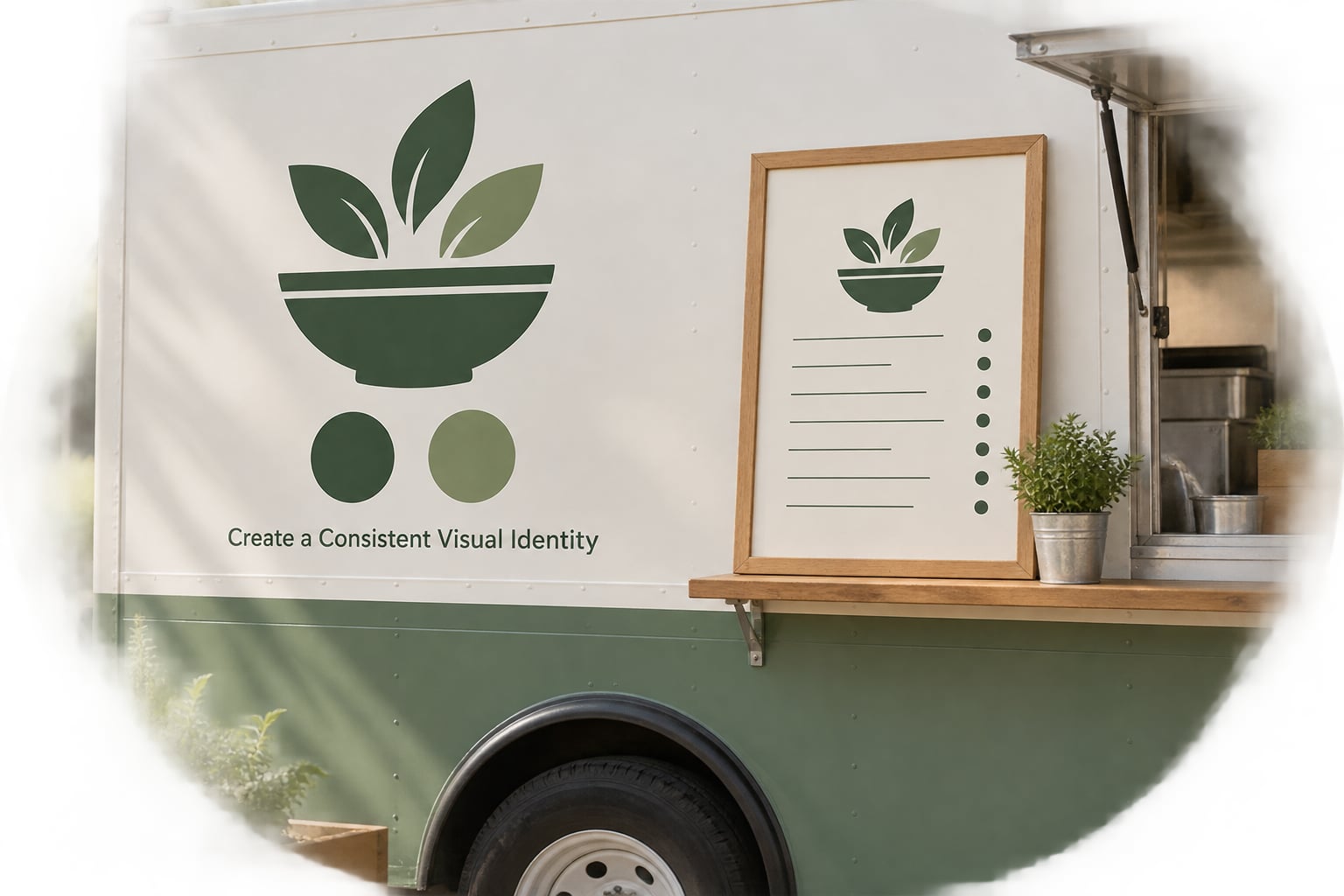
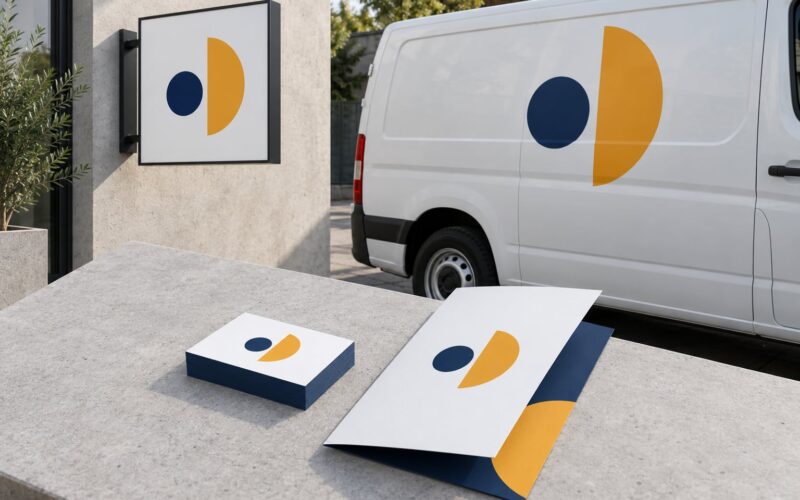
Pick one logo style and stick to it. Badge and emblem marks read well on a round panel and photograph well, worked typography is the cheapest to produce at any size, and illustrative marks need more skill to draw well. Whatever you choose, it has to work in a single color, because some panels will only ever get vinyl in one shade.
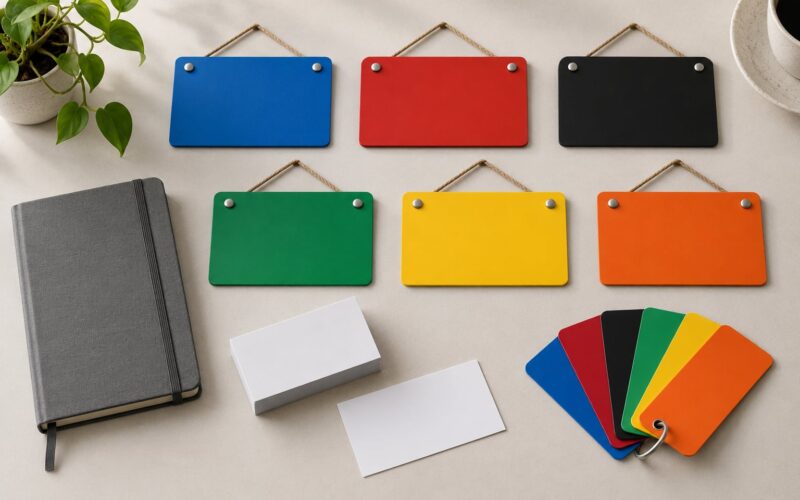
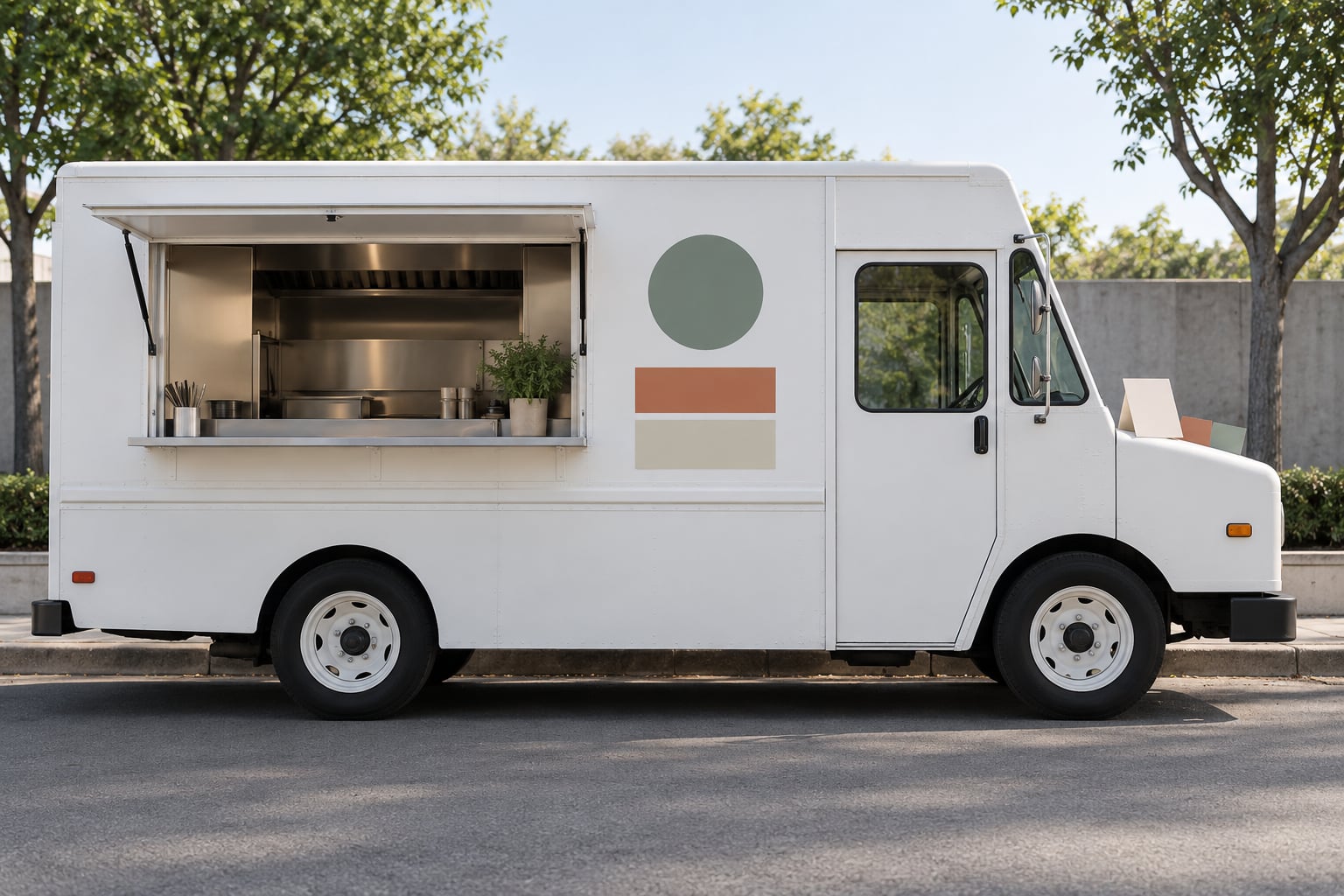
Limit the palette to two or three colors and give each one a job. One is the background color that dominates the truck, one carries the logo, one is for accents and text. Map colors to the food rather than to whatever looked nice: red and yellow read as appetite and heat, green and brown read as fresh and natural, black and gold read as premium.
Ask any designer for vector source files in AI, EPS and SVG. The single most common complaint from owners is handing over a flat PNG, which means paying again for the same logo the next time you need a sticker, a cup or a second truck.
3. Decide How to Brand a Food Truck From a Distance
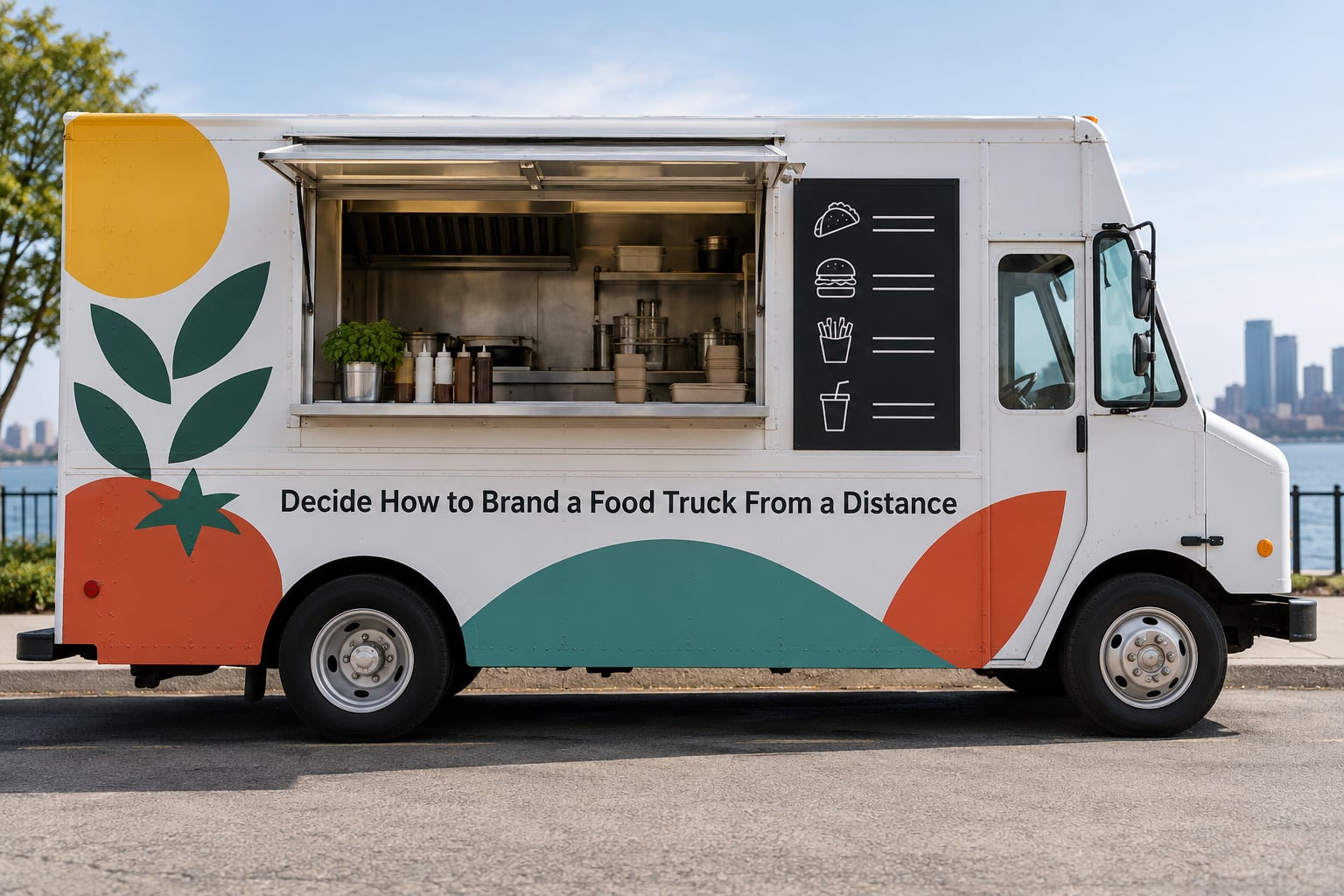
Decide what reads at a glance, then cut everything that does not. The service side panel carries the biggest version of the logo and three or four words at most describing the food. The rear panel carries the logo plus your handle and a QR code, because the rear is what people photograph when they are stuck behind you at a light.
Put the menu on the board near the window, not across the whole side. Customers walk up to a service window; they do not read a wall. Use a high-contrast layout with the best sellers at the top, prices in the same position on every line, and dietary labels as short tags rather than sentences.
You can check legibility before anything is printed. Hold the logo file at arm’s length and squint until the detail disappears; if it turns to mud, simplify it. Have someone stand 200 feet away and tell you what the truck sells. Photograph the design mockup at night, because a wrap that reads in daylight can vanish once the service lights come on.
Know what you cannot cover. DOT rules restrict covering driver, passenger and windshield areas, and perforated window film is not a shortcut around that. Check your state and city rules before a design assumes otherwise.
4. Build a Mobile-First Menu and Message System
Design the menu for someone standing at a window with a phone in one hand and a line behind them. Short item names, prices aligned in one column, no descriptions longer than a few words.
Anchor everything to one signature item. A broad menu is harder to brand and harder to remember than a small one with a dish people can ask for by name when they see the truck from across a street.
Keep the three menu versions identical in wording and price. A mismatch between the board and the online menu is the fastest way to lose a first-time customer, and it is entirely avoidable.
5. Connect the Truck to Digital Touchpoints
Use the same handle on the truck, on every social profile, and on your Google Business Profile. When someone photographs the truck and posts it, that handle is how they find you.
Your maps listing matters more than your follower count. Most food truck searches happen by location, so keep the hours, the service area and the current location accurate, and update them before you post about them anywhere else.
Shoot real photographs. A photo of the actual truck at an actual stop outperforms almost anything written, which is why finished-truck photos dominate the food truck groups. Ask for reviews at the window with a short line on the board or the packaging, not a speech.
6. Launch the Brand in the Real World
Roll out in a sequence that never leaves you half-branded. Install the wrap first, then photograph the finished truck in daylight and after dark, then update every listing and profile with those new photos, then bring in new packaging, uniforms and table tents, then tell your regulars.
Give regulars a heads-up before you change anything. Owners in food truck groups describe existing customers reading a new truck as a different business, and word of mouth recovers faster when you explain the change yourself.
If your wrap is already paid for and you have outgrown the name, you are not stuck. Magnetic panels, window decals and removable signage let you change a name, a price or a seasonal message without replacing the whole wrap.
7. Measure Recognition and Keep It Consistent
You need a way to tell whether the branding is working. Put a trackable QR code on the rear panel pointing to your menu or ordering page, and use a different code during a special or at a new location so you can tell responses apart.
Watch repeat business rather than raw foot traffic. A branded truck that brings back the same faces at the same stops is doing its job even if the line is short. Wrap industry bodies put mobile vehicle advertising impressions in the tens of thousands per day at busy stops, and the neighborhood loop those impressions feed is where word of mouth starts.
Write the rules down. A one-page brand document covering the logo, the colors, the typefaces and the handle is what stops the identity drifting the next time you add a dish, hire help or bring on a second truck.
Common Branding Mistakes and the Fix for Each
Most of these are expensive to undo. Each one has a straightforward fix.
- Too many colors. More than three and the truck stops reading as one brand. Fix: pick a dominant, a support and an accent, and use only those.
- A restaurant menu printed on the side. Nobody reads that at speed and it makes the truck look like a billboard. Fix: logo, three or four descriptive words, and a menu board at the window only.
- A name nobody can spell. Fix: test it by saying it once on the phone and asking someone to write it down.
- Different logos on different channels. A redesigned avatar, a new menu header and a different truck means three businesses. Fix: one logo file, one palette, a written standard.
- Relying on a single social platform. Fix: pick two, post to both, and keep the profile details identical.
- Stock templates and clip art. This comes up constantly in the Facebook food truck groups and it is fair criticism; templated logos make trucks indistinguishable in a pod where every truck is fighting for the same line. Fix: a custom mark, even a simple one, or a strong wordmark in a chosen typeface.
- Skipping trademark and handle checks. Fix: search before you print, not after.
- Printing food photography across the whole vehicle. Owners debate this one endlessly. Fix: put one hero dish image in a small, deliberate spot if you want appetite appeal, and keep the rest of the panel for legibility.
- Rebranding by replacing a wrap you already paid for. Fix: decals, magnetic panels and changeable signage before a full reprint.
A few habits pay off more than any single asset. Keep the logo readable at distance before worrying about how detailed it is, test the design on the actual vehicle rather than on a screen, and photograph the finished result properly because those photos will do more work than the design did.
Frequently Asked Questions
How do I choose a name for my food truck?
Pick names you can say in one breath, spell from memory after hearing once, and that describe the food or the feeling it serves. Check state and local business registrations, social handles and a trademark search before you commit. Avoid names that need explaining or that tie you to a trend likely to fade.
Should I put a full wrap on my food truck?
A full wrap gives you the largest usable graphic surface and the strongest recognition, which suits trucks working high-traffic locations. A partial wrap covers the key panels at a lower cost and is easier to change later. If you are unsure, cover the service side and rear first, then expand once you have seen how the design reads in motion.
How far away should customers be able to read my truck?
Your main logo should stay clear at around 200 feet, which is the distance most people judge at street speed. Support text and the menu should be readable at 20 to 40 feet. Test both in daylight and after dark, because service lighting changes contrast more than most designers expect.
Should my food truck menu match my website menu?
Yes. Keep wording, prices and item order identical across the truck board, printed handouts and the online menu, and update all three on the same day. A mismatch makes customers doubt whether the prices they just saw are real, and it costs you a sale at the window.
How often should I update my food truck branding?
Refresh the food photography, menu board and social templates each season, and review the whole identity once a year. Change the wrap itself far less often, usually only when the menu concept or name changes. If you only have budget for one update, spend it on photography and menu boards rather than on a new wrap.
Conclusion
Branding a food truck is a sequence, not a single design decision. Write your positioning sentence first, choose one name direction after checking availability, and mock up a two-color exterior before committing to full graphics. Get the vehicle right early, keep the menu and social profiles identical to it, and you will have an identity that still holds together after the menu changes twice.