Yes, but only when calls convert into revenue for your business and the number is big enough to read at the distance people actually approach from. Most signs should spend their limited space on the business name. A printed phone number earns its place on take-out restaurants, emergency services, contractors and multi-tenant directory signage. Everywhere else, it usually competes with the letters that identify you.
Last updated October 2026. Nothing here is legal advice, and sign rules vary by city — check your local ordinance before ordering anything.
Table of Contents
- Should a Phone Number Go on a Business Sign? Quick Guide
- Should a Phone Number Go on a Business Sign for Walk-In Customers?
- Why Customers Expect to See a Phone Number
- How to Make the Phone Number Easy to Read
- Where to Place It on the Sign
- When to Use a Cell Phone, Landline, or Another Option
- How to Test the Number Before Installation
- Common Mistakes That Make a Number Useless
- Frequently Asked Questions
- How small can a phone number be on a business sign?
- Should a business sign include both a phone number and QR code?
- Do I need a phone number if my business has a website?
- Should I put a cell phone number on my storefront?
- What is the best contact information to put on a permanent sign?
- How do I keep the phone number on my sign accurate?
- Conclusion
Should a Phone Number Go on a Business Sign? Quick Guide
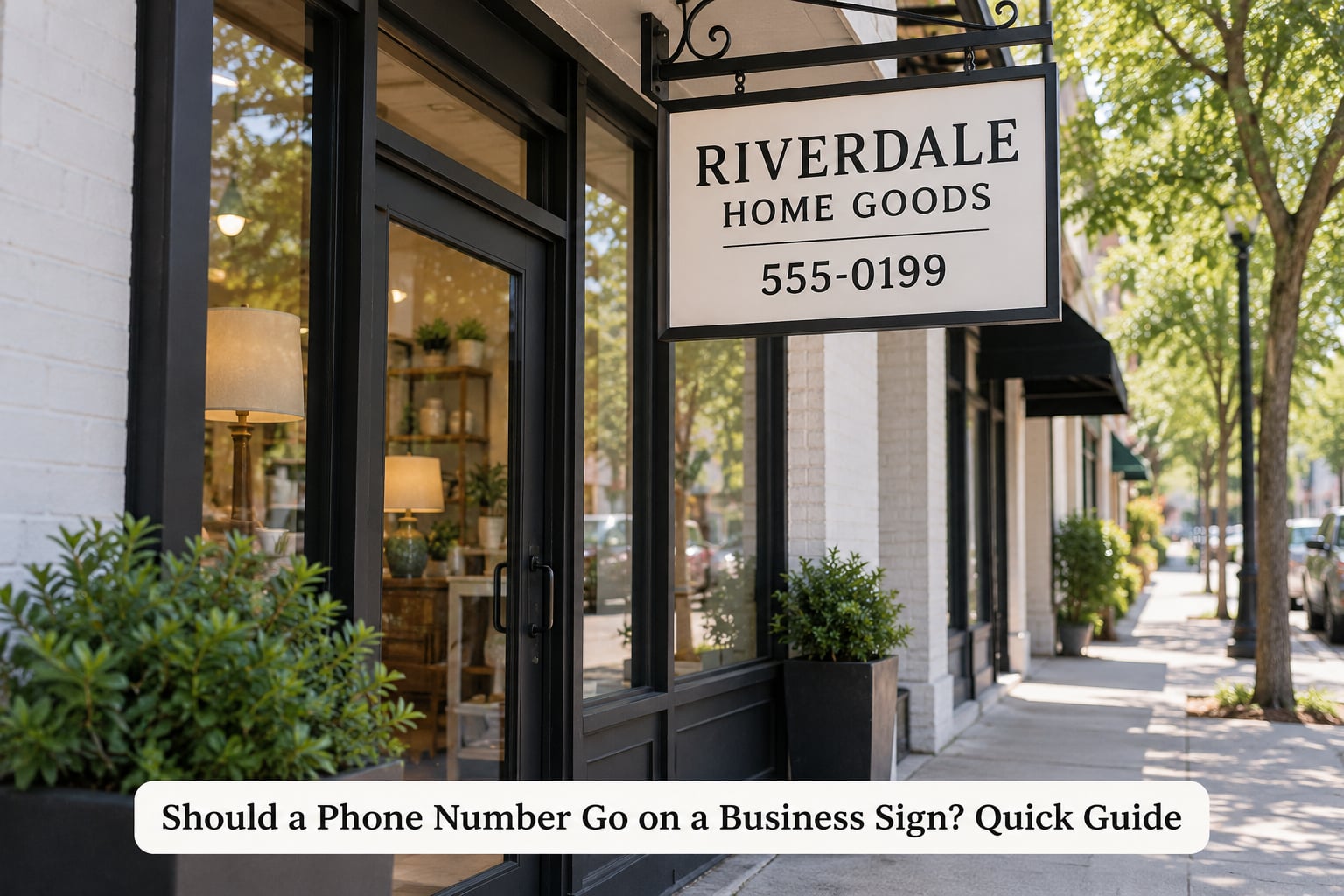
Three questions decide it. First, does a meaningful share of your revenue start with someone picking up a phone? Second, can a driver or walker read ten digits from your typical approach distance? Third, are you willing to keep that number alive for the five to seven years the sign lasts?
If all three are yes, print it. If the first is no but the second and third are yes, the space is probably better spent on your name, your service category, or a scan target. If the third answer is no, do not print it yet.
Sign makers who answer this question daily on the Signs101 forum lean against the number on primary signs. Their standard advice is that a building or pylon sign identifies the business and its location, while contact details belong on secondary lettering. Owners push back constantly, and the same thread has run for more than a decade without a settled answer.
Should a Phone Number Go on a Business Sign for Walk-In Customers?
Walk-in traffic changes the math. A passerby who wants to check hours or ask one question will not stop for a QR scan, and they will not dig out a website. If your business depends on a customer walking in or calling before they walk in, the number is doing real work.
| Business type | Print the number? | Why |
|---|---|---|
| Pizza, take-out, food truck | Yes | Most orders are phoned, and a memorable number gets repeated word of mouth |
| HVAC, plumber, emergency service | Yes | Calls are urgent and low-friction; a vanity number is remembered |
| Contractor, construction company | Yes | Quote requests start with a phone call from a curbside viewer |
| Real estate agent or brokerage | Yes | Producers on the Signs101 thread name this as a standing exception |
| Multi-tenant monument sign | Yes | Suite numbers and directories function as contact lists |
| Repair shop, salon, barber | Usually yes | Appointments still run by phone for most customers |
| Medical, dental, veterinary office | Usually yes | Callers need a number at the door, though privacy rules may apply |
| Retail storefront | No | Identification is the job; the number competes with the name |
| Corporate office or suite building | No | Reception and a directory handle contact more professionally |
| Upscale or boutique brand | No | A raw number reads cheap and dilutes the positioning |
Notice the split. Businesses whose transactions begin with a call get the number. Businesses whose transactions begin with a walk-in or a scan do not.
Why Customers Expect to See a Phone Number
A visible number removes a step. Without one, a customer standing in your parking lot has to find your website, dig through a contact page, and wait on hold — so most of them give up and walk to the next business.
The calls that actually come from signage tend to be short and specific: are you open, do you take walk-ins, how much for a quote, are you the building on the corner, can I book the 3pm slot. These are questions a sign can answer with a number that takes ten seconds to dial from memory.
Then there is the opposite failure. Plenty of signs carry a phone number, a website, an email address, a logo, three service lines and a slogan. At that point the number is decoration. It does not get called because nothing on the sign is visually distinct enough to be remembered.
One more reason to look twice: a number printed on a sign is a promise you have to keep. If the line rings to a voicemail nobody checks, you have paid for a sign that trains customers to stop trusting you.
How to Make the Phone Number Easy to Read
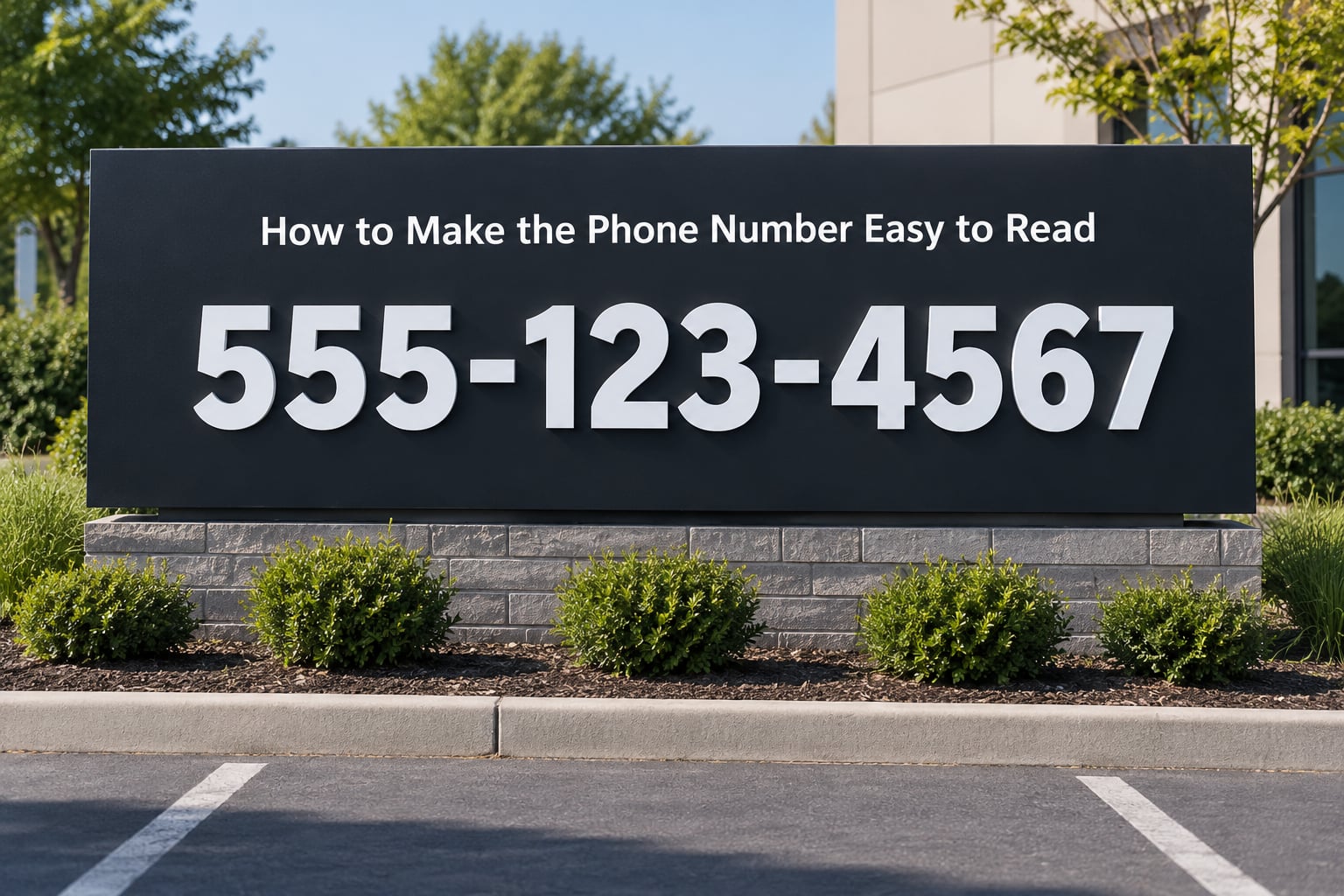
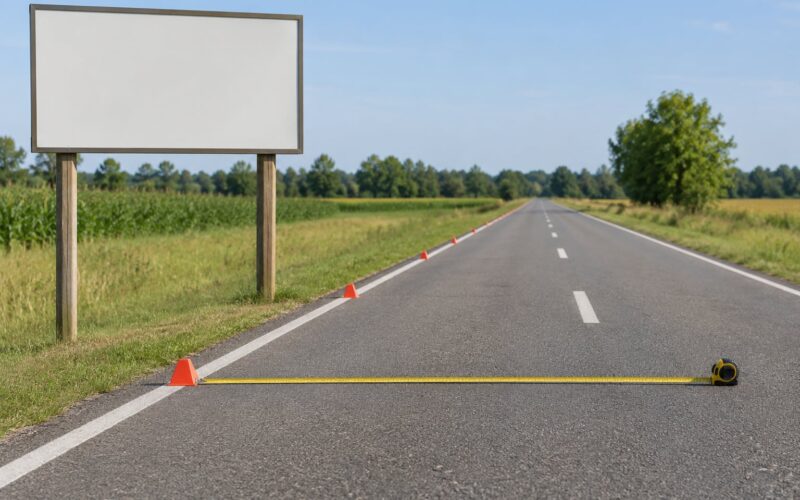
Sign legibility is governed by letter height versus viewing distance. A standard rule of thumb used across the industry is roughly one inch of cap height per 30 to 40 feet of read distance. Apply that to the number itself, not to the business name.
| Read distance | Business name cap height | Phone number cap height |
|---|---|---|
| 25 feet (walk-up, sidewalk) | 3-4 inches | 2-3 inches |
| 50 feet (parking lot approach) | 6-8 inches | 4-5 inches |
| 100 feet (nearby street) | 12-16 inches | 8-10 inches |
| 250 feet (arterial road) | 24-30 inches | 15-18 inches |
| 300+ feet (highway or freeway) | 36 inches or more | Consider dropping the number entirely |
Those ranges are working guidance, not a code requirement. Municipal sign codes sometimes set their own minimums, so confirm before you design.
Beyond size, four details decide whether a number gets dialed:
- Contrast. Light letters on a dark field or dark letters on a light field. Mid-tone grey on white is the most common failure I see.
- Type style. A plain sans serif in the same family as the business name. Thin serifs and script digits disappear at distance.
- No prefix. Drop “Call:”, “Tel:”, “Phone:” and “Mobile:”. Digits alone read as a number; a label reads as an instruction nobody needs. This is the same clutter argument designers raise on business cards.
- Consistent separators. One format everywhere — 555-123-4567 on the sign, on your website, and on your Google Business Profile. Mixed formats slow people down.
Skip the dots, skip the country code, and keep the area code even if you are local. People with new numbers cannot tell whether a local seven-digit number is stale.
Where to Place It on the Sign
Put the number where the eye finishes, not where it starts. The business name owns the top third, typically. The number belongs directly beneath the name or at the trailing end of a horizontal layout, aligned to the same left edge so both read as one block.
For a monument sign facing a parking lot, a secondary band across the bottom or a small address-and-number panel at eye level works well. For a building sign, contact information usually goes on the wall or glass near the entrance, where someone standing at the door can read it comfortably.
Three things the number must not compete with: the logo, the street address, and any directional message such as “entrance around back”. Those elements do identification and wayfinding work, and shrinking them to make room for a phone number hurts the whole sign.
On a pylon or monument sign read from a road, most sign makers will tell you to leave the number off entirely and move it to the window, the door decal, or the monument base. Same reasoning applies to window graphics and yard signs, where the viewer is stopped rather than moving.
When to Use a Cell Phone, Landline, or Another Option
The type of number changes how the sign reads as much as the layout does. A personal mobile can make an established business look temporary, which is the concern owners raise on r/smallbusiness — most of them would rather publish a dedicated business line than their personal cell.
| Option | Best for | Watch out for |
|---|---|---|
| Personal mobile | Solo trades, start-ups, low volume | Locks your personal number into a 5-7 year sign; no business-hours routing |
| Dedicated business line | Most owner-operated businesses | Must be staffed or forwarded; toll-free add-ons can cost monthly |
| Toll-free number | National audience, professional services | Reads corporate; a memorable local number often beats a generic one |
| Vanity number | Pizza, HVAC, dental, trades | Availability and cost vary widely; check what the suffix spells before buying |
| QR code | Pedestrian traffic, menu, booking, directions | Useless at speed; needs 1 inch minimum, 2 inches or more for drive-by |
| Short URL | When you want one memorable string | Still requires typing; no better than a number for a passing driver |
Printed number and QR code together can work when the viewer is stopped — a window graphic, a door decal, a yard sign at a curb. The number serves people who will not scan, the code serves people who want your full site. On a fast-moving roadside sign, pick one.
The memorability argument is the strongest case for printing a number. A pizza shop with a number that spells out a word gets remembered across a town. Nobody can recall the seven digits they glimpsed on a generic monument sign.
How to Test the Number Before Installation
Run this checklist before the sign shop cuts vinyl or fabricates channel letters.
- Read it from the approach. Stand where a customer first sees the sign, at the speed they would be moving, and time yourself. You are checking against a three to five second attention window.
- Call it on a cold phone. Dial from a phone with no saved contacts and no address history. If it is hard to find or hard to remember, so is it for them.
- Check the spelling. Read the number aloud to someone else and have them write it down. This catches 0 versus O and 1 versus I errors before fabrication.
- Test routing. Call after hours, during lunch, and on a weekend. Confirm where the call goes and that someone answers it.
- Confirm consistency. Match the number exactly against your website, business card, invoice and Google Business Profile. Mismatches are the most common and most expensive mistake on this list.
- Check permits, landlord and code. Your municipal sign ordinance, any landlord or association rules, and ADA or state requirements for accessible signage all come before fabrication.
- Plan for the exit. Decide now whether you will replace the sign, apply a surface-applied number panel, or re-letter a band if the number changes. Fabricated channel letters are the expensive mistake to plan around.
Step seven is the one owners skip. A sign typically lasts five to seven years, and the number must still ring when it comes down.
Common Mistakes That Make a Number Useless
| Mistake | Correction |
|---|---|
| Number sized well below the name | Size it to the read-distance table above, even if the name shrinks a little |
| Low-contrast lettering | Light on dark or dark on light; test it in daylight and after dark |
| Buried among service lines and slogans | Move the number into its own band or panel |
| “Call:”, “Tel:” or “Mobile:” in front of it | Print the digits alone |
| Number that differs from your online listings | Fix the listings first, then match the sign to them |
| Number nobody answers after hours | Set up forwarding or a message that reaches a person |
| Personal cell with no business identity | Switch to a dedicated line or toll-free number before ordering |
| Sign installed and then forgotten | Add the number to your quarterly review of listings and assets |
Physical upkeep matters too. Vinyl numbers on a sun-exposed face fade faster than painted or dimensional letters. Any surface-mounted number should use the same outdoor-rated materials and adhesive as the rest of the sign, and lifted edges should be replaced rather than pressed back down.
Frequently Asked Questions
How small can a phone number be on a business sign?
Size it to the distance, not to the sign. A number read from a sidewalk at 25 feet needs roughly 2-3 inches of cap height; from a parking lot at 50 feet, 4-5 inches; from an arterial road at 100 feet, 8-10 inches. Below that it reads as a texture rather than digits. If your budget cannot support a number at the correct size, leave it off the sign and move it to the door or window.
Should a business sign include both a phone number and QR code?
On a moving roadside sign, pick one — a driver has seconds and will not scan. On a window graphic, door decal or yard sign where the viewer is stopped, both can work well: the number serves people who will not scan, and the QR code serves people who want your full site. Give the code at least 1 inch, and 2 inches or more for anything read from a distance.
Do I need a phone number if my business has a website?
No. A website covers people who are already looking for you. A sign reaches people who are passing by, and most of them will not stop, unlock a phone, and search. If your customers search for you by name after seeing the sign, the website is enough. If they need to reach you in the next thirty seconds, the number is doing something the website cannot.
Should I put a cell phone number on my storefront?
It works for solo trades and start-ups, but be deliberate. A personal cell signals a small operation, which is fine if that is what you want to signal. For most established businesses, a dedicated business line or toll-free number reads more credible and gives you call routing and hours. Whichever you choose, check that it matches your website and Google Business Profile before it goes on the sign.
What is the best contact information to put on a permanent sign?
For a permanent sign, the most durable contact detail is often the business name plus address rather than a number, because a number can change and a name rarely does. When you do print contact information, a dedicated business line beats a personal cell, a vanity number beats a random one if it is genuinely memorable, and QR codes are best reserved for signs people are stopped in front of rather than driving past.
How do I keep the phone number on my sign accurate?
Set the number once, before fabrication, and put it in a written checklist alongside your website footer, business card, invoices and Google Business Profile. Review those listings on a fixed schedule, such as quarterly, and update them together. If the number ever has to change, remember that painted or dimensional channel letters mean a full replacement, so use a surface-applied panel you can update instead.
Conclusion
So yes, a phone number can go on a business sign — when calls start your revenue, when the digits are large enough to read from where people approach, and when you can keep that number working for the life of the sign.
Start with the first step: read your own sign from the place a customer would first see it. If the number is unreadable at that distance, sizing it larger is the fix. If it is readable but you are not sure it earns the space, test it against a version without the number, and count the calls for a month. Then decide once, before the sign shop starts cutting anything.