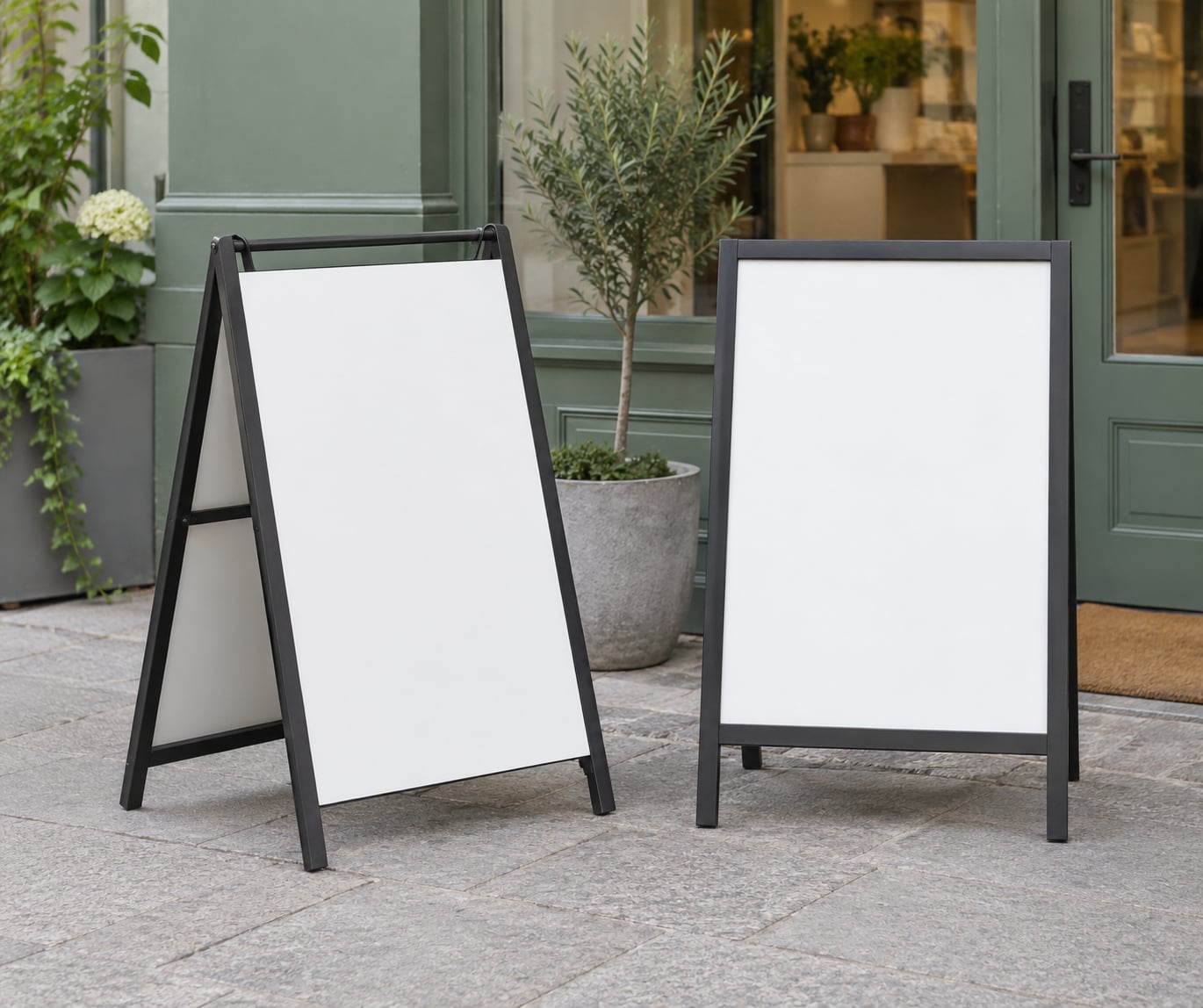
An a frame sign and a sandwich board are usually the same physical product: a freestanding, double-sided sign whose two panels hinge together into the shape of the letter A. A-frame usually names the folding hardware, sandwich board usually names the finished printed unit, so on most listings the two words are interchangeable. The choice that actually matters is whether the message is printed permanently onto the panel or sits in a swappable insert.
That single decision sets your cost, how often you can promote something, and how long the sign holds up on a sidewalk through a full season of sun, rain and gusty afternoons. Get it wrong and you end up buying a beautiful sign you are stuck with, or a flimsy one that curls after six weeks.
I have watched plenty of small businesses wrestle with this in front of a shop door, and the confusion always comes down to vocabulary rather than hardware. Vendors use the terms loosely, so the fix is to ignore the labels and compare what you are actually buying.
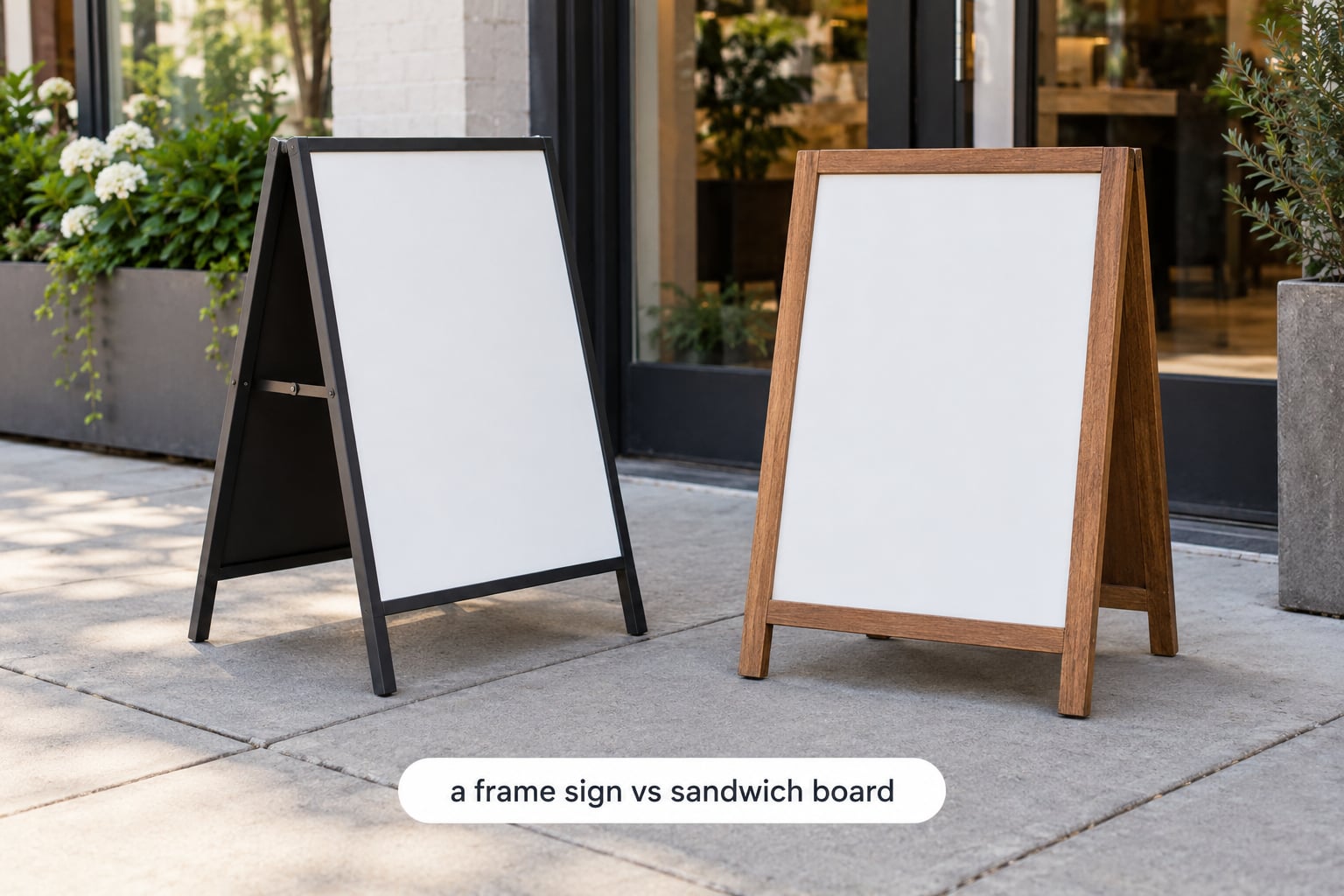
Table of Contents
- A Frame Sign vs Sandwich Board at a Glance
- What Is the Difference Between a Frame Sign and a Sandwich Board?
- Are an a-frame sign and a sandwich board the same thing?
- The distinction that actually decides the purchase
- How They Look and Where They Can Be Placed
- Portability and Message Changes
- Durability and Weather Resistance
- Visibility and Readability at Street Level
- Cost, Maintenance, and Customization
- Which Should You Choose?
- Frequently Asked Questions
- Are an A-frame sign and a sandwich board the same thing?
- Which sign is easier to move and change the message on?
- Which sign lasts longer outdoors in bad weather?
- How do I keep an A-frame sign from blowing over in the wind?
- What size A-frame sign is standard, and how far away can it be read?
- Do I need a permit to put a sandwich board on a sidewalk?
- Conclusion
A Frame Sign vs Sandwich Board at a Glance
Here is the short version of the a frame sign vs sandwich board question. Both stand on the sidewalk, both print on both sides, and both fold flat for storage. The rows below show where they diverge.
| Criterion | A-frame sign | Sandwich board sign |
|---|---|---|
| Best use | Standalone brand message, one set graphic | Daily specials, prices, hours, event notices |
| Portability | Light to carry, often folds flat | Heavier, especially with a weighted or fillable base |
| Visibility | Strong on the main face, often single message | Two distinct messages, one per side |
| Durability | Depends heavily on panel material and framing | Similar, but inserts can be swapped as panels weather out |
| Weather protection | Print direct, so UV fading is permanent | Laminated inserts survive longer, replaceable when dulled |
| Maintenance | New sign or new print each time the message changes | Wipe and re-insert, or slide in changeable copy |
| Cost pattern | One-time unit cost, low cost per campaign | Higher unit cost, low cost per message change |
| Typical placement | Near a door or window, driveway end, event entrance | Right at the curb line, facing both foot traffic directions |
Read that table as a set of tendencies rather than rules. Plenty of signs are both an A-frame and a quick-change sandwich board at once, because the frame and the panel are bought separately.
What Is the Difference Between a Frame Sign and a Sandwich Board?
A sandwich board is a board. An A-frame is the shape and the folding mechanism that holds that board up. That is the whole difference, and it explains why the two names show up on the same product page.
A-frame sign describes the hardware: two panels hinged along the top edge, opened to an angle so the unit stands without support, with one panel facing each direction of foot traffic. Sign makers also call it an A-board, an A-frame sidewalk sign or a folding sign.
Sandwich board sign describes the finished object: the printed panels plus the stand. It is also called a pavement sign, a sidewalk sign, a portable sign, a message board or a changeable copy sign. Some sellers use the brand name of a popular fold-flat design as a generic term for the category.
Historically the term comes from the sandwich man, the 19th century street advertiser who strapped advertising boards to his chest and back. The two boards sandwiched him, and the name stuck to the object once the wearer disappeared and the boards stood on their own.
Because people also ask whether a sign board and signage are different things: a sign board is the physical panel itself, while signage is the broader category covering every sign format a business uses, from window decals to projecting blade signs to the sidewalk stand outside your door.
Are an a-frame sign and a sandwich board the same thing?
Yes, in most cases they are the same object described from two angles. A-frame refers to the stand and its shape, sandwich board refers to the complete sign a customer walks up and reads. If a listing says one and the other, you are looking at the same product category, and the specification that separates a good buy from a bad one is how the graphic attaches to the frame.
The distinction that actually decides the purchase
Ask one question: is the graphic printed and glued onto the panel, or is it an insert that slides into a frame you can open? Fixed-message signs are cheaper and look sharper, and every campaign means a new sign or a new print. Quick-change signs cost more up front and then let you swap the message in about a minute, which pays off quickly if you post something new most days of the week.
How They Look and Where They Can Be Placed
Both signs occupy roughly the same footprint, about two to three feet wide at the base and three to four feet tall, which is roughly the width of a parked car without the car. The visual difference is edge treatment and message count. A-frame displays are often frameless, so the printed panel runs to the edges and the graphic carries more weight. Sandwich boards in the insert style show the frame, which looks tidier with a laminated card and signals that you can change what is on it.
Placement is where foot traffic decides the outcome. Position the sign where pedestrians slow down or turn, which is usually near a crosswalk, at the end of a queue, beside an entrance that is not directly on the main street, or near an outdoor menu. Avoid placing it directly in a doorway or in the only clear path a wheelchair user, stroller or service cart needs.
For drivers, both signs work only if they face the direction traffic arrives from and sit far enough back from the curb to be seen before the turn. A board angled slightly toward the street reads better to cars than one square to the sidewalk.
Portability and Message Changes
This is where the two formats separate most clearly in daily use.
A fixed-message A-frame does not move around at all. Whatever you printed on it in March is what passersby see in August unless you buy a second panel. If you only need to say one thing for months at a time, such as a permanent store name, seasonal hours or a directional arrow to a different entrance, that simplicity is a feature.
A quick-change sandwich board is built for rotation. The common insert styles are a slide-in poster pocket, a snap-in panel held by a spring clip, a hinged frame with a thumb latch, and a dry erase or letter board where you change copy in place with a marker rather than a printed card. Restaurants use these for daily specials, retailers for flash sales, real estate agents for open house dates, and salons for a price list they update twice a year.
Two practical details matter more than buyers expect. Weight and handling decide whether one person can move the sign without a struggle; oversized boards at three by four feet and up are awkward even when the panels are light, because the frame and any base weight add up. Second, inserts blow out or flutter in wind if they are not seated properly, so test a new sign on a breezy day before you rely on it.
Folding design also matters for storage. Most modern stands fold flat enough for a closet or a van, but confirm the folded depth and the folded height against your storage space before buying, especially for a fixed-message board that cannot be rolled.
Durability and Weather Resistance
Sun and rain will shorten the life of any printed panel, and the panel material decides how fast.
Corrugated plastic, often called coroplast, is the most common material for printed A-frame panels. It is light, water resistant and cheap to print in short runs, and it survives rain well. Direct sun and repeated heat make it curl and fade faster than other options, which matters if the sign lives in full sun for a whole season.
MDO board, a smooth medium-density overlay panel, gives a flatter, more premium surface and prints crisply. Sign makers on industry forums such as Signs101 warn strongly against large frameless MDO panels without a proper metal frame, because the panels hinge-twist, mark up and stop lying flat within weeks of use.
PVC foamboard looks refined and is common for insert cards in a dry environment, but it is heavier and needs an edge that will not chip.
Aluminum or angle iron frames with a piano hinge running the full top edge are the durable route, and they are the standard recommendation for larger boards. Steel angle frames add weight, which helps with wind at the same time.
Wind is the failure mode that actually gets people. Fillable bases take sand or water, weighted T-bases carry fixed ballast, and a base wider than the panel footprint resists tipping. Check local rules before adding water, since some cities treat a water-filled base as an obstruction. For theft, a frame with a lock point and a cable to a fixed rail beats hoping nobody walks off with it.
Storage rules are simple and worth following. Fold the sign, dry the panels, and keep inserts in a sleeve indoors rather than leaving them clipped overnight in a downpour.
Visibility and Readability at Street Level
A sidewalk sign works at two distances, and the design has to satisfy both. For pedestrians, read the message at about ten feet, which means a headline of roughly one inch of letter height for every ten feet of viewing distance. For drivers, designers on r/graphic_design point out that anything meant to be read from a car needs far larger type and much higher contrast, because a glance lasts about two seconds.
Contrast beats decoration every time. Dark lettering on a light background reads faster than light lettering on a dark panel in daylight, and reflective or illuminated options help after dark without turning the sign into a glare problem for drivers.
Message count is another trap. One headline, one supporting detail, one action. A menu with fourteen items is unreadable at speed, and a QR code only helps if the line above it explains what scanning gets the customer.
Height matters in one more way: the lower panel of an A-frame is often partially hidden by planters, a step or a parked bike, so put the important words on the upper panel where eyes actually go.
Cost, Maintenance, and Customization
Compare two different costs: what the sign costs once, and what it costs each time the message changes.
A fixed-message sign has the cheaper unit price, because you are buying a panel and a simple frame. But every new promotion means a new printed panel or a whole new sign, and repeat printing quickly overtakes the saving. A quick-change sign costs more to start because it has a frame, glazing or sleeves, but replacing a card or writing on a dry erase surface is close to free after that.
Over a twelve-month period, the sign you change often wins on total cost even when it cost more on day one. If you expect only one or two messages a year, a fixed board is the sensible purchase.
Maintenance follows the same line. Printed coroplast needs no upkeep beyond a wipe, but you cannot fix a fade. Laminating a card, or choosing a dry erase or letter board surface, buys years of rewriting. Glazed frames can scratch and glare, so keep a microfiber cloth near the door.
On customization, an insert sign accepts anything you can print, including your logo on every panel. A chalkboard or letter board is flexible in a different way, good for daily numbers and nothing else, since handwriting will never look as sharp as a printed graphic.
Where to buy matters as much as what you buy. A local sign shop builds a framed board, advises on hinges and base weight and can reproduce inserts later. A print shop handles one-off panels cheaply. Online retailers and distributors such as Signicade-style fold-flat frames or supplies from a distributor like Grimco give you the widest range and steady pricing. Whatever the source, ask whether the frame is real metal or thin plastic, because that decides the service life more than anything printed on it.
Which Should You Choose?
Choose a quick-change sandwich board if your message changes most days. Restaurants posting daily specials, cafes promoting a drink, salons listing prices, and market stalls running the weekend’s offers all recover the extra hardware cost within weeks.
Choose a fixed-message A-frame if your message rarely changes. Store names, opening announcements, event directional signs, real estate standing outside a listed house all week, and any message with a single call to action work well and cost less.
A few situations are worth naming. Retail stores on a busy shopping street get the most from a two-sided insert board facing both walking directions. Restaurants with outdoor seating usually place a second board near the entrance rather than at the curb. Trades and service businesses often pair one sidewalk board with a smaller one at the driveway. Weddings and events want matched sets with directional arrows, and those are usually hired rather than bought.
Check your city rules before buying either one. Many municipalities cap the width a sign can occupy on a sidewalk, forbid placement in a crosswalk or a pedestrian travel lane, and require the sign to sit on private property or at the building edge.
Frequently Asked Questions
Are an A-frame sign and a sandwich board the same thing?
Yes, in most cases. A-frame names the folding stand and its shape, while sandwich board names the complete printed sign. Two panels hinge together at the top and stand at an angle, with one side facing each direction of foot traffic. The distinction that matters when buying is fixed printed panel versus swappable insert.
Which sign is easier to move and change the message on?
A quick-change sandwich board wins on message changes, since the insert slides out and a new one drops in, often with no tools. Portability is closer: lightweight fixed-message A-frames fold flat and carry easily, while quick-change boards with weighted or fillable bases are heavier and awkward for one person.
Which sign lasts longer outdoors in bad weather?
Neither type is weatherproof, but the failure mode differs. A fixed-message board with UV-resistant printing on a rigid panel holds up until the graphic fades, which printed coroplast does sooner than laminated card. A quick-change board with replaceable laminated inserts lets you swap a dulled card instead of replacing the whole sign.
How do I keep an A-frame sign from blowing over in the wind?
Use the base the frame was designed for: a fillable base takes sand or water, a weighted T-base carries fixed ballast, and a wider footprint resists tipping better than a narrow one. Keep panels seated and clipped, avoid leaving inserts loose, and check whether your city allows water-filled bases before filling one.
What size A-frame sign is standard, and how far away can it be read?
Common sizes are 18 by 24 inch and 24 by 36 inch panels, with metric shops using A0, A1 or A2 boards. A practical rule is about one inch of letter height for every ten feet of viewing distance, and text meant for drivers needs much larger type and stronger contrast to register in a two-second glance.
Do I need a permit to put a sandwich board on a sidewalk?
It depends on your city, so ask before you set one out. Many municipalities limit the sidewalk width a sign may occupy, bar placement in crosswalks and pedestrian travel lanes, and require signs to sit at the building edge or on private property. Overnight and unattended signs draw extra complaints and, in some places, fines.
Conclusion
Short version: an a frame sign and a sandwich board are the same object, so choose by message frequency rather than by name. Buy the quick-change board if you promote most days, the fixed panel if you mostly say one thing.
Start by measuring the space you have on the sidewalk, counting how often the message will actually change, checking how much sun and wind that spot gets, and deciding whether you need to reach people walking or people driving. Those four answers settle the purchase faster than any product page will.