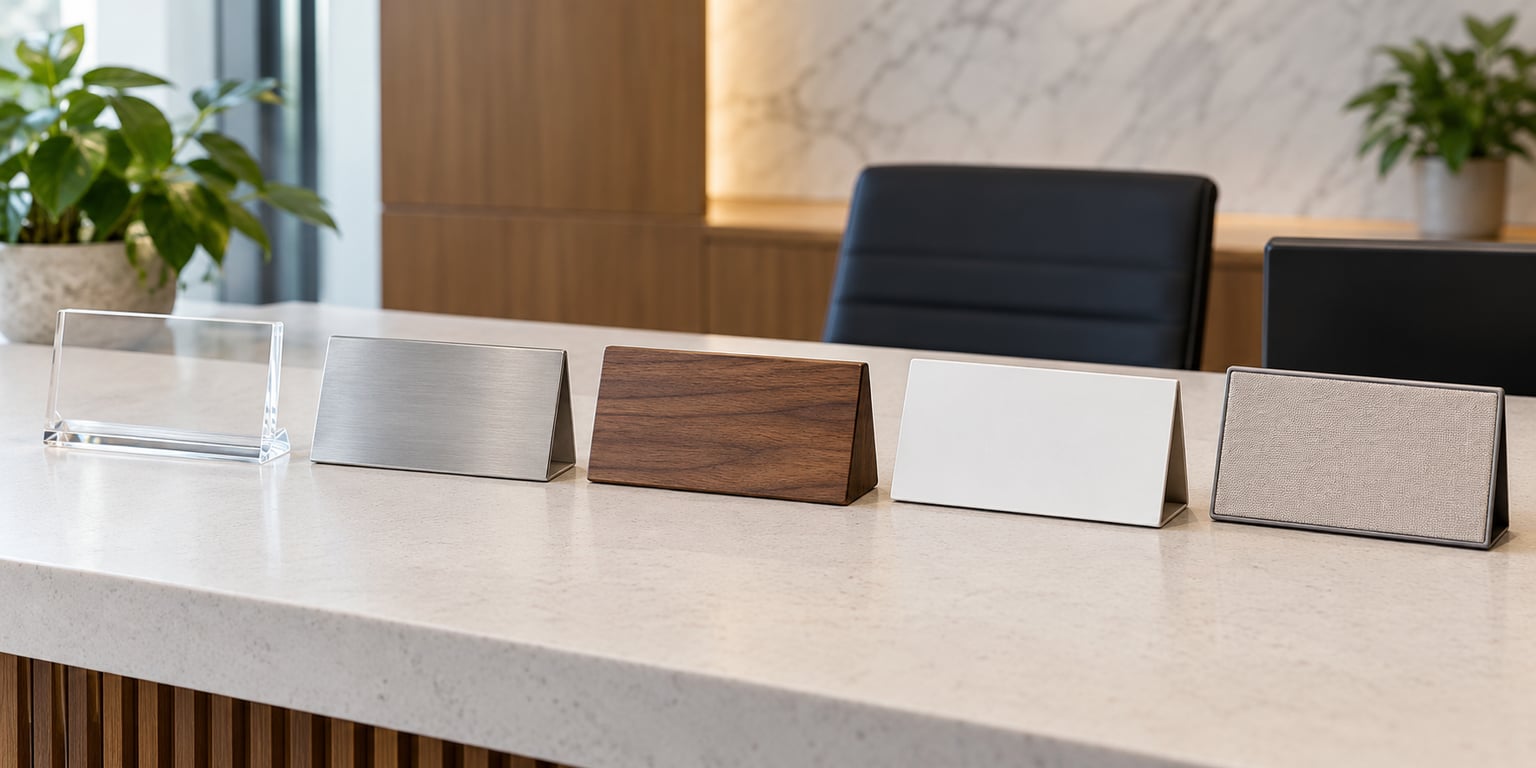
The best material for a reception desk sign depends on where the sign sits and how often it gets touched. Acrylic and laminate suit light-duty indoor displays, metal takes high-traffic counters, wood warms up a boutique or clinic lobby, and fabric-backed panels give you a premium look when the budget allows.
One thing to sort out first, because the search results get muddled on this: we are talking about the materials used for signs in and around reception, not the desk itself. HPL, solid surface, veneer and micro-concrete are desk carcass finishes. A beautiful walnut desk with a peeling vinyl sticker on the front is a common sight, and it is exactly the mismatch this guide exists to prevent.
Every material below trades off the same three things: how it looks at arm’s length, how it behaves after a year of daily wiping, and what it does to your budget once mounting and fabrication are counted. Here is the short version.
Table of Contents
- Reception Desk Sign Materials at a Glance
- Acrylic Reception Desk Signs: Clean and Lightweight
- Metal Reception Desk Signs: Durable and Professional
- Wood Reception Desk Signs: Warm and Natural
- Laminate Reception Desk Signs: Practical and Versatile
- Fabric and Signage Panel Reception Desk Signs
- How Reception Desk Sign Materials Perform
- Reception Desk Sign Materials Compared for Daily Use
- Choosing a Sign Based on Location and Brand
- Which Reception Desk Sign Material Should You Choose?
- Frequently Asked Questions
- What is the best material for a reception desk sign that is handled often?
- Which reception desk sign material looks the most professional?
- Can acrylic desk signs be cleaned with household sprays?
- What is the easiest material for a small business reception desk?
- Are reception desk sign materials compared differently for temporary and permanent signs?
- How do I choose a sign material that matches my office interior?
- Choose Your Reception Desk Sign Material
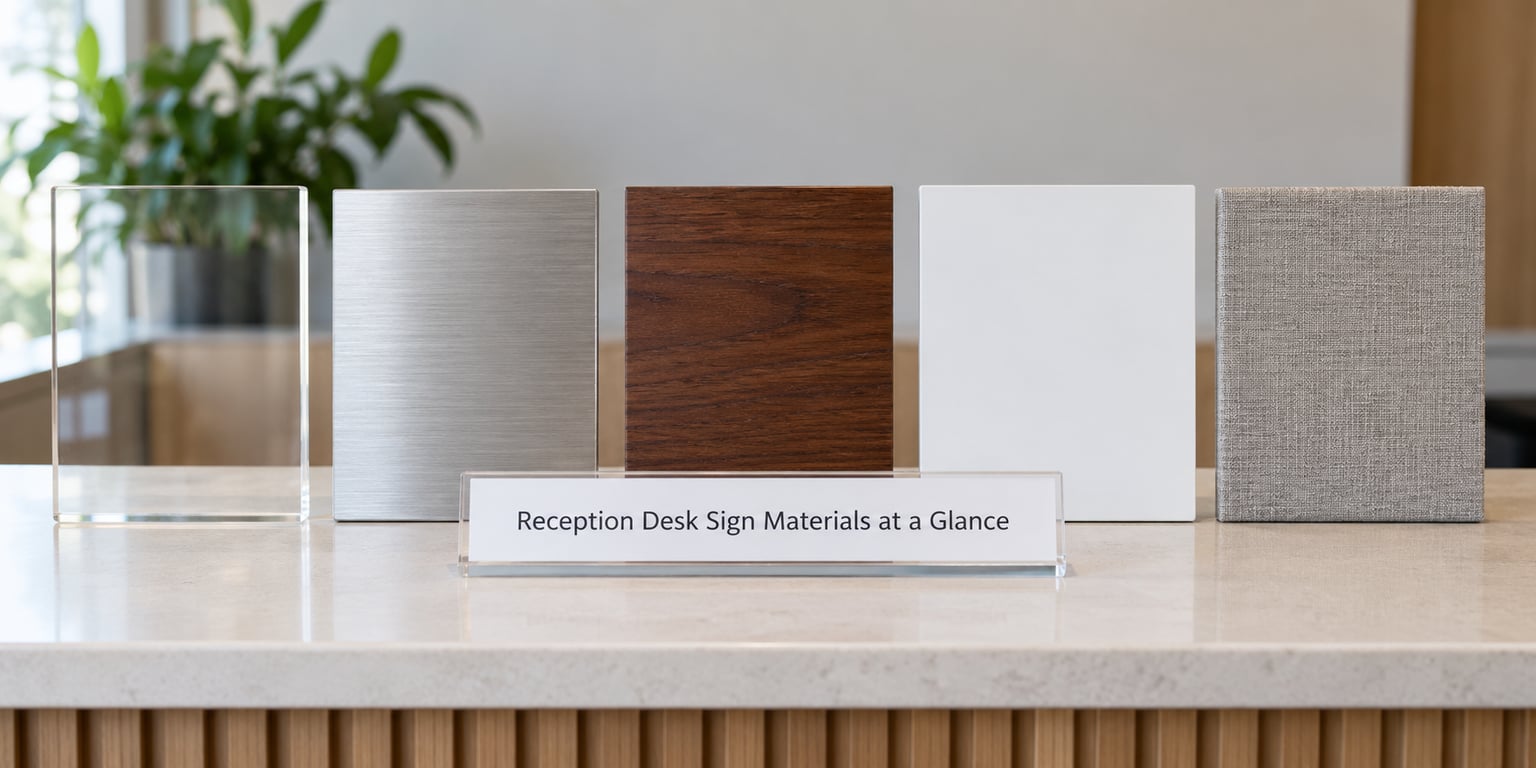
Reception Desk Sign Materials at a Glance
| Criterion | Acrylic | Metal | Wood | Laminate | Fabric Panel |
|---|---|---|---|---|---|
| Appearance | Clean, modern, optically clear | Cool, precise, premium | Warm, natural, handcrafted | Print-accurate, corporate | Soft matte, gallery-like |
| Typical indoor durability | Good, with surface care | Excellent | Good, sensitive to light and moisture | Very good | Very good indoors |
| Maintenance | Frequent, gentle wiping | Low, occasional polish | Periodic re-oiling or waxing | Damp wipe only | Vacuum, no wet cleaning |
| Best location | Indoor lobby, low touch | High-traffic counter or wall | Boutique, clinic, hospitality desk | Multi-tenant, office directories | Feature wall, brand display |
| Relative cost tier | Low to moderate | Moderate to premium | Moderate | Low | Premium |
| Main drawback | Scratches and fingerprints | Shows smudges on polished faces | Warps, fades, needs sealing | Edges can delaminate | Punctures, UV fades, heavy |
| Usual mounting | Adhesive or standoff | Standoff, hidden channel, mechanical | Adhesive, screws into frame | Adhesive | Stiffened frame or standoff |
Read that table as a set of trade-offs rather than a scoreboard. There is no single material that wins every column, and a sign that suits a law firm lobby will look wrong in a barber shop.
Acrylic Reception Desk Signs: Clean and Lightweight
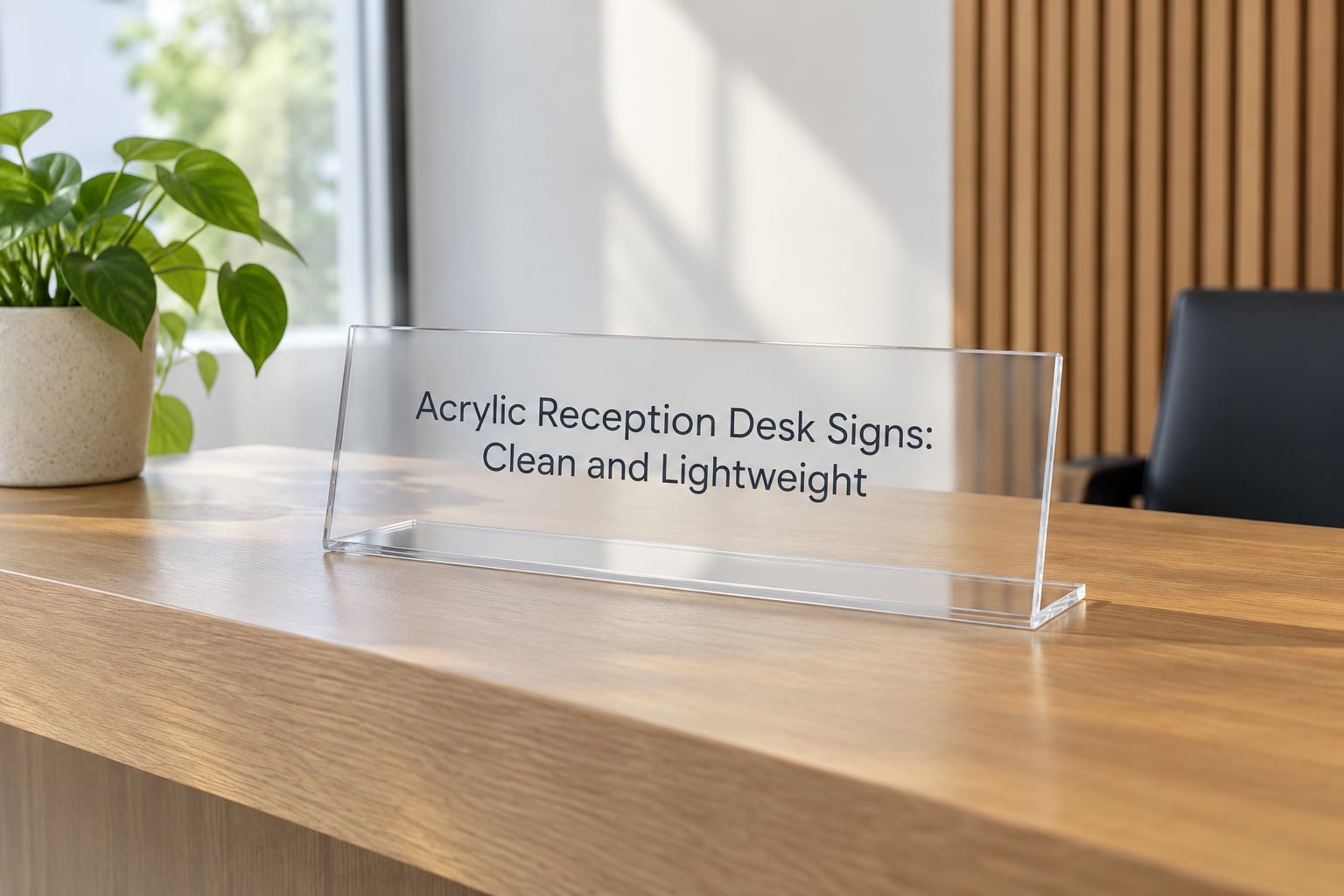
Acrylic, sold as Plexiglass or Perspex, is the default for a reason: it is light, easy to cut, and it carries printed graphics or routed lettering with a crisp edge. Most small reception signs you will see online are 1/8 or 1/4 inch cast acrylic with lettering printed on the surface.
The catch is the surface. Acrylic is a plastic, so it picks up fingerprints, and standard plastic cleaners can haze it. Users on signage forums ask the same question repeatedly: will acrylic scratch or cloud after being handled daily at a front desk? The honest answer is that light-duty acrylic on a low-touch counter lasts fine, while a sign at a busy counter that gets wiped every evening will start showing fine swirl marks within weeks.
Two other failure modes matter. Place clear acrylic near a window or entrance and ultraviolet exposure can yellow it over a few years, and any supplier who says only “acrylic” without giving you thickness, edge finish and whether the colour is through-coloured or printed leaves you unable to compare quotes fairly.
Cleaning is simple: lukewarm water, a soft microfibre cloth, and a plastic-safe cleaner if you must. Avoid alcohol, ammonia and paper towels.
Metal Reception Desk Signs: Durable and Professional
Metal is the durability answer. Aluminium, stainless steel and brass each behave differently, and contractors report that dimensional logo work is usually aluminium, often powder-coated, sometimes with an acrylic face over an internally lit section.
- Aluminium is light, easy to fabricate, and takes powder coating in any brand colour. Marine-grade alloy is the version worth specifying for a long lifespan indoors and out.
- Stainless steel resists corrosion and staining better than anything else here. A brushed or bead-blasted finish hides fingerprints far better than a mirror polish.
- Brass and copper carry the most premium weight, and they will patina or darken unevenly if left unpolished. Expect to wipe them more often than the rest of your signage.
Marking methods change the look. Engraving or routing gives depth and casts small shadows, printing on a brushed face gives a flatter, quieter result, and powder coating locks colour in without a reflective glare. For a reception counter, engraving on brushed stainless is the combination that survives the most abuse while still looking expensive.
Wood Reception Desk Signs: Warm and Natural
Wood is the material people notice because it feels human in a lobby full of glass and steel. Woodworkers tend to favour real timber over a printed or routed sheet, and the grain variation means no two solid wood signs are identical.
The practical options are solid timber, plywood, and veneer over a stable core. Solid timber looks best up close and takes stain or oil beautifully. Plywood is flat, stable and cheap. Veneer gives a consistent face with far less waste, and if you buy it, ask for FSC-certified stock with a chain of custody.
Wood is where the maintenance is real. Unsealed wood takes on spills and fingerprints as a stain rather than a mark you can wipe off, and direct sunlight near a reception desk causes timber to shrink and expand, which can open a joint or bow a panel. Seal it, keep it out of the sun line, and expect to re-oil or re-wax once a year.
Laminate Reception Desk Signs: Practical and Versatile
Laminate, usually high pressure laminate over an MDF or chipboard core, is the value workhorse. It prints in a wide Pantone range, wipes clean with a damp cloth, and shrugs off most moisture, which makes it a good fit for directories, room panels and multi-tenant boards.
Two variants matter. Printed laminate is flat, fast and inexpensive, with a slightly plastic sheen. Engraved laminate gives you crisp text and can be painted or filled for a higher-contrast finish that survives longer than printed graphics.
The weak point is the edge. A laminate sign is only as good as its edge sealing, and if moisture gets into the core the skin lifts and the panel delaminates over time. Ask for sealed or banded edges, and keep panels off damp counters. If you need genuinely wipeable signage in a clinic or food-adjacent area, acrylic or metal is the safer call.
Fabric and Signage Panel Reception Desk Signs
Stretched fabric graphics, often sold as SEG-style panels, are the premium visual option. A taut printed image sits inside an aluminium frame and the result is a completely flat, seam-free picture that reads more like a framed photograph than a sign.
Two things make fabric worth it. It softens a hard lobby and it absorbs sound, so a fabric panel behind a reception counter genuinely reduces echo. It also reproduces photographs and gradients better than any rigid substrate.
The limitations are specific. You cannot wet-clean fabric, so coffee splashes stay. It is vulnerable to puncture from rings, keys and trolley corners. Ultraviolet light fades printed fabric noticeably faster than printed acrylic or metal, so it belongs indoors away from glazing. And the frame has to be genuinely rigid, because a sagging panel looks cheap in a way that nothing else on this list does.
How Reception Desk Sign Materials Perform
Everyday handling is the differentiator. A sign at a clinic counter or a hotel front desk takes elbows, luggage wheels and wet umbrellas. A sign on a lobby wall three metres away mostly gets dust and sunlight. Match the material to the contact, not to the design.
Reception Desk Sign Materials Compared for Daily Use
- Daily wiping: laminate and stainless steel handle it best. Acrylic needs a plastic-safe cleaner and a soft cloth. Brass and copper need polishing to stay presentable. Fabric cannot be wet-cleaned at all.
- Fingerprints and smudges: gloss acrylic and polished metal show them immediately; brushed metal, matte laminate and fabric hide them well. Dark colours show everything.
- Sunlight: metal and laminate hold colour. Clear acrylic yellows over time, printed fabric fades, and solid wood moves as it heats.
- Spills: sealed laminate and metal shrug them off. Unsealed wood stains. Fabric absorbs.
- Scratching and knocks: metal wins, then laminate, then acrylic. Wood dents rather than scratches, which often looks better than a scuffed plastic sign.
- Long-term appearance: metal and good acrylic are the only two here that look the same in year five as in week one.
A quick rule: if a cleaner touches the sign every night, buy for the cleaner. Otherwise buy for the look.
Choosing a Sign Based on Location and Brand
Start with the room. A minimalist corporate lobby in a grey and white palette usually takes brushed aluminium or clear acrylic, and both disappear into the architecture rather than competing with it. A clinic or spa reception does well with warm wood or a soft fabric panel, because those spaces sell calm.
Salons, boutiques and small hospitality counters are where wood and brass earn their keep. Hotels and conference venues tend to lean metal, since the signage gets touched by hundreds of people a day and needs to look unmarked at the end of a long shift. Retail front desks and clinics with wipe-down protocols should avoid fabric entirely.
Then decide how often the message changes. Permanent identity signage can be engraved, routed or dimensional, because nothing needs swapping out. If the sign has to carry hours, room names, temporary notices or a rotating message, choose a changeable insert frame, a snap-frame panel or a tent-style countertop sign instead, and pick the frame material separately from the printed insert.
Finally, match the desk rather than the brand deck. A dark walnut desk with a gloss acrylic sign in a different colour scheme is the mismatch people notice, not the material itself. Ask for a material and finish sample before production, and state the mounting method, the thickness, the edge finish and the expected lifespan in writing.
Which Reception Desk Sign Material Should You Choose?
Pick acrylic for a modern, light-duty indoor display where appearance matters more than abuse resistance. Pick metal, and specifically engraved or printed brushed aluminium or stainless steel, for a high-traffic counter, a dimensional logo or anything that must still look new in several years. Pick wood for warmth, in a boutique, clinic or hospitality setting away from direct sun. Pick laminate for directories, multi-tenant panels and the tightest budget. Pick a fabric-backed panel when the sign is a brand feature rather than a label, and when nobody will be wiping it daily.
Frequently Asked Questions
What is the best material for a reception desk sign that is handled often?
For a sign that is wiped, leaned on and touched all day, choose metal. Brushed stainless steel or powder-coated aluminium tolerate cleaning without scratching, and they will not yellow or stain. High pressure laminate is the second choice if the sign is flat and indoors. Acrylic is fine on a low-touch counter, but standard plastic cleaners and daily microfibre wiping eventually haze it.
Which reception desk sign material looks the most professional?
It depends on the room, not a universal winner. Brushed aluminium or engraved stainless steel reads as precise and corporate in a law or financial office. Engraved laminate with a filled face looks clean and formal at lower cost. Solid wood with a visible grain feels established and traditional. The professional look comes from matching the material to the interior and specifying a matte finish rather than a mirror polish.
Can acrylic desk signs be cleaned with household sprays?
Be careful. Many glass and counter sprays contain alcohol or ammonia, and both will haze or stress-crack acrylic over time. Use lukewarm water with a soft microfibre cloth, or a cleaner specifically labelled safe for acrylic and polycarbonate. Never use paper towels, and keep the sign out of direct sunlight near a window, since ultraviolet exposure yellows clear acrylic over a few years.
What is the easiest material for a small business reception desk?
Printed high pressure laminate is the easiest all-round option for a small business. It comes in a wide range of colours, wipes clean with a damp cloth, resists moisture, and mounts with adhesive so there is no drilling into a counter you may not own. Pair it with sealed edges and it will hold up well. Acrylic is a close second if you want a clearer, more modern look.
Are reception desk sign materials compared differently for temporary and permanent signs?
Yes, and the comparison flips for temporary messaging. Permanent signs should be engraved, routed or dimensional, in metal, wood or acrylic, because nothing needs to be swapped. Temporary or changeable signs work better in a frame with a printed insert, a snap-frame or a countertop tent format, where the frame is chosen for durability and the insert for printability. Fabric has no role in either.
How do I choose a sign material that matches my office interior?
Sample before you commit. Ask the fabricator for material swatches in the finish you are considering, then hold them next to the desk finish and under the lobby lighting rather than judging them in a showroom. Warm interiors usually take wood, brass or fabric; cool grey and white spaces take brushed metal, glass or clear acrylic. Matching the tone matters more than the brand colour on the face.
Choose Your Reception Desk Sign Material
Start with three questions: where the sign will sit, how often it will be handled or updated, and what the interior needs it to complement. Answer those and the material choice makes itself, usually within a couple of samples and a conversation with your fabricator.