
Short answer: if your local sign ordinance requires a permit and you skip it, the sign is an illegal structure from day one. What happens if you install a sign without a permit is usually a written notice of violation first, then fees, then escalation to fines or removal. Who issues it and how hard they come after you depends on the city or county that owns the code.
Table of Contents
- What Happens if You Install a Sign Without a Permit?
- Which Signs Usually Require a Permit?
- How to Check Your Local Sign Permit Rules
- Common Consequences of Installing a Sign Without a Permit
- Who Is Responsible When a Sign Violates the Rules?
- What to Do After Installing a Sign Without a Permit
- How Businesses Can Prevent a Permit Problem
- Frequently Asked Questions
- Do I need a permit for every business sign?
- Can I be fined for putting up a temporary promotional sign without permission?
- Does the sign company handle the permit?
- Will removing an unpermitted sign automatically solve the problem?
- What if the sign was installed before I took over the business?
- Does a landlord’s permission replace a government sign permit?
- Conclusion
What Happens if You Install a Sign Without a Permit?
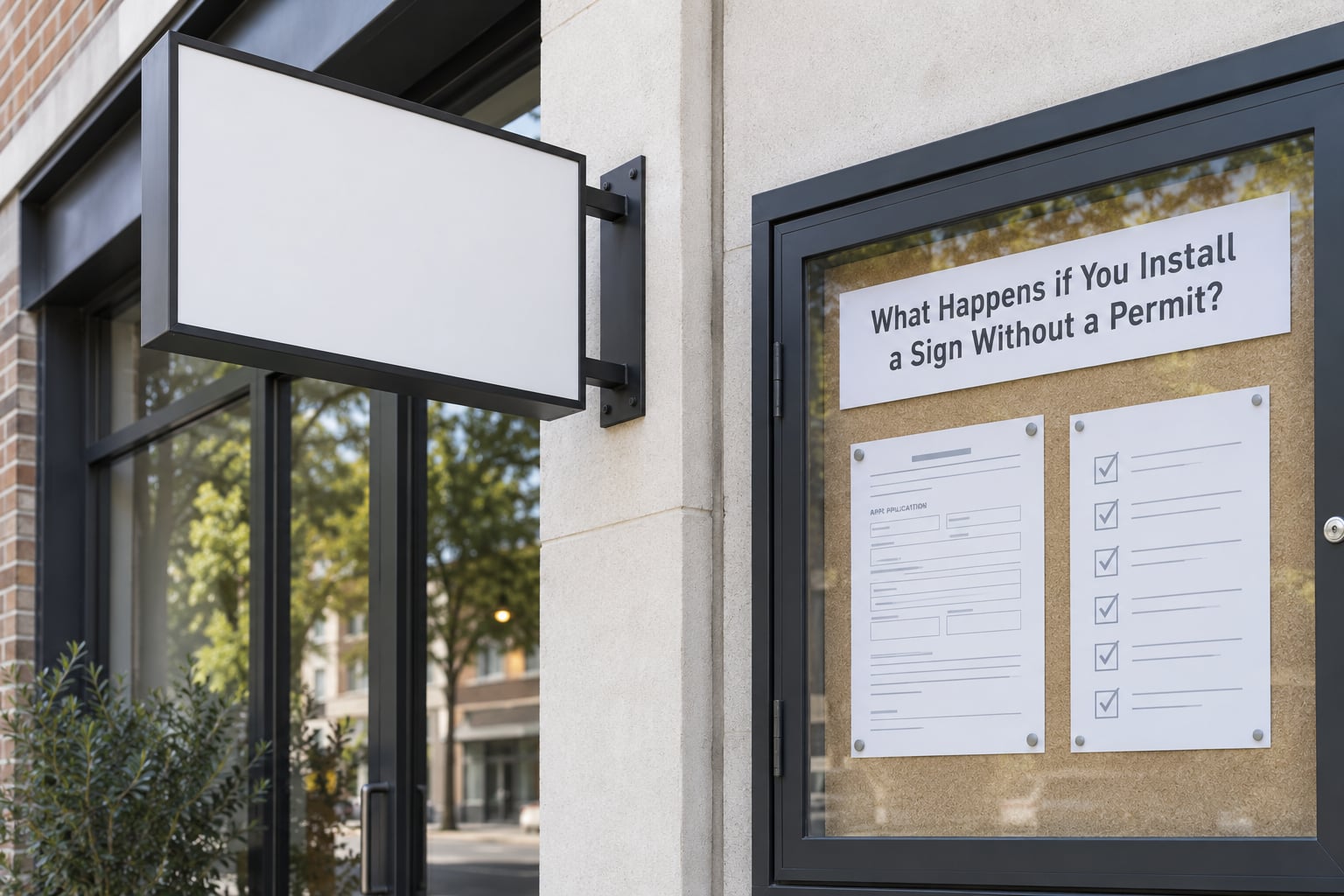
Five things tend to happen, in this order, and none of them are optional.
- A notice of violation or citation. An inspector, or a neighbor who complained, triggers a written notice that gives you a deadline to correct the sign.
- An after-the-fact permit and fees. Most jurisdictions will let you fix it, but they charge the regular permit fee plus an administrative fee for processing something that should have been approved first.
- Fines that compound. If the deadline passes without action, administrative citations usually stack on a daily or per-occurrence basis.
- A stop-work order or removal order. The city can require you to take the sign down, or post the sign for removal itself and bill you for the crew and the disposal.
- Paperwork that follows the sign. Unpermitted work can complicate a lease renewal, an insurance claim, or the sale of the property later on.
Some sign permits exist for reasons people forget. A sign can block a driver seeing a stop sign, a fire hydrant, or a pedestrian crossing. A tall pylon sign in a residential zone can shade a neighbor’s house or block a view someone paid for. An illuminated sign wired into a building without an electrical permit is a fire risk, and the city has no record that anyone checked the load.
Aesthetics and zoning are the other half of the reason. If every business could hang whatever it liked, the first thing to go would be the setback and the sign area limit that keeps a road corridor from turning into a wall of plastic.
Which Signs Usually Require a Permit?
The trigger is usually the sign’s size, location, illumination, or whether the building already has an approved sign. Here is how the categories tend to fall.
| Sign type | Permit usually required? | Notes |
|---|---|---|
| New exterior wall or storefront sign | Yes, in most cities | Counted against the sign area allowed for that wall |
| Illuminated or LED sign | Yes | Adds an electrical permit and brightness limits |
| Monument or pylon sign at the property line | Yes | Height, setback and footing rules apply |
| Change to an already-approved sign | Often yes | New size, face or wording usually counts as an alteration |
| Temporary banner or promotional sign | Depends on the code | Many codes cap duration and total square footage |
| Sign on a historic property | Almost always yes | A separate historic review usually runs in parallel |
| Interior sign | No, almost everywhere | Interior signage is routinely exempt |
| Small yard or A-frame sign | Usually no | Common exemptions, often subject to size and time limits |
| Directional and accessibility signs | No | Treated as safety signage, not advertising |
One category catches people out: a painted mural. If it contains the business name and can be read from the street, most codes treat it as a sign, even though no sign was hung. A small business owner in Columbus learned that after the city showed up and flagged a mural on the side of the building.
Exempt is not the same as unregulated. An exempt sign still has to stay inside the height, size, setback and duration limits the code already sets. Getting the exemption and breaking the limits are two separate problems.
How to Check Your Local Sign Permit Rules
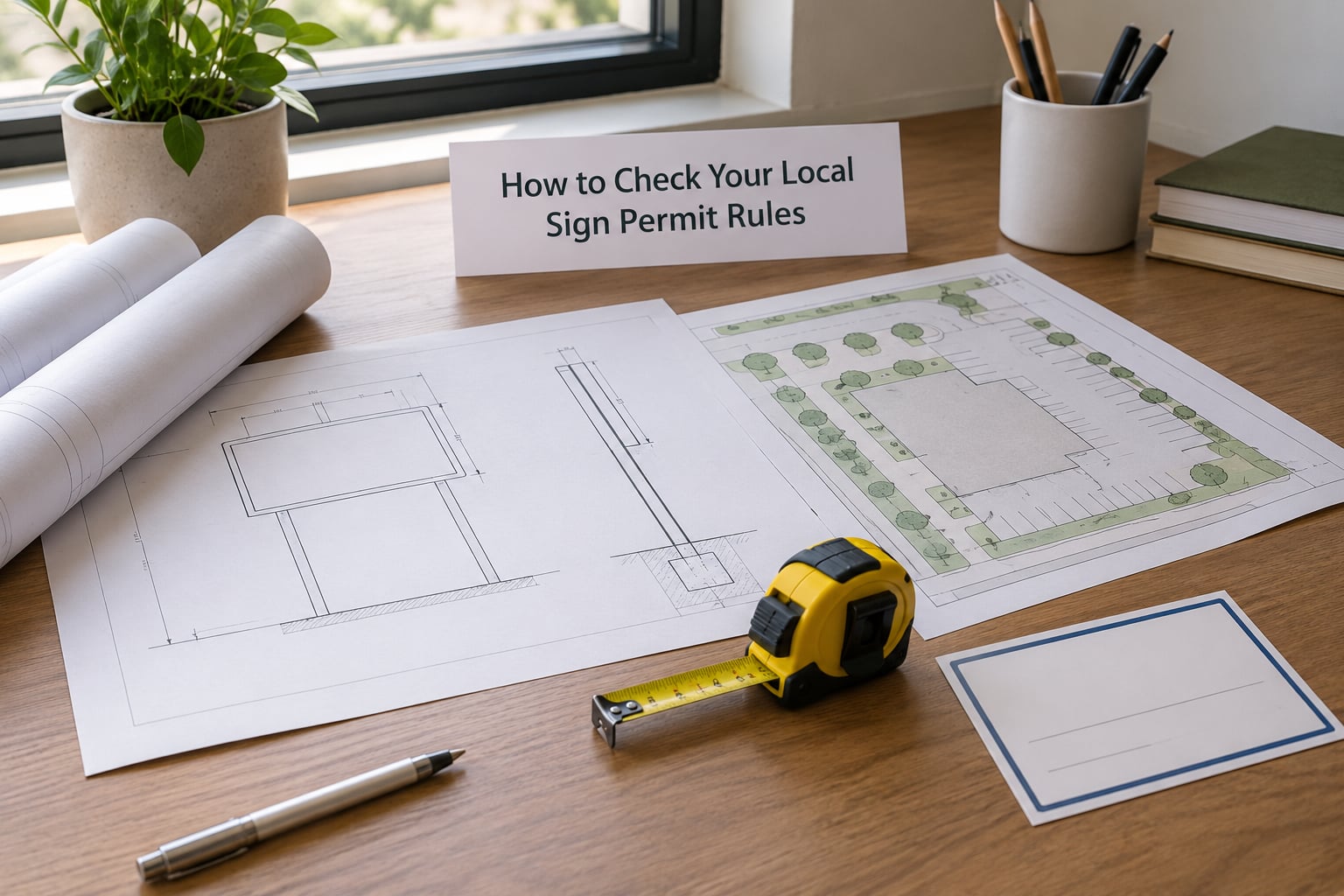
Start with the city planning department, or the building department if the city folds planning into it. In a county without municipal zoning, the county planning or codes office handles it instead.
- Find the authority. Search your city name plus “sign permit” and you will usually land on the right department page within one try.
- Read the sign chapter of the municipal code. Codes are published online. The sign chapter lists what is exempt, what needs a permit, and the penalty section, which is the part most people never read.
- Check the overlays. A zoning district, a historic district, an airport overlay, or a streetscape plan can add rules on top of the base code.
- Ask what they need in writing. A short email asking whether your specific sign needs a permit gets you a written record, and most offices answer the same question the same way each time.
Have the basics ready: property address, a site plan showing where the sign sits, an elevation drawing with dimensions, the electrical component if it is lit, and proof you are authorized to sign for the property. If you are a tenant, that last document is your lease or a letter from the landlord, and getting it early is the single most common cause of a delayed application.
Practitioners on Signs101 describe permit applications bouncing between installer, tenant, property manager and owner for months over exactly this kind of documentation. Ask for the document list before you order the sign, not after it is fabricated.
Common Consequences of Installing a Sign Without a Permit
Here is how enforcement actually works, and who issues each step. Fine amounts are set locally, so treat the cost column as a shape rather than a number.
| Situation | Typical consequence | Issued by | Who pays |
|---|---|---|---|
| Sign found with no permit | Notice of violation with a compliance deadline | Code enforcement officer | Property owner or tenant |
| Deadline missed | Administrative citation, often per day or per occurrence | Code enforcement officer | Property owner or tenant |
| Sign is unsafe or unapproved | Stop-work order, sign posted for removal | Building inspector | Owner pays removal and disposal |
| Sign blocks required sightlines | Order to relocate or reduce, at your cost | Building or public works | Owner or tenant |
| Lit sign without electrical permit | Electrical correction order, re-inspection | Electrical inspector | Owner or installer |
| Repeat or refused violation | Municipal court, misdemeanor in some jurisdictions | Prosecutor’s office | Named individual or company |
Enforcement usually starts with a complaint rather than a random sweep. A neighbor disputes the sign, a tenant complains, or a city staffer photographs a new storefront on a drive-by and forwards it to code enforcement. That means the clock starts the day somebody notices, not the day you installed it.
The practical takeaway is that the penalty for skipping the permit is usually a multiple of the fee you avoided, before you count removal costs, revised drawings, or a second trip from the inspector. Saving a few hundred dollars on the front end is rarely a good trade.
Who Is Responsible When a Sign Violates the Rules?
Responsibility usually follows control of the sign and the property, and it can attach to more than one party at once.
- The property owner is the most commonly cited party in the municipal code, because the permit runs with the land.
- The tenant or business owner is often cited directly for a wall sign on leased space, especially when the lease assigns signage rights to the tenant. BigPockets real-estate users warn that unpermitted work creates insurance problems later, and an insurer looks first at whoever did the work.
- The sign installer can be cited for installing without a permit and for electrical work done without a license. Practitioners on Signs101 are blunt about it: if the owner cannot produce a permit, do not do the install, because the installer gets blamed.
- The advertiser on a tenant’s sign or a vehicle wrap can be pulled into a master sign program dispute.
- The landlord is liable for signs they authorized or installed, and sometimes under a master sign program that covers a whole building.
Hiring a contractor does not transfer legal responsibility to the contractor. It moves who does the paperwork, not who answers for the violation.
What to Do After Installing a Sign Without a Permit
Do not touch the sign yet. Removing it on your own can look like evasion, and in some codes it removes the evidence the city needs to close the case.
- Write down what went up, when, and who installed it. Dates, photos and the installer name all help your explanation.
- Read your local code before you call. Know the penalty section and the exemption list so the conversation starts from facts.
- Contact the permitting office in writing before making changes. Say plainly that the sign is up and ask how they want it handled. That message becomes your record.
- Submit an after-the-fact permit application. Expect to pay the normal permit fee plus an administrative fee, and to supply the same drawings a pre-install application would have required.
- Ask about an as-built inspection. The inspector may need to verify footings, height and electrical work, not just paperwork.
- Get the approved plan and the approval in writing. Keep both with your lease and insurance records.
Be polite and factual on the phone. Code enforcement officers deal with the same scenario many times a week, and most would rather regularize your sign than escalate it.
How Businesses Can Prevent a Permit Problem
- Ask the planning department before you order, not after it is hanging.
- Get landlord approval in writing before submitting anything, especially in multi-tenant buildings with a master sign program.
- Submit accurate drawings. A site plan with dimensions and an elevation drawing prevent most plan-review bounces.
- Coordinate the electrical permit separately if the sign is lit, and use a licensed electrician.
- Keep the approved permit, the stamped drawings and the inspection sign-off with your records.
- Track your temporary signs. Set a calendar reminder for the removal date the code allows.
- Photograph the finished, permitted installation for your property file.
One habit covers most of it: get the permit number before installation and put it on the job sheet the crew carries. If anyone shows up at the site, the number answers the question before it becomes a violation.
Frequently Asked Questions
Do I need a permit for every business sign?
No. Most codes exempt interior signs, small yard and A-frame signs, directional and accessibility signage, and often temporary promotional signs within stated size and duration limits. Exterior wall, monument, pylon, illuminated and LED signs almost always need one. The trigger is usually size, illumination, location or a change to an already-approved sign. Check your municipal code chapter on signs, since the exemption list is local and specific.
Can I be fined for putting up a temporary promotional sign without permission?
Possibly. Temporary signs are frequently exempt outright, but many codes cap their size, number of sign faces, placement and display period. A banner left up past its allowed period, or a temporary sign that blocks a right of way, can be treated as an unpermitted sign and handled through the same notice and citation process. Read the temporary sign section of your code before you hang anything.
Does the sign company handle the permit?
Sometimes. Many sign companies offer to pull the permit as part of the job, and in some states only a licensed sign contractor may pull one. Others require the owner to apply first and will not fabricate until the permit is approved. Either way, ask in writing who is submitting the application, who pays the plan-review fees, and who responds if the application is returned for corrections.
Will removing an unpermitted sign automatically solve the problem?
Not always. A removal order is usually there to remove a hazard, not to end the case. The city may still hold an open violation, and the underlying work can resurface during a later sale, lease renewal or insurance claim. Contact the permitting office in writing first and ask how they want it closed. If they confirm in writing that removal resolves it, then remove it.
What if the sign was installed before I took over the business?
Tell the city that in your first contact, with dates. Ownership matters for enforcement, and an unpermitted sign that predates you can often be regularized through an after-the-fact permit at your cost, with added administrative fees. If the sign came with the property, ask the seller for the permit and inspection records. If you lease the space, the lease usually tells you who owns the existing signs and who must obtain approval.
Does a landlord’s permission replace a government sign permit?
No. A landlord controls the private property rights, but the sign code is a public regulation enforced by the city. Landlord approval covers the lease and any master sign program for the building; the permit covers zoning, structural and electrical rules. You generally need both. Getting the landlord’s letter early is still smart, because it is a required document on most applications.
Conclusion
Check your local zoning and sign authority before you install or alter anything, and get the answer in writing so you have a record. If a sign is already up without approval, contact the permitting office in writing before you touch it, ask about an after-the-fact permit, and keep the approved plan with your records.