Yes — most permanent exterior business signs need a permit before you install them, but the rules come from your city or county code, not from federal law. Small unlit signs, window graphics and many temporary signs are usually exempt, so what decides it is the size, height, lighting and placement of your sign, plus the sign ordinance where the property sits. Last reviewed October 2026.
There is no national sign permit and no single answer that works everywhere. A sign that is fine in one suburb can need a variance two miles away in the next town. That is why searching for a national rule is so frustrating, and why the practical answer lives in your municipal code chapter on signs.
Do you need a permit for a business sign? In most cases you do, and getting it before fabrication is dramatically cheaper than getting it after the sign is already bolted to the building. Below is how to work out what applies to you, who issues the permit, and what to do at each step.
Table of Contents
- Do You Need a Permit for a Business Sign? Jurisdiction Decides Everything
- Three questions that settle most cases
- What Types of Business Signs May Require a Permit?
- Sign types explained
- Where you can legally put a sign
- What Signs Are Usually Exempt?
- How to Check Your Local Business Sign Rules in Five Minutes
- Do you need a permit for a business sign? Ask these three questions
- How to Apply for a Business Sign Permit
- Step 1: Assemble the documents
- Step 2: Confirm the district limits
- Step 3: Submit to the correct department
- Step 4: Respond to corrections
- Step 5: Inspect and install
- What a business sign permit costs
- How long approval takes, by sign complexity
- Who Can Handle the Permit Process for You?
- Common Reasons a Business Sign Permit Is Denied, and How to Fix Them
- Zoning conflict
- Sign area or height over the limit
- Lighting and content rules
- Missing structural or electrical documentation
- Historic district restrictions
- Setback and right-of-way problems
- Property owner refusal
- What happens if you install a sign without a permit
- What to do if the sign is already installed
- If your permit is denied: variance and appeal
- Frequently Asked Questions
- Do you need a permit to put up a sign on your storefront?
- Which signs do not need a permit?
- How much does a business sign permit cost?
- How long does a sign permit take to get approved?
- Who pulls the sign permit, the landlord or the tenant?
- What happens if you install a sign without a permit?
- What to Do First
Do You Need a Permit for a Business Sign? Jurisdiction Decides Everything
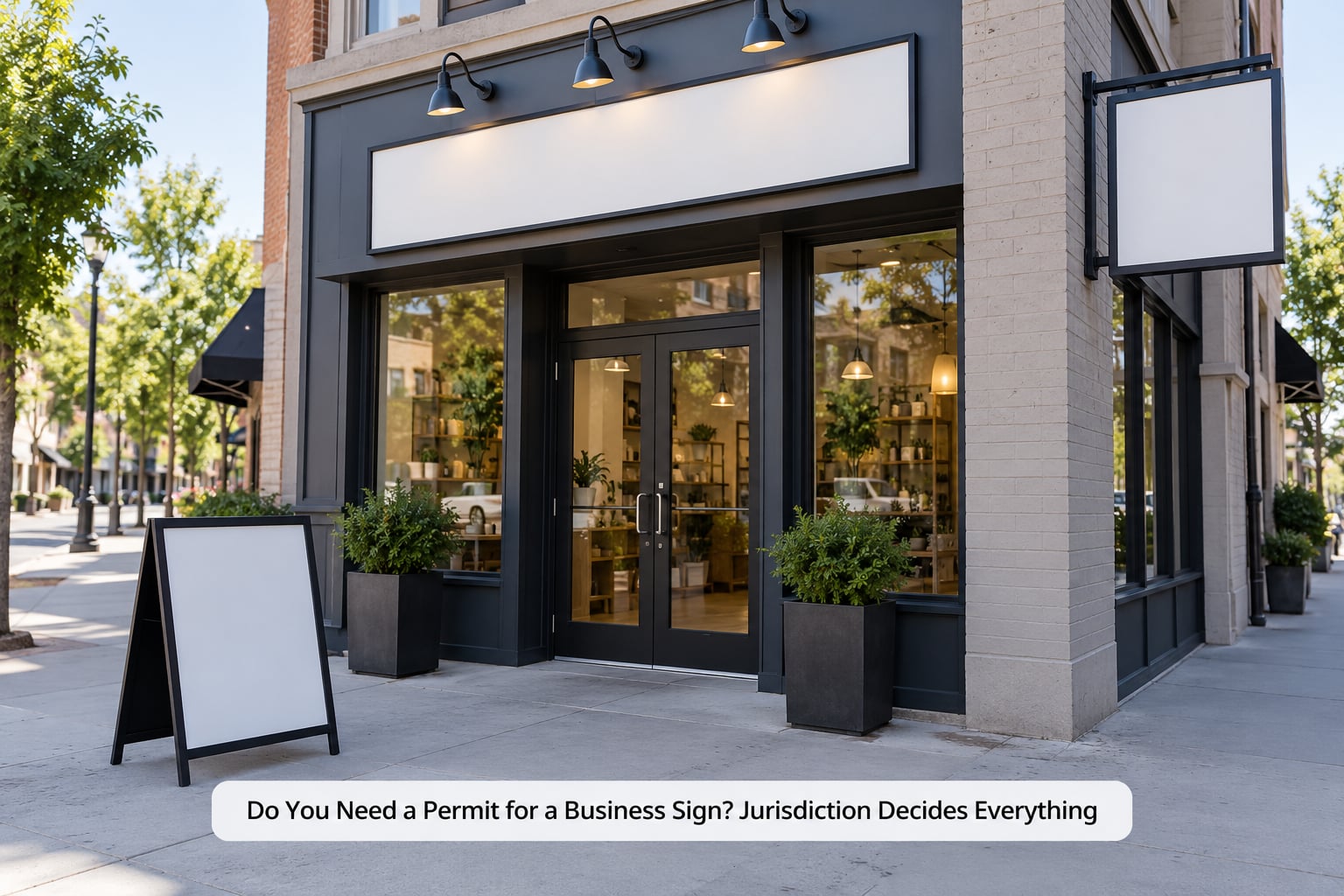
Sign regulation in the US sits mostly at the local level. Most cities adopt a sign ordinance as part of their zoning code, and unincorporated areas fall under county planning and zoning instead. The result is that your permit comes from a city or county department, not from a state agency and not from Washington.
A few state rules sit on top of local ones. Signs in a state highway right-of-way usually need approval from the state transportation department, whatever the city says. A small number of states limit how much local governments may regulate signs, so it is worth a quick check on whether your state preempts local sign rules before you spend time at city hall.
Most local sign codes borrow their structure from model codes such as the International Building Code and the International Fire Code. That is why you will see the same vocabulary everywhere: sign area, height above grade, setback from the property line, illumination level, and structural attachment requirements.
Three questions that settle most cases
Ask these in order and you usually know whether to keep reading:
- Is the sign permanent, and is it attached to the building, a pole or the ground?
- Is it illuminated, animated or an electronic message display?
- Is it near a size, height or square-footage limit, or does it reach into the sidewalk or street right-of-way?
If the answers are yes to permanence and yes to lighting, plan on a permit. If the sign is small, unlit, flat against the building and well inside the local limits, you are probably in exempt territory.
Leased property adds one wrinkle before any of that. If you rent the space, you need written permission from the property owner before you apply, because the owner may have a master sign plan for the building or a center that already fixes sign locations, sizes and lighting for every tenant. Some shopping centers approve one sign type and refuse everything else regardless of what the city would allow.
What Types of Business Signs May Require a Permit?
Large, tall, elevated and lit signs are the ones that get reviewed. Here is the practical picture by type.
| Sign type | Typical permit status | What reviewers check |
|---|---|---|
| Wall sign, monument or pylon | Usually required | Sign area against the frontage formula, height above grade, setback |
| Projecting or blade sign | Usually required | Projection over the sidewalk, vertical clearance, bracket detail |
| Channel letters | Usually required | Often approved once under a master sign plan for the whole center |
| Illuminated or digital electronic message display | Almost always required | Brightness, message duration, flashing rules, electrical listing |
| A-frame or sandwich board on the sidewalk | Often exempt, sometimes needs an annual portable sign permit | Sidewalk clearance and how much of the walkway the board takes |
| Banner or flag | Temporary ones often exempt, permanent flagpole mounts usually not | Duration limits and pole height |
| Window graphics and vinyl decals | Usually exempt below a square-footage cap | Window coverage limits in some cities |
| Vehicle or trailer-mounted sign | Usually exempt on private property | Regulated as a vehicle when parked in the roadway |
| Off-premise billboard or roadside sign | Required, often by more than one agency | Highway authority approval, spacing and maximum height |
| Any sign in a historic district or signage overlay | Required, with extra review | Historic preservation commission sign-off |
Sign types explained
On-premise identifies the business on the lot where it operates. Off-premise advertises something else, including a business located at another address, and those face much tighter limits.
A monument sign sits low and flat on the ground at the property line. A pylon sign is the taller vertical version, often visible from far down a road corridor.
A channel letter is an individual fabricated letter with a metal cabinet, often internally lit. A projecting sign sticks out perpendicular from the facade and reads from both directions along the street.
An electronic message center, or EMC, is the LED or digital display that scrolls or changes messages. It is regulated separately because brightness, animation and how long a message can stay on screen are all restricted.
Sign area is usually not just the face of the sign. Codes commonly calculate it as a multiple of the sign height times width, sometimes doubled for both sides, and then compare that total against a maximum that scales with your building frontage. A sign can pass the height limit and still fail because the allowed area is small.
Where you can legally put a sign
Placement rules are where most denied applications fail. A sign has to sit inside the lot by a required setback from the property line, clear the property line entirely in some districts, and stay out of the visibility triangle at intersections so drivers can see traffic signals.
Anything over a public sidewalk needs enough vertical clearance for pedestrians, and a projecting sign cannot block the walkway. Anything attached to a light pole, a utility structure or anything in the street right-of-way needs a separate approval from the public works or transportation department, and it may need that department’s own permit on top of the city’s.
Mounting height is also capped. A freestanding sign usually has a maximum height above grade, and the code may reduce that maximum near a residential boundary so the sign does not dominate the neighboring property.
What Signs Are Usually Exempt?
Every sign ordinance has an exemption list, and the categories look surprisingly similar from town to town. Most codes exempt some combination of:
- Small non-illuminated wall signs and window signs under a square-footage cap
- Signs naming the building, the business and the address
- Directional signs on the lot pointing to a driveway or entrance
- Safety and emergency instruction signs
- Holiday and seasonal decorations, often for a limited number of weeks
- Temporary sale, grand opening and leasing signs, usually for a set number of days
- Real estate and yard signs in residential districts
- Menu boards and drive-through or order-confirmation panels in some cities
- Non-illuminated window decals and door vinyl that sit inside the glass area
- Signs on vehicles and trailers while parked on private property
Read the exemption list for its limits, not just its headings. Small signs are commonly capped at one or two square feet per face, and a city may cap the total exempt area at a property so a business cannot cover a storefront with exempt-sized signs. Exemptions also expire: a temporary grand opening banner is free for a set window of days and needs a permit on day thirty-one.
Historic districts and signage overlay districts usually override the general exemption list. Materials, colors and illumination that would pass anywhere else get a second look from a preservation commission.
How to Check Your Local Business Sign Rules in Five Minutes
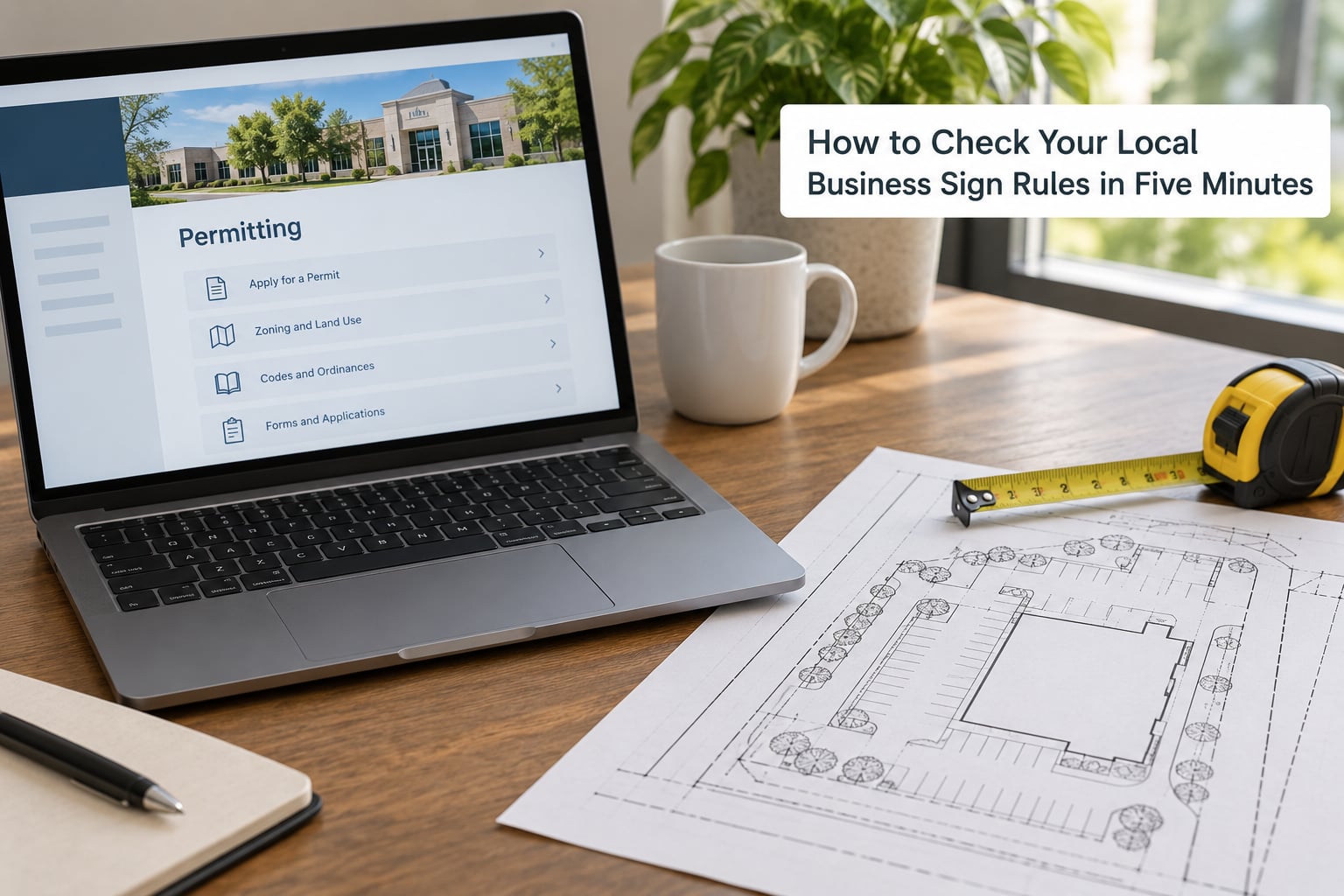
Start by figuring out who governs the property. If the address has a city name, it is the city. Rural addresses outside any municipality fall to the county planning department, and that department is often less well known than a city hall.
Then find the right department. Look for planning and zoning, or sometimes called development services or community development. Sign permits are a zoning matter first, because they control size, placement and appearance, and a building permit second when the sign is lit or structurally attached. If the sign goes over the sidewalk or touches a city pole, that is a public works question.
Search your municipal code online for the word sign inside the zoning or development title. You are looking for the sign chapter, and inside it the permit section, the definitions section, and the exemption table. Most cities publish the code free through a code library or the city clerk’s site.
Several lookup tools will pull the zoning district and sign rules for a specific street address, which saves a lot of guessing about which district you are in. What those tools will not tell you reliably is the height of the existing building, the existing sign area already used on the facade, or whether a master sign plan covers your unit. For those, call the department.
When you call, ask four things: what is the zoning district at this address, what is the maximum sign area and height for that district, what is the exemption list, and does the property sit in a historic district or under a master sign plan. Get the code section number while you are on the phone. Later disputes are much easier when you can point at a specific section.
Do you need a permit for a business sign? Ask these three questions
First, is it permanent? Anything bolted, mounted or on a pole is treated as permanent even if you plan to take it down in a year, and temporary permits for things like banners are usually a separate, simpler application.
Second, is it lit? Any internal illumination, external lighting, or a display that changes counts, and it pulls in electrical and brightness review.
Third, how big and where? Add up the total sign area on the facade and compare it to the formula for your frontage, then measure the height above grade and the distance from the property line. If it fits inside every limit and it is small and unlit, you are close to exempt. If it brushes a limit in either direction, get it reviewed before you order.
How to Apply for a Business Sign Permit
The process itself is straightforward. The part that trips people up is arriving with drawings that do not match what the installer builds.
Step 1: Assemble the documents
A site plan showing the lot, the building outline and the proposed sign location, scaled and marked with dimensions from the property lines. A sign elevation drawing showing the face, the overall height, the sign area calculation and the mounting height above grade. A construction detail if the sign attaches to the wall, so reviewers can check fasteners and attachment points. Illumination information if the sign is lit, including fixture type and whether the equipment is listed.
Also expect to supply electrical information and the name of a licensed electrician for a lit sign. Written authorization from the property owner is required if you are a tenant. Historic district paperwork applies if the address sits inside one. Large signs usually need stamped structural calculations attached.
Step 2: Confirm the district limits
Before submitting, check the maximum sign area and height for your zoning district and note any signs already on the building. In a multi-tenant strip, existing tenant signs usually count toward the total allowed.
Step 3: Submit to the correct department
Planning and zoning handles the sign itself. If the sign is illuminated, a separate electrical permit is usually required and a licensed electrician pulls it. If the sign is large enough to need engineering, expect to supply stamped calculations.
Step 4: Respond to corrections
Plan review almost always comes back with at least one correction. Usually it is a missing dimension, a site plan without the property line, or a sign area calculation done wrong. Fix the drawings, resubmit, and do not start ordering the sign until the permit is issued.
Step 5: Inspect and install
Some jurisdictions require a footing or attachment inspection before the sign goes up, and electrical work needs its own final inspection. Install to the approved drawings, because a permit that does not match the installed sign is still a problem.
What a business sign permit costs
Most municipalities charge a base administrative fee plus a review fee, and the review fee scales with how hard the sign is to check. A simple wall sign with a standard elevation is often administrative review only. A monument sign with lighting or a digital display adds structural and electrical review, which is where the real cost lands. A historic district sign adds a commission review fee, and most departments offer a rush option for a larger fee.
Two costs sit outside the fee schedule. Drawing the site plan and elevation well enough to pass review is real work, and it is what sign companies charge for when they offer permit handling. Get the fee schedule in writing before you pay, and ask whether the permit fee is passed through at cost.
How long approval takes, by sign complexity
| Sign type | Typical review time | Why |
|---|---|---|
| Small non-illuminated wall sign, under local size cap | Exempt, or same day to a few days | Below the review threshold |
| Standard wall sign, one face, no lighting | A few days to two weeks | Administrative review of the elevation |
| Monument or pylon sign with lighting | Two to four weeks | Site plan, setback and sign area check plus electrical review |
| Digital or electronic message center | Three to six weeks | Brightness, message duration and often engineering review |
| Sign in a historic district | A month or longer | Commission meets on a fixed calendar, not on demand |
| Off-premise or roadside sign | Two months or more | Multiple agencies and possible public hearings |
These are planning-stage times, not fabrication times. A sign company telling you four weeks should mean four weeks to the permit, not to the sign hanging on the wall.
Who Can Handle the Permit Process for You?
The permit itself is issued to a named applicant, usually the property owner or the business. Who prepares the paperwork is a separate question.
Your planning and zoning department reviews and issues the permit. Your building department handles the structural and electrical side when the sign is lit or heavily mounted. A sign company will usually prepare the site plan and elevation and pull the permit as part of its service, and many advertise permit handling specifically because so many owners do not want to deal with the department. A designer or engineer prepares drawings and may need to stamp them if the sign is large. A licensed electrician pulls the electrical permit. The installer builds to the approved drawings.
The catch is that hiring someone to file the paperwork does not move the liability. The owner or business named on the application is responsible for what goes up, and if the sign differs from the approved drawings the permit is worthless to you.
Leases are usually silent on this, which is where disputes start. A clause that settles it looks something like: tenant is responsible for obtaining any sign permit required for signage installed at the premises, and tenant shall not install signage prior to receipt of written approval from landlord. If you are the landlord, say the opposite, and say who pays if the tenant’s sign has to come down.
Common Reasons a Business Sign Permit Is Denied, and How to Fix Them
Zoning conflict
The address is in a district with tighter rules than you assumed, or a conditional use permit is missing. Fix: confirm the district from the department rather than the property listing, then apply for the conditional use permit or a master sign plan amendment.
Sign area or height over the limit
The most common denial. Your face size is fine but the code counts total sign area, and other signs on the building already use most of the allowance. Fix: reduce the sign, move it to a facade with unused area, or reduce the height since allowed area often scales with height.
Lighting and content rules
Flashing, scrolling or animated messages are prohibited in many districts, brightness above the local limit is rejected, and certain wording is restricted. Fix: submit a static message, drop the brightness, add shielding and a timer, and revise the copy.
Missing structural or electrical documentation
No stamped calculations, unlisted equipment, or no licensed electrician named on the application. Fix: have an engineer size the attachment or pole, specify listed equipment, and bring in a licensed contractor.
Historic district restrictions
Materials, colors or illumination that the commission considers incompatible. Fix: ask for a pre-application meeting before you redesign, because the commission works from drawings and meeting calendars.
Setback and right-of-way problems
The sign crosses the property line, blocks the visibility triangle, or hangs too low over the sidewalk. Fix: move it back onto the lot, raise it to the required clearance, and get separate public works approval for anything in the right-of-way.
Property owner refusal
The city would approve the sign but the landlord says no, or the master sign plan does not allow it. Fix: get the owner’s written consent, and if there is a master sign plan, request an amendment from the property manager rather than working around it.
What happens if you install a sign without a permit
The usual sequence starts with a complaint or a code officer drive-by, then a notice of violation. From there, a jurisdiction can require a stop-work and removal of the sign at your expense, issue a fine that grows with each week the sign stays up, and in some places suspend or refuse to renew the business license until the sign is resolved. A retroactive review may also require engineering that a normal permit would not have, and an unpermitted sign that falls or causes damage creates a liability and insurance problem that a permitted sign would not.
Removing and reinstalling a monument sign costs real money in equipment and concrete work, which is why the fee on a sign permit looks trivial next to it.
What to do if the sign is already installed
Ask the department directly for an as-built or retroactive permit. Plenty of jurisdictions have a path for this, and many will review an installed sign more cheaply than they would have reviewed a drawing, provided it complies with the current code. Keep photos of the finished sign and the existing signage on the building, since sign area is cumulative. If the sign does not comply, removal is usually cheaper than arguing the variance, and you can reapply with a compliant design.
If you inherited the sign from a previous tenant, you are still the occupant on the hook. That question comes up constantly in small business forums, and the answer is that prior approval does not transfer to you, so get either proof that the sign was permitted or a retroactive permit for it.
If your permit is denied: variance and appeal
There are three routes, and they are different things. An administrative appeal goes to the planning director and asks them to reconsider the decision on the record you already submitted. A variance asks the planning commission or board of adjustment to approve a sign that exceeds a standard such as height or sign area. A conditional use permit allows a sign type normally prohibited in that district.
Act fast. Appeal windows are short, often ten to thirty days from the date of the decision, and they close whether or not you have finished gathering evidence. Put the appeal in writing, quote the code section and the decision you are challenging, attach the corrected drawings, and get the fee and hearing date confirmed the same week.
Frequently Asked Questions
Do you need a permit to put up a sign on your storefront?
Most permanent storefront signs do need a permit from your city or county planning or zoning department. The deciding factors are whether the sign is attached or freestanding, whether it is illuminated, and whether it exceeds the size, height or square-footage limits for your zoning district. Small non-illuminated window and wall signs are usually exempt. Check your municipal code and confirm with the department before you order anything.
Which signs do not need a permit?
Codes commonly exempt small non-illuminated wall signs and window decals below a square-footage cap, signs naming the business and address, directional signs on the lot, safety notices, seasonal decorations, and temporary sale or grand opening signs for a limited number of days. Real estate and yard signs in residential areas are often exempt too. Exemption lists carry limits, so read the cap and the time limit rather than the heading alone.
How much does a business sign permit cost?
Most cities charge a base administrative fee plus a review fee, and the review fee scales with sign complexity. A simple unlit wall sign is often administrative review only, while a monument or digital sign adds structural, electrical and brightness review. Historic district review and rush service cost more. Expect separate fees for drawings, and ask whether the permit fee is passed through at cost when a sign company handles the filing.
How long does a sign permit take to get approved?
A small unlit wall sign may be exempt or approved in a few days to two weeks. A monument or pylon sign with lighting commonly takes two to four weeks, and a digital electronic message center takes three to six weeks because of brightness and engineering review. Historic district signs need a commission meeting cycle, and roadside signs often run two months or more because several agencies are involved.
Who pulls the sign permit, the landlord or the tenant?
Usually the property owner or the business, because the permit is issued to a named applicant who is responsible for what gets installed. A sign company or designer often prepares the drawings and files the application for a fee, but that does not transfer the liability. If you rent, get written owner consent first, and add a lease clause that says which side applies for the permit and who pays for removal if the sign is rejected.
What happens if you install a sign without a permit?
You may get a notice of violation after a complaint or a code officer visit, followed by a fine that grows while the sign stays up, a stop-work order, and removal at your own cost. Some jurisdictions also hold up business license renewal. A retroactive permit is sometimes available and often costs less than taking the sign down and putting it back up. Installing first and permitting afterward is the expensive mistake.
What to Do First
So, do you need a permit for a business sign? For any permanent, attached, elevated or lit sign, assume yes until your city or county says otherwise, because the rule lives in their code and not in any national standard.
Start with the address. Find the governing city or county, look up the zoning district, and read the exemption list and the maximum sign area formula for that district. Then take your actual sign dimensions and lighting plan to the planning and zoning department for a five-minute conversation before you spend anything on fabrication. If you rent, get the owner’s written consent in the same week.
Rules change when an ordinance is amended, so treat anything here as a starting point and confirm it with your local department, especially if your sign is large, digital or in a historic district. This guide was last reviewed in 2026 and reflects general US practice rather than any one city’s code.