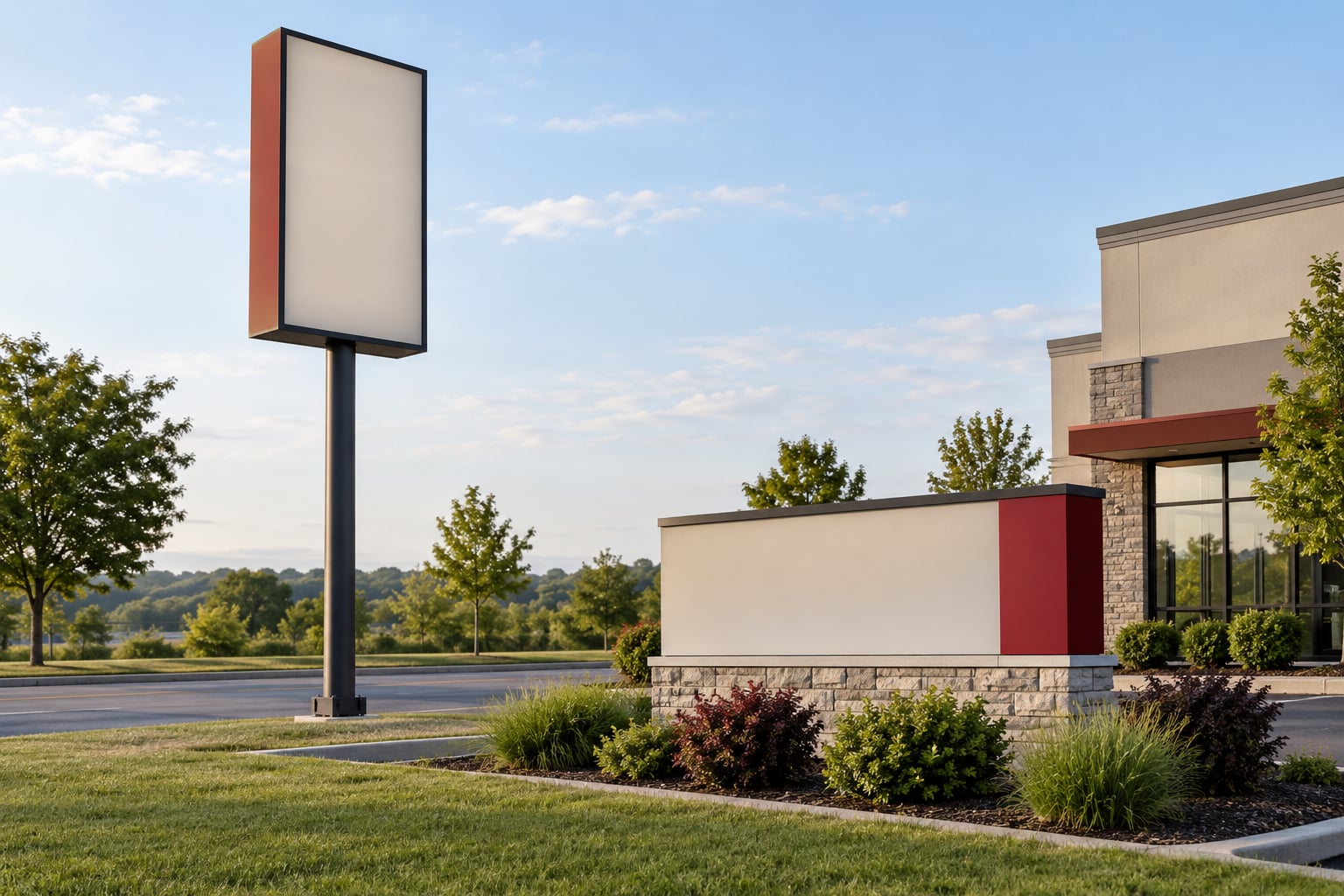
A pylon sign is a tall freestanding sign on one or more poles, built to be read from far down a road. A monument sign is a low freestanding sign, usually 3 to 10 feet, built on a masonry base at the property entrance. Height is what separates them, and height decides the job: if drivers need to see you at highway speed, you need a pylon.
The wrong pick either hides your business from passing traffic or wastes a stack of engineering and permitting effort on a tall sign nobody can see. Here is how the two compare on the things that actually matter.
Table of Contents
- Pylon Sign vs Monument Sign at a Glance
- How Visibility and Height Differ
- Pylon Sign vs Monument Sign Cost
- How Property Size and Placement Affect the Choice
- Customization and Branding Options
- Permitting, Zoning, and Installation Requirements
- Which Should You Choose?
- Frequently Asked Questions
- Which sign is more visible from the road, a pylon or monument?
- How tall can a pylon sign or monument sign be?
- Is a monument sign usually cheaper than a pylon sign?
- Can a business install a monument sign on a rented property?
- Can the message on a pylon or monument sign be changed?
- Conclusion: Start With Visibility and Local Rules
Pylon Sign vs Monument Sign at a Glance
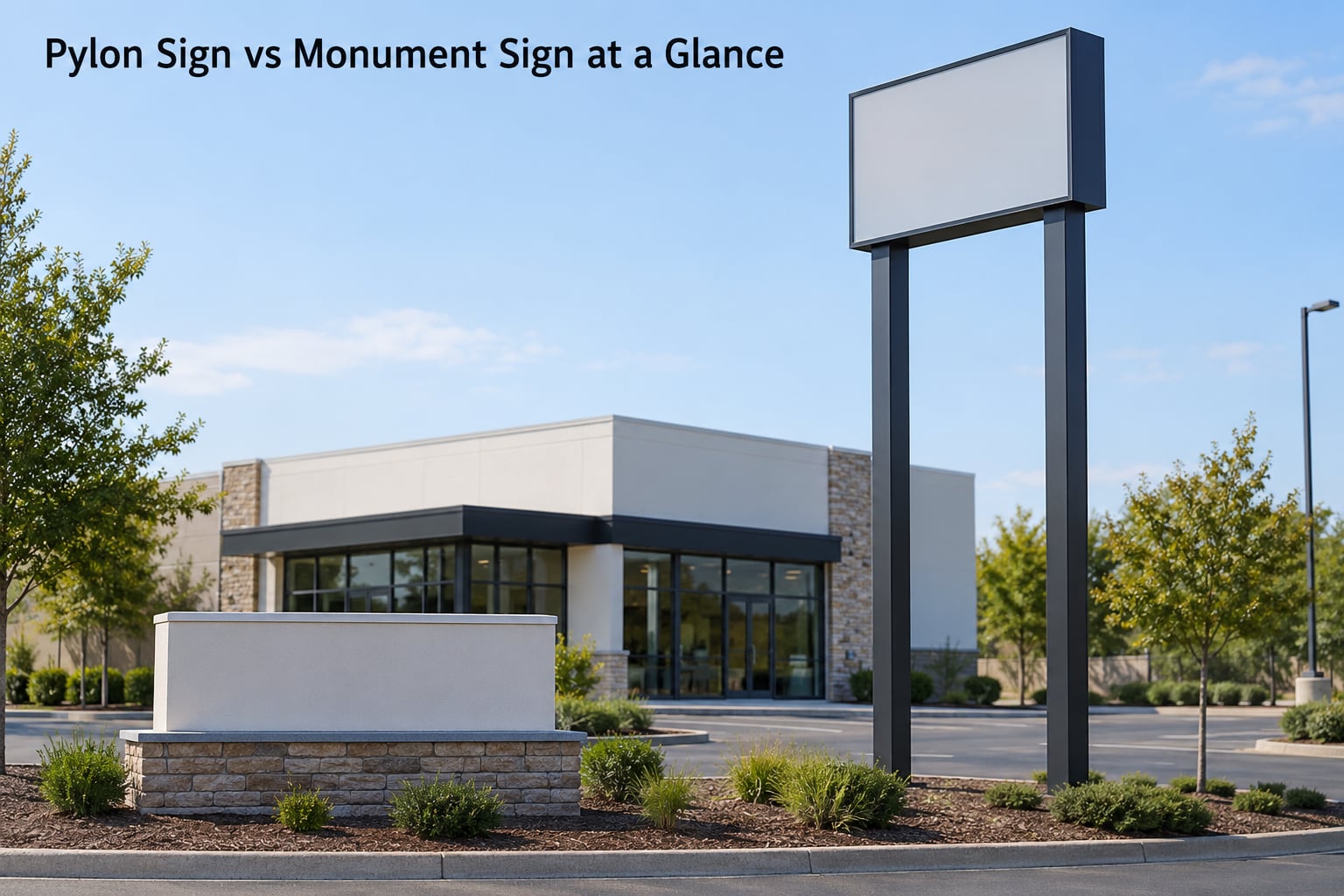
Dimensions, prices and allowed heights vary by location. The ranges below are typical US conditions, not rules.
| Criterion | Pylon Sign | Monument Sign |
|---|---|---|
| Typical height | Often 20 to 80 feet or taller | Often 3 to 10 feet |
| Also called | Pole sign, hi-rise sign | Ground sign |
| Structure | Steel or aluminum pole with an anchored base, sometimes two or more poles | Masonry, stone, brick or stucco base holding a cabinet |
| Read at a glance | Yes, from a moving vehicle at distance | Yes, at slow speeds and on foot |
| Land needed | A narrow footprint, often at a corner or median | More frontage, usually with a planting bed |
| Relative cost | Higher, driven by engineering and height | Lower, driven by masonry and finish work |
| Customization | Brand, tenant panels, LED price or message displays | Architectural detail, directories, logos |
| Strongest use case | Roadside, fuel, truck stop, highway retail | Office park, campus, medical center, community entrance |
Label by label, in the format most searchers ask for:
- Pylon sign: Height: 20 to 80+ feet. Visibility: long distance, at road speed. Best uses: roadside and fuel businesses. Considerations: engineering, wind load and a permit for height.
- Monument sign: Height: 3 to 10 feet. Visibility: entrance and parking-lot approach. Best uses: campuses, offices, communities. Considerations: frontage, masonry upkeep and local sign area limits.
How Visibility and Height Differ
A pylon sign, also called a pole sign, is a freestanding sign carried high above the ground on a steel or aluminum pole or set of poles, with the sign cabinet at the top. Its whole design goal is a clear line of sight from a distance.
A monument sign, often called a ground sign, sits on the ground on a substantial base of masonry, stone, brick or stucco. It is built to be read by people who are already slowing down or standing at the entrance.
That difference in reading context drives everything else. A driver three hundred feet away at highway speed has maybe two to three seconds to take in a sign. Tall is the only reliable way to clear a tree line, a neighboring building, or a row of parked trucks.
Where each one performs better:
- Roadside and high-speed corridors: Pylon. Height is the only variable you control.
- Suburban approach roads at moderate speed: Either works. A monument often looks better where trees already frame the entrance.
- Low-traffic or pedestrian-dominant locations: Monument. Detail and directories actually get read.
Pylon Sign vs Monument Sign Cost
Pylons cost more because of what height demands. You are paying for structural steel sized to a wind load calculation, a drilled foundation or a mat, a base plate and anchor bolts, plus engineered drawings. Taller means more of every material.
On top of that, a tall sign usually needs a crane or a lift on install day, electrical service for illumination, and access panels at height for LED modules later.
Monument costs sit closer to the ground, so the money goes somewhere else: masonry work, an architectural finish, a cabinet face in acrylic or polycarbonate, and often a planted bed around the base. Individual signs can still vary widely once size, materials and lighting are fixed.
Two cost items owners forget. Changing a tenant panel in a multi-tenant sign is a recurring cost, not a one-time one. And an illuminated sign commits you to an electrician and to power access, whoever owns the sign later.
Perpetual maintenance is the quieter line item. A cabinet at 60 feet needs a lift to service. A monument at waist height needs a ladder and a hose.
How Property Size and Placement Affect the Choice
The sign that works on one parcel is illegal or invisible on the next one. Property constraints decide more often than taste does.
A few that matter most:
- Setback. Most ordinances measure from the property line and cap how close a freestanding sign can sit to the right-of-way.
- Available frontage. A monument needs room for its base and planting. A pylon needs less width but more vertical clearance.
- Traffic speed. The faster the road, the more the sign must rise above visual clutter.
- Corner lots. A tall sign at the corner of two roads can serve both approaches. A monument usually serves one.
- Narrow parcels. Deep, thin lots often favor a pylon, since the base footprint is small.
- Building visibility. If the building itself is set back far and screened by trees, low signage disappears. A monument works when the entrance and building are visible together.
A practical screening checklist before you call a fabricator:
- Stand at the nearest road and note what already blocks your sightline: trees, utility poles, a taller sign next door, a curve.
- Measure your frontage and note the nearest overhead utility line. Height competes with that line.
- Find your jurisdiction’s sign ordinance and note the height cap, the sign area cap and the setback requirement.
- Check whether your lot is a corner lot and count how many directions you would be seen from.
- Decide how many tenants need to be listed. If more than a handful, you are designing a directory, not a sign.
- Photograph the sightlines from both approach directions in morning and evening light.
Customization and Branding Options
A monument sign gives you message area at human scale. That is where fine finishes live: routed dimensional letters, a metal logo, a changeable tenant directory, a color that matches the building’s brick or stucco.
Because drivers are close and moving slowly, a monument can carry architectural detail and it will be seen. It is the sign that makes a property look permanent, which is why campuses, medical centers and office parks lean on it.
A pylon trades that detail for distance readability. Letter height and contrast matter far more than finish quality, because the sign is read as a shape at 300 feet and as words at 60.
Changeable copy is where the two diverge most. Pylons carry LED fuel price modules, digital message boards and swap-in tenant panels high up, readable across a forecourt. A monument carries a physical directory where someone walks up and pulls a panel.
My rule for branding: if the goal is recognition from a distance, keep the pylon message short. If the goal is trust at the entrance, put your money into the monument.
Permitting, Zoning, and Installation Requirements
Nearly every jurisdiction treats these as regulated structures. Your local planning or building department holds the sign code, and it decides height, square footage, setbacks, illumination and how many freestanding signs a lot may carry.
A typical path runs through: a sign permit application, engineering review for any structure above a certain height, electrical permit if the sign is lit, then installation by a licensed contractor, then a final inspection.
Verify the rules with your local jurisdiction before you design anything. Ordances differ sharply between adjacent towns, and commercial corridors are often stricter than residential ones.
Use qualified sign professionals for design and installation. Wind load, foundation depth and electrical access are the three places where a cheap shortcut becomes an expensive repair later.
If a pylon gets denied, ask whether a variance is available, whether the cabinet height can be reduced while keeping the pole tall, or whether a monument at the entrance plus a smaller roadside blade better fits the code.
Which Should You Choose?
Choose a pylon when:
- Your main traffic passes at speed and your building is set back behind trees or other structures.
- You are roadside, fuel, truck stop, car wash or highway retail.
- You want a fuel price display or a message visible from the far end of the block.
- Your lot is narrow or corner frontage where horizontal room is tight.
Choose a monument when:
- Traffic enters at moderate speed and stops at your driveway or gate.
- You are an office park, medical center, school, hotel or residential community.
- You want the property to read as established and permanent.
- You need a multi-tenant directory people can walk up and read.
Sometimes the answer is both. Commercial developments often pair a pylon at the highway with a monument at the entrance and channel letters on the building face. The pylon earns attention, the monument confirms arrival, and the letters finish the identification.
A quick decision method: write down your required visibility distance first, then your available land, then your budget, then your local height limit. The sign that survives all four answers is your sign.
Frequently Asked Questions
Which sign is more visible from the road, a pylon or monument?
A pylon sign is more visible from a distance because it rises above trees, buildings and vehicles, so drivers can read it while still moving. A monument sign is built for slower speeds and for people who are already at the entrance. On a fast, tree-lined road, choose a pylon. Near a driveway in a landscaped plaza, a monument does the job.
How tall can a pylon sign or monument sign be?
Typical US ranges run from about 3 to 10 feet for a monument sign and 20 to 80 feet or more for a pylon sign, though smaller low-profile pylons exist for tight lots. These are industry habits, not legal limits. Your maximum allowed height comes from the local sign ordinance, which also regulates square footage, setbacks and illumination.
Is a monument sign usually cheaper than a pylon sign?
Usually yes. A pylon carries extra cost from structural steel, wind-load engineering, a drilled foundation, a base plate and anchor bolts, and crane access on install day. A monument spends its budget on masonry, architectural finish and cabinet face. Actual figures depend on size, materials and lighting, so get itemized quotes that separate design, fabrication, foundation, electrical and installation.
Can a business install a monument sign on a rented property?
Yes, if you have written permission from the property owner and the sign meets local sign code. Leases often address signage specifically, including who owns the sign, whether it may be removed at lease end, and whether the owner requires a matching design. Check those clauses before ordering anything, and confirm setback, height and sign area limits with your local jurisdiction.
Can the message on a pylon or monument sign be changed?
Yes. Both can carry changeable tenant panels, and a pylon can add an LED fuel price module or a digital message board. Pylon panels are swapped by a lift at height, which costs more per swap; monument directories are usually refastened at ground level and are cheaper to update. Confirm in writing how panels are changed and who pays for labor.
Conclusion: Start With Visibility and Local Rules
A pylon sign buys distance recognition. A monument sign buys a permanent, credible entrance. That is the whole difference, and everything else is a consequence of it.
Start by documenting the visibility you actually need, then walk the sightlines from each approach direction. Check the local sign ordinance for height, sign area and setback limits before anything gets designed. From there, collect two or three itemized quotes that separate fabrication, foundation, electrical and installation, and pick the sign type that gives you the strongest permitted presence on your property.