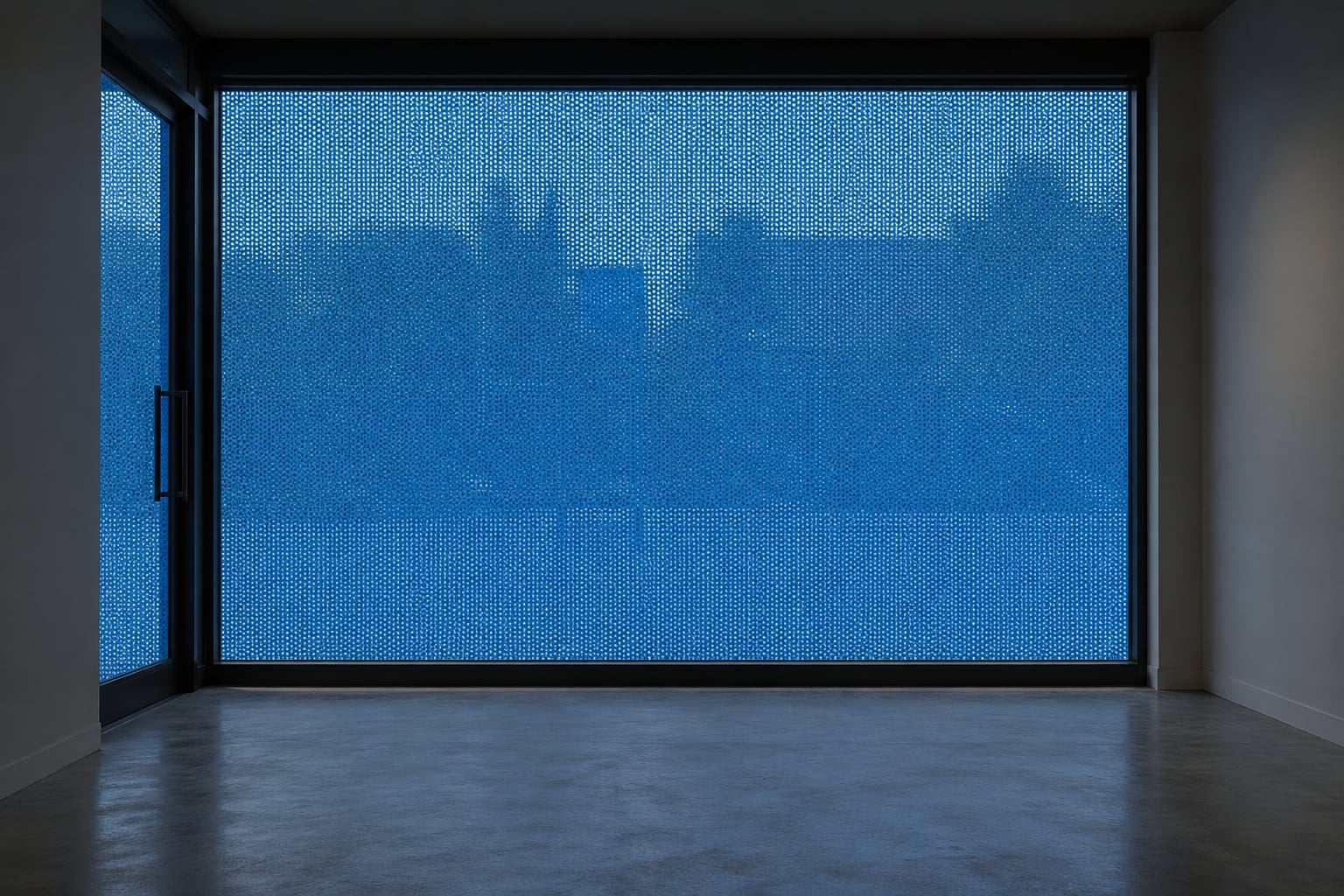
Window perforated vinyl is a printed adhesive film covered in a grid of tiny holes, usually about 1.5mm across. The ink blocks light while the openings pass it, so a full-colour graphic looks solid from the bright side and reads as transparency from the darker side. It is the standard material for storefront and vehicle window graphics, and it is an advertising product first, not a tint film or a privacy film.
Most people first notice it as a wrap on a shop window or the back of a delivery van, then wonder how anyone inside can still see the street. The short version: the side that is brighter wins the view.
Table of Contents
- What Is Window Perforated Vinyl?
- How Window Perforated Vinyl Creates One-Way Visibility
- What Does the Perforation Pattern Mean?
- What Can Perforated Window Vinyl Do for a Business?
- How Window Perforated Vinyl Is Installed
- Should the film go on the inside or the outside of the glass?
- How Does Perforated Vinyl Compare With Other Window Graphics?
- What Are the Limitations and Common Mistakes?
- Frequently Asked Questions
- Can you see through perforated vinyl at night?
- Does window perforated vinyl provide complete privacy?
- Is a higher perforation percentage better?
- Can perforated vinyl be removed without damaging glass?
- Does perforated window vinyl block more light than regular window film?
- Conclusion
What Is Window Perforated Vinyl?
The construction is simple. A printed face carries your artwork, a layer of adhesive bonds it to the glass, and a release liner comes off during installation. Between the face and the adhesive, the material is punched full of micro-perforations in an evenly spaced grid. That grid is the whole trick.
Because the holes are punched rather than printed, your colours land around them, not over them. Printers account for this with a white ink or opaque underbase so the graphic still reads as full colour rather than washed out.
You will run into three names for the same material: perforated window vinyl, window perf, and one-way vision film. A tinting shop will say one-way vision. A sign shop will say perf. They mean the same roll of film.
How Window Perforated Vinyl Creates One-Way Visibility
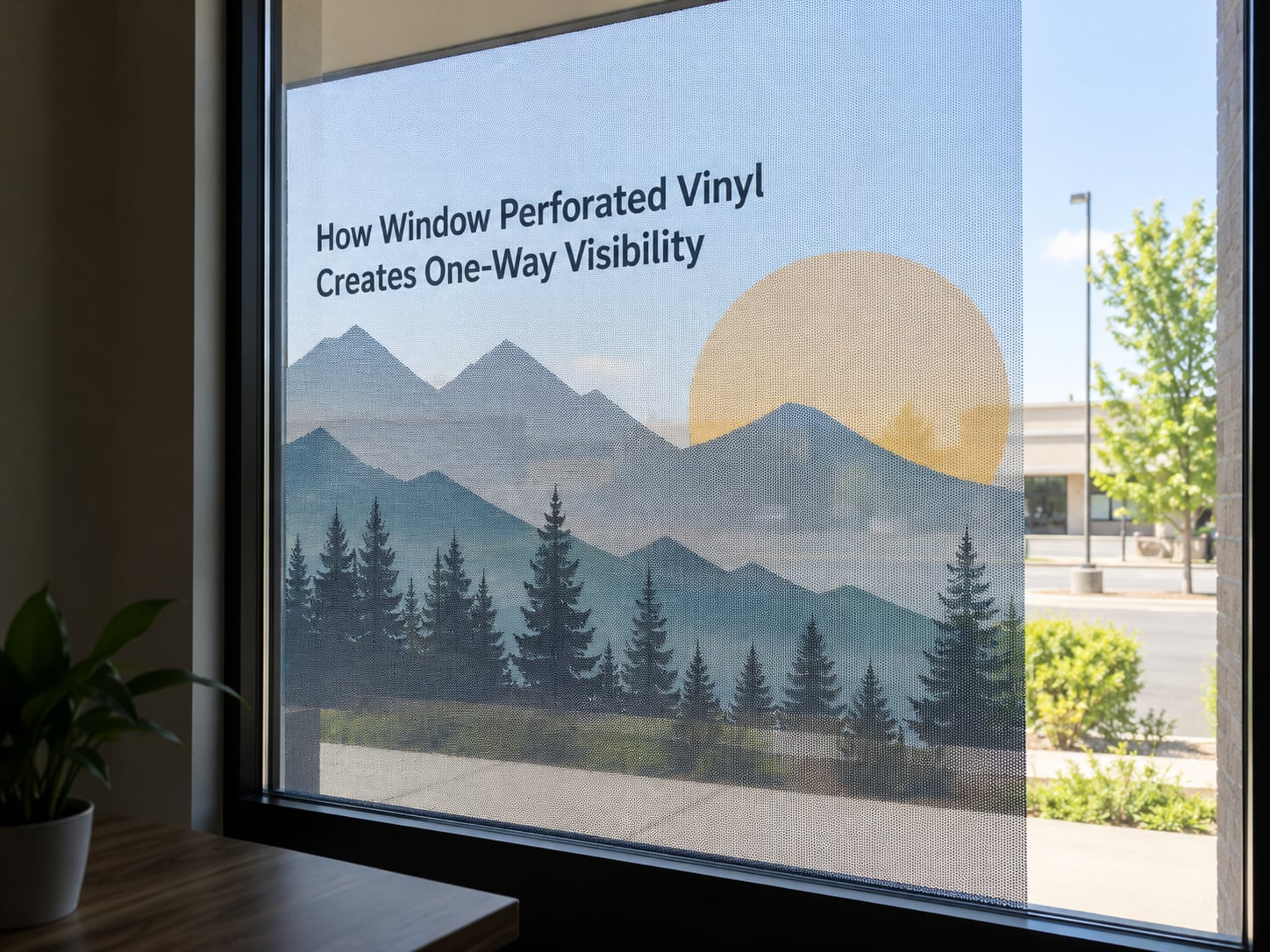
Perforated vinyl works because of a brightness difference, not because the holes are magic. Daylight on the street is usually far brighter than a shop interior, so the outdoor viewer gets a wall of colour reflected back at them while the open area shows a dim interior image. From inside, the eye adapts to the darker room and picks out the bright openings, so people at the counter can watch the pavement.
It is not one-way glass. Two panes of perforated film on the same window, or a lit room after sunset, change the result completely.
Here is what actually happens after dark. If your interior lights are on and the street is unlit, the differential flips. The window now looks like a lit display from the street, and people outside can see your counter, your staff and your floor plan. Anyone who treats perf as a security or privacy measure discovers this the first evening they leave the lights on.
What Does the Perforation Pattern Mean?
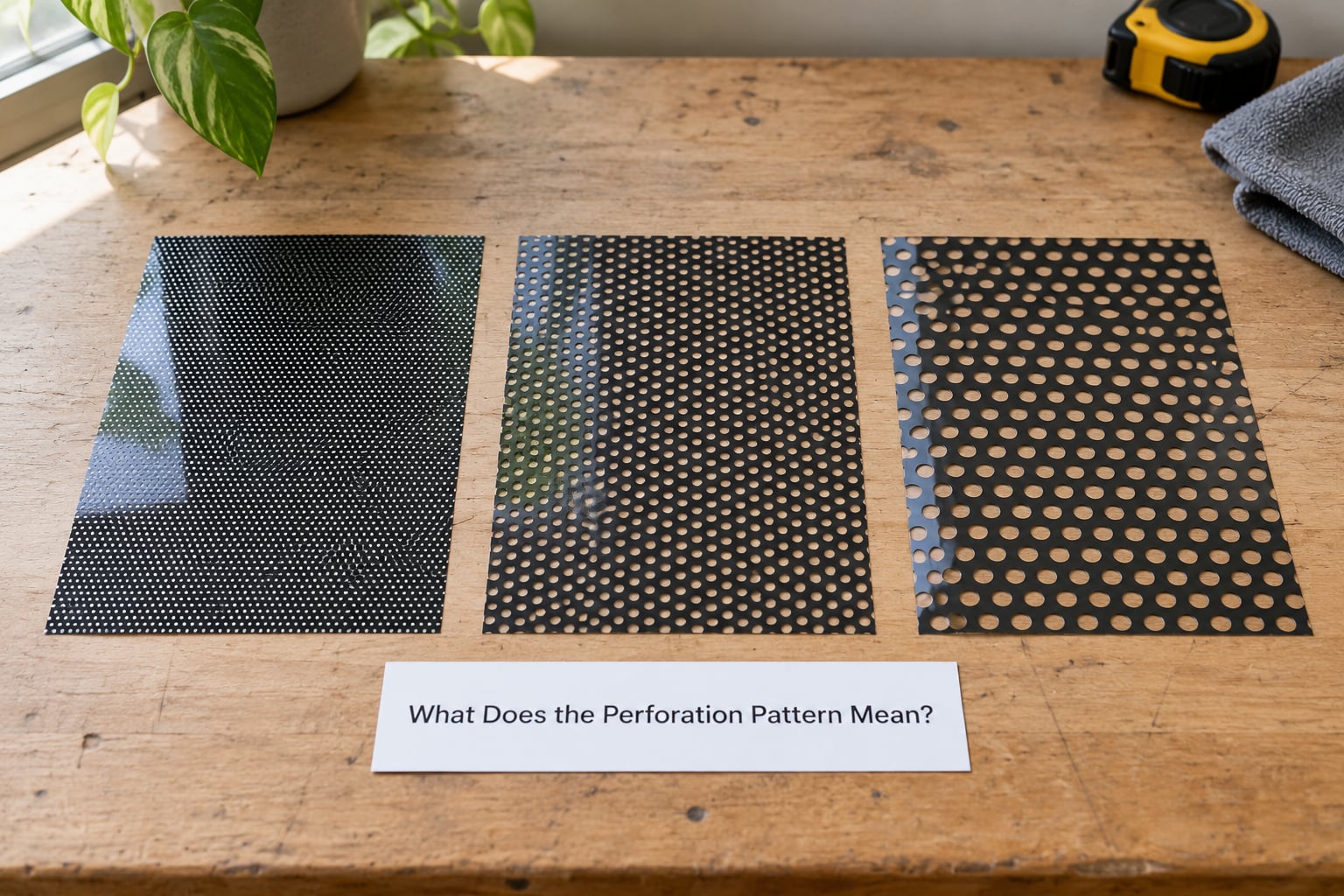
Perforation is expressed as a ratio of open area to solid area. 60/40 means 60 percent open, 40 percent inked face. The higher the open area, the more light passes through and the easier the view from inside reads. The lower the open area, the more the graphic looks like solid printed vinyl from outside and the more the interior gets shaded.
| Ratio | Open area | How the graphic reads | View from the darker side | Best for |
|---|---|---|---|---|
| 50/50 | Highest | Lightest, most see-through | Clearest | Full-window storefront coverage, vans, bus panels |
| 60/40 | Standard | Balanced | Good in daylight | Storefront logos, hours and menu graphics |
| 70/30 | Lowest of the three | Densest, closest to solid vinyl | Soft, slightly hazy | Bold artwork where colour strength matters more than the view out |
A higher perforation percentage is not automatically better. It is better only if you want more daylight and a clearer sightline. If your design is heavy, a denser pattern gives you colour strength at the cost of a slightly hazier interior view.
What Can Perforated Window Vinyl Do for a Business?
Storefront branding is the biggest use. A full-window perf graphic turns dead glass into advertising space while staff keep daylight and a view of the foot traffic outside.
Messaging, opening hours and menu items work well on vinyl because the holes keep the glass readable rather than blank. Directional signage works too: arrows and bands of colour guide people to a door that would otherwise be easy to walk past.
Daytime privacy is the honest benefit. People on the street cannot make out equipment, screens or work surfaces during the day, provided the interior stays dimmer than outside. Partial sun control is a side effect, not a specification. Vehicle and transit branding is the other major category, from van side panels to bus wraps and rear windows.
| What you need | Characteristics to ask for |
|---|---|
| Logo or brand display on a storefront | 60/40, large-format print, outside mount, overlaminate for scratch and UV resistance |
| Daytime privacy on street-facing glass | 60/40 or 70/30, low interior lighting, sparse coverage |
| More shade and a stronger printed look | 70/30, or combine perf with a solid vinyl band |
| Maximum daylight in a workroom | 50/50, limited coverage, keep mullions and door glass clear |
| Seasonal or campaign graphics you will remove | Removable adhesive, or a static-cling perf for a temporary run |
| Vehicle or transit panels | Cast vinyl, check defroster lines before covering rear glass |
How Window Perforated Vinyl Is Installed
Most installs are a day of work for a two-person crew. A small decal on a door is an afternoon. A full storefront across six panes takes longer because each panel has to be set and squeegeed before the next.
- Measure the glass. Record width and height at the top and the bottom, and note every mullion, door swing and handle.
- Clean the surface. Glass cleaner and a lint-free pad, then a separate pass to remove grit. Dirt under a graphic is the number one cause of bubbles.
- Prep the paste. A full window goes on wet with a soapy solution so the film can slide into place. Small decals often go dry with a few drops of solution in the tack.
- Align and hang the liner. Mask tape along the top edge holds the panel while you position it.
- Squeegee outward from the centre. Push air toward the edges, then check for lift at the corners.
- Let it bond. Give the graphic 24 to 48 hours before heavy cleaning or close-contact cleaning.
Perforation adds one wrinkle: air and paste can hide in the holes and slow the bond, so a wet install with a proper squeegee matters more here than on solid vinyl.
Should the film go on the inside or the outside of the glass?
Perforated graphics normally go on the outside, on the first surface. Inside is the second surface, and it is possible, but the artwork has to be reversed and the colour usually reads flatter because you are looking through the glass.
| Factor | Outside (first surface) | Inside (second surface) |
|---|---|---|
| Protection | Film takes the cleaning and the weather | Protected, but glass cleaning happens around it |
| Colour | Full strength | Muted by the glass |
| Artwork file | Normal orientation | Mirrored |
| Best for | Almost all storefront and vehicle work | Windows where outside access is impossible |
How Does Perforated Vinyl Compare With Other Window Graphics?
Window perforated vinyl is one option among several, and it loses to the others in two categories: light control and night privacy. Pick it when you want a printed graphic that preserves daylight.
| Type | Daytime visibility | At night | Light transmission | Printable | Best use |
|---|---|---|---|---|---|
| Perforated vinyl | See out from inside | Reverses if inside is lit | Moderate to high | Yes, full colour | Advertising and partial shade |
| Clear static cling | Fully see-through both ways | No visual difference | Almost none blocked | Yes | Short-term seasonal messaging |
| One-way privacy film | Designed to work one way | Designed to keep the view dark | Low | Limited | Rooms where privacy matters more than colour |
| Frosted or etched film | No clear view either way | Still blocks the view | Diffuses light | Limited | Clinic and office glazing, doors, partitions |
| Solid opaque vinyl | Fully blocked | Fully blocked | None | Yes, full colour | Signage panels, hours decals, branding bands |
One thing worth saying plainly, because installers correct this constantly: perforated vinyl is not window tint. It does not reject heat or UV the way a performance film does. If your real problem is glare, heat gain or a view that must stay blocked after sunset, you want a film from a glazier, not a graphic.
What Are the Limitations and Common Mistakes?
No privacy at night. Perf delivers daytime privacy only, and it reverses the moment the inside is brighter than the outside. Fix: keep interior lighting lower than the street, or close blinds after dark. If night privacy is the goal, buy frosted or one-way privacy film instead.
Small type disappears. Letters below roughly half an inch read as a grey blur from the street because the holes break them up. Fix: set minimum type around one inch for the main message, use bold weights, and lean on colour blocks rather than fine detail.
Coverage that looks heavy. Printing the entire window at a dense ratio turns the glass into a dark wall and kills the interior daylight the material was chosen for. Fix: leave borders, door glass and eye-level gaps open, or drop to a higher open ratio.
Bubbles on textured glass. Old glass, laminate and textured privacy film trap air and prevent a flat bond. Fix: a physical test sample on the exact pane before production, since the same panel can behave differently from its neighbour.
Both sides at once. Installers on Signs101 report that perforated vinyl on the interior and exterior of the same window produces a distracting optical illusion as you walk past, because the two hole grids do not line up. If a client wants graphics facing both ways, print on clear perf with a white ink underbase and test a small area first.
Removal. Pulling perforated film off in one motion can take glass cleaner and a pane of coating with it. Heat the adhesive gently, peel at a shallow angle, and never use a razor or aggressive solvent on coated glass.
Frequently Asked Questions
Can you see through perforated vinyl at night?
Sometimes, and that is the part most people get wrong. Perforated film shows its see-through effect from whichever side is darker. In daylight that is your interior, so staff see out fine. After dark with the shop lights on, the interior becomes the brighter side and the street can see in. The graphic itself looks weaker from outside at the same time.
Does window perforated vinyl provide complete privacy?
No. It gives partial daytime privacy, which means people outside cannot make out screens, counters or work surfaces while the sun is up. It is a printed advertising graphic, not a security film. If you need the view blocked at every hour, choose frosted, etched or one-way privacy film instead, and treat perf as a separate question.
Is a higher perforation percentage better?
Higher open area means more light and a clearer view out, so 50/50 is the right pick for maximum daylight and full-window coverage. 60/40 is the standard balance for storefront logos and messages. 70/30 is denser, which suits bold artwork where colour strength matters more than the interior view. The ratio is a trade-off, not a quality ranking.
Can perforated vinyl be removed without damaging glass?
Usually yes, especially if the graphic is lifted before the adhesive fully sets or within a few months. Warm the film with a heat gun or hair dryer, peel at a shallow angle from a corner, and keep razor blades and aggressive solvents away from coated or tinted panes. Expect to clean adhesive residue with a mild glass cleaner and a soft pad.
Does perforated window vinyl block more light than regular window film?
Regular window film is built to reject heat, UV and glare, and it blocks far more light by design. Perforated vinyl is built to carry a printed image, so it passes most light through the open area. If heat control or glare is the actual problem, a tinting film from a glazier will do that job. Perf does advertising and partial shade only.
Conclusion
Start with the view, not the material. Decide whether you need daylight and a sightline from inside during business hours, or whether you actually need the glass blocked, and pick from there. Window perforated vinyl answers the first question well and the second one badly, especially after dark.
Then pin down three things before you order: the perforation ratio, the ratio of the window you intend to cover, and which side the film mounts on. Ask for a physical test sample on one of your own panes, and a printed proof at full size. Installers treat that sample as non-negotiable, and it is the cheapest way to find out that your glass is textured or your lighting reverses the effect.