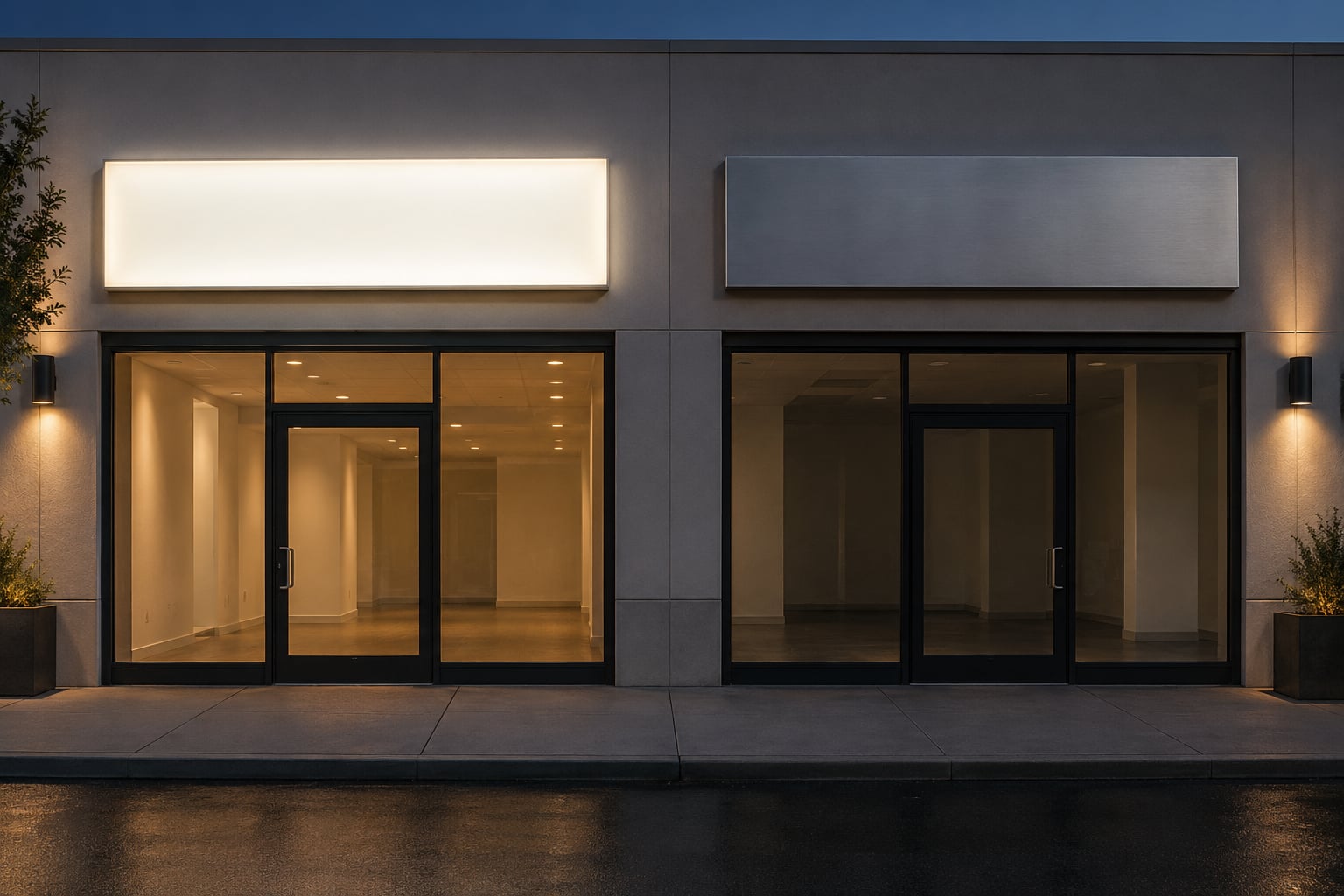
If your customers arrive mostly between nine and five, a non-illuminated sign will do the job and cost far less to install. If you trade after sunset, illuminated signage is the only version of your name a passing driver can read at nine at night.
There is a third path too. Reflective sheeting, dimensional letters and halo returns buy you partial night visibility without a single wire, and for a lot of storefronts that is the honest answer.
This guide compares illuminated vs non illuminated business signs across visibility, hours, installation, upkeep and cost, so you can decide which one your building actually needs.
Table of Contents
- Illuminated vs Non-Illuminated Business Signs at a Glance
- Nighttime Visibility and Brand Impact
- How Illuminated and Non-Illuminated Signs Work
- How Illuminated vs Non-Illuminated Signs Work After Dark
- Operating Hours and Location Suitability
- Installation, Electrical Needs, and Permits
- Maintenance, Energy Use, and Durability
- Which Option Costs More?
- Which Should You Choose?
- Frequently Asked Questions
- Are illuminated business signs always better for nighttime visibility?
- Can a non-illuminated sign use external lighting?
- Do illuminated signs use a lot of electricity?
- What type of lighting is best for an outdoor business sign?
- Do illuminated signs need a permit or licensed electrician?
- Can a business use both illuminated and non-illuminated signs?
- Conclusion: Start With Visibility Needs
Illuminated vs Non-Illuminated Business Signs at a Glance
| Criterion | Illuminated sign | Non-illuminated sign |
|---|---|---|
| Best for | Businesses with evening or night traffic | Businesses with daytime or walk-up traffic |
| Nighttime visibility | Readable at night by design | Depends on street lighting, reflection and material finish |
| Operating hours covered | Full, around the clock | Sunrise to sunset, plus ambient light |
| Power requirement | Needs a circuit, a transformer or LED driver | No power at all |
| Maintenance | Cleaning plus electrical and light source service | Cleaning and occasional paint or panel repair |
| Installation complexity | Higher: wiring, mounting and often an inspection | Lower: mechanical mounting only |
| Relative cost | Higher upfront and ongoing | Lower upfront and near-zero ongoing |
| Typical service life | Ten years or more with LED modules replaced once or twice | Five to fifteen years depending on material and exposure |
| Suitable locations | Highways, nightlife districts, retail strips, gas stations, casinos | Historic districts, office campuses, daytime retail, leased units with landlord sign rules |
Two lines in that table carry most of the decision. If your trading day ends at six, the night visibility row is irrelevant to you, and you are buying fabrication quality with the lighting money you saved.
Nighttime Visibility and Brand Impact
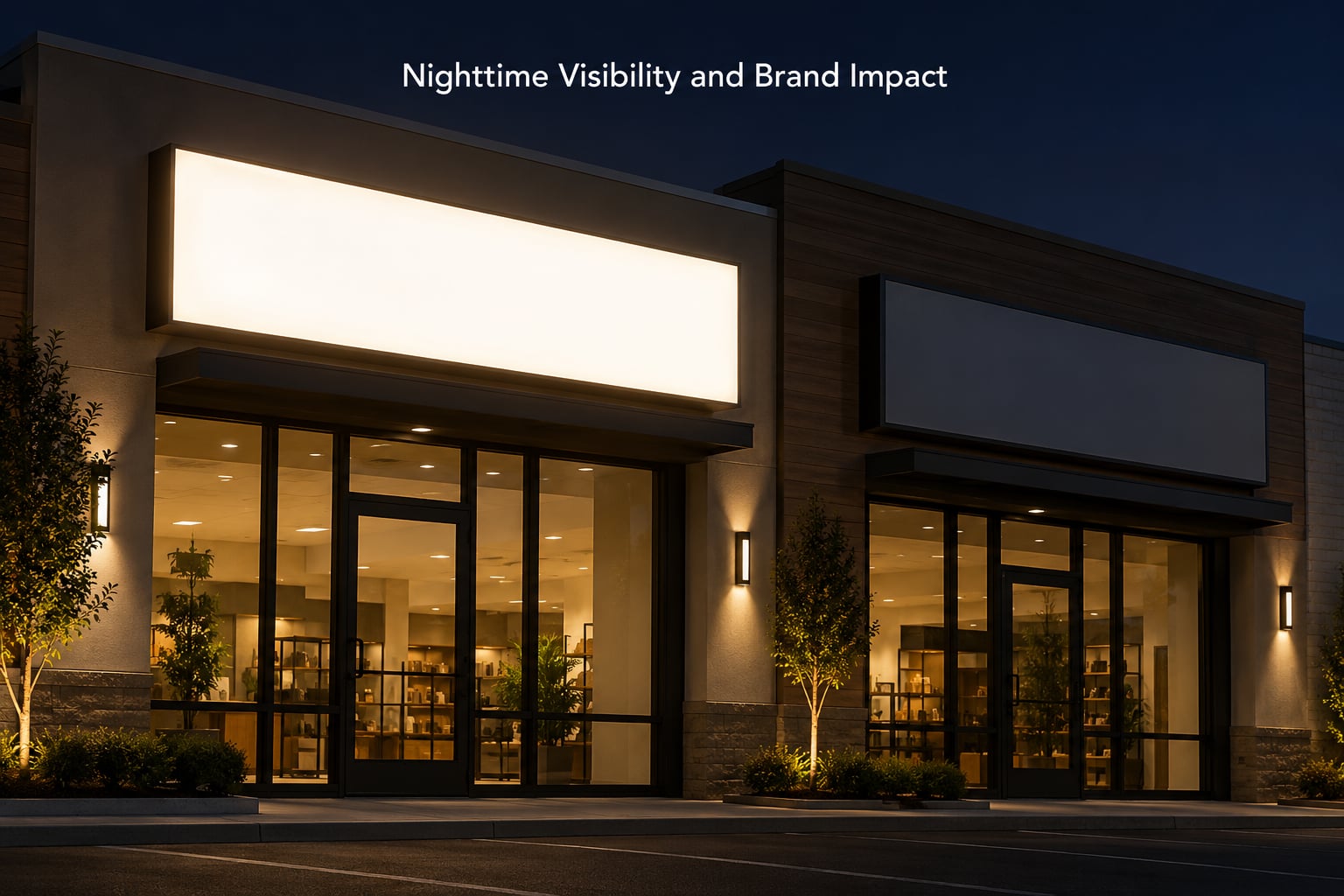
A lit sign manufactures its own light, so its brightness does not depend on what the street is doing. That single fact is why illuminated signage wins at night.
Non-illuminated signage works through contrast and surface finish instead. Brushed aluminum, high-contrast paint, dimensional letters casting small shadows, and reflective sheeting all catch whatever light is around and push it back at the viewer. On a well-lit commercial strip that is plenty. On a dark residential side street at eleven at night, it is not.
Branding plays a role too. Internally lit channel letters and light boxes read as a finished, permanent storefront. A well-fabricated unlit panel reads as a finished storefront as well — provided the type is dimensional and the finish is crisp rather than flat.
How Illuminated and Non-Illuminated Signs Work
Illuminated signs come in three lighting families. LED is now the default inside light boxes and channel letters, with neon still used for its look in bars and hospitality, and fluorescent showing up mainly in older retrofit work.
Non-illuminated signs do the opposite. They rely on a light source somewhere other than the sign itself: sun, a nearby pole light, a shop window, or a small fixture aimed at the wall. Materials carry the load — acrylic and acryliclonitrile panels, painted or brushed aluminum, high-density urethane, PVC, HDPE, and cut vinyl graphics on aluminum composite.
The practical difference in daily use is that an unlit sign never has a failure mode that involves electricity. Nothing to short out, no driver to swap, no transformer humming behind a wall at closing time.
How Illuminated vs Non-Illuminated Signs Work After Dark
Brightness is only half of night legibility. Glare matters just as much: an over-bright sign viewed from an angle washes out its own letters. Light color shifts how a color reads, and ambient light from a neighboring business can either help you or compete with you.
Viewing distance decides the rest. A sign read at forty feet needs bigger letterforms and more contrast than a sign read at fifteen, which is why highway signs are lit and doorway plaques often are not.
Picture a lit shop entrance on a commercial street, next to an unlit sign on a dark residential block three streets over. The lit sign is readable from a moving car at any hour. The unlit one is readable on foot, from about thirty feet, and only while a streetlight is on.
Operating Hours and Location Suitability
Start with when you are open, because that decides most of this.
- Daytime-only businesses. A bakery, an accountant, a dental office, a garden center. The sign does its job between opening and closing. An unlit sign with strong dimensional lettering is the sensible spend.
- Extended-hour businesses. Restaurants, bars, convenience stores, hotels, urgent care, auto service. The hours when revenue is earned often start after the daylight sign has already gone dark. This is where illumination pays for itself.
- Indoor locations. Office lobbies, reception walls, interior directories and atrium identification rarely need wiring. Lit logos appear in lobbies mostly as brand statement, and the fixture usually comes from the ceiling lighting circuit you already have.
- Busy commercial streets. High volumes of passing traffic reward a brighter, higher sign. Two competing illuminated signs on one block raise the bar for everyone.
- Low-traffic or remote sites. A roadside monument sign can carry reflective sheeting and read for miles without a powered cabinet.
One more factor trumps all of these: if your landlord, HOA or historic district controls signage, the answer may already be made for you. Several landmark and historic areas restrict illuminated signs, flashing or animated light, and light intensity outright.
Installation, Electrical Needs, and Permits
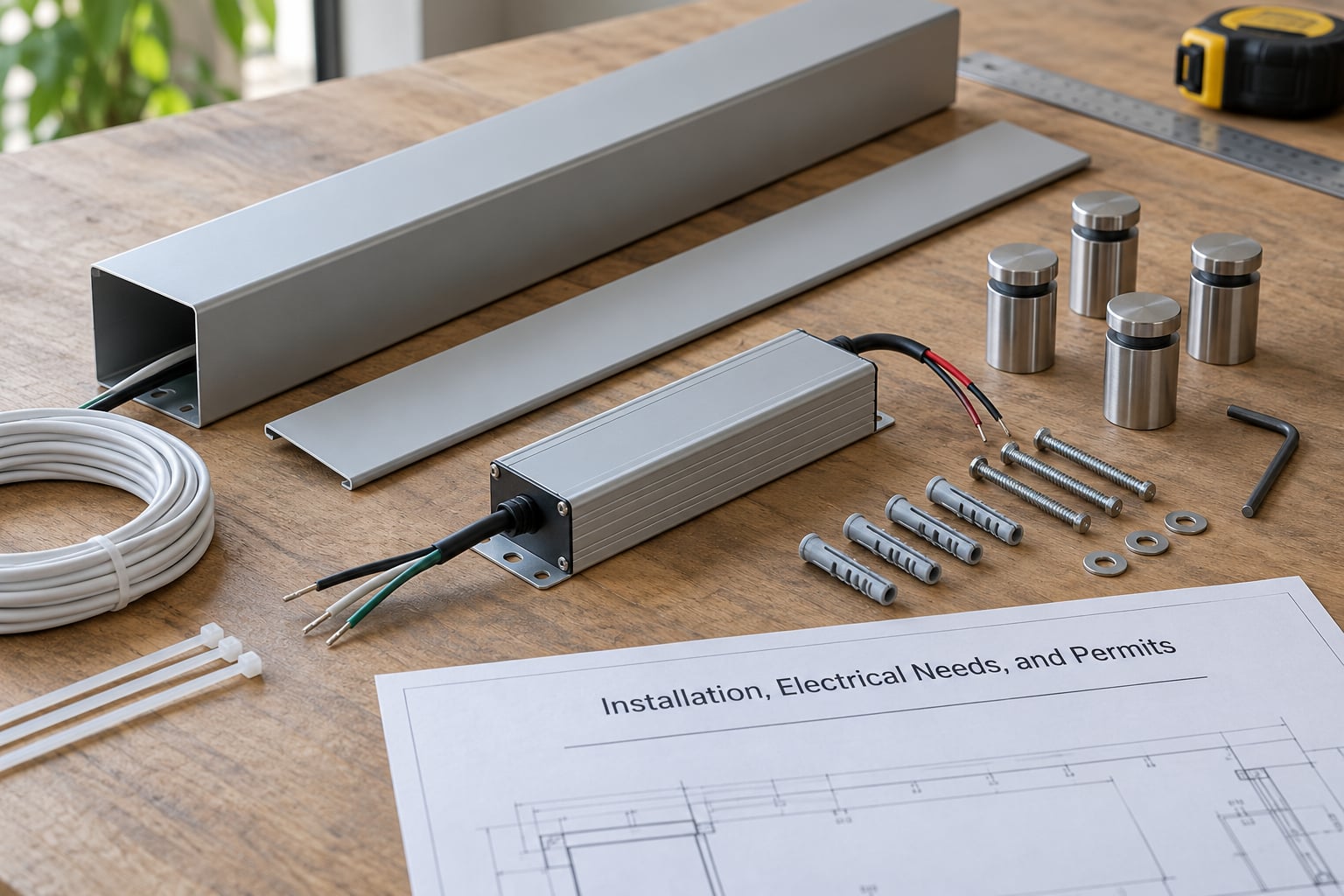
A non-illuminated sign is a mechanical job. Measure the wall, check the substrate, anchor with standoffs or a flush raceway, and hang it. A licensed installer or your own crew can usually handle it, and most trades only need to follow the fabricator’s mounting points.
An illuminated sign adds three separate scopes of work. The first is the electrical: a GFCI-protected circuit, weatherproof connections, a disconnect if the code requires it, and a transformer or LED power supply sized to the sign load.
The second is access. Panel work or a service call is routine on a single-story storefront and a much bigger conversation on a multi-tenant building where the electrical room is locked and shared. Ask who pulls the permit and who does the tie-in before you sign anything.
The third is the inspection. Most municipalities want an electrical permit and a rough-in inspection for any powered sign, and your sign company should tell you plainly whether they handle that paperwork or whether you are on the hook.
Electrical work in the United States belongs to a licensed electrician, full stop. Sign companies that quote a turnkey install including power usually subcontract that piece.
Maintenance, Energy Use, and Durability
Daily care is simple for both, and mostly involves not being careless. Skip pressure washing on acrylic sign faces, since it can haze the plastic, and skip abrasive pads on painted or powder-coated lettering. A soft cloth, mild soap and low-pressure water is enough for almost everything.
Illuminated signs add an electrical maintenance schedule. LED modules are typically rated for tens of thousands of hours, so a well-made sign can run many years before individual modules or a power supply fail. The failure is still real, and it usually shows up as a section of dark letters that needs a technician on a lift.
Energy use is rarely the deciding factor people expect. Most LED channel letter and light box signs draw less than a couple of household bulbs, and signage typically accounts for a fraction of a storefront’s electricity bill. The bigger ongoing cost for an illuminated sign is service access — a bucket truck or lift rental for a repair on a two-story facade.
Unlit signs have their own aging story. Paint fades, vinyl curls at the edges in sun and heat, and foam or plastic dimensional letters can warp. High-density aluminum and ACM panels outlast both, which is worth asking about in a quote.
Which Option Costs More?
Illuminated signage costs more, and the gap is driven by a handful of specific things rather than a mystery markup.
- Sign size and material. Bigger, thicker, higher-grade material costs more in either category. This is usually the largest line on any quote.
- Illumination method. Internal LED modules and power supplies add fabrication cost that an unlit sign never carries. Fabrication method matters more here than the lit-versus-unlit choice: a well-made unlit panel can cost as much as a cheap lit one.
- Electrical work. New circuit, panel work, long conduit runs, or a service upgrade. On a site with no convenient power access, this can rival the cost of the sign itself.
- Permits and design review. Historic districts and planning boards often add professional drawings and review fees.
- Maintenance and repair access. Illuminated signage carries a service contract and lift rental in the background of its life.
- Install complexity. Mounting height, wall substrate, and whether a crane or lift is needed.
Ask any quote to separate fabrication, electrical, permit and installation. Owners who shop for signage tell us repeatedly that an itemized quote is the difference between feeling informed and feeling surprised.
Which Should You Choose?
Five questions settle it faster than any product catalog.
- How many customers arrive after sunset? If the honest answer is close to none, non-illuminated wins on cost with no real loss.
- Is traffic drive-by or walk-up? Drive-by needs brightness and letter size designed for a moving viewer at distance. Walk-up traffic can read an unlit sign at fifteen feet all night long.
- How far is the sign viewed from? Signage read at speed has to be lit or reflective. Signage read at arm’s length does not.
- Is power available at the mounting point? No circuit nearby can push an illuminated project past the point where it makes sense.
- What do local rules allow? Check the municipal sign ordinance and any landlord, HOA or historic district rules before you commit to anything.
Choose illuminated signage when evening hours carry revenue, when you compete for drive-by attention, and when the brand position calls for it. Choose non-illuminated signage for daytime businesses, simpler branding, tighter budgets, and sites without convenient power or with restrictions on lighting.
And consider the middle option. Owners in business forums keep pointing out the same thing: a flat panel or aluminum sign looks good enough far more often than the industry implies. If someone quotes you a replacement sign when only the face or graphics have aged, ask about reusing the existing cabinet or hardware first.
Frequently Asked Questions
Are illuminated business signs always better for nighttime visibility?
Yes, when visibility after dark is the goal. An illuminated sign produces its own light, so it stays readable regardless of street lighting, weather or shadows. A non-illuminated sign depends on ambient light and surface finish, which is fine on a lit commercial street and weak on a dark one. If nobody reaches your business after sunset, the advantage buys you nothing.
Can a non-illuminated sign use external lighting?
Yes. Non-illuminated signs are frequently lit from outside by a wall pack, gooseneck or ground fixture aimed at the face, or by a nearby pole light. That is often the cheapest way to add night visibility to an existing sign, and it avoids the raceway, wiring and inspection that come with internal lighting. Confirm the fixture does not create glare for drivers.
Do illuminated signs use a lot of electricity?
Far less than most owners expect. A typical LED channel letter or light box sign draws roughly the power of one or two household bulbs, and LED modules are rated for tens of thousands of hours. For most small businesses, signage is a tiny fraction of the electricity bill. The meaningful ongoing cost is service access, such as a lift rental to replace a failed power supply.
What type of lighting is best for an outdoor business sign?
LED is the default for a reason: long life, low power draw and consistent brightness across the face. It suits light boxes, channel letters and halo lighting in nearly every commercial setting. Neon still has a distinctive look some hospitality businesses want, and fluorescent mostly appears in older retrofits. Whichever you pick, brightness should suit the viewing distance, not the neighbors.
Do illuminated signs need a permit or licensed electrician?
Usually both. Most municipalities require an electrical permit and an inspection for any sign with a power source, and the connection must be made by a licensed electrician. Municipal sign ordinances also regulate size, height, brightness and flashing, and historic districts often restrict illumination entirely. Ask your sign company in writing who pulls the permit and who handles the inspection.
Can a business use both illuminated and non-illuminated signs?
Yes, and plenty of well-run storefronts do. A common pattern is a lit sign at the entrance for night identification and an unlit monument, pylon or directory sign at the roadside where high visibility matters more than appearance. Mixed signage also lets daytime businesses spend where foot traffic actually is, and avoids paying to light a sign nobody sees after closing.
Conclusion: Start With Visibility Needs
Illuminated signage wins when your customers come after dark. Everything else, including a lot of what gets sold to you, comes down to that one question.
Before you request a quote, check four things: how visible you need to be at night, where the sign will be viewed from, when you actually trade, and whether there is power at the mounting point. Bring those answers to a sign company and ask for an itemized quote that separates fabrication, electrical, permit and installation. The right sign is the one that does the job your hours require, and nothing more expensive.