For signage, send your sign shop vector artwork: an AI, EPS, or PDF file with the fonts outlined. Never hand over a JPG, because a JPG is a fixed grid of pixels and the moment it gets blown up to a 10-foot banner or a truck wrap, the edges go soft and blocky. This guide breaks down logo file types explained for signage so you know exactly which version of your logo to attach to the order form, and which ones are only useful on a screen.
The whole topic comes down to one thing: how the artwork is stored. Vector files describe your logo with lines, points, and curves, so any printer can redraw it at the exact size needed. Raster files describe it with individual pixels, so they are sharp only at the size they were made.
I have watched a lot of sign jobs circle back to the customer because the artwork that arrived was a flattened screenshot. It is a five-minute fix if you ask for the right file up front, so it is worth spending a few minutes reading this before you order.
Table of Contents
- Logo File Types at a Glance
- What Is a Logo File Type?
- What is a vector file?
- What is a raster image?
- Why the wrong file costs you time
- Which Logo File Type Is Best for Different Signage Projects?
- What do vinyl cutters need that printers do not?
- What do channel letters need?
- What do vehicle wraps need?
- Vector Logo Files: SVG, PDF, EPS, and AI
- Which vector format should you actually send?
- The fake-vector trap: renaming a JPG does not make it vector
- How to check whether your file is really vector
- Raster Logo Files: PNG and JPG
- Why transparency matters for a sign
- Lossless versus lossy compression
- When a raster file is perfectly acceptable
- What about TIFF and WebP?
- How to Prepare a Logo File for a Sign Company
- How Resolution and File Size Affect Signage Quality
- The viewing distance rule
- How to check a raster file’s size yourself
- Frequently Asked Questions
- What are the different types of logo files?
- What is the best file format for a logo?
- Should logos be PNG or SVG?
- What is JPG, PNG, and TIFF?
- What are the differences between EPS and PNG files?
- How do I open a logo file?
- Conclusion
Logo File Types at a Glance
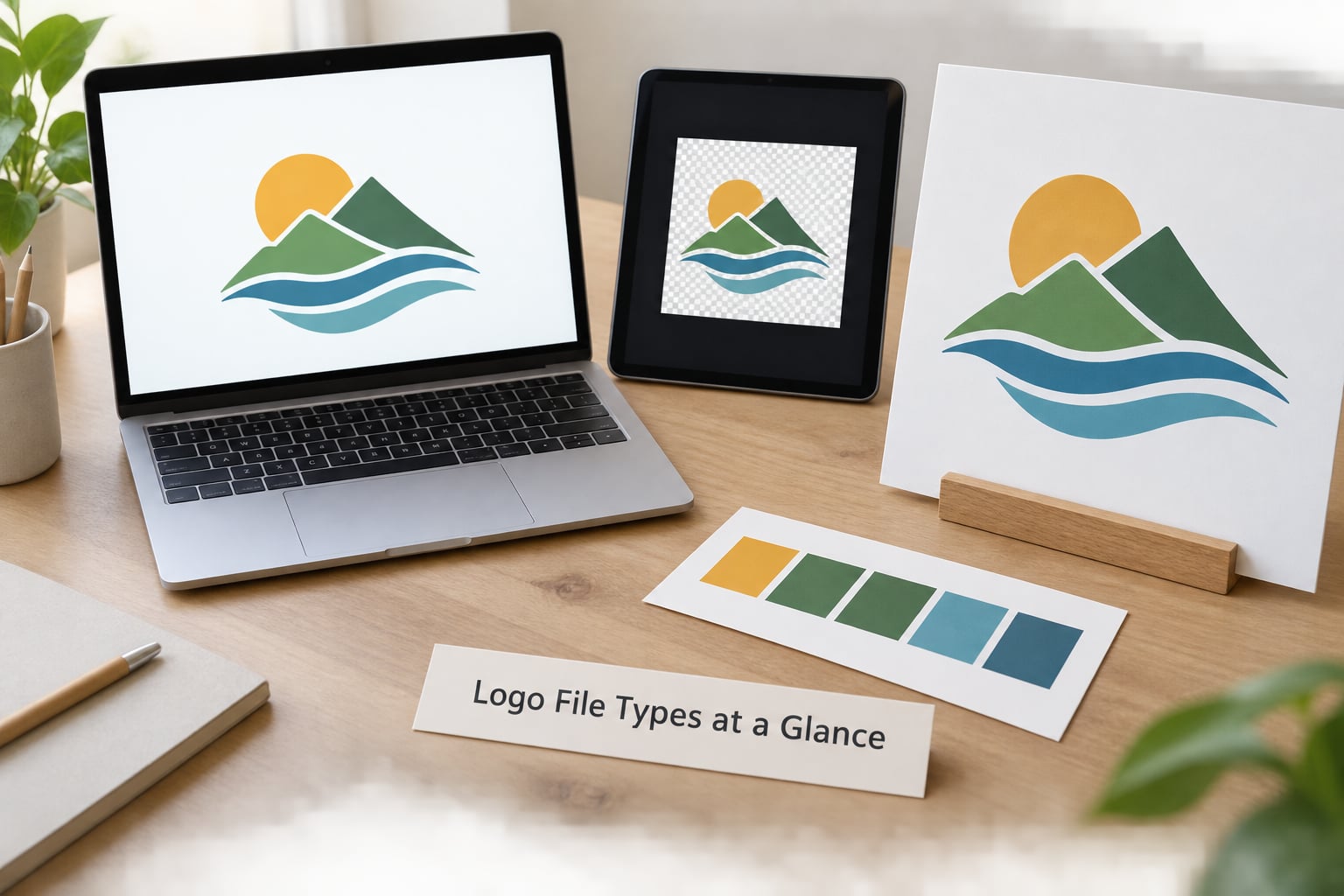
Here is the short version of every format you are likely to be handed, and how each one behaves in a sign shop.
| Format | Type | Best for | Watch out for |
|---|---|---|---|
| AI (Adobe Illustrator) | Vector | The master logo file, edit requests, sign shops that cut vinyl or fabricate letters | Opens only in Illustrator or a program that reads it; check fonts are outlined |
| EPS (Encapsulated PostScript) | Vector | Print-ready handoff to almost any printer, plotter, and fabricator | Some versions flatten effects; confirm transparency survived the save |
| Vector or raster | The easiest universal file to send, and the one most shops prefer | A PDF can secretly be a photo, so check it is not flattened | |
| SVG (Scalable Vector Graphics) | Vector | Web use, signage displays, laser cutting, CNC routing | Text stays live in the file and some RIP software handles it badly |
| PNG | Raster | Transparent backgrounds, small decals, mockups, email signatures | Has a fixed pixel size; large banners need a much bigger file |
| JPG (JPEG) | Raster | Photos and quick proofs only | Lossy compression, no transparency, worst choice for a sign |
| TIFF | Raster | Very large photographic prints where quality outranks file size | Lossless and heavy; no transparency, no scalability |
Four of those seven are vector formats. That ratio is the single most useful thing to remember, because signage is almost always a scale-up job.
What Is a Logo File Type?
A logo file type is simply the format your artwork is saved in, and each format stores that artwork in one of two fundamentally different ways: as vectors or as raster pixels. Understanding which is which explains nearly every quality problem you will run into with printed or fabricated signage.
What is a vector file?
A vector file stores a logo as mathematical paths, points, and curves rather than as a grid of pixels. Because the computer recalculates the shapes at any size you ask for, the artwork stays razor sharp from a 2-inch decal to a 48-foot billboard. That is exactly why sign shops ask for vector artwork before they quote a job.
What is a raster image?
A raster image stores a logo as a fixed grid of pixels, which is what JPG, PNG, and TIFF files contain. It looks sharp at its original size, but stretching it beyond its pixel dimensions makes edges blurry, blocky, or jagged. That is why raster files are a poor choice for anything large.
Here is why the distinction matters commercially. A screen logo is usually shown at a few hundred pixels across. A roadside monument sign might be ten times that in each direction, and a vehicle wrap covers a curved surface several feet long. The file that looks perfect in a browser preview has to survive that jump, and only vector artwork can.
Why the wrong file costs you time
Sign fabricators say the same thing over and over: most artwork delays trace back to a customer sending a low-resolution raster file instead of vector art. The shop has to email back, wait for the right file, or quote a redraw fee, and the production calendar slips with it.
A second cost shows up after the sign is installed. If you sent a JPG with a white background instead of a transparent PNG, that white rectangle is now baked into the panel, and there is no fixing it after the fact.
Which Logo File Type Is Best for Different Signage Projects?
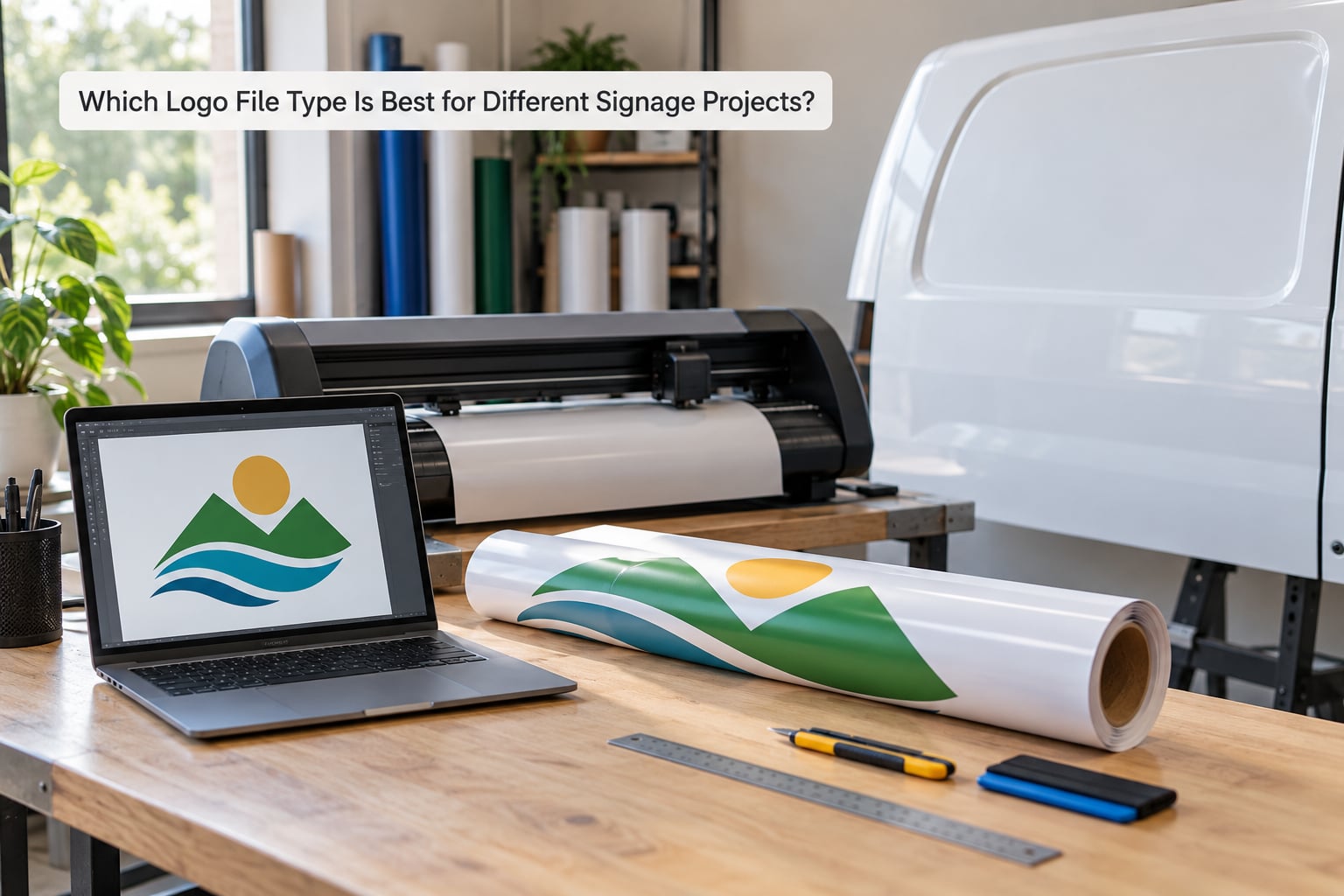
Vector wins for essentially every physical sign, but the format a particular shop wants varies by process. Knowing the production method ahead of time lets you send a file the machine can actually use, rather than one the shop has to convert for you.
| Project | Production method | Send this |
|---|---|---|
| Vinyl-cut lettering and decals | Cutting plotter traces the outline of the artwork | EPS or PDF vector, single-color, contour cut, fonts outlined |
| Channel letters and dimensional signs | Vector paths drive CNC routing, vinyl capping, and returns | AI or EPS vector with clean closed paths, plus a scaled drawing |
| Printed banners and yard signs | Large-format inkjet on vinyl or board | Vector preferred; otherwise a large PNG at the right pixel dimensions |
| Window graphics and storefront decals | Printed vinyl or cut vinyl with contour path | Vector EPS or PDF; PNG with transparency if the shop confirms it is large enough |
| Vehicle wraps | Large-format panels, printed, laminated, applied on a vehicle | Vector master plus high-resolution raster panels sized to the printer’s tile limit |
| Screen printing on apparel | Separation into one file per ink color | Vector, one color per file, spelled out as spot colors |
| Embroidery and patches | Digitizing software converts artwork into stitches | Vector with simplified shapes and no fine detail |
| Laser engraving | Laser follows the vector path into wood or acrylic | SVG or AI with single-line strokes, fonts converted to paths |
What do vinyl cutters need that printers do not?
A cutting plotter does not print an image. It follows a closed path with a blade, so your artwork has to contain a real outline it can trace. Sign industry forums are blunt about this: contour cutting needs vector paths, and a flattened Photoshop file has to be redrawn before any machine will touch it.
Two details cause most of the trouble. First, thin features: hairlines below roughly 1/16 inch tend to disappear on small vinyl decals, and very thin strokes can snag a plotter blade on larger runs. Second, gaps: separate letters sitting too close together can fuse when the cut path is offset for blade width, which is why fabricators ask for a few thousandths of an inch of clearance between shapes.
What do channel letters need?
Fabricators typically want two things: a clean vector file, and a scaled drawing showing exact letter heights, stroke widths, and return depths. The vector lets them cut or route the faces. The dimensions let them quote material, and they can only quote accurately if the sizes are stated rather than left to interpretation.
What do vehicle wraps need?
Wraps are printed in panels of limited size and then seamed together, so a designer often produces both a vector master and separate raster panels that fit the printer’s tile dimensions. High-resolution PNG or TIFF panels are acceptable here because the file is built specifically for its print size rather than enlarged from something small.
Vector Logo Files: SVG, PDF, EPS, and AI
Vector formats are the right answer for signage, and the differences between them are mostly about who can open the file rather than how it looks. Here is how the four main ones differ in practice.
| Format | Strength | Typical snag |
|---|---|---|
| AI | The editable master. Layers, spot colors, and effects stay intact. | Opens in Adobe Illustrator; other software may ignore or substitute fonts. |
| EPS | Accepted by printers, plotters, and CNC machines worldwide. | Transparency support improved over time but varies by version. |
| One file that opens anywhere, and the easiest thing to email to a shop. | Can be vector or a flattened photo. Both look identical in a file listing. | |
| SVG | Open standard, small file size, sharp on screens at any size. | Text remains live, so machines can misinterpret fonts or spacing. |
Which vector format should you actually send?
Send EPS or PDF if you are ordering printed graphics, and send AI as well if the shop fabricates letters or cuts vinyl. Ask the shop which they prefer before you export, because preferences here come down to the equipment in the building rather than any quality difference.
If you have one file to hand over, an outlined vector PDF is the safest single choice. It opens in browsers, design software, and most RIP systems, and it does not depend on whether the recipient owns a subscription.
The fake-vector trap: renaming a JPG does not make it vector
This comes up constantly and it is worth saying plainly. If you take a file called logo.jpg and change the extension to logo.ai or logo.eps, you have not created vector artwork. You have created a raster image wearing a vector filename, and the shop will find out the moment they try to scale it.
The fix is straightforward. Rename the extension back, then open the file in a vector editor and use the image trace function to generate paths. A clean trace works well on flat, high-contrast logos. It struggles with gradients, photography, and very fine detail, and a designer redrawing the original will always look better.
How to check whether your file is really vector
- Open it in a free vector editor such as Inkscape, or preview it in a browser if it is an SVG.
- Zoom in to roughly 800 percent on the edge of a letter.
- Look at the edge: a true vector stays a clean curve at any magnification, while a raster shows square pixels.
- Check the file size. A full-page logo with photographic detail is often several megabytes; a simple vector logo is frequently under 200 KB.
- If you see a picture of a logo inside a white rectangle, you have a raster file with a background baked in.
Raster Logo Files: PNG and JPG
Raster formats describe your logo as a fixed grid of colored squares, which makes them useful on screens and unacceptable for large physical signage. Two properties decide whether a raster file is any good: whether it supports transparency, and how many pixels it contains.
Why transparency matters for a sign
PNG supports an alpha channel, which is the transparent background that lets your logo sit on a colored panel, a window, or a vehicle body without a white box around it. JPG has no transparency at all, so it fills the background with whatever color was there when the image was saved, usually white.
That white box is the single most common defect on storefront graphics. It looks obvious on a dark panel and easy to fix before production, but once the vinyl is printed and cut there is nothing to remove.
Lossless versus lossy compression
PNG uses lossless compression, so the pixels it stores are the pixels you get back when you open it. JPG uses lossy compression, discarding detail it decides the eye will not notice. That is fine for photos and terrible for artwork: the crisp edge of a letter picks up small smudges and halos around high-contrast boundaries, and those artifacts are still there after any enlargement.
When a raster file is perfectly acceptable
A PNG is the right call for a small window decal, a social profile image, an email signature, or a mockup you are showing the customer. It is also fine for laser engraving on a small item when the shop confirms the resolution clears its equipment.
The cutoff is size. A logo under roughly 12 inches wide, printed from a PNG of 2000 pixels or more, looks fine. The same file used at 8 feet wide will look visibly soft, which is the reason behind most blurry-logo complaints on signage jobs.
What about TIFF and WebP?
TIFF is the lossless heavyweight used for very large photographic prints where quality matters more than file size. It carries no transparency and no scalability, so it is not a logo format for signs. WebP is a modern web format that compresses efficiently and now supports transparency; it works well for websites and social platforms and has no place in a production artwork package.
How to Prepare a Logo File for a Sign Company
Most artwork problems come from missing information rather than the wrong format. This checklist covers what a fabricator needs before they can quote and produce accurately, and it is short enough to send straight to your designer.
- Request the master vector file. Ask for the AI, EPS, or PDF version and confirm it is vector, not a renamed image. Ask for it with fonts converted to outlines unless the shop says otherwise.
- Give exact dimensions. State the finished sign size, not just the file. Include letter heights and stroke widths for fabricated work.
- Say what the production method is. Cut vinyl, printed vinyl, channel letters, and engraving each need different artwork, and the shop may need a contour path, spot colors, or single-line strokes.
- Ask for every logo variation. Horizontal, stacked, icon-only mark, and a monochrome version. A one-color version is often required for etching, engraving, and single-color vinyl.
- Specify the background situation. Confirm whether the artwork needs to be transparent so it can be placed on a colored surface.
- Name your color requirements. Give Pantone or CMYK values if brand colors matter, and ask whether the shop prints in CMYK or works from RGB files.
- Send a production PDF where appropriate. For printed graphics, a flattened high-resolution PDF with 0.125 inch bleed and crop marks is standard. Keep the vector master alongside it.
- Name the files clearly. Something like logo-vector-outlined.ai and logo-print-ready.pdf beats a folder called Downloads with twelve files in it.
Two color points cause the most friction. Large-format printers work in CMYK, so saturated blues and purples converted from an RGB screen file can land noticeably duller on vinyl than on the monitor, and some fabricators prefer to work from an RGB file and handle the conversion themselves. Ask which way they want it. For cut vinyl, the real color reference is the manufacturer’s vinyl color chart rather than your screen, so get the shade name and code in writing.
Fonts cause the other recurring delay. If the artwork carries live text and the font is not installed on the shop’s machine, the RIP software substitutes something else, and letter spacing changes enough that the fit of the channel returns is wrong. Outlining the fonts removes the variable entirely, which is why most sign companies ask for it explicitly.
How Resolution and File Size Affect Signage Quality
Resolution only matters for raster files, because vector files have no pixels to count. For a raster image, quality is decided by how many pixels the file holds compared with how many inches it gets printed across. Large format is the most forgiving medium in print, because viewers stand far away.
The viewing distance rule
Use this as a working formula: multiply the finished width in inches by the resolution target below, and that gives you the minimum pixel width. The viewing distance is what sets the target, not the printer.
| Sign size (finished width) | Typical viewing distance | Resolution target | Minimum pixel width |
|---|---|---|---|
| 12 inches (window decal) | 2 to 3 feet | 150 to 300 PPI | 1800 to 3600 px |
| 3 feet (yard sign) | 10 to 30 feet | 100 PPI | 3600 px |
| 6 feet (banner or wrap panel) | 10 to 40 feet | 100 PPI | 7200 px |
| 12 feet (billboard panel) | 100 feet or more | 30 to 50 PPI | 4300 to 7200 px |
| 48 feet (full billboard) | 200 feet or more | 25 to 30 PPI | 14400 px |
These numbers are why a 900-pixel logo from a website fails so badly on a banner. It was designed to be seen on a phone at 300 pixels wide, not printed six feet wide. Meanwhile, a 14,000-pixel-wide artwork is more than enough for a 48-foot billboard, because nobody in traffic is resolving individual dots.
Vector files sidestep the entire calculation. A vector logo sized to 48 feet carries the same tiny file weight as one sized to a business card, which is why fabricators would rather have vector artwork even for the enormous jobs where resolution sounds dramatic.
How to check a raster file’s size yourself
- Right-click the file and open its properties; most systems show the pixel dimensions.
- Compare the pixel width against the sign width you need, using the table above.
- If you are under the minimum, ask the shop whether they can work from it or whether you need artwork redrawn.
- If you are over, the file is fine, just larger than it needs to be. Compression tools can shrink it for emailing.
One more practical note on file size. An email attachment limit around 25 megabytes is a real constraint with large TIFFs and detailed PNGs, and a file that fails to send at the worst moment delays the job. A shared link or a compressed PDF is the dependable option for big artwork.
Frequently Asked Questions
What are the different types of logo files?
Logo files come in two families. Vector formats (AI, EPS, PDF, SVG) store artwork as paths, points, and curves, so they scale to any size without losing sharpness. Raster formats (PNG, JPG, TIFF) store a fixed grid of pixels, so they blur when enlarged. Signage needs vector artwork because signs are always printed or fabricated larger than a screen.
What is the best file format for a logo?
For physical signage, send AI, EPS, or PDF vector artwork with fonts outlined. Those formats open in production software, survive enlargement, and carry the outlines a cutting plotter needs. SVG works well for digital displays and laser cutting. Keep a transparent PNG alongside the vector files for mockups, proposals, and small decals.
Should logos be PNG or SVG?
It depends on where the logo is going. SVG is vector, so it stays sharp at any size and works well for websites, signage displays, and laser cutting. PNG is a pixel-based image that supports transparency, which makes it the practical choice for small decals, proposals, and email. For anything larger than a couple of feet, choose SVG or another vector format.
What is JPG, PNG, and TIFF?
All three are raster formats, meaning they store your logo as a fixed grid of pixels. JPG uses lossy compression, discards detail, and cannot hold transparency, which makes it the worst choice for signage. PNG uses lossless compression and supports transparent backgrounds, so it is the better raster option. TIFF is lossless and high quality but very large, and it is used mainly for photographic prints.
What are the differences between EPS and PNG files?
EPS is a vector format built for print production. It stores paths and curves, so it scales cleanly and drives vinyl cutters, CNC machines, and large-format printers. PNG is a raster format built for screens. It supports transparency, which is handy, but it has a fixed pixel size and will look soft when enlarged for a large sign. EPS is the one to send to a fabricator.
How do I open a logo file?
You do not need paid software. Inkscape opens AI, EPS, PDF, and SVG files for free, and LibreOffice Draw can preview EPS and PDF. PDFs and PNGs open in any browser by dragging them onto the window. To check whether a file is truly vector, zoom in to about 800 percent on a letter edge: a vector stays smooth, while a raster shows square pixels.
Conclusion
Start by asking whoever designed your logo for the vector master: an AI, EPS, or PDF with fonts outlined. That single request covers vinyl cutting, printed graphics, dimensional letters, and wraps, and it removes the most common reason a sign job gets delayed.
Then confirm the finished size and the production method with your sign company before sending anything, because a decal, a channel letter face, and a banner panel need different artwork. If you only have a raster file, check its pixel width against the size you need and decide early whether to enlarge, redraw, or simplify the logo. Handing over a clean production file is what gets the job approved on the first try.