To get repeat customers at a local shop, you need three things working together: a first visit worth talking about, a way to contact the shopper afterwards, and a reason for them to come back on a specific day. Most owners already do the first one by accident. The other two take about two hours a week to set up and running.
This guide is written for someone running the place themselves. No marketing team, no CRM, no agency. If all you have is a card reader, a phone and a notebook, everything here works. If you have software already, use it, but the schedule underneath is the same.
It also helps to know why the second visit is the one that matters. The first purchase is largely a decision the customer makes on the spot. Once they have bought twice, they have decided you are the shop they use, and that habit is what turns into predictable revenue you can order stock against. Everything in this guide is aimed at getting visit number two.
Table of Contents
- What You Need
- Step-by-Step: How to Get Repeat Customers at a Local Shop
- Step 1: Make a Strong First Visit Worth Repeating
- Step 2: Capture Useful Customer Information
- Step 3: Follow Up Soon After the Purchase
- Step 4: Create a Simple Loyalty Reward
- Step 5: Give Customers a Reason to Return Soon
- Step 6: Ask for Feedback and Handle the Lulls
- Step 7: Track the Numbers and Improve the Routine
- Common Mistakes
- Frequently Asked Questions
- Do loyalty programs increase customer retention?
- What are the 8 C’s of customer retention?
- How often should I contact past customers?
- How do I get customers on an email list at the counter?
- How do I win back customers who stopped coming?
- How do I calculate my repeat purchase rate?
What You Need
Five things, and none of them expensive. Get these in place before you run a single promotion.
- Contact records with permission. A list where each row is a name, a phone number or email, the date of the last visit, and roughly what they bought. Permission means they said yes, out loud, at the counter.
- A simple way to record sales. If your point-of-sale system can export a customer list, use it. If not, a receipt book with the name and phone written on it, or a spreadsheet, does the same job.
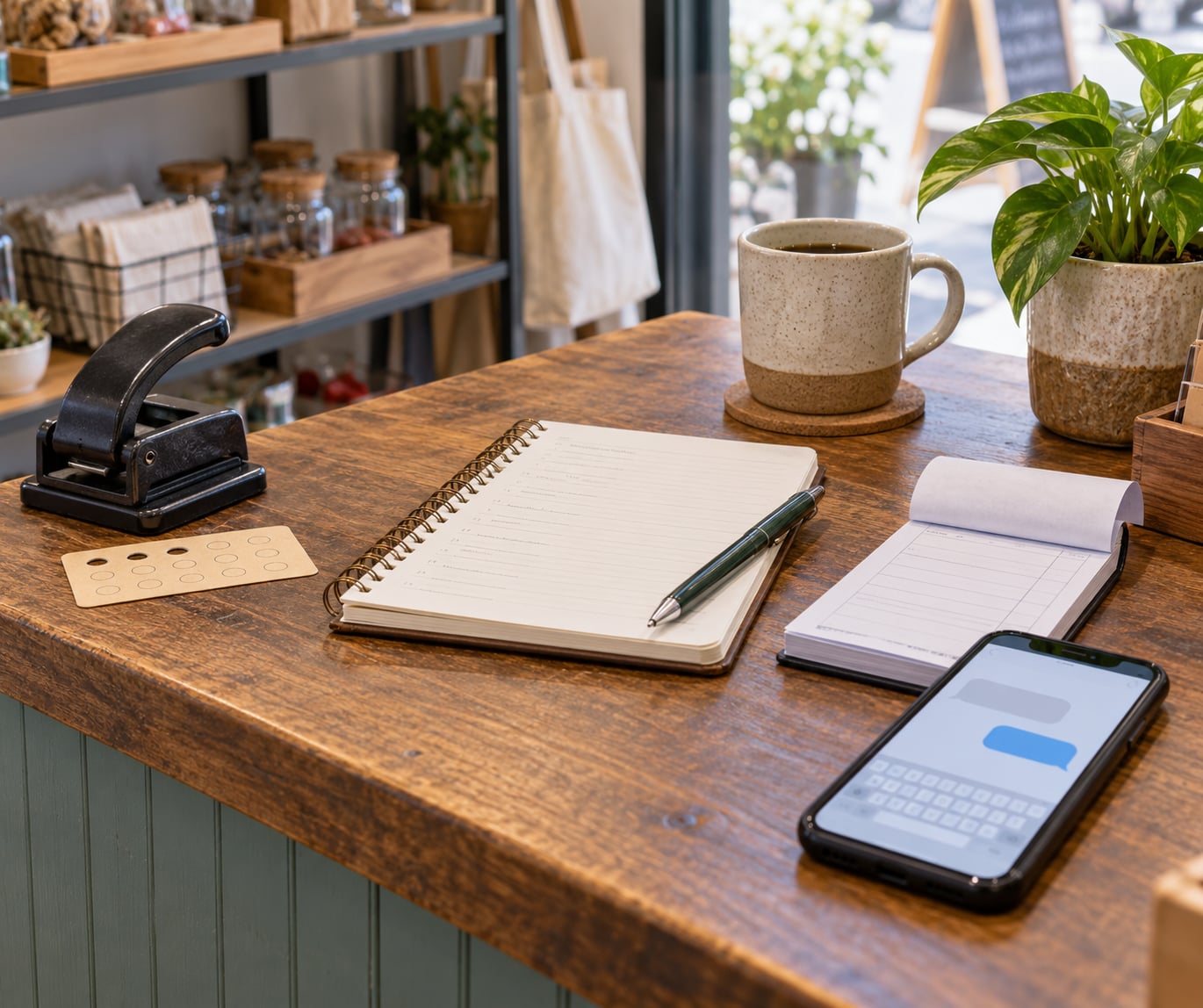
- A loyalty tracker that takes ten seconds. A paper punch card, a stamp card, or a points column in the same spreadsheet. If signing someone in takes longer than the transaction itself, nobody will do it.
- One named person responsible. Usually whoever is most often on the register. Written down on the back of the till or inside the till lid, not just assumed.
- A way to collect feedback. A comment card by the door, a reply-to text number, or a question on the receipt. Whatever exists, the answer has to be read by someone who can change something.
If you are starting from zero, do the first two and ignore the rest for a week. Getting names on a list beats a clever reward scheme every time.
Step-by-Step: How to Get Repeat Customers at a Local Shop
Step 1: Make a Strong First Visit Worth Repeating
The visit is the whole ballgame, and almost everything you do afterwards only works because of what happened in the room. Make the shop predictable, fast and pleasant, and fix anything annoying fast enough that the customer stays.
Three things make the biggest difference in a small shop. Know the layout well enough that a first-time customer does not have to hunt for the fitting rooms, the counter or the bin. Keep the thing you sell most on the shelf, because a customer who came for one specific item and did not find it is very unlikely to give you a second chance. And let anyone working the register solve a small problem on the spot without needing a manager.
Recognising people is fine; announcing you remember them is not. Greeting a regular by name and asking what they are up to today feels like service. Reading out their last order while they are standing at the counter feels like being tracked. Shop owners describe the middle ground as the one that works: notice, then move on to helping.
Two quiet details carry more weight than anything you can add later. The first is how long someone waits at the counter. Owners consistently blame a two-minute wait for a lost return visit, more than price. The second is whether the person who served them looked unhurried. Customers forgive a small shop for not having everything on the shelf; they do not forgive being made to feel like an inconvenience.
Step 2: Capture Useful Customer Information
Ask for the phone number or email at the moment of payment, because that is where the conversion is highest. Owners running small shops say the request is far less awkward if it comes attached to something rather than out of nowhere.
A few wordings that land better than “can I get your email?”:
- “Do you want a receipt by text? I can send it now and it has your loyalty stamp on it.”
- “Would you like me to text you when the [item you asked about] comes back in? Most people say yes to that one.”
- “Are you on the rewards list? It is one stamp per visit and the tenth one is free.”
Collect one channel, not both, unless the customer volunteers the second. Say what you will do with it and how often: “I send one message a month, mostly about new arrivals and the occasional offer. Unsubscribe any time.” People who understand the deal hand over their details far more freely.
Keep it tidy. One row per customer, no duplicates, no home addresses unless you genuinely deliver. If you are running this on paper, a spiral notebook with columns for name, phone, date and last item works for months before you outgrow it.
Step 3: Follow Up Soon After the Purchase
Follow up within 48 hours, then at two weeks, then at roughly two months. Three touches in the first 60 days is plenty, and each one should be useful rather than promotional. Shopkeepers who run this well describe fewer messages with a person’s name on them as the thing that works, not more messages.
The first message is a thank-you plus one practical thing. How to care for what they bought, how long it lasts, when to come back for a refill. The second is a check-in about the product, not a discount. The third is the invitation, sent with a clear window.
| When | What to send | Channel |
|---|---|---|
| Same day | Thank-you plus one care or use tip | Text or email |
| Within 48 hours | Care advice or how long the product lasts | Text or email |
| About 2 weeks | Check-in on the product, no offer | Text |
| About 2 months | Invitation with a clear reason to come back | Text or email |
| Every 4 to 6 weeks after that | New arrivals, restock news or a seasonal note |
Short copy you can send as-is:
- “Hi Marcus, that was the right call on the [item]. Wear an hour before you judge it. Thanks for coming by.”
- “Quick one from Anna at [Shop]. The [product] you picked up is performing well, so I wanted to let you know before anyone else asks. Anything you need, reply here.”
- “We restocked the [item] you looked at last month. It is on the shelf by the window. Thought of you.”
One named person writing these beats a bulk blast every time, because a customer who feels personally recognised forwards it and a customer who feels targeted ignores it.
Step 4: Create a Simple Loyalty Reward
The best reward for a small shop is one the customer can explain to a friend in five words. Buy ten get one free. Spend 30 and get 3 back. Free coffee on your birthday. If you cannot say it simply, it will not work.
Price it before you launch it. Take your normal margin on the item, divide by the number of visits it takes to earn, and check that the reward costs you less than the visits you expect it to buy. On a 40% margin coffee, a tenth free cup costs roughly 4% of ten sales. That is the kind of arithmetic that keeps a program running for years.
Two details matter more than the maths. Put the expiry where people can see it, or set none at all, because forgotten points are the number one reason people never redeem. And remind them the reward exists at the moment they are closest to earning it, which is usually one visit from done.
Match the shape of the reward to how often people come in. A punch card suits weekly or daily visits, because the customer can see the stamps filling up and wants to close the card. Points or spend-threshold suits irregular visits, where nobody counts. A birthday or anniversary reward costs little and reliably triggers one visit a year from people who would never have planned one. A paid membership only makes sense where your margins are healthy and your customers come often enough to feel the fee offset, and most single-location shops should skip it.
If you have no system at all, a paper card stamped by hand still works. So does a phone number and a note that says how many visits someone has had. The mechanics matter far less than the consistency.
Step 5: Give Customers a Reason to Return Soon
Retention works best when the customer knows when to come back. A specific date beats a vague invitation every time, and you can build a calendar of those dates around what the shop already sells.
Useful reasons to return: new arrivals on a known day, a seasonal item going out soon, a service reminder based on when they last came in, an event you host once a month, or a complementary product they probably need next. The refill reminder is the strongest for high-frequency shops, the seasonal window is the strongest for boutiques, and the service interval is the strongest for auto and salon work.
The lever that works changes completely depending on what you sell, so match it to your floor:
- Cafe and bakery. Frequency and a routine. Same drink on the same morning is the habit to protect, and a stamp card is enough. Seasonal drinks and a monthly pastry item give you two reasons a month to be in the door.
- Boutique and specialty retail. New arrival dates and seasonal windows. Customers who bought once are usually waiting to see whether anything new arrived, so a specific arrival date beats any discount.
- Salon and barber. The booked appointment. A reminder a day or two ahead plus a rebooking nudge is most of the work, and it barely touches anything else in your week.
- Auto repair and service shop. Mileage or time-based service reminders. Nobody thinks of you until the light comes on, and a reminder that arrives before that happens is the cheapest customer you will ever keep.
- Restaurant and takeaway. The midweek slot. A quiet Tuesday or Wednesday offer works far better than discounting the busy Friday everyone already fills on their own.
- Florist and gift shop. A calendar of occasions. Build next month’s send list around birthdays, anniversaries and holidays, and write the message once a year per date.
Keep promotions to about one meaningful message a month. That is enough to stay in their head and rarely enough that you are not a nuisance. When you do promote, make it feel like information rather than a sales blast, and give people a way to stop hearing from you.
Step 6: Ask for Feedback and Handle the Lulls
Ask two kinds of question, and they need different handling. “How are we doing?” gets you politeness. “What did you think of the person who cut your hair?” and “What almost stopped you coming in today?” get you something you can act on.
Ask for a review at the moment of happiness, not at the end of the transaction. A short text while they are walking to the door, or a comment card with the link already printed on it, works far better than a reminder later. Owners who try this say the conversion depends almost entirely on whether the ask feels part of the service or bolted onto it.
When a complaint arrives, reply personally within a day, apologise once, and say what you changed. Do not defend yourself in writing. Write down every recurring question or complaint, and once a month ask which one you are fixing first.
When visits dry up, look before you change anything. Did the hours change? Did a regular move, get ill, or start working elsewhere? Did you run out of something they came for? Did your prices move? Did the person who made them feel welcome leave? Most lulls have a cause you can still act on, and chasing them with a discount is the last move, not the first.
Step 7: Track the Numbers and Improve the Routine
How to get repeat customers at a local shop comes down to a handful of numbers and a monthly look at them. Five are enough for a single-location shop, and you can keep all five in one spreadsheet.
- Repeat purchase rate: how many of the customers who bought this month also bought in the last 90 days. Formula: repeat customers divided by total customers, times 100.
- Average time between visits: average number of days between a customer’s last two purchases.
- Loyalty sign-up rate: new members as a share of the month’s customers.
- Redemption rate: rewards actually claimed. A very low number means the scheme has a communication problem, not a design problem.
- Referral requests made: how often you asked a happy customer to bring a friend, and whether the friend showed up.
Set a baseline before you change anything, then test one lever at a time for 30 days. On 200 monthly transactions, a move from 30% to 36% repeat rate is roughly 12 extra returning customers a month, which is a signal. A swing of one or two customers is noise.
Then look at it by month rather than as one running average. Asking ten new customers in March is a different business from asking everyone again in April. A simple monthly view tells you which cohort came back, and that is usually where the answer is hiding.
Common Mistakes
Most repeat business is lost to habits rather than to competitors. These are the ones owners describe most often, with the fix next to each.
- Sending too many messages. One useful message a month beats four promos. Fix: keep a calendar, aim for four touches a quarter, and make sure there is a stop button.
- Relying on discounts alone. If the only reason to return is money, you train people to wait for deals and you teach them your prices are negotiable. Fix: lead with service, reminders and new stock, and let the reward be the punctuation, not the sentence.
- Over-complicating the loyalty scheme. Tiers, apps and personalisation rules are built for chains. Fix: one rule, written where staff can see it, worked out in under ten seconds at the counter.
- Ignoring service problems. A customer who had a bad day and heard nothing back is usually gone for good. Fix: one named person owns complaints, and replies go out the same day.
- Contacting people who never agreed to it. Buying a list or texting a number someone gave you for a repair is a fast way to damage a name you are working on. Fix: opt-in every time, no exceptions.
- Changing the promotion every week. Nothing gets remembered and nothing gets a fair test. Fix: run one offer for a full six weeks before judging it.
Four retention habits worth keeping: greet regulars by name, keep your best sellers on the shelf, ask one question at the register, and follow up three times in the first two months. That combination is unglamorous and it works almost everywhere.
Frequently Asked Questions
Do loyalty programs increase customer retention?
Yes, when customers actually use them. A loyalty reward raises visit frequency and usually nudges customers toward a slightly larger basket, because a free item after ten visits makes the tenth visit worth reaching for. What it does not do is rescue bad service or a shop that has run out of its best seller. The design matters more than the app: one clear rule, worth roughly 4 to 10 percent of what it costs the customer, and a reminder one visit before they earn it.
What are the 8 C’s of customer retention?
A useful shorthand for local shops: convenience, consistency, care, connection, communication, community, compliments and continuity. Convenience means easy to reach and easy to buy. Consistency means same hours, same prices, same quality. Care means problems get fixed fast. Connection means customers know you and are known by you. Communication means the right message at a sensible time. Community means giving back locally. Compliments means recognition that is warm, not creepy. Continuity means staying in the relationship past the sale.
How often should I contact past customers?
Once a month for something useful, and no more than that for anything promotional. In the first 60 days after a first purchase, three touches is a good rhythm: a thank-you within 48 hours, a check-in around two weeks, then an invitation at roughly two months. After that, monthly works for high-frequency shops and every six to eight weeks for shops people visit occasionally. Unsubscribe requests are absolute, and a customer who opts out is still a customer in your shop.
How do I get customers on an email list at the counter?
Attach the ask to something the customer already wants: a text receipt with the loyalty stamp attached, a restock alert on the item they asked about, or a birthday message. Say what you will send and how often before they hand over the details. Collect one channel rather than both unless they volunteer the second, and write the consent on the record. On a good month a simple counter ask typically turns a small share of transactions into a reachable list, which is all a local shop needs.
How do I win back customers who stopped coming?
Work out why they went first, because the fix depends on it. No response to your messages, or a complaint you never answered, needs an apology before an offer. A regular who moved, changed hours or got ill needs one friendly check-in with no coupon attached. Someone who simply drifted needs a reason tied to what they bought before. Send those separately, keep the coupon out of the first message, and expect most lapsed customers not to return, which is normal and fine.
How do I calculate my repeat purchase rate?
Count the customers who bought in the last 90 days, then count how many of those had also bought in the 90 days before that, and divide the second number by the first. Multiply by 100 for a percentage. Run it monthly and keep the results in one column so you can see the direction. On a small shop, changes under about five percentage points are usually noise from one customer either way, so look at three-month trends before reacting to a single month.
Start tomorrow with two things only: fix the counter ask so a phone number gets captured on every sale, and send a thank-you within 48 hours of the first one. Two hours of work, and the rest of the routine builds on top of it.