
To onboard a new employee in a small business, run an eight-step process: pre-boarding paperwork before the start date, a light first day, role and business context, tool access and training, written expectations, team connections, daily week-one check-ins, and a review at 30 days. Expect 15 to 25 hours of your own time spread across the first month, most of it in week one.
- Send the welcome email and paperwork before day one.
- Run a light first day that ends with a schedule for the rest of the week.
- Explain what the business does and how the role fits into it.
- Set up accounts, devices, and role-specific training before the hire needs them.
- Write down responsibilities and the first three goals.
- Introduce the people the hire will actually work with.
- Check in briefly every day of the first week.
- Collect feedback at one week and 30 days, then fix the process for the next hire.
Nothing on that list requires an HR department. It requires about ninety minutes of preparation and a willingness to write down what you normally just know.
Table of Contents
- What You Need to Onboard a New Employee in a Small Business
- The documents
- The equipment and access
- The written material
- The people
- The schedule
- Step-by-Step: A Small-Business Onboarding Checklist
- How to Onboard a New Employee in a Small Business: Before Day One
- Create a Welcoming First Day
- Explain the Business and the Employee’s Role
- Set Up Tools, Access, and Training
- Set Clear Expectations and Initial Goals
- Build Connections and Company Culture
- Check In During the First Week
- Review and Improve the Process
- Common Onboarding Mistakes and How to Fix Them
- What Most Owners Get Wrong
- Onboarding Tips for a Lean Team
- Frequently Asked Questions
- How long does it take to onboard a new employee in a small business?
- What paperwork should a new employee receive on their first day?
- How should a small business onboard a remote employee?
- What should a new employee learn during their first week?
- How can a small business onboard two new employees at the same time?
- What are the stages of the onboarding process?
- Conclusion
What You Need to Onboard a New Employee in a Small Business
Most owners who feel unprepared are missing paperwork and access, not enthusiasm. Get these items lined up and the process runs itself.
The documents
A federal I-9 employment eligibility form and a W-4 withholding form are the two federal starting points. Add your state withholding form, a direct deposit authorization, an at-will employment acknowledgement, a confidentiality agreement, and an equipment and property agreement if you are handing over a laptop, phone, vehicle, or keys.
Rules differ by state and change over time, so confirm the exact form set with your payroll provider or accountant before you send anything.
The equipment and access
- A laptop or terminal with the standard build already applied.
- Email, calendar, chat, and any operational system the role touches.
- Phone, keys, badge, and whatever PPE the job requires on a warehouse floor, in a kitchen, or on a job site.
- Physical workspace, whether that is a desk, a bench, or a home office.
The written material
A one to three page welcome packet beats a forty-page handbook nobody reads. Include your hours, pay period, how time off is requested, where to find the schedule, who to ask for what, and the three company rules you never bend.
The people
Nominate one onboarding owner, which in a small business is usually you, plus one buddy who answers the questions too small to bother the owner with. Confirm both names before the start date.
The schedule
Write the first day hour by hour and the first week day by day. A hire with nothing on the calendar feels like an error, not a welcome.
Step-by-Step: A Small-Business Onboarding Checklist
One distinction first, because it fixes most confusion. Orientation is a day of information about the company. Onboarding is the longer process of becoming productive and connected. Orientation is a single event inside onboarding.
How to Onboard a New Employee in a Small Business: Before Day One
Pre-boarding starts the moment the offer is signed. Send a welcome email that confirms the start date, the time to arrive, what to bring, and who they will meet. Keep it under 200 words.
Copy and paste welcome email:
Subject: Welcome aboard, first day details
Hi [Name],
We’re glad you’re starting on [date]. Arrive by [time] and come to [location]; dress is [guidance]. Bring [items if any].
Your first day is light: paperwork, a tour, and introductions. On Tuesday we’ll start role training, so you don’t need to prepare anything beforehand.
You’ll meet [owner] and [buddy]. Bring questions, there are a lot of them at this stage and that’s normal.
See you on [date].
Then send the paperwork with a deadline. Give the hire a week, not a month, because forms that drift are forms that arrive wrong on the last day.
Finish the setup yourself the day before: build the laptop, create the accounts, write the temporary password into a sealed envelope or set up a proper password manager invite. Sharing your own login is one of the most common mistakes owners make, and it breaks your audit trail.
Create a Welcoming First Day
Keep day one to about four hours of actual content and let the rest be human. A short welcome from the owner, a tour of the space, introductions to the two or three people they will work with most, and a walkthrough of the practical stuff: where the bathroom is, where the supplies live, how the schedule works.
Do the paperwork in one sitting rather than trickling forms across the week. Owners tend to spread it out to avoid overwhelming the hire, and the result is a half-finished file and a confused payroll clerk. One calm hour beats three interrupted ones.
End the day by walking through Tuesday’s schedule with them. That single conversation removes most of the Sunday-night anxiety.
Explain the Business and the Employee’s Role
New hires can run a task perfectly and still not understand why the task exists. Spend an hour on the business: who the customers are, what they buy, where the money comes from, and which three numbers matter most this year.
Then connect the role. Explain which parts of the customer experience this person touches and which they do not, and where their work hands off to someone else. In small businesses roles overlap, and an honest map beats a clean-sounding fiction.
Set Up Tools, Access, and Training
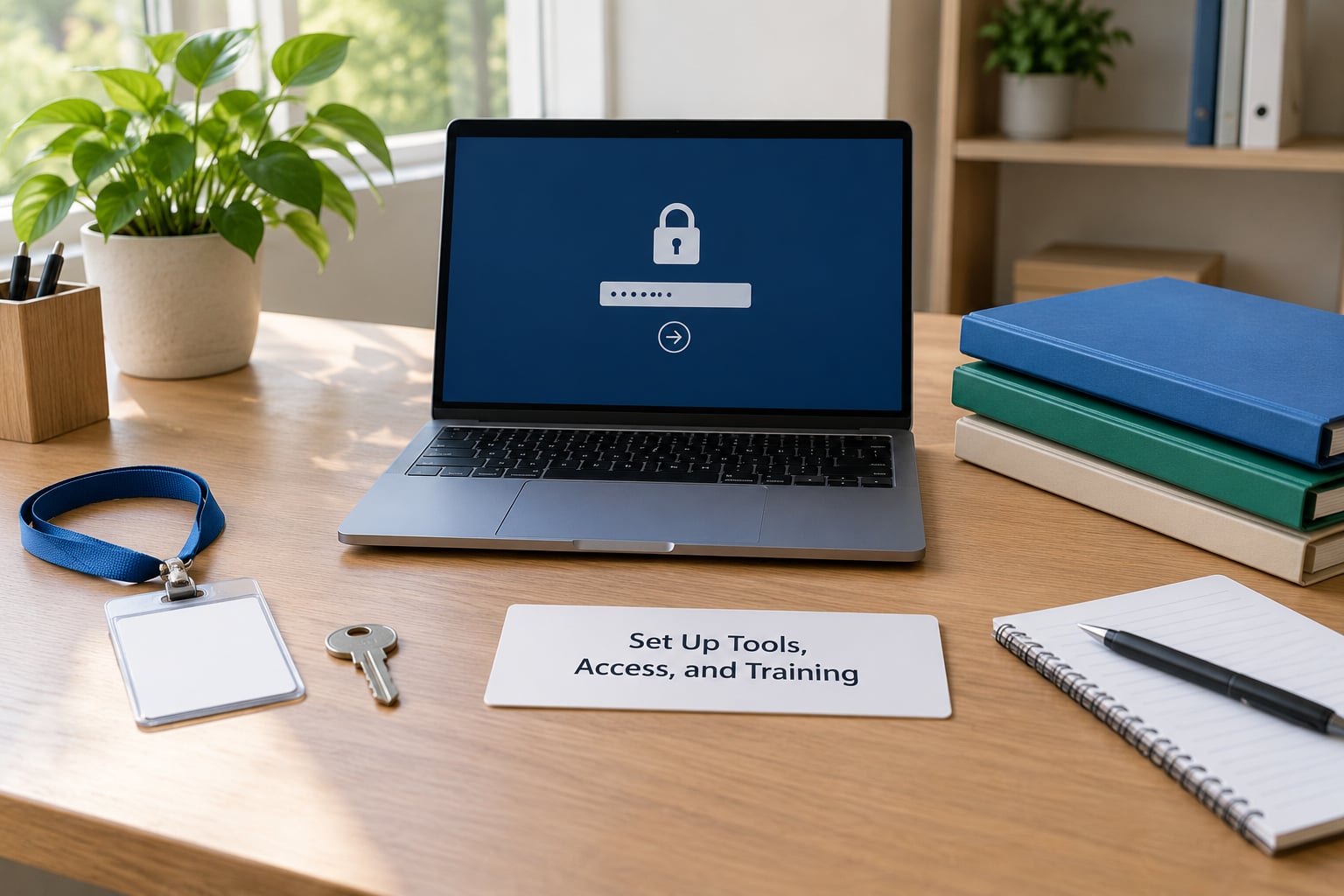
Provisioning is the step that quietly makes people fail. Create every account before day one, or at minimum before the hour the hire needs it. Test the login yourself on the device they will actually use, not on your own.
For safety-critical roles, cover the safety briefing, PPE requirements, emergency exits, and incident reporting on day one and again within the first week. Written standards, plus the acknowledgement that the hire read them, are the record you want.
Training materials can be short. A one-page standard operating procedure per task, plus a short walkthrough video where the task is visual, is enough to start. Ask the hire to perform each task back to you before you call it trained.
Set Clear Expectations and Initial Goals
Vague expectations produce vague performance. Write a one-page document with the title, the core responsibilities, the hours and schedule, how communication works, who approves what, and what performance looks like at 30, 60, and 90 days.
Three goals for the first month is the right number. They should be achievable inside four weeks, visible to a customer or a manager, and written so both of you can tell whether they were met.
| Period | Typical focus | Check-in |
|---|---|---|
| Days 1 to 30 | Learn the systems, shadow key people, finish training tasks, own one small recurring job | Weekly 20-minute check-in plus a 30-day review |
| Days 31 to 60 | Work independently on the role’s core duties, take on one stretch task | 30-day feedback written down, goals adjusted |
| Days 61 to 90 | Full ownership of the role, quality and speed targets agreed, review training of the next hire if there is one | 60-day check-in, then a 90-day conversation about growth |
Put all three dates in the calendar now, while you are still thinking about it. These are the 30-60-90 day plan dates, and they are what turns a new hire into a settled one.
Build Connections and Company Culture
Small businesses do not fail new hires with cruelty, they fail them with invisibility. Nobody knows their name, nobody tells them where to stand at lunch, and nobody tells them when a joke is a joke.
Assign a buddy and give the buddy a short job description too: sit with the new hire twice in week one, introduce them to the two people they will work with most, and be the person they ask the small questions. Buddy is different from mentor; the buddy answers today, the mentor talks about the career.
Walk them through the unwritten rules out loud. Who books the meeting room, whether lunch is at the table, how decisions get made, how someone asks for vacation. None of this is written anywhere.
Check In During the First Week
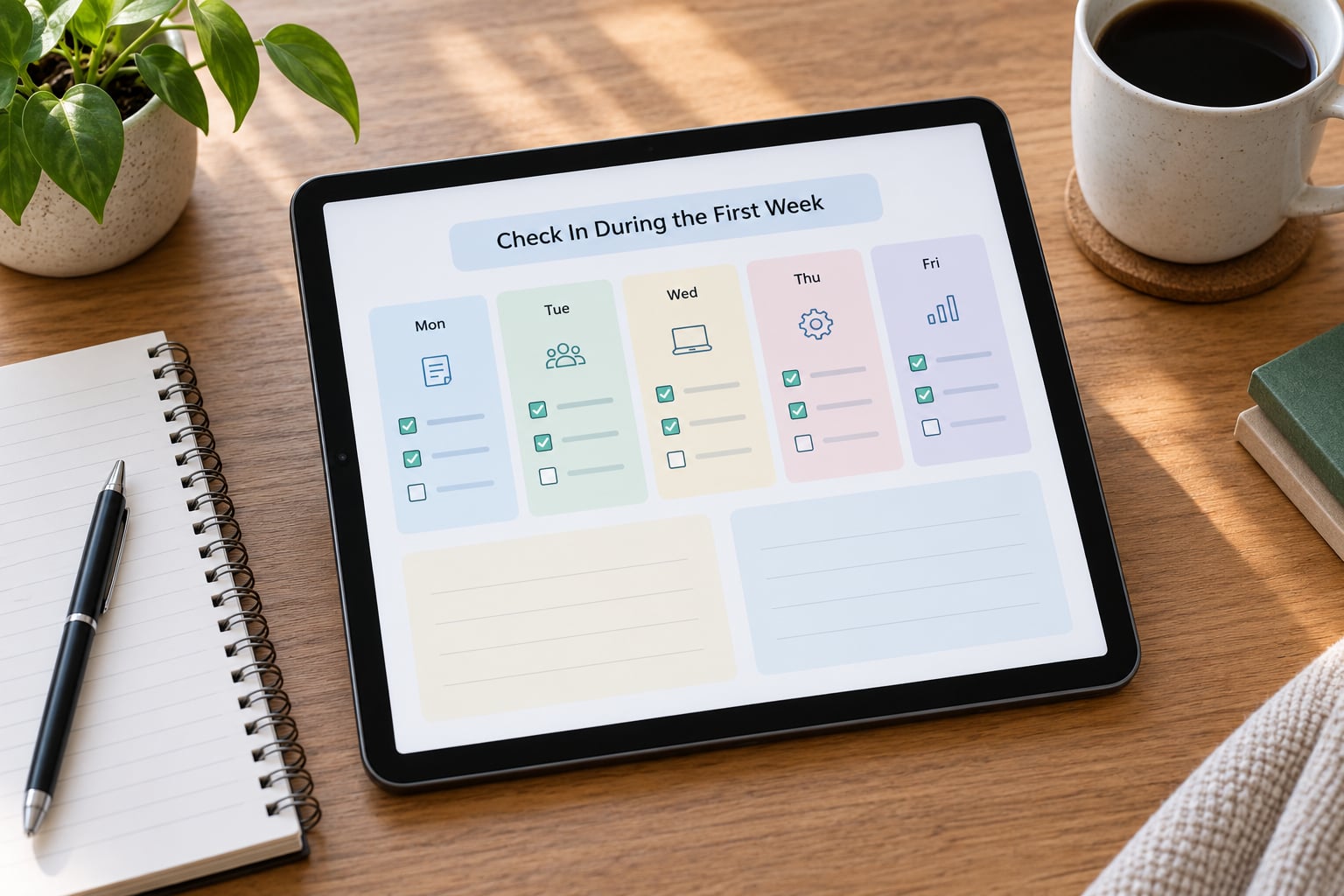
Fifteen minutes at the end of each day in week one. Ask three things: what was confusing, what surprised you, what do you need tomorrow. Write the answers down and act on at least one of them the next morning.
Day-one problems are usually small and fixable: a login that fails on mobile, a schedule that was never shared, a piece of equipment that was not actually in the box. Catching them on day two costs ten minutes. Catching them on day thirty costs a resignation.
| Day | Focus | Who leads it |
|---|---|---|
| Day 1 | Paperwork, welcome, tour, introductions, tomorrow’s plan | Onboarding owner |
| Day 2 | Business context, customer overview, systems tour | Owner |
| Day 3 | Core task training with the buddy, first supervised task | Buddy |
| Day 4 | Second core task, safety and policy review, goal review | Owner and buddy |
| Day 5 | Recurring job handed over, week-one feedback conversation | Owner |
A first-week survey helps too. Three written questions is enough: what was clear, what was missing, what would you change for the next person.
Review and Improve the Process
Onboarding is not finished when the hire becomes productive. It is finished when the process works without you.
At 30 days, sit down and ask three things: are the goals being met, does the hire know what is expected, would they recommend this business to a friend. Then take ten minutes to write down what you would do differently for the next hire, because you will not remember it in three months.
Keep the checklist, keep the templates, keep the SOPs. The second hire should take half the time to onboard, and the tenth should take an afternoon.
Common Onboarding Mistakes and How to Fix Them
What Most Owners Get Wrong
Owners on small business forums describe the same handful of failures repeatedly. None of them are about money or headcount.
- Sending paperwork late. Fix: set a deadline one week out and send everything in one email with one reply address.
- Flooding day one. Fix: cap it at four hours of content and one piece of paperwork per sitting.
- Assigning vague goals. Fix: write goals as a finished outcome with a date, not as an activity like get up to speed.
- Sharing logins. Fix: issue personal credentials through a password manager or a sealed note, then change them after the first login.
- Skipping check-ins. Fix: fifteen minutes daily in week one, then weekly for the first two months.
- Treating onboarding as paperwork only. Fix: if the hire cannot do real work by week two, onboarding stalled.
- Keeping everything in your head. Fix: write down one procedure every time you explain something for the third time.
That last one shows up more than anything else in owner discussions. The knowledge exists, it just has never been moved out of someone’s memory and into a document. Owners debate whether it should live in SOPs, recorded walkthroughs, or shared docs, which means most of them have none of the three.
Owners also flag a hiring mistake that shows up later: hiring for skills instead of trainability. Your first hire will touch five jobs and do them all unevenly for a while. If you need someone who is already excellent at the narrowest part of the work, that is a different conversation.
Onboarding Tips for a Lean Team
- Give onboarding to exactly one named person. Shared ownership means nobody owns it.
- Keep a single checklist, not six documents in six places.
- Protect focus time. Onboarding competes with serving customers, and interruptions are the reason training never finishes.
- Write down every instruction you give twice. That repetition is your documentation backlog.
- Ask for feedback before you change anything, so you fix the real problem.
- Start hourly and frontline hires differently. They need shift-level clarity, a safety briefing, and one station mastered before the whole workflow.
- For remote hires, over-document everything. They cannot ask a question by walking past your desk, so pair them with a buddy and check in daily for the first two weeks.
Frequently Asked Questions
How long does it take to onboard a new employee in a small business?
Plan on 30 to 90 days to reach full productivity, with the heaviest work in the first week. Your own time is usually 15 to 25 hours total, most of it before day one and during week one. Office-based roles ramp fastest when a single recurring job is handed over in week one. Frontline and remote hires usually need a longer window because they learn without watching you work.
What paperwork should a new employee receive on their first day?
The federal basics are Form I-9 for employment eligibility and Form W-4 for withholding. Most businesses also use a state withholding form, a direct deposit authorization, an at-will employment acknowledgement, and a confidentiality agreement. If you provide a laptop, phone, vehicle, or keys, add an equipment and property agreement. Confirm the current requirements for your state with your payroll provider before sending.
How should a small business onboard a remote employee?
Remote onboarding leans harder on written material and scheduled contact. Send equipment and account access before the start date rather than on it. Give them a first-week calendar with real times in it, a named buddy for small questions, and a short written summary of how the business works. Daily fifteen-minute check-ins for two weeks do more for early engagement than a large handbook.
What should a new employee learn during their first week?
Four things: how the business makes money and who the customers are, how their role connects to that, how to do their core tasks safely and correctly, and who to ask when they are stuck. Everything else can wait. A useful test is whether they can complete one recurring piece of work independently by Friday, with the buddy available for questions.
How can a small business onboard two new employees at the same time?
Do not run two first days at once. Stagger start dates by one to two weeks so each person gets your full attention on their own start day, then have them share a buddy and a peer check-in. Share the checklist, the welcome email, and the training materials so you build them once. Your time per hire drops sharply the second time because the process already exists.
What are the stages of the onboarding process?
Most small businesses use five: pre-boarding before the start date, first-day orientation, initial role training in the first weeks, goal-setting against a 30-60-90 day plan, and ongoing check-ins and feedback through the first 90 days. Orientation is the single event inside the larger process. The stages matter because new hires disengage fastest in the gap between week one and week four, when nobody is scheduled to talk to them.
Conclusion
Onboarding a new employee in a small business comes down to preparation, a light first day, written expectations, and check-ins that are actually on the calendar. None of it scales with headcount, and none of it needs software.
Start today by naming one person to own the process, writing the first-day schedule hour by hour, and listing every document, account, and piece of equipment the new hire needs before they walk in. That list is your onboarding checklist, and the second hire will take half as long because of it.