A chalkboard sign is a reusable board you wipe clean and rewrite as often as you like, so a small shop can promote a different item, price or notice every single day without reprinting anything. The best chalkboard sign ideas for small shops are not fancy illustrations. They are short, readable messages that tell a passerby what to do next: buy this, ask about that, come back Friday.
Most shop owners I talk to overdo the decoration and underdo the wording. They spend an hour drawing a wreath and then cram eight lines of text underneath in lettering half an inch tall. A sidewalk board works because people walking past are not stopping to admire your hand-lettering. They are slowing down for two seconds, so those two seconds get one idea on them.
Below are twelve chalkboard sign ideas for small shops, each with the message it should carry and wording you can copy straight onto the board. Finish with the section on writing messages customers can actually read from three feet away, because that is where most boards fail.
Table of Contents
- 12 Chalkboard Sign Ideas for Small Shops at a Glance
- 1. Daily Special or Featured Product
- 2. Today’s Fresh or Local Offer
- 3. Hours and Today’s Availability
- 4. New Arrivals or Seasonal Display
- 5. Coffee, Tea, or Drink Menu
- 6. Salon or Service Menu
- 7. Retail Sale or Clearance Message
- 8. Event or Workshop Promotion
- 9. Loyalty or Repeat-Visit Offer
- 10. Holiday or Limited-Time Message
- 11. Customer Notice or Policy Reminder
- 12. Simple Shop Branding Statement
- How to Write Chalkboard Messages Customers Can Read
- Frequently Asked Questions
- What are some creative sign ideas for small businesses?
- How can I make a DIY chalkboard sign?
- What should I use to write my menu on a chalkboard sign I have?
- What are the downsides of using a chalkboard?
- What size chalkboard works for a small storefront?
- How do I keep chalkboard messages fresh without a designer?
- Conclusion
12 Chalkboard Sign Ideas for Small Shops at a Glance
The table below is the whole collection on one page: what each sign is for, what you want the customer to do, and which kind of shop it fits best. Read it straight down and you have a month of boards already planned.
| Sign idea | Best used for | What you write | Ideal shop type |
|---|---|---|---|
| Daily special | One rotating hero item | Item name, price, why today | Cafe, bakery, deli |
| Fresh or local offer | Seasonal or nearby sourcing | Source, item, today-only hook | Farm stand, grocer, market stall |
| Hours and availability | Schedule changes and sold-outs | Hours, changes, sold-out note | Any storefront |
| New arrivals | New stock or a collection | Three item names, arrival date | Boutique, record shop, home goods |
| Drink menu | Short readable menu | Categories, prices, one featured drink | Cafe, roastery, tea shop |
| Service menu | Core services and add-ons | Service names, starting prices | Salon, barber, studio, repair |
| Sale or clearance | Markdowns and final reductions | Offer, eligible items, deadline | Retail, thrift, outlet |
| Event or workshop | Classes and in-store demos | Date, time, topic, where to sign up | Craft shop, bookstore, studio |
| Loyalty offer | Repeat visits | Reward, how to join, what counts | Cafe, bakery, salon |
| Holiday message | Seasonal or limited time | Hours, closing dates, festive offer | Any shop |
| Customer notice | Policies and logistics | Payments, returns, order-ahead, parking | Any shop |
| Branding statement | Personality and welcome | Motto, neighbourhood line, promise | Independent and family-run shops |
1. Daily Special or Featured Product
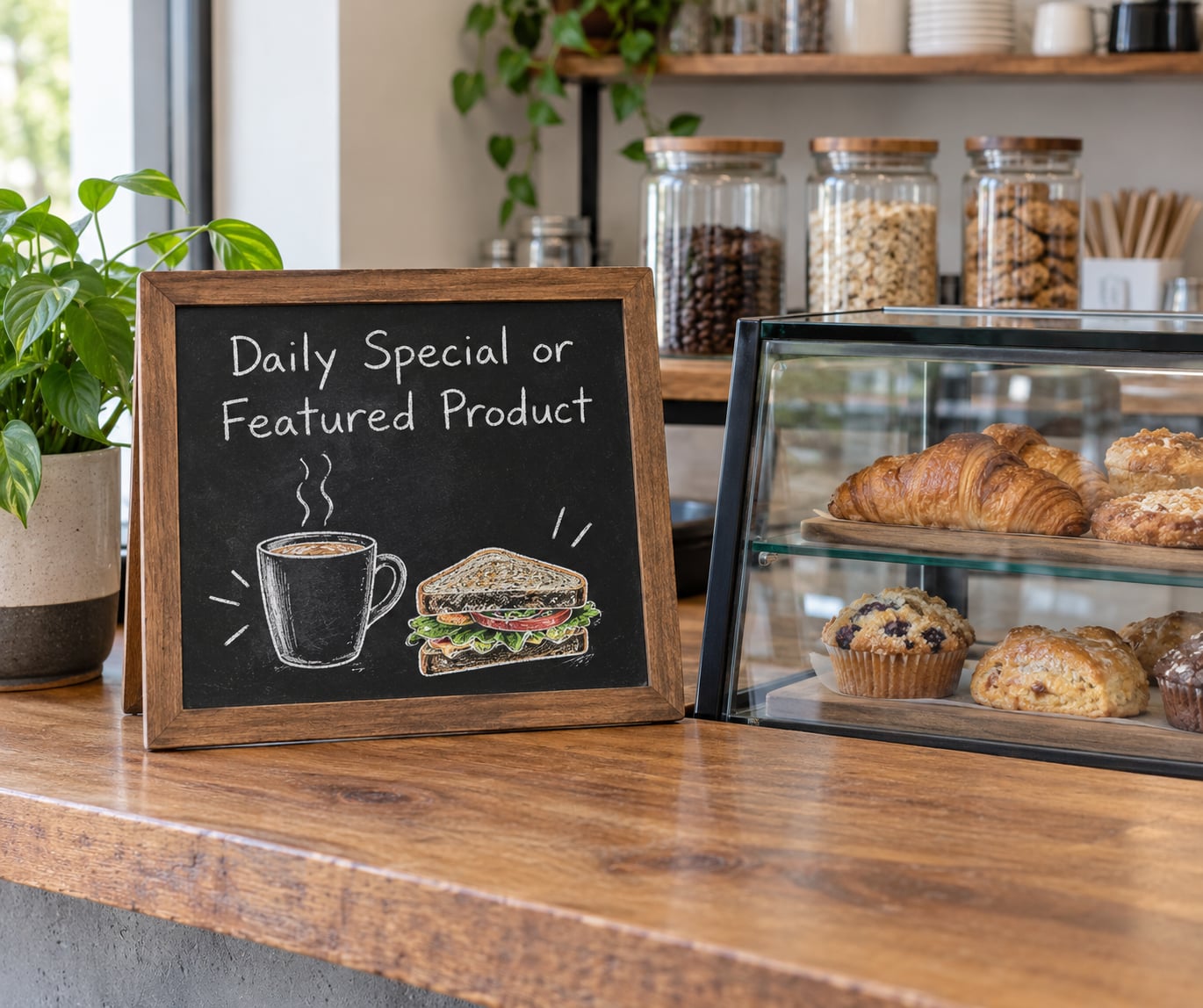
A daily special board exists to move one specific item instead of describing your whole shop. The reason this is the highest-value board for a small shop is that owners on shop forums consistently rank frequently changed messages, daily specials above everything else, because it is the one message that justifies stopping at the board today rather than tomorrow.
Keep it to three lines: the item, the price, and the reason it is special today. Copy you can write as-is:
TODAY’S SPECIAL
Brown butter croissant
3.50 – until we sell out
The reason line matters more than the drawing. “Until we sell out” and “baked at 6am” give a shopper a reason to act now, while a bare item name reads like a menu, not an invitation. Rotate one item a day and take a photo of each finished board; those photos are free content for your social accounts, which is the other thing shop owners like about them.
2. Today’s Fresh or Local Offer
A fresh-or-local board works when you can name where something came from, not just that it is fresh. Customers cannot verify your sourcing claims, but they can decide whether a farm six miles away sounds better than a supplier three states over, and that decision happens at the board.
Write the source first, then the item, then what makes today the day to buy it:
FROM THE FARM UP THE ROAD
Heirloom tomatoes
Picked yesterday – these go fast
This is the board that works hardest for a farm stand, a greengrocer, a fishmonger or a weekend market stall, where the same box of produce turns over fast. Farmers market regulars arrive early and read every board at the row, so keep the daily offer to one line and put the rest of your signage on a second board behind you.
3. Hours and Today’s Availability
The hours board is the least creative sign a small shop can write and the one that prevents the worst customer experience, which is someone standing at a locked door at the wrong time. Put the current hours in the same position every day, in the largest lettering on the board, and treat any change as a rewrite, not an addition.
Handle the four situations owners ask about most, each on its own line:
OPEN TODAY 8AM – 6PM
Out of the almond croissants until tomorrow
Kitchen closes 30 min before us
Back Saturday at 10
Sold-out notices are the most useful and most neglected use of a board. A bakery that wipes off a crossed-out item and writes “back tomorrow morning” gets more goodwill than one that leaves yesterday’s board up for three days. Keep the standard hours permanently and use a separate small line for today’s exception, so nobody has to hunt for the change.
4. New Arrivals or Seasonal Display
A new-arrivals board answers the question a window display cannot: what is actually inside right now. List three items by name, say when they landed, and give one reason to come in today rather than next week.
For a boutique or a record shop, this is often the entire board:
NEW THIS WEEK
Waxed canvas totes
Hand-poured candles – 6 new scents
Local press, 40 titles
First look before the weekend rush
Three items is a real constraint, not modesty. Shop owners on sign-design forums report that boards with more than five lines stop being read at walking pace, and the whole point of a new-arrivals board is that a passerby absorbs it without stopping. If you have twelve new things, put three names on the board and a full list on a sheet behind the counter.
5. Coffee, Tea, or Drink Menu
A drink menu board should be readable in one sweep, which means fewer items, bigger prices, and one clearly marked featured drink. Customers do not need your full menu on chalk, because they will not read it from a distance and you will be erasing it constantly anyway.
Group by category, keep names short, and put a single decoration beside the drink you want to move:
ESPRESSO BAR
Flat white – 3.80
Filter of the day: Ethiopia, peach, jasmine
Oat milk +0.60
Ask about the seasonal cold brew
The trick that makes menu boards survive a week is pricing. A short item name plus a clearly aligned price column updates in seconds each morning, because you are replacing one number rather than rewriting a line. If your board is magnetic or has clips, swap the price strip and leave the lettering alone.
6. Salon or Service Menu
Service boards fail in one specific way: they list every add-on a trained person could name, so the board becomes unreadable and prices stop being visible from the doorway. Small salons and barbershops do better with a short core list of services, starting prices, and a line for anything that varies by hair length or complexity.
Example layout for a barber or salon:
SERVICES
Cut – from 28
Beard trim – 15
Cut and beard – 38
Kids cut – 20
Long hair, colour and rework priced in chair
“From” pricing protects you from a conversation you did not ask for, and one honest line about what gets quoted in person removes most of the awkwardness. For repair shops, studios and salons that book ahead, the same board can carry the booking instruction: “Walk-ins until 2pm, after that by appointment only.”
7. Retail Sale or Clearance Message
A sale board reads as credible when it names the offer, the eligible items, the deadline and the conditions. Vague boards create the two problems small retailers complain about most, which are customers arguing about what was included and customers assuming everything is already marked down.
Say it in four lines:
END OF SEASON
Selected winter stock – 40% off
Rack marked items only, exclusions at the till
Ends Sunday
Stating where an offer applies and where it does not, in small writing at the bottom, is what separates a board that builds trust from one that generates a refund conversation. Post the end date honestly and take the board down when it passes; a sale board left up after the deadline is the fastest way to make people stop reading your other boards.
8. Event or Workshop Promotion
An event board has four facts to deliver, and if all four are legible from the pavement it will fill seats. Date, time, what happens, and how to join. Owners running classes from a small shop usually have the topic and the enthusiasm covered and the logistics missing.
A workshop board that fills up:
HANDS ON: TIN FOIL PRINTING
Saturday, 2 – 4pm
Bring a shirt or buy one here
6 places, 2.50 materials
Sign up at the counter
The scarcity line is not optional if you run limited sessions, and “sign up at the counter” converts far better than an email address on a pavement board, where nobody has their phone out. After the event, the board is the easiest thing in the shop to repurpose into the next one, so design it as a template with two blank lines rather than a one-off.
9. Loyalty or Repeat-Visit Offer
A loyalty board works best when the reward is simple enough to explain in a sentence and the counting method is visible. The usual objection is not the offer, it is the system, so write down exactly what counts and what the customer gets.
Two formats that work at small-shop scale:
BUY 6 COFFEE – 7TH IS ON US
Ask at the counter, we stamp the card
OR
FLORIST’S WEEK
Free wrap on orders over 30
Tell us the occasion on the tag
The stamp-card message is worth writing on the board permanently because it answers the question a customer has when they see a card but do not know how to get one. A referral message works too, and it costs nothing: name the reward, then write the line that makes it feel like a favour between neighbours rather than a discount scheme.
10. Holiday or Limited-Time Message
Holiday boards go wrong in one direction, which is adding a tree, a snowflake and a script font until the message disappears inside the decoration. Festive does not mean full. A border, one colour and three lines of text reads as holiday and still does its job.
For the December window, the most useful version tells people the practical things:
SEASONAL HOURS
Dec 1 – 24: 9AM – 7PM
Closed Dec 25 – 26
Order by Dec 21 for collection
Order cut-off dates are the single most valuable holiday message for a small shop that sells food or gifts, and almost nobody puts them on a board. Seasonal boards also have a short life, so treat them as a separate board from your permanent one, and swap it rather than trying to erase your everyday specials to make room for tinsel.
11. Customer Notice or Policy Reminder
Notice boards handle the logistics that otherwise get asked at the counter ten times a day. Payments, returns, order-ahead instructions, parking, where to queue, whether you take card at the market stall. None of it is glamorous, and all of it shortens the interaction at the counter, which is where independent shops feel the pressure most.
A compact notice board can carry four lines comfortably:
GOOD TO KNOW
Cash and card at the counter
Order ahead by 10am for same day
2-hour parking on the corner
Small dogs always welcome
Put this one at eye level inside or on the door, not out on the pavement. Customers have already decided to come in when they read it, so it works best where it answers the question they are already asking, and it removes the small friction of a queue that nobody knows the rules for.
12. Simple Shop Branding Statement
A branding board does not sell a product, it tells people what kind of place they are in, and it is the one board that never goes out of date. For an independent shop competing with a chain three doors down, this is where the handmade character of chalk actually earns its place.
Four styles that suit small shops, with copy you can adapt:
MADE ON THIS STREET SINCE 1994
or
OPEN EARLY. LOUD MUSIC. GOOD COFFEE.
or
NO RUSH, NO MINIMUM, STAY AS LONG AS YOU LIKE
or
NEIGHBOURS FIRST SINCE DAY ONE
The best version names something true and slightly unusual about how you work, because generic warmth on a board reads as filler. Check it against your existing brand materials before you write it, so the tone on the board matches the tone on your window, packaging and social accounts.
How to Write Chalkboard Messages Customers Can Read
Write for a reading distance of three feet and a reading time of two seconds, and every one of these ideas works in a real storefront. Here are the rules that separate a board customers read from one they walk past.
Size the letters by distance. A person reads about one inch of letter height per ten feet of distance. At three feet your headline letters should be around three inches tall, and your body text no smaller than one inch. Most failed boards use half-inch lettering for everything, which reads fine to the person who wrote it and nothing to anyone else.
Keep lines short. Four to six words per line, left-aligned. Long centred lines force the eye to hunt for the end of the sentence, and centred text looks hand-made in a way that works only when everything else on the board is tight.
Give prices their own column. Right-align prices so the eye can run down the numbers without re-reading the words. Then you can update a price by replacing one number instead of rewriting a whole line.
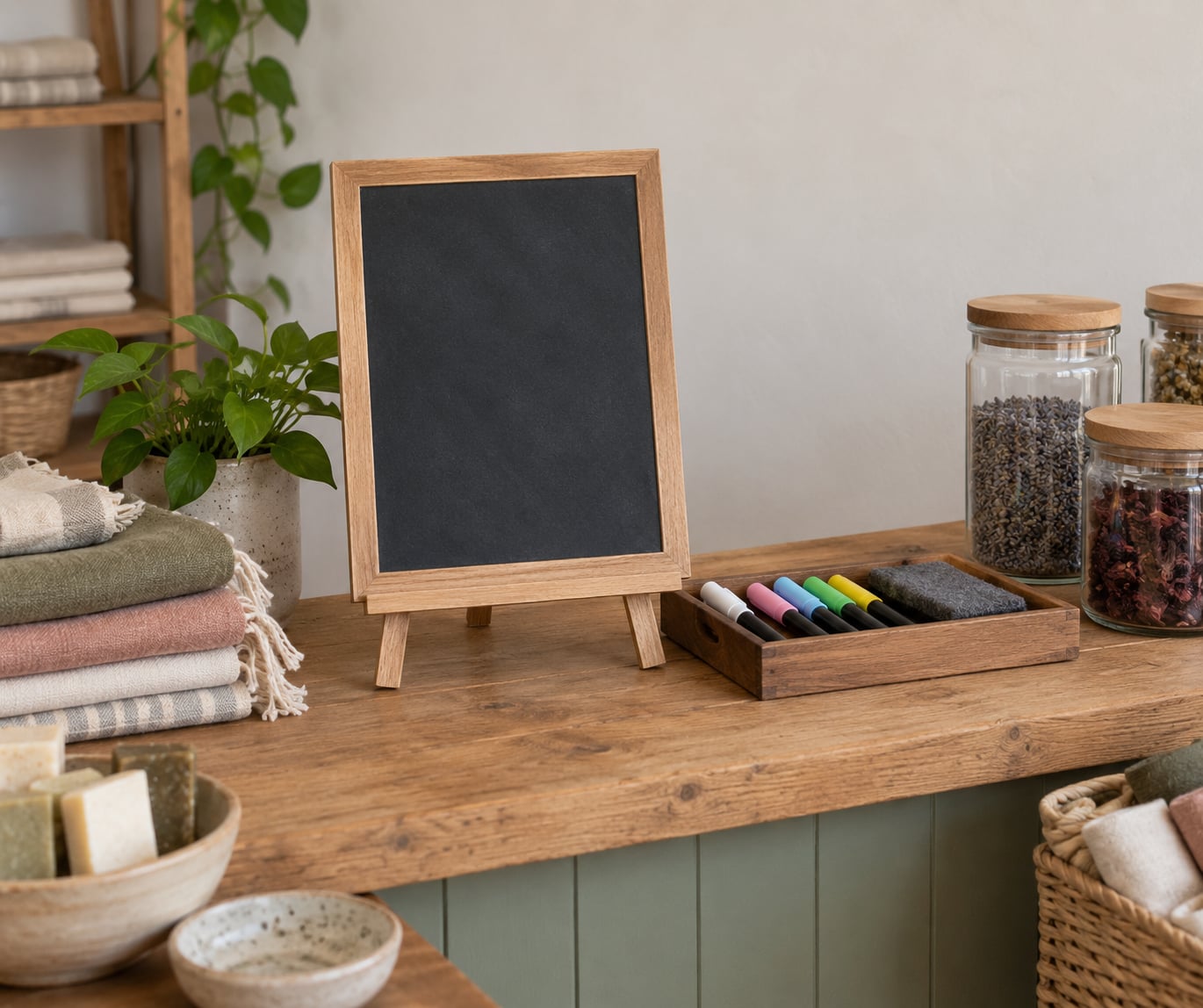
Use two colours, maximum. One white for the message and one accent colour for prices, the featured item or the deadline. Liquid chalk markers in a 1mm tip give clean lines and strong colour payoff, and that fine tip is the one most recommended on shop forums for anything larger than a price tag.
Leave air. An empty inch between sections costs nothing and makes a small board feel deliberate. Filling every corner is the most common reason a chalkboard looks cheap.
Set a rewetting routine. Sponge with water, a drop of mild dish soap, wipe with a cloth, then dry with a hairdryer on cool. That removes marker ghosting that plain dry wiping leaves behind, which is what makes old boards look dirty even when they have been cleaned. For outdoor boards, seal painted surfaces with a clear sealant and stick to waterproof marker tips, and expect a full rewrite after a wet season.
If you are planning to put a board on the pavement, check your local rules first. Sidewalk and A-frame sign permits vary a great deal between US cities and are usually handled by the city rather than the business, and shops on private property face different rules from shops on public sidewalk.
Frequently Asked Questions
What are some creative sign ideas for small businesses?
The ideas that get read are the ones tied to a decision: a daily special, a fresh or local item, changed hours, a sale with a stated end date, an event with a date and a signup instruction, a loyalty reward, or a short notice about payments and parking. Decorative boards without a call to action get photographed rarely and acted on never. Pick one message per board and one board per purpose.
How can I make a DIY chalkboard sign?
Pick a surface, clean it, sketch your layout in chalk first, then letter it with a 1mm liquid chalk marker. Keep the headline at about three inches tall for a board read from three feet, keep lines to four or six words, right-align prices, and use one accent colour. Finish with a sealer if the board sits outdoors, and photograph the result before you erase it.
What should I use to write my menu on a chalkboard sign I have?
Liquid chalk markers give clean lines and bold colour, and a 1mm tip is the most useful size for prices and item names. Traditional chalk suits a brief, informal board and dusts easily. If your board has a magnetic or clip surface, print the menu and swap the sheet rather than rewriting it every time you change a price.
What are the downsides of using a chalkboard?
They smudge while you are writing, they ghost if you only dry-wipe them, they fade in sun and rain, they do not glow at night, and a message left up past its deadline damages trust. Most of those fix with a routine: soapy water and a cool hairdryer, waterproof tips, a clear sealant, and a rule that outdated boards get erased the same day.
What size chalkboard works for a small storefront?
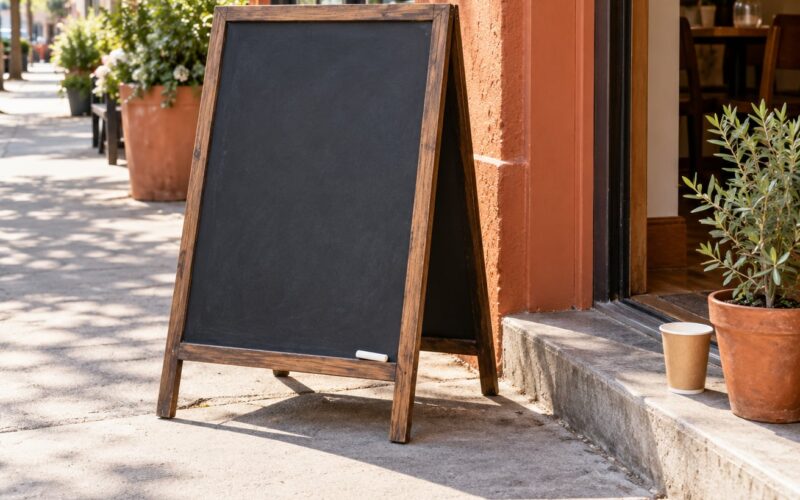
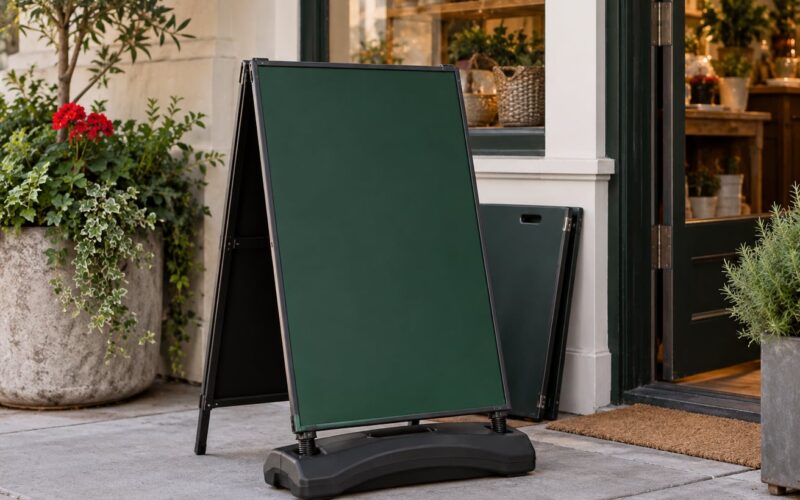
For a shop window or counter, a board around 18 by 24 inches is readable and easy to rewrite daily. A sidewalk A-frame wants to be closer to 24 by 36 inches so it survives being read at an angle. Market stalls have the least room, so a hanging board above the table beats a standing one, since it stays visible over a crowd.
How do I keep chalkboard messages fresh without a designer?
Keep two permanent boards, one for hours and notices and one for branding, then change only the daily or promotional board. Batch the rewriting at the same time each morning, keep a photo of every finished board, and rotate through a monthly list of recurring offers so you are rebuilding a layout you already know works.
Conclusion
Start with one message, not twelve. Write today’s special or today’s hours on a board you already own, keep the headline around three inches tall, right-align the price, and give one reason to act now. Once that works, add a second board for notices and a third for whatever your shop is known for.
Of the twelve ideas here, the daily special, the hours and availability board, and the branding statement are the three worth building first, because they are the ones you will rewrite or keep for months rather than weeks. Photograph each finished board before you wipe it, and those photos become your next season’s inspiration as well as free content for your social accounts.