A business owners policy, usually called a BOP, bundles three coverages into one document: commercial property insurance for your building, equipment and inventory, general liability insurance for claims brought by customers and other third parties, and business income coverage for lost revenue and ongoing expenses after a covered loss. Anything beyond that, such as cyber or equipment breakdown protection, is added by endorsement.
I read BOPs the way most small-business owners do, which is at midnight, after something has already gone wrong. The trouble is that the declarations page is written in a code that nobody outside the industry speaks, so the same three-section bundle can look like a complete answer and still leave a dozen holes in it.
Table of Contents
- What a Business Owners Policy Covers
- Property and Equipment Protection
- How a business owners policy values property
- General Liability Coverage
- Business Interruption and Lost Income
- Common Exclusions and Coverage Gaps
- How Coverage Limits, Deductibles, and Endorsements Work
- How to Check the Policy Before an Incident
- Frequently Asked Questions
- Does a business owners policy cover replacement cost?
- Is business interruption coverage included in a business owners policy?
- What does a business owners policy cover for employee injuries?
- Does a business owners policy cover a customer’s damaged property?
- Do I need a separate policy for a home-based business?
- What to Do First
What a Business Owners Policy Covers
What a business owners policy covers is, at its core, three things: damage to your physical assets, liability to third parties, and the income you lose when a covered damage event shuts you down. Everything else on the policy either attaches to one of those three sections or is an exception to them.
| Coverage | What it protects | Typical scenario |
|---|---|---|
| Commercial property | Building, contents, equipment, inventory, data and property off-site | A freezer fails and thousands of dollars of inventory are lost |
| General liability | Third-party bodily injury and property damage, plus advertising injury | A customer slips on a wet floor and sues |
| Business income | Lost revenue and continuing expenses after covered physical damage | Roof damage from a storm forces a six-week closure |
| Endorsements | Extra protection bolted onto the three core sections | A ransomware attack locks the point-of-sale system |
Property and Equipment Protection
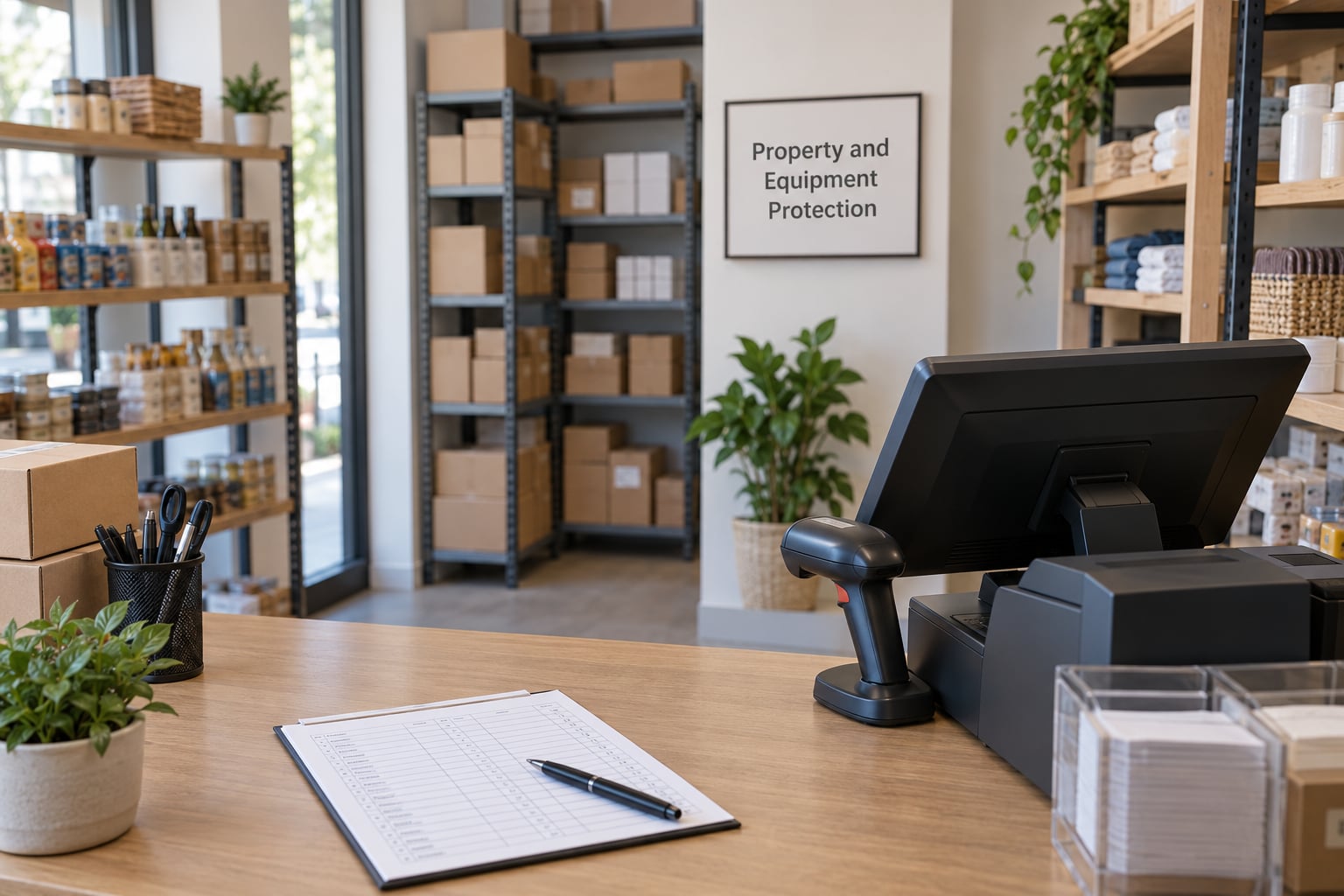
The property section is first-party coverage, meaning it pays on your loss rather than on someone else’s claim. A fire, a burst pipe, a windstorm, a break-in, vandalism and most accidental damage fall inside the covered perils list, which is the specific list of causes named in your policy.
Take a small retail shop. The building, the shelving, the point-of-sale terminals, the computers, the register, the inventory on the racks and the owner-provided fixtures are all property the section responds to, provided the loss traces back to a named cause rather than gradual deterioration.
Contents away from the premises are usually handled too. Inventory at a trade show, equipment stored at a rented warehouse, or a laptop in a consultant’s car falls under coverage as long as it stays off-site for a limited period, which carriers commonly cap at about 30 days. That is one of the details owners most often discover after the fact, so check the length of the off-site provision on your declarations page.
How a business owners policy values property
Two valuation methods decide what you actually collect. Actual cash value pays the item’s worth today minus depreciation, so a five-year-old espresso machine that was new for 8,000 dollars might settle for a fraction of that. Replacement cost pays for a comparable item at today’s price, and that is the version most owners assume they have.
Property you own outright is typically written on a replacement-cost basis, while property leased to you is usually capped at actual cash value, because the lessor has no interest in subsidising your upgrade. A schedule of values attached to the policy is what makes replacement cost work, and if your values are stale the settlement will be based on the stale number.
Some property sits outside the section even when it feels like it should not. Business vehicles, mobile equipment, tools that travel to job sites, and property in the care of others often need inland marine coverage or their own policies. If your business is a contractor, that distinction is the single biggest gap between what you think you have and what you actually carry.
General Liability Coverage
General liability, written on the commercial general liability form, responds when someone outside your business claims they were hurt or their property was damaged because of something your operations did or failed to do. It is third-party coverage, so it never pays for your own injuries, your own damaged equipment or your own legal fees in a dispute with the government.
The two triggers readers hear about most are bodily injury and property damage. A customer falls in your shop, a contractor damages the flooring you were hired to refinish, or a delivery driver backs into your window frame. Each of those lands somewhere in the liability section, and the policy usually pays for the defence lawyer first and the settlement or judgment second.
Personal and advertising injury covers a narrower band: defamation, libel, slander, copyright infringement, and invasion of privacy connected to something you published. For most small businesses this is the part of liability they never think about and occasionally need.
Here is where it stops. Your own employees’ injuries belong to workers compensation, not the BOP. Faulty work or a defective product you sold belongs to professional liability or product liability. A deliberate act by an insured is excluded outright, and most policies exclude damage arising from a contract you signed, which is why contract language matters when a customer sues.
Business Interruption and Lost Income
Business income coverage, the section sometimes called business interruption, replaces the money you would have earned during the period a covered physical loss keeps you from operating. It generally covers two things: the net income the business would have produced, and the continuing expenses such as rent, utilities and payroll that you keep paying even while you cannot earn.
Two time periods control the trigger. The waiting period, commonly 24 to 72 hours, is the stretch after the loss where no payment is due, which is why policies with longer waiting periods cost less. The indemnity period, often set at 6 or 12 months, caps how long the insurer will pay. If your restoration runs past that cap, you absorb the rest.
Everything hinges on your financial records. The settlement is built from the income figures you supplied at application time, so a business that kept clean monthly revenue figures settles faster and higher than one that guessed. Ask your accountant what the insurer needs and keep those records current.
What this section does not do is cover the losses owners most fear. A ransomware attack, a power outage on the utility’s side, a supplier strike, a pandemic closure or a government order are not damage to your property, so they are not covered unless you buy an endorsement that names them. Two popular additions handle this: utility services interruption for a covered breakdown of the utility equipment serving your building, and contingent business interruption for a named supplier.
Common Exclusions and Coverage Gaps
Exclusions are where most denied claims live, and they are written to be skimmed past. These are the ones that catch new business owners out most often.
- Flood and earthquake. Water damage is covered only where the cause is a named peril such as a burst pipe. Rising water from a river, storm surge or a wet foundation is not, and needs separate flood insurance, often through the national flood program.
- Wear and tear, deterioration and maintenance. A roof membrane that fails because it aged, an unmaintained appliance, mould that grows slowly, or damage that would have happened anyway is outside the policy in nearly every form.
- Mechanical or electrical breakdown. Without the equipment breakdown endorsement, a compressor, oven, furnace or data server that fails on its own is not covered even though it sits in your building.
- Employee theft and dishonesty. Standard property and liability sections respond to outside criminals, not to staff who take cash or stock. That gap needs a commercial crime or fidelity endorsement.
- Cyber incidents and privacy breach. A BOP is not a cyber policy. Data breach costs, ransom, forensic work and business interruption from a locked system all need a cyber liability policy with its own limits.
- Professional liability and errors and omissions. Advice given, a missed deadline, bad bookkeeping or a design mistake are professional exposures, not premises exposures.
- Workers compensation and employee benefits. Not part of the bundle in any state. Nearly every state requires the coverage once you have employees.
- Business and hired auto. A company vehicle needs commercial auto. An employee driving their own car to a client site needs hired and non-owned auto coverage, and owners mention this gap more often than any other.
- Contractual liability. Obligations you accept in a written contract are usually excluded unless an endorsement extends liability coverage to them.
- Pollution and intentional acts. Environmental release and anything done deliberately sit outside the standard wording.
Language and endorsements vary by carrier and by state, so treat this list as a reading guide for your own declarations rather than a verdict on your policy.
How Coverage Limits, Deductibles, and Endorsements Work
Limits are ceilings, not promises. The general liability section usually shows two numbers: a per-occurrence limit, which is the most the insurer pays for any single claim, and an aggregate limit, which is the most it pays for all claims combined over the policy term. One million dollars per occurrence and two million dollars aggregate is a common pairing, and the second number is the one that erodes first.
A worked example makes it concrete. Your per-occurrence limit is 1 million dollars and the aggregate is 2 million dollars, with a 1,000 dollar deductible. A customer sues for 400,000 dollars of damages and legal fees. The insurer pays 399,000 dollars, you absorb the 1,000 dollar deductible, and roughly 1.6 million dollars of aggregate capacity remains.
Next year a second claim settles at 1.7 million dollars. The insurer pays it, but the aggregate is now exhausted, and any third liability claim in that same policy term has no room left. That is why owners who carry a heavy claims history get a non-renewal notice or a move to a surplus lines carrier rather than a price adjustment alone.
The deductible is the slice of every covered loss that stays with you, and it applies per occurrence. Raising it lowers the premium; the trade-off is that your own cash has to absorb more on the first claim.
An endorsement modifies the base wording. Some broaden it, such as adding equipment breakdown or spoilage protection. Some restrict it, such as a coinsurance clause that cuts the settlement when your declared property value falls below a percentage of the building’s actual value. Read the endorsements before the declarations page, because they quietly rewrite it.
How to Check the Policy Before an Incident
Ten minutes with the declarations page will tell you more than an hour of guessing. Start there.
- Find the declarations page and write down the named insured, the policy period and the claims number for the carrier and your agent. Those two numbers are what you call at 7am after a loss.
- Match each limit on the page to the coverage section it belongs to, and check that the liability aggregate is at least twice the per-occurrence figure.
- Compare the property values on your schedule with what the equipment and inventory actually cost to replace today, not what it cost when you signed.
- Confirm your business income figures reflect the last full year of revenue, then note the waiting period and the indemnity period in months.
- List every endorsement by name, so you know whether equipment breakdown, spoilage, inland marine or hired and non-owned auto are present or absent.
- Check the covered perils list for the perils specific to your premises, such as water back-up or sprinkler leakage.
- Compare liability limits with what your landlord, clients or government contracts require. Many contracts ask for 1 to 2 million dollars, and a BOP set at 1 million will not satisfy a 2 million requirement without an umbrella.
- Re-run the review after a renovation, an expansion, a new location, a significant equipment purchase or a change in what you sell.
Two details deserve their own habit. Store the claims number on your phone, because searching for it during a loss wastes hours. And ask your agent for a copy of the endorsements, since many policies hide the coverage that matters most on the back pages.
Frequently Asked Questions
Does a business owners policy cover replacement cost?
Usually yes for property the business owns outright, and usually no for property it leases. Owned property is typically settled at replacement cost, meaning a comparable item at today’s price, while leased property is normally capped at actual cash value with depreciation subtracted. The schedule of values attached to the policy decides how much each item settles for, so stale values directly reduce the payout.
Is business interruption coverage included in a business owners policy?
Most BOPs include some form of business income coverage, though it is optional rather than automatic in some policies. It pays lost net income and continuing expenses after a covered physical loss keeps you from operating. It does not cover a cyberattack, a utility outage, a supplier failure or a closure ordered by a government unless an endorsement specifically names that cause.
What does a business owners policy cover for employee injuries?
Almost nothing. The liability section is third-party coverage, so it pays claims brought by customers, visitors and other outsiders, not by your own staff. Injuries to employees fall under workers compensation, which nearly every state requires once you have staff and which carries its own wage and medical benefits. Employers liability coverage usually rides along with it.
Does a business owners policy cover a customer’s damaged property?
Yes, through the property-damage half of general liability, provided the damage arose from your operations or your failure to act. A contractor who scratches a customer’s floor, or a shop that spills cleaning solution on a customer’s rug, both sit inside this section. Limits apply per occurrence, and a deductible usually comes out of the settlement first.
Do I need a separate policy for a home-based business?
Most insurers will write a BOP or a home-office endorsement for a home business, and it is usually cheaper than a homeowners policy rider or a full commercial package. Be careful that the declarations page names the home address, lists business personal property separately from household belongings, and covers business use of the computer and the printer you share with the family.
What to Do First
Start with the declarations page, then read the exclusions and the schedule of values, because that is where a business owners policy quietly stops being the safety net its name suggests. Compare the limits and deductibles against what your operation actually looks like now, not what it looked like at renewal.
Then ask an agent or qualified insurance professional about the four gaps that trip up the most owners: workers compensation, hired and non-owned auto, cyber liability and professional liability. Rules and rating vary by state and change over time, so treat any answer you get, including this one, as a starting point for a conversation rather than a substitute for one.