
A cash reserve for a seasonal business is money you set aside during your strongest earning months and hold in a separate business account, sized to cover your fixed costs through every slow month plus a cushion for what goes wrong. You build it in seven steps: map your 12-month cash flow, work out your low-season essentials, set a target, open a separate account, automate transfers from peak months, trim costs in the quiet stretch, and review the balance every month.
The flat advice to hold three to six months of expenses comes from steady-state businesses that earn roughly the same every month. A seasonal business earns most of its revenue in a short window, so that rule misfires here. Plenty of seasonal operations pull in half their annual revenue or more inside a few months, which means the rest of the year runs on savings you created in summer or during the holidays.
Set aside 5 to 10 percent of every peak-season payment into a dedicated reserve account and the off-season stops being scary. Below is the plan I would hand to any owner whose income arrives in lumps: pool installers, snow removal crews, Christmas tree retailers, surf schools, wedding venues, and seasonal contractors. Updated for 2026.
Table of Contents
- What You Need
- Step-by-Step: How to Build a Cash Reserve for a Seasonal Business
- 1. Measure Your Seasonal Cash Flow
- 2. Estimate Your Low-Season Costs
- 3. Set a Cash Reserve Target for Your Seasonal Business
- 4. Open a Separate Reserve Account
- 5. Create Automatic Transfers
- 6. Reduce Costs During Slower Months
- 7. Review and Replenish the Reserve
- Common Mistakes
- Frequently Asked Questions
- How much cash should a seasonal business keep in reserve?
- Does a seasonal business need more cash than a steady-state one?
- Should a seasonal business keep six months of expenses in cash?
- Where should I keep the money in my business reserve?
- How do I stop dipping into my business emergency fund?
- How fast can a seasonal business build a cash reserve?
- Conclusion
What You Need

None of this needs software you do not already have. You need records, a place for the money, and an honest list of what the business costs when sales stop.
- Twelve months of records, or as close as you have. Bank statements, a profit and loss report, and your sales totals by month. If the business is younger than a full cycle, note that in step 1 and plan around it.
- A separate business bank account for the reserve. Do not build the number before you build the place to keep it, because the moment the money sits in the operating account it starts getting spent.
- Your revenue history by month. Mark which months carry the year, which ones are steady, and which ones run at a loss.
- A list of fixed expenses that never stop. Rent, insurance, utilities, software, loan payments, minimum staff, vehicle costs, professional fees.
- Your tax obligations, written down. Estimated income tax payments, payroll taxes, and any sales tax you collect for others.
- A low-season spending forecast. A realistic monthly number for the months when revenue drops, not the best month you have ever had.
If you can only get your hands on two of those six, get the twelve months of records and the fixed expense list. The rest can be built while the money accumulates.
Step-by-Step: How to Build a Cash Reserve for a Seasonal Business
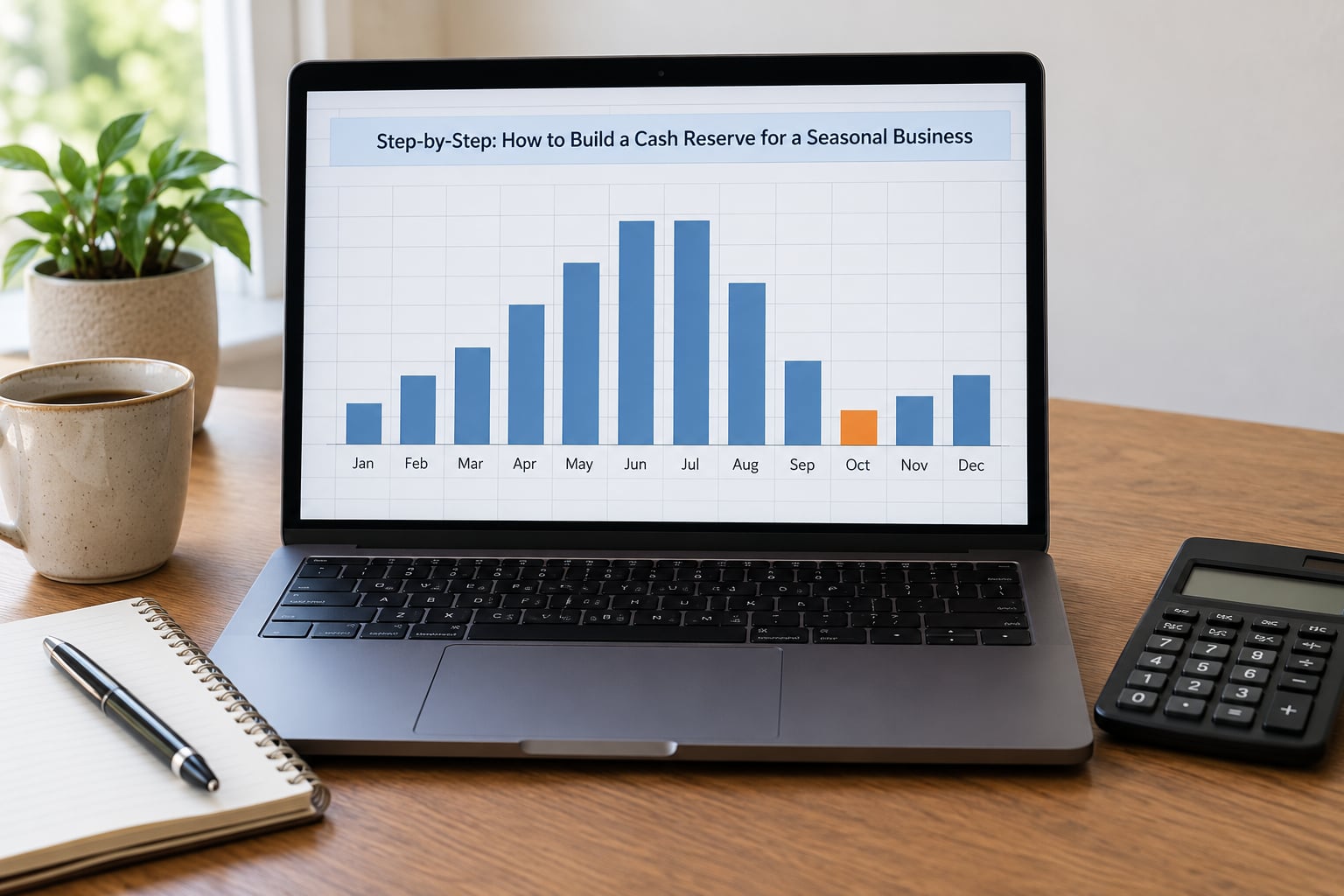
1. Measure Your Seasonal Cash Flow
Pull twelve months of revenue, expenses, and the timing of when cash actually landed in the account. Profit on paper and cash in the bank are different things, and a seasonal business feels that gap hardest when a big invoice is paid 60 days after the work is done.
Divide the year into peak months, shoulder months, and slow months. Then identify the costs that continue no matter what: a leasing company still wants their rent in February, the insurance bill still arrives, and the person keeping the books still needs paying.
You know it worked when you can point to a single low month and say how much cash came in, how much went out, and how many days of runway that left. Owners who run this exercise usually end up seeing, on one page, that their February was funded entirely by December.
In year one, with no history to draw on, do the same exercise with your best guess and build in a 20 percent cushion above it. Then replace the guess with real numbers after the first full cycle.
2. Estimate Your Low-Season Costs
Now write down what the business spends in its slowest stretch. Be specific: an average slow-month number is useless if it hides a loan payment and a seasonal insurance premium in the same line.
Split that list in two. Fixed and essential costs carry on because the business still exists: rent, insurance, utilities, phone and software, loan payments, minimum part-time payroll, vehicle costs, and professional fees such as accounting or payroll service. Discretionary spending is what you chose: paid advertising, subscriptions, travel, meals, and equipment upgrades.
Your reserve target uses the essential number, not the total. Then trim the discretionary side deliberately, because lower spending in the off-season means a smaller reserve and a shorter runway to worry about. Aim for a realistic monthly figure rather than a best-case one; owners who plan on a terrible quarter usually end up with no reserve at all.
3. Set a Cash Reserve Target for Your Seasonal Business
Use this formula:
Reserve target = (low-season fixed monthly essentials – low-season discretionary spending you will keep) x number of low-season months + emergency buffer
Taxes are deliberately not in that formula. Set them aside as their own bucket when the money comes in, so a quarterly estimate never lands on a reserve you already counted as your cushion.
Worked example, using a pool installation business with five low months a year. Fixed essentials in a slow month: 4,000 rent, 850 insurance, 600 utilities, 450 phone and software, 1,250 loan payment, 2,600 part-time payroll, 700 vehicle and fuel = 10,450. Discretionary spending kept at zero because marketing stops in winter. Emergency buffer: 15,000 for an equipment failure or a cancelled installation with a refund owed.
Target = (10,450 x 5) + 15,000 = 67,250. Round it to about 67,000 and write the number on the wall. Compare that to the flat three-to-six-month rule: six months of this business’s average expenses is about 60,000, which looks similar, but it happens to be right only by accident. In a bad year, six months of average expenses could be 50,000 and still leave you short.
Two versions are worth having. The minimum survival reserve covers only low-season essentials, no buffer, and is what you build first. The stronger cushion adds the emergency amount plus one extra month, and it is where you want to be within two or three seasons. Build toward the cushion, but start with the survival figure so you have something to point at immediately.
4. Open a Separate Reserve Account
Open a business savings account at a different bank or credit union than your operating account. Separation is the whole mechanism here: money that is hard to reach in one transfer does not get spent on a supplier who calls.
What matters is access speed, not yield. Look for no monthly maintenance fee, no minimum balance requirement, mobile deposit, and transaction alerts that ping you on every withdrawal. Turn on overdraft protection or keep the account funded above zero, because a returned transfer costs more than a month of interest earns.
| Account type | Liquidity | Typical use |
|---|---|---|
| Business savings | Same day | Operating and emergency buckets, the default choice |
| Money market | Same day, usually by wire | The emergency bucket once it grows past a few months of costs |
| Certificate of deposit ladder | Locked until maturity | Only the portion beyond 12 months of expenses, never the emergency money |
| Business line of credit | Draw on demand, pay interest | Backup for a one-off spike, opened before the peak season, not during it |
Keep money in more than one place only if the second place is not needed for the next twelve months of essential costs. Interest is a nice bonus; being unable to pay payroll in March is not.
5. Create Automatic Transfers
Decide the rule once, then automate it so it runs without your permission. The habit that works for most owners is simple: a fixed percentage off every peak-season payment, moving on a set date, into a separate buffer account. The percentage is the part that works, because peak-month willpower is not reliable.
Work the percentage backwards from your target. In the pool business above, peak revenue runs about 45,000 a month for six months. Sweeping 15 percent of revenue puts roughly 40,000 into the reserve each season, so the 67,000 target is covered in two good seasons rather than five.
| Season type | Low-season months | Suggested sweep of peak payments | Where the money usually goes first |
|---|---|---|---|
| Holiday retail and gift shops | 6 to 8 | 10 to 15 percent | Inventory for the following November and December |
| Summer-only services such as lawn care, pools and camps | 5 to 7 | 15 to 20 percent | Equipment repairs and spring hiring |
| Snow removal and other winter trades | 7 to 9 | 20 to 25 percent | Vehicle payments and the slow summer payroll |
| Tourism, hospitality and wedding venues | 4 to 6 | 10 to 15 percent | Property costs and off-season marketing |
| B2B and contract work with one big payment cycle | 3 to 5 | 25 percent of each large invoice | Payment timing gaps and slow receivable months |
Subtract your tax percentage before you commit, not after. If payroll tax and estimated income tax together take 25 percent of revenue, sweep from what is left. A transfer that empties the operating account is not a reserve strategy, it is a second cash flow problem.
6. Reduce Costs During Slower Months
The fastest way to shrink your reserve requirement is to spend less during the months the reserve is paying for you. Cancel subscriptions you paid for during peak season, pause advertising that only worked while demand was high, and schedule equipment purchases for months when cash is comfortable.
Renegotiate the fixed side where you can. Ask your landlord for a seasonal rent adjustment, ask the software vendor about a lower tier between seasons, and ask your bookkeeper for a monthly retainer instead of a year-end fee that lands in a slow month.
Watch labor specifically. Seasonal hiring is usually the biggest lever, and cross-training staff during the quiet months so you can schedule fewer during the peak saves money in both directions. Do not reach into the reserve for routine bills: the moment it funds a monthly subscription, it stops being a reserve.
7. Review and Replenish the Reserve
Check the balance monthly, on the same day, against a written target. Thirty seconds a month is enough: balance, target, gap, and the date of the next scheduled transfer.
Define two triggers and write them down, because most owners get this wrong. One trigger tells you when to resume sweeping after an emergency withdrawal, for example when the balance drops below 80 percent of target. The other tells you when to stop, for example at 100 percent of target, where extra money in that account starts costing you flexibility for no real benefit.
For every emergency withdrawal, write the amount, the reason, and the replacement plan on the same day. Treat the reserve as a loan to the business. Businesses that keep the reserve intact through a bad quarter rarely need the backup credit at all, and the line of credit is much cheaper when it has never been drawn.
Open that line of credit before your peak season if you can, while the statements look good, and treat it as a bridge for planned spikes like a large inventory pre-buy. Invoice factoring and merchant advances are expensive ways to borrow and can crowd out the cash you are trying to keep. Review your whole plan once a season: if revenue, expenses, taxes or your risk profile changed, the target moves.
Common Mistakes
Most reserve failures are behavioral, not mathematical. These are the ones that come up again and again.
- Counting sales you have not been paid for. An invoice is not cash. Base your sweeps on money that has cleared the bank.
- Using the reserve for ordinary bills. If it covers a normal month, it is an operating account with a different name. Essentials come from revenue; the reserve covers the trough.
- Setting an arbitrary target. A round number chosen in a good month tells you nothing about your low-season essentials. Calculate it from step 2.
- Forgetting the tax obligation. Run a separate tax bucket and pay from it. Estimated payments and payroll taxes do not wait for a slow month to improve.
- Withdrawing without a repayment plan. A withdrawal with no scheduled replacement quietly shrinks your cushion a season at a time.
- Treating the reserve as an investment account. Money that is meant for March does not belong in something you cannot reach in March. Interest never beats a missed payroll.
Two habits fix most of these. Automate the transfers so your own mood in December is not part of the decision, and put the target and the triggers in writing where you will see them monthly. That is the whole plan: a number, an account, a rule, and a date you look.
Frequently Asked Questions
How much cash should a seasonal business keep in reserve?
Size it by low-season months, not by a flat multiple. Take your essential fixed costs in a slow month, subtract the discretionary spending you are willing to cut, multiply by the number of slow months, then add an emergency buffer of roughly one extra month. For a business with five slow months at 10,450 a month and a 15,000 buffer, that is about 67,000. Update the number whenever your costs or your season changes.
Does a seasonal business need more cash than a steady-state one?
Often yes, and for a structural reason rather than a risky one. A steady-state business spreads its costs across revenue that arrives evenly, while a seasonal one must fund several months of rent, insurance and minimum payroll from savings built in a short window. If your low season is long or your revenue is concentrated in two months, your reserve target will be higher than the usual three-to-six-month advice suggests.
Should a seasonal business keep six months of expenses in cash?
Only if your low season plus one buffer month comes out near six months. The number itself is not the goal. Two months of low-season essentials with a small buffer is a legitimate target for a business with two weak months, while a business shut for six months needs far more than six months of average expenses if it also carries debt and equipment costs.
Where should I keep the money in my business reserve?
A separate business savings account is the right starting point. Look for no monthly fee, no minimum balance, mobile deposit and transaction alerts, plus overdraft protection so a transfer cannot bounce. Once the emergency portion grows past a few months of costs, a money market account is a reasonable upgrade. Put only money you will not need for twelve months into a CD ladder.
How do I stop dipping into my business emergency fund?
Write down one sentence defining what the reserve is for: emergencies and planned troughs, never routine bills. Then set two triggers in writing, for example resume sweeping when the balance falls below 80 percent of target and stop at 100 percent. Log every withdrawal with its amount, reason and replacement date. Owners who automate transfers and review monthly report far less temptation.
How fast can a seasonal business build a cash reserve?
It depends on your margin and how short your season is, so work it backwards from the target. In one example, sweeping 15 percent of peak revenue across a six-month season put about 40,000 into the reserve, covering a 67,000 target in two seasons. A business with a ten-week peak and thin margins may need three or four, which is why the first year usually goes toward the minimum survival figure.
Conclusion
Three actions this week, in order. Pull twelve months of records and mark your slow months, then calculate the essential costs you would still pay during them. With that number in hand, open a separate business savings account and automate a transfer of 10 to 15 percent of your next strong month into it.
That is enough to start. The target grows every season you sweep, and once it is reached you stop at the trigger and keep it there.