Learning how to finance a work van comes down to four things: know exactly what the van has to do, budget the full monthly cost rather than just the payment, compare options on total cost and APR instead of headline monthly figures, and get preapproved before you walk into a dealership. Most owners who get a good deal do those four things in that order, and most who end up disappointed did them backwards.
The whole process takes a few days of paperwork and an afternoon of lender shopping. Rates, credit thresholds and tax rules vary by lender and by state, so treat every number here as a range to check against your own situation.
Table of Contents
- What You Need
- Step-by-Step: How to Finance a Work Van
- 1. Define How You Will Use the Work Van
- 2. Set a Monthly Budget and Down Payment
- 3. Compare the Main Ways to Finance a Work Van
- 4. Check the Interest Rate and Total Cost
- 5. Get Preapproved Before Shopping
- 6. Inspect the Van and Review the Contract
- 7. Complete the Purchase and Set Up the Van
- Common Mistakes
- Frequently Asked Questions
- Can I finance a work van with bad personal credit?
- Do I need a business loan to buy a van for my company?
- Should I buy or lease a work van?
- What documents do lenders need for vehicle financing?
- Can I use a work van loan for a personal vehicle?
- Conclusion
What You Need
Lenders want to see two things before they price anything: who is borrowing and what they are buying. Gather the following before you apply anywhere, because a missing document is the most common reason a good application stalls.
Business and identity records
- Driver’s license and social security number for everyone who will be on the loan
- EIN if you have an LLC or corporation, plus your state formation documents
- Articles of organization, operating agreement or business license where one is required
- Two years of business tax returns, or year-to-date 1099s if you are newly self-employed
- Three to six months of business bank statements
- Existing loan statements so the lender can see current monthly debt
- Proof of residence
Details about the van itself
- Year, make, model and trim, or the VIN of the specific van you want
- Mileage and whether it is new or used
- Payload and towing needs, especially if you plan a rack, ladder rack or utility body
- Where it will be garaged and driven
Your credit picture
Know your personal credit score before you apply, and your business credit score if you have been operating for more than a year. Both get read, and it helps to know which one is the weaker of the pair.
The down payment
Decide how much cash you can put down without touching working capital. Sellers usually want 10 to 20 percent, and anything you contribute lowers the amount you actually borrow.
Step-by-Step: How to Finance a Work Van
1. Define How You Will Use the Work Van
Start with mileage, because it drives everything else. A landscaping crew running 30,000 miles a year and a mobile installer running 12,000 miles a year need very different vehicles and very different payment structures.
Write down the annual mileage you genuinely expect, the payload you need to carry, whether you need to tow anything, and the smallest parking space you have to fit into. Roof height is the one that quietly decides a lot of purchases: a high-roof van may not fit your garage, your parking structure or your loading bay.
Then decide the business-use split. A van used only for work and never for personal errands is treated very differently by both lenders and the tax code than one shared with family. Keep a mileage log from day one, because that log is the evidence behind both.
2. Set a Monthly Budget and Down Payment
Build the real monthly number, not the payment a salesperson quotes. Add the payment to sales tax, registration, commercial auto insurance, fuel, tires, oil changes, and a reserve for repairs.
Then add the costs people forget. Shelving, racking, a ladder rack or a contractor body can run into the thousands, and if you are financing those, they belong in the total budget too. On r/smallbusiness, owners who bought rather than leased said it plainly: the van was going to be customized, and you cannot customize a lease the same way.
A good rule is to keep total van costs under 10 to 15 percent of monthly gross revenue. For seasonal income, test that ratio against your slowest three months, not your best one. Owners on r/personalfinance who had just lost their truck to a transmission failure described financing a used van with a few thousand saved as the realistic path, which matches this framing.
Once the budget is set, pick the largest down payment you can make without emptying your operating reserve, and the longest term you can genuinely survive. A bigger down payment buys a lower total cost. A longer term buys a lower payment and a higher total cost. You only get one of those, so decide which one matters more to you.
3. Compare the Main Ways to Finance a Work Van
There are five routes worth comparing, and they differ on ownership and upfront cost more than on the monthly number.
| Option | Upfront cost | Do you own it at the end | Maintenance and wear | Best fit |
|---|---|---|---|---|
| Dealer finance | Down payment plus taxes and doc fees | Yes | Yours | Convenience at the point of sale, or a promotional rate |
| Bank or credit union auto loan | Down payment, lowest fees | Yes | Yours | Owners with solid credit and time to shop |
| Commercial vehicle loan | Down payment, sometimes fees | Yes | Yours | Larger cargo vans, vans with racks or upfit, fleet buyers |
| Lease | Drive-off payment, tax and acquisition fee | No, unless you buy the residual | Often included or near-included | Owners who want a new van every few years and drive predictable mileage |
| SBA 7(a) loan | Down payment plus lender fees | Yes | Yours | Buyers who want a longer term or have little equity to contribute |
Two notes on the table. On forums like expeditionportal.com, owners report that some credit unions will finance above the retail guide value, which gives a real negotiating edge at the dealer. And on leases, read the excess-mileage rate before signing: a contractor running 30,000 miles a year can turn a reasonable-looking lease into an expensive one at the end.
4. Check the Interest Rate and Total Cost
The monthly payment is a function of four inputs: price, down payment, APR and term. Ask for the APR, not the interest rate, and ask for the total of payments and the total finance charge, both of which are required disclosures in a US retail installment contract.
Here are rough principal-and-interest examples at three APR bands. They assume no down payment and exclude taxes and fees, so the real payment is higher. Rates move with the market and with your credit, so treat these as a range to argue within rather than an offer.
| Van price (USD) | 60 months at about 6.5% | 60 months at about 9.5% | 60 months at about 12.5% | 72 months at about 9.5% |
|---|---|---|---|---|
| 30,000 | about 587 | about 630 | about 675 | about 548 |
| 40,000 | about 783 | about 840 | about 900 | about 731 |
| 55,000 | about 1,076 | about 1,155 | about 1,238 | about 1,005 |
| 70,000 | about 1,370 | about 1,470 | about 1,575 | about 1,279 |
Read that table twice. Moving from 60 to 72 months at 9.5 percent drops the payment on a 40,000 USD van by roughly 110 a month and adds thousands in interest over the life of the loan. If a deal only works at 72 months, that is a budget problem, not a financing problem.
Also price the options that change the total rather than the payment. A balloon or stated-payment structure lowers the monthly figure and leaves a large sum due at the end. Extended service products, doc fees, electronic filing fees and accessory packages are all negotiable line items, and the ones bundled at signing are rarely discounted.
Pay attention to prepayment terms too. A loan with a penalty for early payoff is a poor choice for a business that expects a good year and wants to clear the balance.
5. Get Preapproved Before Shopping
This is where most owners protect themselves. Preapproval tells you what rate band you qualify for before you negotiate, and it turns the conversation from what payment can you afford to what is the rate on this loan.
Understand the two kinds of credit inquiry. A prequalification or preapproval usually uses a soft inquiry that does not affect your score, while a formal application right before signing uses a hard inquiry. Shopping for loans means one hard pull at the end, not one per dealer visit. That concern comes up constantly in small business groups, and the fix is simple: get preapproved with one or two lenders first, then let the dealer try to beat that rate.
On which file gets pulled, expect the personal credit report to carry most of the weight on a vehicle loan, even for an LLC purchase. The business credit file and business tax returns matter more for larger commercial loans. Ask any lender directly which reports they will use; the answer separates the ones who understand business borrowers from the ones who do not.
If your business is new, expect to lean on personal credit, personal income and sometimes personal collateral. Lenders also look at commercial auto coverage before they approve, so get an insurance quote early.
6. Inspect the Van and Review the Contract
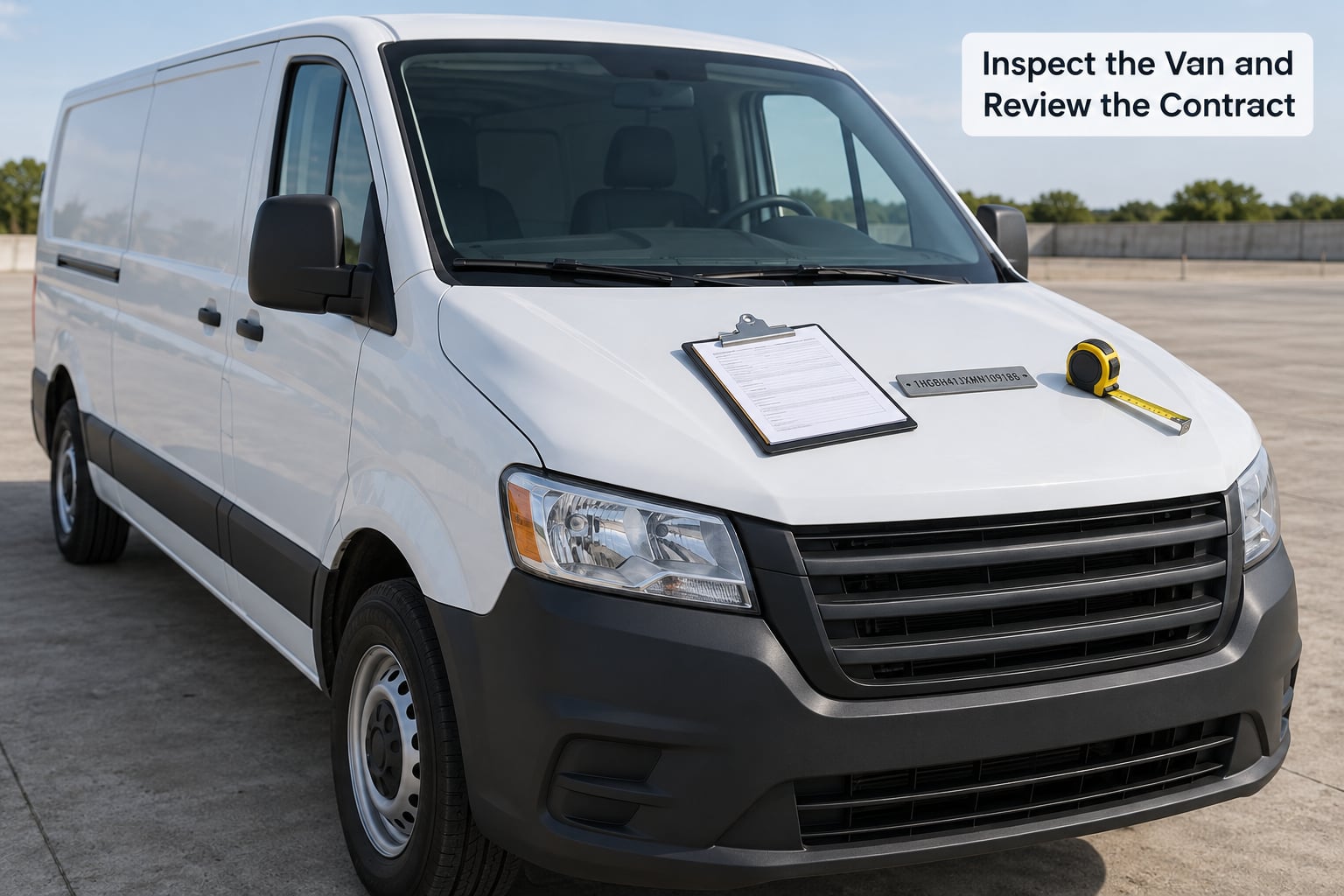
Take the van for a proper look before you discuss numbers. Check the VIN against the window sticker and the title, confirm the title is clean and in the seller’s name, read the odometer, and look for accident repair, tire wear and fluid leaks. For a used van, an independent pre-purchase inspection is a few hundred dollars and routinely saves far more than that.
Then read the contract line by line. Confirm the APR, the term, the monthly payment, the total of payments and the finance charge all match what you were quoted. Look for prepayment penalties, mandatory add-ons, arbitration clauses, late fees and any GAP product folded in without discussion.
Financing disclosure documents let you take the deal to another lender before committing, and some states give cooling-off rights you should know about. Ask for the blank copy if you want to shop the deal elsewhere, and never sign a contract that still has unfilled blanks in it.
7. Complete the Purchase and Set Up the Van
Once the lender approves and you sign, the money goes to the seller and the title transfers. Put the van in the business name, register it, and get a commercial auto policy in place before you drive it. A personal policy frequently excludes commercial use, so tell the insurer exactly what the van does.
From day one, keep a mileage and expense log for the van and take photos of any upfit work before and after. Then track the payment, insurance, fuel and maintenance as separate line items each month so the van’s real cost is visible, not blended into a general overhead figure.
On tax, ask your accountant rather than trusting a forum answer. Depreciation and expense deductions such as Section 179 can reduce the after-tax cost substantially, but vans with heavy passenger capacity or high gross vehicle weight can be subject to additional restrictions that reduce the benefit. The rules change, and the answer depends on your specific van and how you use it.
Common Mistakes
Shopping on the monthly payment alone. A lower payment on a longer term is more expensive in total. Ask for the total of payments before you react to anything.
Stretching the term to 72 months to make the number fit. If the payment only works at 72 months, buy a less expensive van or put more down.
Applying with maxed-out credit cards. High balances are the fastest way to move into a higher rate tier. Pay the minimums down before you apply.
Applying through several dealers before getting preapproved. You give up your negotiating position and risk multiple hard pulls. Preapprove first.
Forgetting the upfit and running costs in the budget. Shelving, racks, insurance and maintenance decide whether the payment is affordable, not the loan rate.
Insuring it as a personal vehicle. Personal policies often exclude commercial use, and a gap after a claim can end the business relationship with your lender.
Frequently Asked Questions
Can I finance a work van with bad personal credit?
Yes, usually. Bad credit costs you rate, not access. Expect a higher APR, a larger down payment or a shorter term instead of a 60 or 72 month loan. Credit unions, online lenders and commercial van specialists lend below 700, and many work at 580 and under. A trade-in, a down payment of 10 percent or more, and steady operating cash flow improve approval odds more than anything else.
Do I need a business loan to buy a van for my company?
No, most vans are financed with an auto or commercial vehicle loan, not a general business loan. The lender finances the vehicle and takes a lien on it. For a newly formed company with no filed accounts, the personal credit of the owner usually carries most of the weight, so expect to be approved on your personal file with the business as the co-borrower.
Should I buy or lease a work van?
Buy if you plan to keep it more than a few years, customize it, or drive well past the lease mileage allowance. Lease if you want a new van every few years, drive a predictable annual mileage, and would rather hand maintenance and wear to someone else. Contractors driving heavy annual mileage should be careful with lease excess-mileage rates, which can be steep.
What documents do lenders need for vehicle financing?
Typically a driver’s license, social security number or EIN, business formation documents, two years of tax returns or year-to-date 1099s, three to six months of business bank statements, current loan statements, proof of residence, and proof of commercial auto insurance. Documentation requirements vary a lot by lender, so ask for an exact list before you start collecting.
Can I use a work van loan for a personal vehicle?
Generally no. A vehicle loan is secured by the specific vehicle it finances, so the funds go toward that van and the lender places a lien on it. Using business van financing to buy a personal vehicle, or repaying a van loan with a different vehicle, breaks the agreement and risks default. Ask the lender directly about any exception before you sign.
Conclusion
Work out what the van has to do before you look at a single payment figure, then budget the full monthly cost including insurance, fuel, maintenance and upfit. Compare offers on APR, term and total of payments rather than the monthly number, and get preapproved with one or two lenders so you walk into the dealership already holding a rate. If you finance a work van with those four steps in that order, you will know what you agreed to and why.