Sales tax basics for small retailers come down to three things: know when you have nexus, charge the right rate on the right items, and file the collected money on time. There is no federal sales tax in the United States. Each state and local authority sets its own rules, and 45 states plus most local jurisdictions levy some form of it.
If you sell tangible goods, whether from a storefront, a craft table at a market, or a website, you may already be liable to collect tax. This guide walks through the mechanics without the jargon, and it flags the places where you should confirm the answer with your own state revenue department.
Table of Contents
- What Is Sales Tax, and Who Needs to Collect It?
- Sales tax is not the only tax you will meet
- Do I Need to Register for Sales Tax?
- Which Products and Services Are Taxable?
- Sales tax basics for small retailers come down to a per-item decision
- How Do I Calculate Sales Tax on a Purchase?
- Do Sales Tax Exemptions Apply to My Customers?
- How Should a Small Retailer Collect and Record Sales Tax?
- How Do I File a Sales-Tax Return?
- What Should I Do for Marketplace, Online, and Out-of-State Sales?
- Common Sales Tax Mistakes and How to Avoid Them
- Sales Tax Basics for Small Retailers: A Simple Compliance Checklist
- At the end of every day
- Every month
- Each filing period
- Frequently Asked Questions
- What is a simple definition of sales tax?
- Do I pay sales tax on my small business?
- Do I need a sales tax permit if I am just starting out?
- What is the difference between sales tax and use tax?
- How do I avoid paying sales tax as a reseller?
- What items are exempt from sales tax in New Jersey?
- Conclusion
What Is Sales Tax, and Who Needs to Collect It?
Sales tax is a pass-through tax on retail purchases. The seller adds a percentage to the price at checkout, collects that money from the buyer, and remits it to the taxing authority on a schedule. The money is never yours to keep or spend, which is why a strong cash cushion matters before your first payment date.
A retailer has to collect it when the state says the retailer has nexus with that state and the sale is taxable. Retailers, unlike consumers, are the party the state holds responsible for the money.
Sales tax is not the only tax you will meet
| Tax | Who pays it | What it covers |
|---|---|---|
| Sales tax | Buyer, collected by seller | Retail purchases of taxable goods and services |
| Use tax | Buyer, often self-assessed | Out-of-state purchases where no sales tax was charged |
| Excise tax | Usually the seller | Specific goods such as alcohol, tobacco, or fuel |
| Income tax | Business owner | Profit earned, paid on your personal or business return |
You might also see a state gross receipts or franchise tax. That is separate from sales tax and does not replace the obligation to collect and remit.
Do I Need to Register for Sales Tax?
You register when you have nexus in a state. Most retailers cross that line in one of four ways, and a single store can create nexus for several of them at once.
| Type of nexus | What triggers it | Typical example |
|---|---|---|
| Physical nexus | Any place of business, employee, inventory, or event in the state | A shop, a home office used regularly, a warehouse, a trade show booth |
| Economic nexus | Sales or transaction volume above a state threshold | Online sales exceeding a state’s dollar or transaction count |
| Marketplace nexus | Sales made through a marketplace facilitator | Orders fulfilled and sold by a large online marketplace |
| Click-through nexus | Advertising that sends customers to your own site | Paid ads in another state that route to your checkout |
Economic thresholds differ by state and are revised regularly. A widely used starting point is roughly 100000 dollars in sales or 200 transactions in a calendar year, but several states now count a lower dollar figure or a higher transaction count, and some still use only one of the two measures.
Registration is generally handled through your state revenue department’s online portal, and there is usually no fee. Some states ask for a surety bond or an advance deposit before you can file, and those can be released later.
Marketplace sales deserve their own note. When a marketplace facilitator sells and ships the item itself, it usually handles collection and remittance in that state, which can remove your economic nexus there. If you list on a marketplace but ship from your own inventory, the rules can work the opposite way, so read the marketplace’s seller terms carefully rather than assuming.
If you have been selling without registering, a voluntary disclosure agreement is available in many states. It gives you a defined path to come into compliance for a limited period with reduced penalty exposure, and penalties are generally waived when you come forward voluntarily. A CPA or enrolled agent can tell you whether it makes sense in your case.
Which Products and Services Are Taxable?
Most things you can put in a shopping bag are taxable. The exceptions are narrower than most new retailers expect, and they vary a great deal from state to state.
| Category | Typical treatment | The detail worth checking |
|---|---|---|
| Clothing and general merchandise | Taxable | Some states exempt clothing below a price threshold at set times of year |
| Groceries | Exempt in many states | Prepared food, candy, and soft drinks are often taxed even when groceries are not |
| Medicine and medical supplies | Often exempt | Prescription rules differ from over-the-counter rules |
| Digital goods and streaming | Taxed in most states | Treated as goods in some states and services in others |
| Services | Taxable in many states | Repairs, installation, subscriptions, and business services differ state by state |
| Alcohol and tobacco | Excise tax plus sales tax | Separate permits and filings of their own |
Sales tax basics for small retailers come down to a per-item decision
Assign a tax category in your point-of-sale system to every product you sell, and revisit it when your state updates its rules. A single mixed basket needs line-level treatment, so a basket with exempt groceries and taxable cleaning supplies is taxed only on the taxable portion.
Bundled goods get tricky. When items are sold together as one package at one price, many states tax the whole package based on the least exempt component. Sell the components separately and the treatment can differ. If you sell kits, candles with holders, or gift baskets, check your state’s guidance on composite transactions.
How Do I Calculate Sales Tax on a Purchase?
Calculate tax in three steps: find the taxable base, apply the combined state and local rate for the delivery address, then round the result the way your state requires.
The rate comes from two places. The state sets a base rate, and county, city, district, and special transit authorities can add their own on top. The sum is the combined rate, and it changes street by street within a single city.
Worked example with fictional figures:
- Merchandise subtotal: 84.00 dollars
- Less one exempt item: 12.00 dollars
- Taxable base: 72.00 dollars
- Combined state and local rate at the delivery address: 7.25 percent
- Tax due: 5.22 dollars
- Total charged to the customer: 89.22 dollars
Most states round the tax to the nearest whole cent, with a few rounding up to the next cent instead. Set your system to match your state’s rule and stop thinking about it.
Where the sale is sourced matters as well. The large majority of states, and all of the destination-based states, use the customer’s delivery address to pick the rate. A small number still use origin-based sourcing, where the rate comes from your store’s location. Which one applies to you is a state-level fact you should confirm rather than infer from neighboring states.
Do Sales Tax Exemptions Apply to My Customers?
Sometimes, and only when the customer hands you the right paperwork. There are two documents that get confused with each other, so it is worth separating them.
A resale certificate says a buyer intends to resell the goods and is registered to do so. When you accept a valid one, you can take the sale out of your taxable sales. It does not exempt your own purchases from use tax. An exemption certificate covers a specific exempt category, such as a qualifying organization, a prescription, or a tax-exempt resale, and it only covers what it names.
Never accept a resale certificate without checking it. Most states let you verify a certificate number online in a few seconds, and some will tell you immediately that it is invalid or was never issued. You can charge the tax and then refund it once the paperwork clears, but you cannot charge the tax on the strength of a customer’s word alone.
Keep the documentation with the transaction record, not in a shoebox. The exemption is only defensible if you can produce the certificate that supported it at the moment of sale, and an audit can reach back several years.
How Should a Small Retailer Collect and Record Sales Tax?
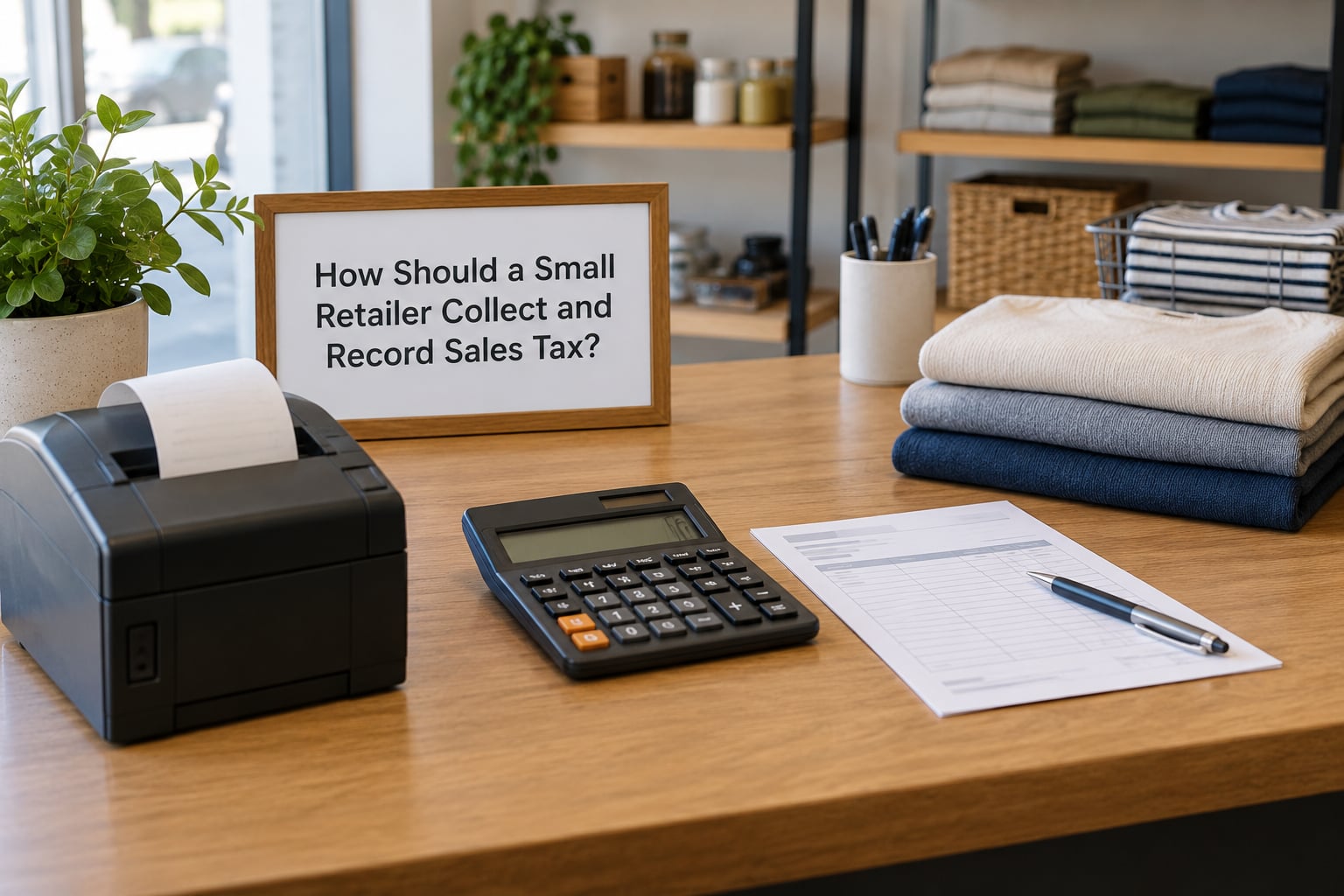
Let your point-of-sale system do the arithmetic, and let it write down the answer. Hand-calculating tax on a busy weekend is where errors enter the file, and errors are what an auditor finds first.
A workable daily routine takes a few minutes:
- Close out the register and confirm the day’s tax total matches the software report.
- Separate the tax money from your operating cash before it gets spent.
- Review any exemptions granted that day and make sure each one has documentation attached.
- Check refunds issued and take back the tax portion that came with them.
- Store the receipts and reports in one dated folder per filing period.
Two details catch out new retailers. Discounts matter: if you take the discount off before tax, tax is computed on the lower amount, and some states handle post-discount coupons differently from pre-discount ones. And shipping charges matter, because some states include taxable shipping in the base and others do not. Configure both once and let the system apply the rule to every sale.
If you use Square, Shopify, Clover, or a similar platform, check whether sales tax reporting is included or sold as an add-on before adding a separate filing tool. Small catalogs rarely need both.
How Do I File a Sales-Tax Return?
Returns are periodic, and the common cadence is monthly, quarterly, or annually depending on your sales volume and your state’s rules. Filing frequency is set when you register and it can usually be changed if your volume grows or falls.
Most returns follow the same shape. You report gross sales, then subtract exempt sales and refunds to arrive at taxable sales. You multiply by the rates that apply to each jurisdiction, total the tax due, subtract any prepayments you already made, and pay the balance.
Small example with fictional figures:
- Gross sales for the quarter: 48,000 dollars
- Exempt sales: 6,500 dollars
- Refunds issued: 900 dollars
- Taxable sales: 40,600 dollars
- Weighted average combined rate: 6.5 percent
- Tax due: 2,639 dollars
- Advance deposit already paid: 500 dollars
- Balance to remit: 2,139 dollars
File a zero return when you had no taxable sales in the period. Many states treat a missing return the same as a late return, with penalties attached, so file the zero and keep the confirmation.
If you fall behind, contact the state before the deadline passes. A payment arrangement is usually available, and an installment plan beats a collection action. If your delay stretches back years, look into a voluntary disclosure agreement before the state finds it first.
What Should I Do for Marketplace, Online, and Out-of-State Sales?
Selling through someone else’s platform and selling through your own website create very different obligations, and mixing them up is a common and expensive mistake.
On a marketplace such as a large online marketplace or an Etsy-style site, the platform is generally the seller of record for that order. It collects the tax, remits it, and issues you a remittance report. Keep those reports, because they are the proof that you did not collect that money yourself.
On your own website, you are the seller. Once your sales cross a state’s economic nexus threshold, you are responsible for collecting in that state, registering there, and filing there. Inventory location matters too. A seller using fulfillment by a third party can pick up nexus in states where stock sits, and that can happen without any sale being made in those states at all.
For sales made face to face outside your home state, whether at a market, a festival, or a trade show, check the host state’s rules before you set up a booth. Several states require a permit or a temporary event license regardless of how brief the event is.
On the buying side, use tax applies to the equipment, fixtures, and supplies you purchase for the shop when no sales tax was charged. Track those separately and remit them on your return, because they are your obligation, not your customer’s.
Common Sales Tax Mistakes and How to Avoid Them
- Charging one flat rate everywhere. A single store-wide percentage understates tax in high-rate jurisdictions and overstates it in low-rate ones. Pull combined rates by address instead.
- Taxing exempt items anyway. Groceries and prescription items are frequently exempt. Audits routinely test the item mix, and overcollection comes back out.
- Taking a resale certificate and never checking it. Verify the number online at the time of sale and file the certificate with the transaction.
- Ignoring refunds. The tax portion of a refunded sale comes back off your next filing. Not subtracting it inflates your taxable sales.
- Missing the zero return. A period with no sales still needs its return filed in most states.
- Assuming a marketplace handled your own website orders. Facilitator coverage applies to the marketplace’s orders, not to sales you make directly.
- Letting the register, the bank account, and the return disagree. Reconcile monthly so the report you file matches the money that moved.
- Waiting too long to ask for help. A single question to your state revenue department, or a short consult with a CPA, is cheaper than a notice with penalties attached.
Sales Tax Basics for Small Retailers: A Simple Compliance Checklist
Put these on a recurring schedule so compliance becomes routine rather than a project.
At the end of every day
- Confirm the register total matches the sales report.
- Move tax collected out of your operating cash.
- Attach exemption documentation to each exempt transaction.
Every month
- Reconcile collected tax against deposits made.
- Check whether you have crossed a nexus threshold in any state.
- Review rate changes at addresses where you have regular customers.
- Back up transaction records and certificates.
Each filing period
- Prepare the return, file on time, and save the confirmation number.
- Pay the balance by the deadline, or set up an arrangement before it passes.
- File a zero return if you had no taxable sales.
- Review whether your registered jurisdictions match where you actually sold.
Keep records for as long as your state requires, which is commonly several years, and longer if you are ever under audit or disputing a filing.
Frequently Asked Questions
What is a simple definition of sales tax?
Sales tax is a percentage-based tax on retail purchases that the seller collects from the buyer at checkout and remits to the state or local tax authority. The money is held in trust and is never the retailer’s to keep. The United States has no federal sales tax, so rates come from state and local governments and range widely depending on the address.
Do I pay sales tax on my small business?
You collect sales tax from customers on taxable sales, and you pay it to the state. You also owe use tax on things you buy for the business when no sales tax was charged. That is separate from income tax and self-employment tax, which apply to your profits, and separate from excise tax on specific goods. Each is filed on its own form with its own schedule.
Do I need a sales tax permit if I am just starting out?
Most likely yes, as soon as you make a taxable sale. Selling taxable goods without a permit is exposure from the first transaction, because uncollected tax becomes the retailer’s own debt and penalties accrue on top. Registration is usually free and online. Some states require a permit even for occasional events, and selling without one can put your license or business at risk.
What is the difference between sales tax and use tax?
Sales tax is charged by a seller at the point of sale. Use tax is the same kind of tax applied to purchases where no seller collected it, typically when you buy something from another state or from a supplier that does not charge sales tax. For a retailer, use tax is usually owed on your own purchases of fixtures, equipment, and supplies that came without tax.
How do I avoid paying sales tax as a reseller?
You do not avoid sales tax, you collect it on the sale and remit it, and you avoid paying sales tax on the purchases you make for resale by holding a valid resale certificate. Take the sale out of your taxable sales when a buyer presents a valid certificate, verify the certificate number online, and file it with the transaction. Your own supplier still applies use tax if no exemption was documented.
What items are exempt from sales tax in New Jersey?
New Jersey exempts many grocery items, prescription medicine, paper and plastic bags, and certain property used in manufacturing, with rules that change and are published by the state. Exemptions vary well beyond New Jersey, so treat any single-state list as a starting point. Check the current state guidance before pricing, and remember that prepared food, candy, and soft drinks are often taxed even when groceries are not.
Conclusion
Start with your own state. Register, get a sales tax permit, and confirm which of your products are taxable before your next sale. Then set your point-of-sale system to pull combined rates by address and file on the schedule your state assigned you.
Rules and rates change, and states differ in ways that a general guide cannot capture. When a question comes up that your state answers better than anyone else, that is what your revenue department is for.