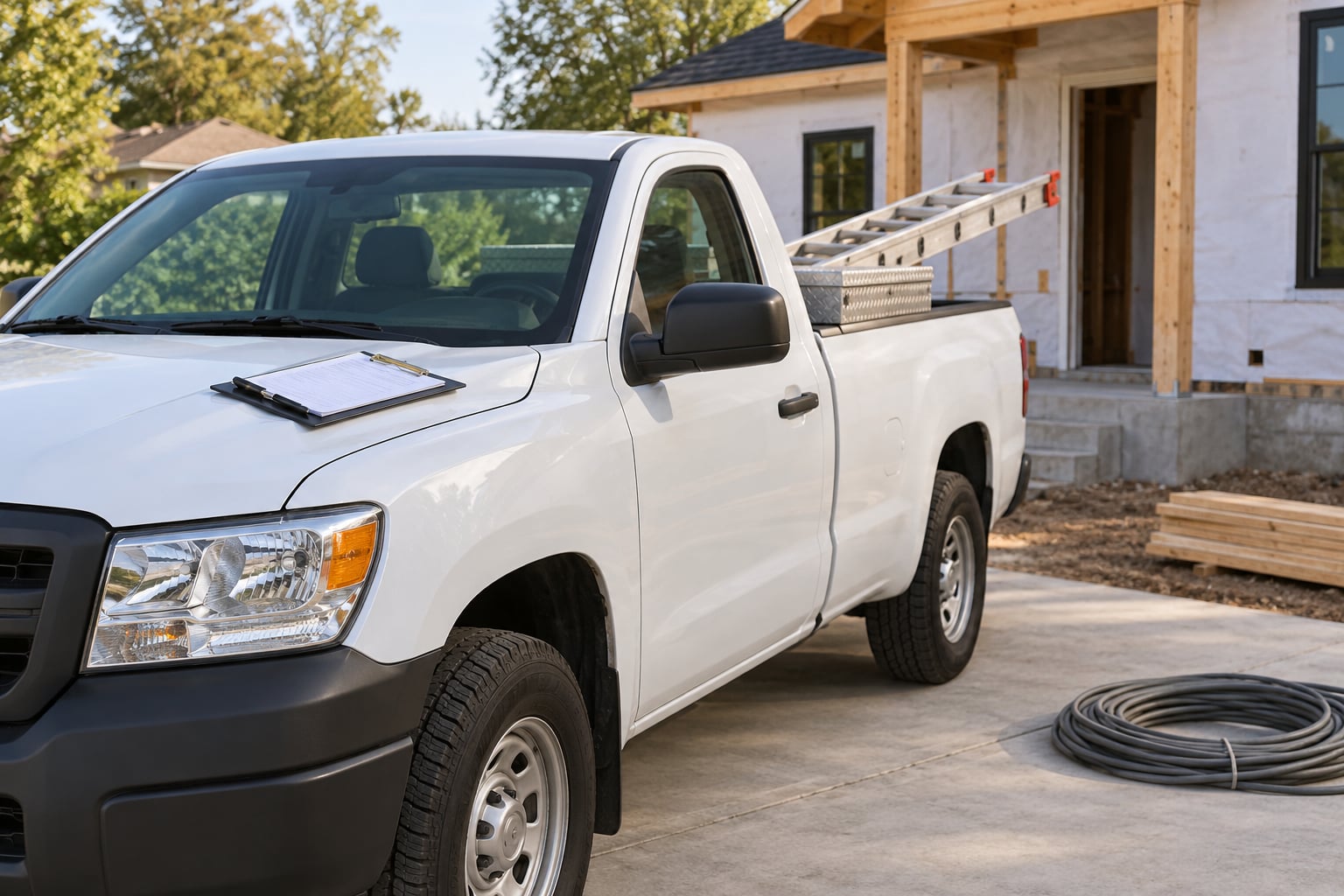
Do you need commercial auto insurance for a work truck? In most cases where the truck earns money, hauls work gear, or carries people on the job, yes. Personal auto policies are written for private driving, and most of them exclude the vehicle the moment it starts hauling tools, serving customers, or driving from one job site to the next. What the truck does decides the question, not whose name is on the title.
This guide walks through the triggers that require commercial coverage, what a personal policy genuinely excludes, how to handle employees who drive their own trucks, and what to gather before you ask for a quote. It is general information, not insurance advice. Rules and rates differ by state and change, so confirm your situation with a licensed insurance professional.
Last updated: October 2026
Table of Contents
- Do You Need Commercial Auto Insurance for a Work Truck?
- What Is Commercial Auto Insurance?
- How Business Use Changes Your Coverage
- Do You Need It if You Own the Work Truck?
- Do You Need It for Employee-Operated Vehicles?
- What if the Truck Is Used for Both Personal and Business Purposes?
- What Does Commercial Auto Insurance Usually Cover?
- Do You Need a Separate Policy or an Endorsement?
- What Documents and Details Should You Give an Insurer?
- What Happens If You Don’t Have Commercial Auto Insurance?
- Frequently Asked Questions
- Can I use my personal auto insurance for a work truck?
- Is a work van or pickup automatically covered under a personal auto policy?
- Do I need commercial auto insurance if an employee drives their own truck for work?
- What if my work truck is registered to my personal name?
- Are commercial auto insurance requirements the same in every state?
- How much commercial auto insurance do I need for a small business?
- Bottom Line
Do You Need Commercial Auto Insurance for a Work Truck?
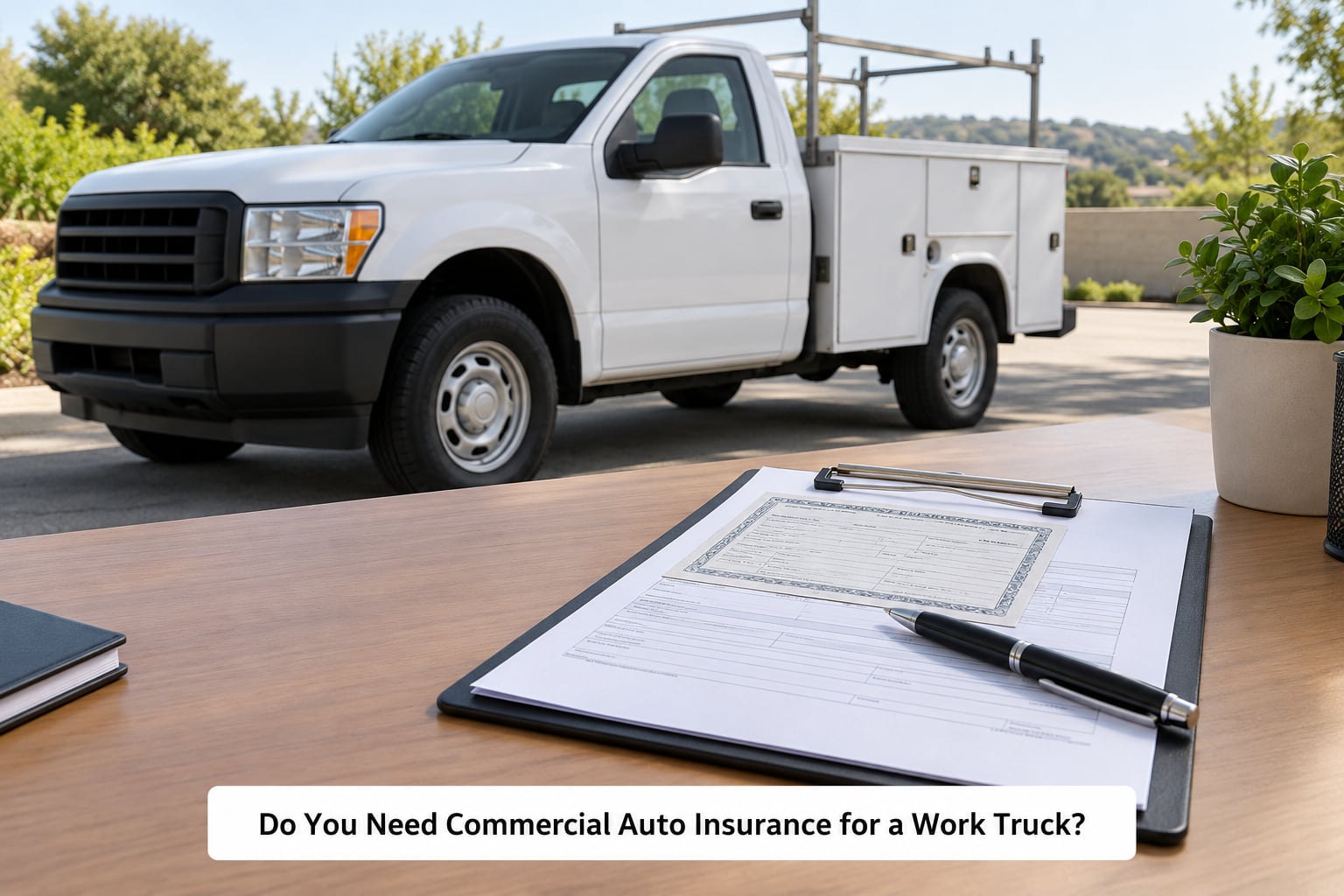
Answer these five questions honestly, and count the yeses:
- Is the truck titled or registered in a business name? If yes, your personal policy is almost certainly the wrong form.
- Is it used regularly for work? Job site to job site, deliveries, client visits, service calls, inspections.
- Do employees drive it, or drive their own vehicles for your business? If either is true, you need liability that follows the people, not just the truck.
- Does it carry tools, materials, equipment, or customers? A pickup loaded with a contractor’s gear is a different risk than an empty truck.
- Is it over 10,000 pounds gross vehicle weight, or rated to haul more than about 2,000 pounds? That weight class often triggers commercial vehicle registration rules in your state, and a commercial policy with it.
Three yeses is a clear signal. One yes deserves a phone call with an agent who can read your actual policy language.
What Is Commercial Auto Insurance?
Commercial auto insurance, also called a Business Automobile Policy or a BAP, covers vehicles used in the course of business. It can cover vehicles the business owns, vehicles it leases, vehicles employees drive for the job, and sometimes trailers.
The form is built differently from a personal auto policy in three ways. It follows a person rather than a vehicle, it carries higher liability limits, and it extends to non-owned autos, meaning vehicles the business does not own but uses for work.
It also sits next to two policies people mix up constantly. General liability covers your business for accidents that happen off the vehicle, a customer slipping on a wet floor, for example. It does not cover the truck itself or an accident caused by the truck. Workers compensation and employers liability cover injuries to people. Commercial auto covers the vehicle, its occupants, and the liability that comes with operating it.
How Business Use Changes Your Coverage
Personal auto policies carry a business-use exclusion. While the truck is being used for work, the personal policy is not the policy paying the claim. That is not a technicality agents enjoy raising after an accident. It is the rule they apply. So the question of whether you need commercial auto insurance for a work truck rarely turns on the vehicle itself.
The test is the trip, not the day. A tech driving from home to the shop is commuting. That same tech driving from the shop to a customer address with parts in the bed is on business. It is the same seat and the same truck.
The clearest example comes from contractor circles: an employee who stops for personal coffee is on a personal trip, while an employee sent out to buy lunch for the crew is on a business trip. Small difference, opposite answer. Owners in small business forums describe finding out which side of that line they were on only after a claim was filed and the costs were sunk.
Two more exclusions trip up owners. Most personal policies exclude loading and unloading, so getting hurt while lifting materials into your own truck is not a covered injury. And vehicles listed for business use on a personal policy, including work trucks declared on your personal policy, are routinely excluded.
Do You Need It if You Own the Work Truck?
Ownership is the part people latch onto, and it is the least useful test. Plenty of sole proprietors own their work truck outright and still need commercial coverage, because the deciding question is what the truck does.
Where the truck is titled matters for a different reason. When the registration and the title both sit in a business name, a personal policy generally cannot be written for that vehicle at all. You are looking at a commercial placement from day one.
As a sole proprietor you also carry personal asset exposure. There is no separate legal person behind the business, so a serious liability judgment can reach your home, savings, and personal bank accounts. That is the argument for titling the truck to an LLC or corporation when one makes sense for your operation, and for buying commercial liability limits that a claim cannot chew through in one afternoon. Forming an entity does not remove the need for commercial coverage. It changes who is standing behind it.
One last detail worth knowing: some personal application forms ask whether vehicles will be used for business. Answering no when work is genuinely involved gives the insurer grounds to dispute the claim later.
Do You Need It for Employee-Operated Vehicles?
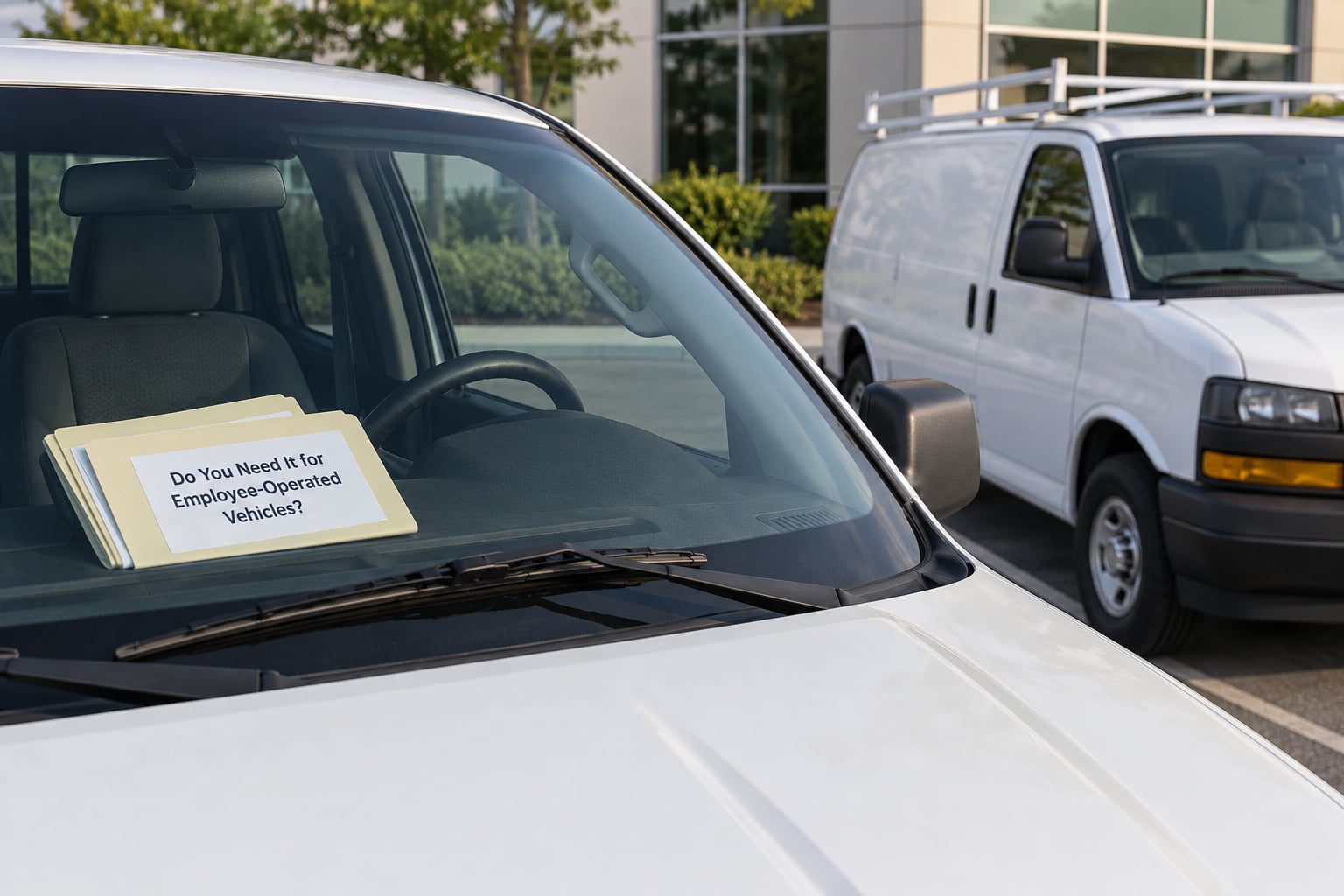
This is the largest blind spot small businesses carry. If an employee drives their own pickup to a job site for you, your commercial auto policy does not automatically cover it, and their personal policy likely excludes the business trip.
The fix is a coverage called hired and non-owned auto, usually shortened to HNOA. It covers vehicles your business uses but does not own, under two conditions: employees use them for work and not for personal purposes, and the business does not have regular use of that vehicle. Some carriers fold non-owned coverage into the main policy and skip the HNOA label, so ask what the form actually contains rather than whether it has the acronym.
Ask the same agent these five things:
- Does the policy include non-owned auto for employee vehicles, and what limits apply?
- How much is that limit for a single accident?
- Do you require certificates of insurance from staff, and what limits should they carry?
- Can you be added as an additional insured on their personal policies?
- Is there a written mileage or per-mile reimbursement policy, and is it required?
Keep the certificates. Independent contractors are a real gray area, and whether a worker is a contractor or an employee changes what the policy responds to. Field techs describe employers never stating the rule clearly, so ask for it in writing before anyone drives.
What if the Truck Is Used for Both Personal and Business Purposes?
Dual-use trucks are normal, and a single commercial policy normally covers the incidental personal driving too. Grocery runs on the way home, a kid’s football game, an evening with the boat hooked up. That is not a coverage problem on a well-written BAP.
Stacking a personal policy and a commercial policy on the same vehicle is where trouble starts. Owners running flat-out businesses warn against it for a reason: when two carriers can respond to the same loss, each one tends to point at the other and you end up doing the arguing yourself.
Two workable options for a genuine dual-use truck. Buy the commercial policy and let it carry both uses, adding an occasional personal-use rider if the form needs one. Or keep the personal policy and ask specifically about a business-use endorsement, which adds a narrow commercial allowance to an otherwise personal form.
The second option is the right fit for a handful of delivery-app runs a month or the occasional supply pickup. It is the wrong fit for a truck that goes to job sites every morning. Insurers read the declaration page, and an endorsement that does not match the actual driving pattern is not coverage, it is a promise that dissolves at claim time.
What Does Commercial Auto Insurance Usually Cover?
Availability and naming vary by carrier, but most business auto policies are assembled from the same set of parts.
| Coverage part | What it responds to | Why a work truck cares |
|---|---|---|
| Commercial liability | Injury or damage you cause to others, up to the limit | Highest-rated part of the policy and the reason limits matter more than on a personal policy |
| Collision | Crash damage to the truck itself | A loaded work truck is worth far more than the personal sedan average |
| Comprehensive | Theft, hail, glass, animal strikes, vandalism | Tools and equipment inside the cab are the bigger loss in many field claims |
| Uninsured and underinsured motorist | Damages from drivers carrying too little or nothing | Frequent on job sites and parking lots where limits are often minimal |
| Medical payments | Medical bills for you and your passengers | Often the cheapest part of the policy and worth keeping on |
| Tools, equipment and cargo | Loss of the gear the truck carries | Frequently a separate endorsement rather than part of the standard form |
| Hired and non-owned auto | Employee vehicles used for work | Covers the vehicles you do not own, subject to the two HNOA conditions |
Read the tools line carefully. A BAP covers the vehicle. The saw, the meter, the diagnostic tablet, the materials inside the bed, the trailer you tow, and the job you were performing when the loss happened can all sit outside that coverage unless you ask for them by name. Tool theft from a parked truck at a job site is one of the most common losses in the field, and it is usually the one nobody priced in.
Do You Need a Separate Policy or an Endorsement?
Three routes usually make sense, and the right one depends on how much of your driving is work.
A standalone Business Automobile Policy fits any operation where work driving is the main job. It is the cleanest option and the easiest to read. A business-use endorsement on an existing personal policy fits occasional work driving, where the truck is a personal vehicle first. An existing commercial fleet policy can often be extended, and businesses already carrying general liability usually get a better combined quote than a buyer who approaches each policy separately.
The form name matters too. A garage policy covers vehicles in your care, for sale or in service, and is a poor fit for a truck driving job sites. A business auto policy fits service vehicles and light trucks. A motor carrier policy, with its federal filing, is the form the Department of Transportation expects when you haul freight for hire across state lines.
The weight threshold trips people up. Vehicles above 10,000 pounds gross vehicle weight, or rated to carry more than about 2,000 pounds, often fall into a commercial vehicle registration category under state law, and personal coverage stops being available for them. If your dump truck or box truck crosses that line, call your state motor vehicle department and your insurance agent in the same afternoon.
Certain trades should ask about an agreed value endorsement. Standard physical damage pays actual cash value, which is what the truck was worth on the day of the loss, not what a new one costs today. On a truck with a lift, a rack, a wrap, or a bed full of company gear, that gap is large and predictable.
What Documents and Details Should You Give an Insurer?
A quote is only as good as what you tell the underwriter. Most of these items are the difference between a rough quote and a real one.
- Vehicle details for each truck: year, make, model, VIN, gross vehicle weight, payload, and any modifications, racks, lifts, or towing equipment.
- Title and registration showing whose name is on the paper.
- Annual mileage, split between personal and work. Underwriters price the work miles harder than the personal ones.
- Radius of operations: your home state only, or states you routinely cross for jobs.
- Cargo description: tools, materials, equipment, customers, or none of these.
- Drivers: everyone who touches the wheel, including family members and anyone who borrows the truck, with license numbers and driving records.
- Employees and their vehicles, if you want non-owned coverage quoted.
- Estimated annual payroll and your current workers compensation carrier, since the two are often written together.
- Claims history for the last three to five years across all your policies.
- Coverage choices you are considering: liability limits, deductibles, and whether you want agreed value, tool, cargo, or trailer coverage.
Be accurate about use, not aspirational about it. If the truck never leaves the county, say so. If the crew hauls a trailer, say so. Misstated use is one of the most common reasons a claim gets disputed.
What Happens If You Don’t Have Commercial Auto Insurance?
The consequences arrive in a predictable order, and the first one arrives last in most people’s experience.
- The claim is denied under the personal policy. The insurer points to the business-use exclusion after the accident, when the repair bill, the tow bill, and the lost work days are already stacking up.
- You pay out of pocket. The truck repair, the rental, the tools that were inside it, and the medical bills all land on you personally.
- Your personal assets are exposed. A sole proprietor with no commercial liability coverage can be pursued for home equity, savings, and personal accounts.
- A contract gets breached. General contractors, property managers, and municipalities routinely require a certificate of insurance and additional insured status before you set foot on site. No certificate, no access.
- The bid disappears. Vendors scoring insurance requirements often disqualify contractors who cannot produce one, without ever telling you why.
- The next claim gets harder. Uninsured or underinsured exposure is a red flag that raises the cost of everything you buy afterward.
If you have already filed under a personal policy and believe it should have been business coverage, request the denial in writing with the specific exclusion cited. Then take the letter to an independent agent or attorney. Appeals succeed when the facts on the ground matched the facts you described, and they fail when they did not.
Frequently Asked Questions
Can I use my personal auto insurance for a work truck?
Only if your policy specifically allows occasional business use, and only for the drives it allows. Most personal auto forms exclude the vehicle entirely while it is being used for work, including loading and unloading. If you are asking whether you need commercial auto insurance for a work truck, treat the answer as yes whenever the truck hauls gear, serves customers, or carries crew.
Is a work van or pickup automatically covered under a personal auto policy?
No. A van or pickup used for business is not automatically covered by a personal auto policy. If the vehicle is titled to a business, personal coverage is generally unavailable altogether. If it is titled to you and you work out of it, the policy may exist but exclude the truck during business use. Ask your insurer in writing whether that specific vehicle and those specific drives are covered.
Do I need commercial auto insurance if an employee drives their own truck for work?
Yes, and this is where most small businesses have the widest gap. Employee vehicles used for work, but not for personal purposes, fall under hired and non-owned auto coverage. Their personal policies generally exclude the business trip, and your policy does not reach vehicles it does not name. Collect certificates of insurance, check the limits, and ask to be named additional insured.
What if my work truck is registered to my personal name?
Registration to a personal name does not remove the need for commercial coverage. What the truck does decides the requirement, not who holds the paper. Many sole proprietors keep the truck titled personally and still carry a business auto policy on it. What changes with a personal title is asset exposure, since there is no separate legal person absorbing a liability judgment.
Are commercial auto insurance requirements the same in every state?
No. Minimum liability limits, proof-of-insurance rules, and commercial vehicle registration thresholds differ by state, and weight-class rules vary too. Requirements above the state minimum are set by the business, its contracts, or the vehicle. Check with your state department of insurance for the rules that apply where you are registered and where you drive.
How much commercial auto insurance do I need for a small business?
Enough that a liability judgment does not reach your personal assets, which usually means limits well above the state minimum. Start by matching limits to the contracts you sign, since general contractors often require a specific figure. Then decide whether you can afford higher deductibles, higher limits, and agreed value on a modified truck. Get at least two quotes from independent agents and compare the declarations page, not just the headline number.
Bottom Line
Write down every regular use of the truck for one week: the jobs, the miles, the people in the cab, and the gear in the bed. If any of it is work, ask a licensed insurance professional for a commercial quote before you drive it again. Then put the answer in writing, keep the certificates, and stop guessing.