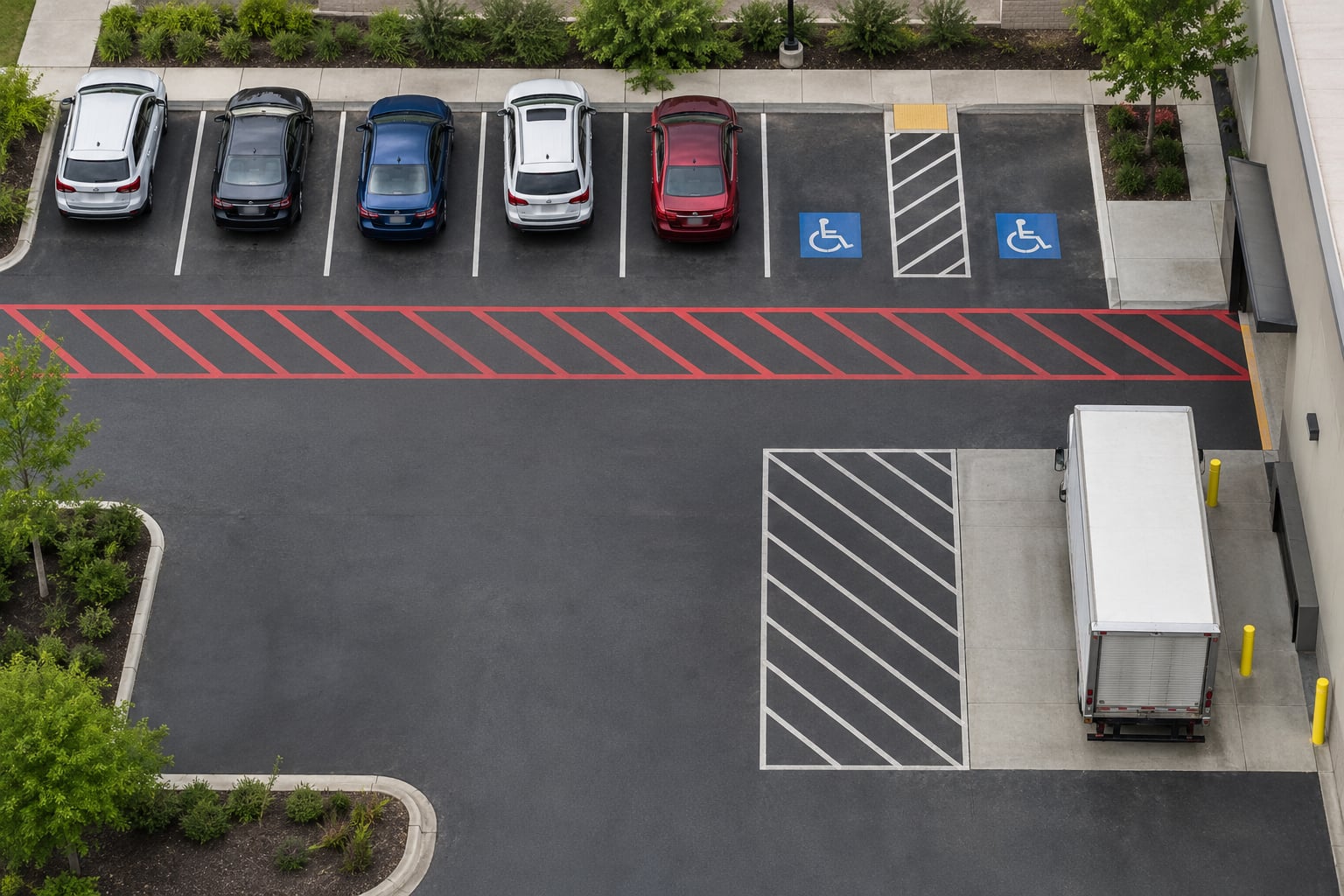
Fire lane and parking sign requirements for businesses come down to one question: who has authority over your lot. In most US cities the answer is the local fire code official, working from a model code the city has adopted with its own amendments, so the rules that bind your storefront are the ones written in your municipal code rather than in a national rulebook. Here is what gets signed, what gets painted, where it goes, and how to confirm the version that applies to your address.
Last reviewed October 2026. Requirements differ by city and by adopted code edition, and the fire code official in your jurisdiction has final authority on any variation.
Table of Contents
- Fire Lane and Parking Sign Requirements for Businesses
- The three layers behind fire lane and parking sign requirements for businesses
- Which Signs Are Required in a Business Parking Lot?
- What Do Fire Lane Signs Usually Prohibit?
- Where Should Fire Lane and Parking Signs Be Placed?
- How Fire Lane and Parking Sign Requirements Vary by Location
- How Do You Find the Rules That Apply to Your Business?
- What Size, Color, and Wording Should Signs Use?
- Can a Business Enforce Its Own Parking Rules?
- What Happens If the Signs Are Missing or Incorrect?
- Frequently Asked Questions
- What wording is required on a fire lane sign for businesses?
- How far from a building or driveway should a fire lane sign be installed?
- Do private business parking lots have to follow local fire-lane rules?
- Can a business tow a vehicle parked in a marked fire lane?
- Are temporary signs acceptable when a parking area is temporarily closed?
- Who should a business contact to confirm local parking and fire-lane requirements?
- How to Make Your Business Parking Area Compliant
Fire Lane and Parking Sign Requirements for Businesses
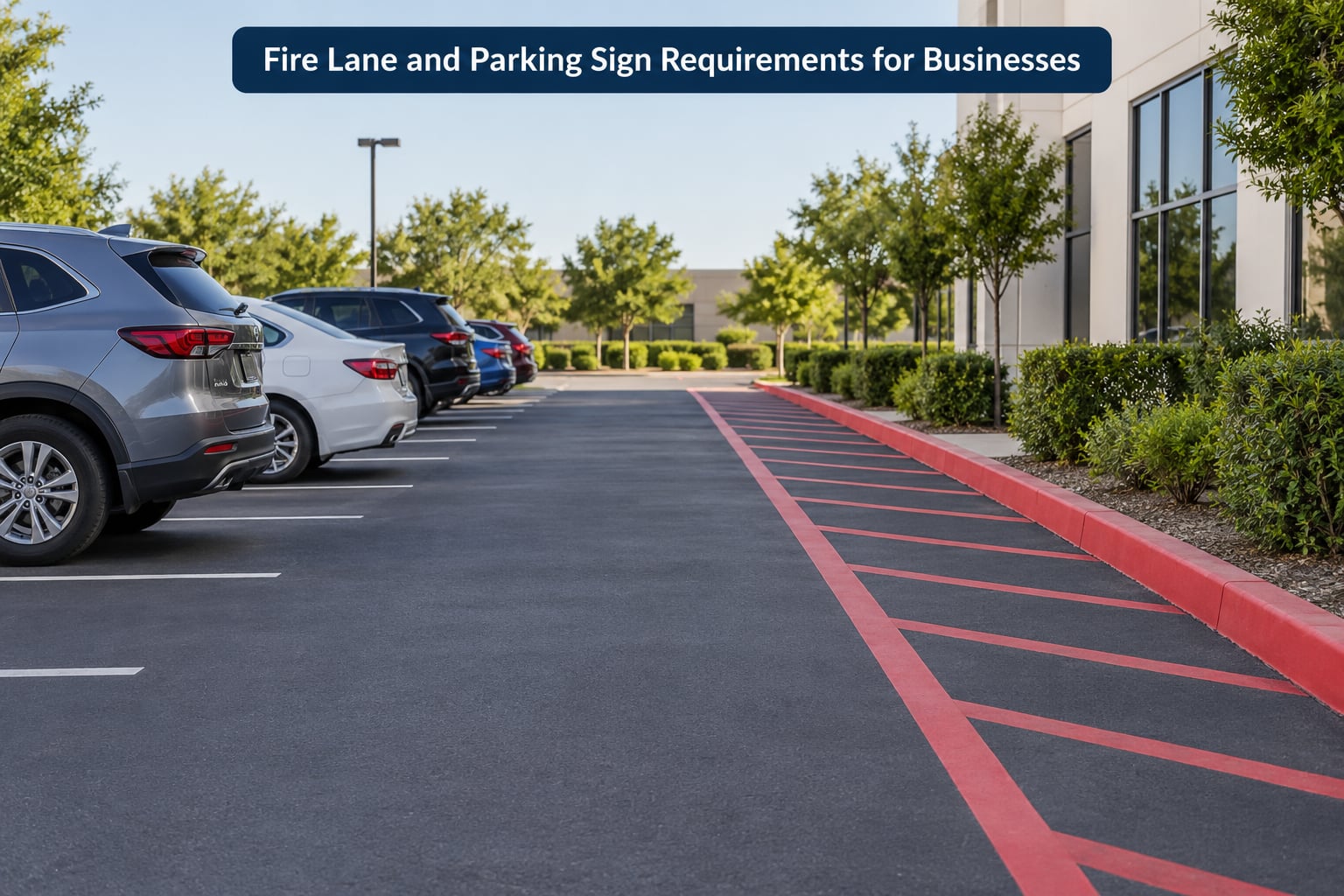
Fire lane, defined by the International Building Code: a road or other passageway developed to allow the passage of fire apparatus. A fire lane is not necessarily intended for vehicular traffic other than fire apparatus.
That definition is short, but it is the whole point. A fire lane is not a nicer name for a no-parking zone. It is a route reserved for emergency vehicles, kept clear at all times, including from vehicles that are parked and left alone.
The three layers behind fire lane and parking sign requirements for businesses
The International Fire Code sets a national baseline in Section 503, covering width, clearance, marking and obstruction. It is a model code, so it only binds you once somebody adopts it.
Layer two is the state, which adopts a specific edition of the IFC and can adopt it in part. Washington is the clearest published example: the state adopted the IFC at WAC 51-54A-003, then WAC 51-54A-0503 declared the Section 503.2 specifications not adopted. A business owner in Washington who orders signs to the national 20-foot width figure is working from a number that does not apply there.
Layer three is local. Cities and counties adopt ordinances, amend the model text, and issue their own specifications for curb paint, sign size, lettering and placement. Two businesses on opposite sides of a county line can be held to different sign dimensions.
One more layer sits on top of all three: the fire code official, sometimes called the fire marshal, who approves plans, inspects the property and can approve or deny a variance. Everyone else is working from that person’s interpretation.
Which Signs Are Required in a Business Parking Lot?
Most lots need a mix of regulatory signs and physical markings. The common types are:
- No-parking, fire lane: the core sign, carrying the words NO PARKING-FIRE LANE or FIRE LANE NO PARKING.
- Fire lane with directional arrows: tells drivers which way to clear or which way the lane runs.
- No-parking zone signs: separate from fire lane signs, covering curb areas, loading zones and snow emergency routes.
- Loading zone and tow-away signs: attach to commercial loading rules and to the right to remove a vehicle, not to fire access.
- Accessible parking signs: required under the ADA and state accessibility rules, carrying the International Symbol of Access.
- Temporary and seasonal signs: construction access, event parking, snow restrictions and phased openings during site work.
Fire lane duty and accessible parking duty are separate, and both apply. A lot marked perfectly for fire apparatus can still fail an inspection because the access aisle or the symbol of access sign sits in the wrong spot. Check the two areas on the same walkthrough rather than treating the fire lane as the whole job.
Wording, colors, symbols and dimensions are set by your jurisdiction. A sign that satisfies one city’s specification can be rejected fifty miles away.
What Do Fire Lane Signs Usually Prohibit?
Fire lane signage and IFC Section 503.4 work the same way: fire apparatus access roads shall not be obstructed in any manner, and that includes parking vehicles in them.
In practice, that covers more than a parked car. It covers stopping to load a customer, idling while someone runs inside, storing pallets or trash bins along the curb, letting landscaping grow into the clear width, and parking on the boundary stripe where the fire lane crosses the tips of parking stalls.
The short-stop misconception comes up more than anything else. A driver who parks for two minutes is still parked, and still obstructed. There is no grace period in the code text.
A business cannot fix this with a private rule. Fire lane requirements exist because a blocked access route costs an engine crew time on every response, and the property owner carries the exposure for keeping it clear.
Where Should Fire Lane and Parking Signs Be Placed?
Placement is where most failed inspections start, because a technically correct sign in the wrong spot does not count. Typical expectations:
- Visible from each direction of approach, including from inside the lot looking out.
- Near the beginning of the restricted area, so a driver meets the sign before entering it.
- No more than 150 feet apart along the lane, spaced closer where sight lines are blocked or where the fire lane passes behind parked vehicles.
- Mounted so the bottom of the sign sits about 7 feet above finished grade, and not blocked from below.
- Clear of tree branches, shrubbery, snow piles, light poles, banners and parked vehicles.
Marking placement matters just as much. Curbs along a fire lane are often painted red on both the vertical and horizontal faces for the full curb length, with the legend repeated at a set interval rather than printed once at the corner. Pavement lettering gets repeated along the lane for the same reason.
One detail that catches people out: where a fire lane runs across the front of a parking row, the boundary often falls exactly at the tips of the stalls, and a continuous red stripe is painted across those tips. On some new projects the fire lane is shown as a dedicated easement on the recorded plat instead of just a painted stripe.
How Fire Lane and Parking Sign Requirements Vary by Location
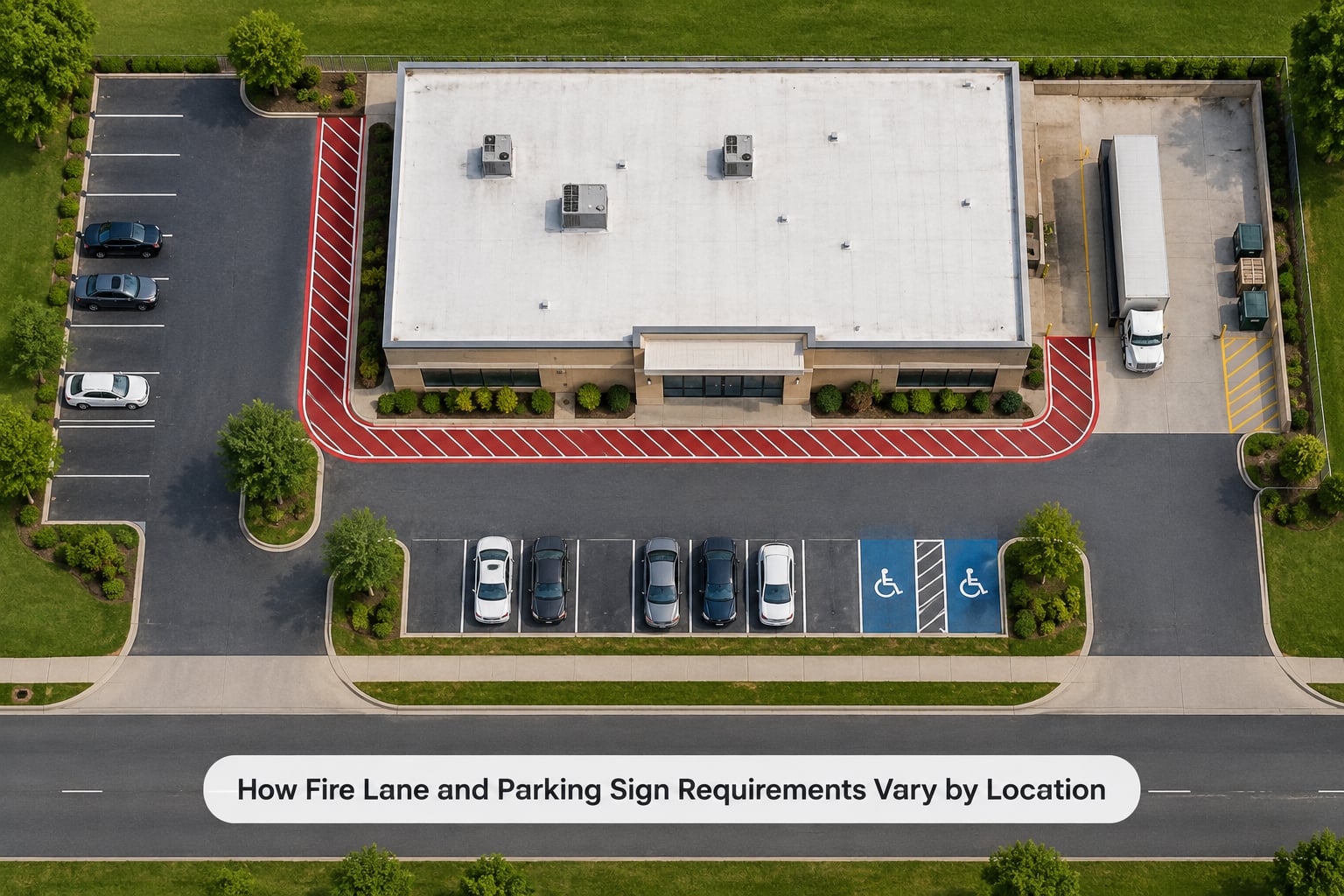
The same four requirements — width, sign, marking, obstruction — arrive with different numbers in different places. Here is the practical comparison.
| Layer | What it controls | Worked example |
|---|---|---|
| National model code | Baseline width, clearance, marking and obstruction rules | IFC 503.2.1 sets a 20-foot unobstructed width with 13 feet 6 inches vertical clearance; 503.3 requires approved markings including the words NO PARKING-FIRE LANE; 503.4 bars obstruction |
| State adoption | Which edition applies, and which sections were left out | Washington adopted the IFC at WAC 51-54A-003 and did not adopt the Section 503.2 specifications per WAC 51-54A-0503, so the national width figures do not govern there |
| City or county ordinance | Sign size, colors, lettering height, repeat intervals, curb treatment | Bellevue, WA requires red curb paint on both the vertical and horizontal curb faces with white lettering at least 3 inches tall reading NO PARKING – FIRE LANE every 50 feet, using an R8-31 sign or equivalent; Avondale, AZ requires marking when a fire apparatus access road is 28 to 36 feet wide |
| Property and lease terms | Who pays, who repaints, who gets cited | A lease may shift repainting cost and maintenance duty to the tenant while the citation and the insurance exposure stay with the owner of the building |
On the sign question specifically, city amendments are common. Corinth, TX requires a white-background sign reading NO PARKING FIRE LANE or FIRE LANE NO PARKING, sized 12 inches wide by 18 inches high, which matches the IFC baseline rather than departing from it.
How Do You Find the Rules That Apply to Your Business?
Six steps, in order, and you will usually finish before buying anything.
- Identify the jurisdiction. Not just the county name from your mailing address. Check whether the lot sits inside city limits or in an unincorporated pocket with county fire control.
- Pull the ordinance. City and county websites publish fire prevention and parking ordinances. Search for the adopted fire code edition, Section 503, and the words fire lane.
- Ask the fire prevention bureau or building department. One call or email asking which fire code edition is enforced and whether fire lane marking is required at your address resolves most of the uncertainty.
- Ask for the fire lane width in writing. If a lane looks narrower than the national figure, get the local number rather than assuming either one.
- Talk to the property owner or manager. Leases, site plans and recorded plats often carry restrictions tighter than the city code.
- Confirm before you order. Sign dimensions, mounting height, lettering size and curb paint all need to come from the same local source, not from a mix of a vendor catalog and a national code.
What Size, Color, and Wording Should Signs Use?
There is no single national answer, so confirm each variable with the authority having jurisdiction before installation:
- Sign dimensions, commonly 12 by 18 inches as a baseline, with local amendments either tightening or confirming it.
- Colors, most often red legend on a white background, sometimes black on white.
- Legend wording, NO PARKING-FIRE LANE or FIRE LANE NO PARKING, and only some cities accept a paraphrase.
- Reflectivity, traffic-grade reflective sheeting so the sign reads at night and in bad weather.
- Mounting height, about 7 feet to the bottom of the sign in many jurisdictions, sometimes measured from the curb face instead.
- Spacing, up to 150 feet between signs, reduced where visibility is restricted.
- Marking, red curb paint, red pavement stripe, white stencil lettering, and how often the legend repeats.
The lettering figures circulating online conflict, and the conflict is real rather than a mistake. Curb-face lettering is often set at 3 inches minimum, pavement block letters commonly run 6 inches, and some specifications call for larger still. The number depends on the surface and the jurisdiction, so ask which surface the figure applies to before you trust it.
A sign sold online as compliant is a starting point, not a verdict. It may be the right size, the wrong color, the wrong mounting height and installed on a post the local standard does not accept.
Can a Business Enforce Its Own Parking Rules?
Yes for your own policies, and that is a different thing from enforcing a fire lane requirement.
The confusion is worth being precise about. Police generally do not enforce ordinary parking rules on private property. Fire lanes and accessible parking spaces are the exceptions people hear about, and even there enforcement usually runs through the property owner rather than a patrol car.
That means your business carries the duty. The owner of the lot is typically the one cited for a blocked fire lane, not the driver who parked, and your insurance certificate and your lease can both be affected by how the situation was handled.
To act lawfully you need clear notice, signs that actually match your stated policy, a process that is applied the same way every time, and a towing sign that meets the separate legal duty attached to towing itself. Washington, for example, ties towing notice requirements to RCW 46.55.070, a duty that attaches to the property and is separate from the fire lane sign entirely.
When a vehicle is disabled, stuck across the lane and creating an immediate hazard, call the fire code official or the fire department rather than moving it yourself on a guess.
What Happens If the Signs Are Missing or Incorrect?
Consequences depend on local law and circumstance, so treat this as the range rather than a promise of a specific outcome.
- A fire code citation or civil violation against the property, with fines set locally.
- A failed inspection, which can hold up an occupancy renewal or a tenant improvement sign-off.
- An insurance dispute. A carrier can argue that a blocked fire access road contributed to damage and that the condition existed before the loss.
- A lease dispute, where a landlord or tenant points to repainting and maintenance obligations the other side skipped.
- Towing, once your signage supports it.
- Liability after an incident, when the question becomes whether the route was clear and marked when apparatus arrived.
Unmarked fire lane signs are also the reason maintenance is treated as a compliance task rather than cosmetic work. IFC Section 503.3 expects approved markings to be kept in a clean, legible condition and replaced or repaired when necessary. Faded paint under a delivery truck every morning fails that standard.
Frequently Asked Questions
What wording is required on a fire lane sign for businesses?
Most jurisdictions require the legend NO PARKING-FIRE LANE, and some accept FIRE LANE NO PARKING as the alternative, typically on a white background with red letters. The IFC language requires approved signs or markings that include those words, but your city or county may amend the size, color and mounting height. Confirm the exact wording and dimensions with the local fire code official before ordering.
How far from a building or driveway should a fire lane sign be installed?
There is no national distance-from-building rule. The usual requirements are that the first sign sits near the point where drivers enter the restricted area and that signs repeat at intervals along the lane, commonly no more than 150 feet apart, with tighter spacing where sight lines are blocked. Sign mounting is usually about 7 feet above finished grade. Your local fire code official sets the figures that apply.
Do private business parking lots have to follow local fire-lane rules?
Yes. A fire lane is usually required on a private lot when the building’s fire apparatus access road runs through it, and the requirement attaches to the property owner rather than to individual drivers. Many police agencies do not enforce ordinary parking rules on private land, but that does not remove the owner’s duty to keep the marked lane clear. The citation and the insurance exposure typically land on the owner.
Can a business tow a vehicle parked in a marked fire lane?
Only after your signage supports it. Towing carries a separate legal duty from fire lane marking, and most states require specific towing notices posted in a defined way before a vehicle can be removed from private property. A fire lane sign alone is usually not a towing authorization. Post the required towing notice, document the vehicle, and follow the same procedure every time so the process holds up if it is challenged.
Are temporary signs acceptable when a parking area is temporarily closed?
Sometimes, and only with approval. Construction sites, phased site work and temporary event parking commonly use temporary signs or temporary markings, but the fire code official generally has to approve the arrangement in advance, including how emergency access is maintained during the work. Permanent signage can stay in place during short-duration closures. Ask before you swap permanent fire lane signs for temporary ones.
Who should a business contact to confirm local parking and fire-lane requirements?
Start with the local fire prevention bureau or building department and ask which fire code edition is enforced at your address. Your city or county clerk can also point you to the adopted ordinance and any amendments. If the property is leased, ask the landlord or property manager for the approved site plan, the recorded plat and any lease restrictions on signage and repainting. Then confirm sign specifications in writing before ordering.
How to Make Your Business Parking Area Compliant
Run these six steps and the rest of the work gets straightforward.
- Identify the property and the jurisdiction. City limits or county fire control, confirmed rather than assumed.
- Obtain the applicable rules. The adopted code edition, the local amendments and the fire code official’s current specification.
- Map every restricted area. Fire lane, fire hydrant clearance, accessible stalls and access aisles, loading zones and snow routes.
- Confirm sign specifications in writing before anything is ordered, including size, legend, colors, mounting height and spacing.
- Install before enforcement starts. A citation issued on day one is far more expensive than a sign.
- Re-check after changes. New landscaping, repaving, a re-striped lot or a modified site plan can move a lane boundary without anyone telling you.
Photograph each finished lane and log the measurements once the work is done. When an inspector asks whether the boundary sits at the stall tips, a dated photo with dimensions answers the question in seconds instead of days.
The short version: the IFC gives you the baseline, your city gives you the numbers, and the fire code official decides. Do that part first and the signage follows.