A service page is a permanent page on your website that explains one service in depth, while a landing page is a focused page built for one campaign or offer with a single call to action and no site navigation. The difference matters: point paid ad clicks at a generic service page and you waste spend, point cold searchers at a stripped-down landing page and you lose both conversions and rankings.
Here is the rule I hand to owners who ask this question most often: if someone searched for your service, give them a service page. If you paid for the click, or handed them a QR code, give them a landing page.
That is the short version of service page vs landing page explained. Both page types exist, both convert, and the terminology gets used loosely across the industry, so the label matters far less than matching the page to the traffic that lands on it.
Below I break down what each page type is, how each one is built, how search engines treat them, and how to pick the right one when your budget only allows a single page to be built first.
Table of Contents
- Service Page vs Landing Page Explained at a Glance
- What Is a Service Page?
- Where service pages sit on a website
- Real examples of service pages
- What Is a Landing Page?
- The landing page types you will actually use
- How Do the Main Goals Differ?
- How Is Each Page Structured?
- Service page anatomy, top to bottom
- Landing page anatomy, top to bottom
- Which Page Is Better for Search Traffic?
- Watch out for cannibalization
- Do landing pages rank at all?
- Service Page vs Landing Page Explained: Calls to Action
- Form length and friction
- Which Should You Choose?
- How many of each do you need?
- If you can only build one page first
- What each one costs in effort
- When one page does both jobs
- Frequently Asked Questions
- What is a service page?
- Can a service page work as a landing page?
- Should landing pages be indexed by search engines?
- How many service pages does a small business need?
- Do service pages or landing pages convert better?
- How do I track leads from each page type separately?
- Conclusion
Service Page vs Landing Page Explained at a Glance
| Criterion | Service page | Landing page |
|---|---|---|
| Primary job | Explain a service and build trust | Turn one specific click or lead into one action |
| Traffic source | Organic search, Google Business Profile, referrals, direct | Paid ads, email, social, QR codes, retargeting |
| Navigation | Full menu, internal links to related services | Stripped out, or limited to a logo link |
| Calls to action | Several: request a quote, call, browse services | One, repeated at intervals down the page |
| Typical length | 800 to 2,000 words, plus images and proof | 200 to 600 words, sometimes less |
| Search treatment | Indexed, targeted at a search term, linked internally | Often noindex, or indexed only if it earns it |
| Success metric | Organic leads, enquiries, assisted conversions | Conversion rate and cost per lead for one campaign |
| Lifespan | Years, reviewed and refreshed regularly | Days to a season, then archived or merged |
| Who maintains it | Whoever owns the service and the site content | Whoever runs the campaign or ad spend |
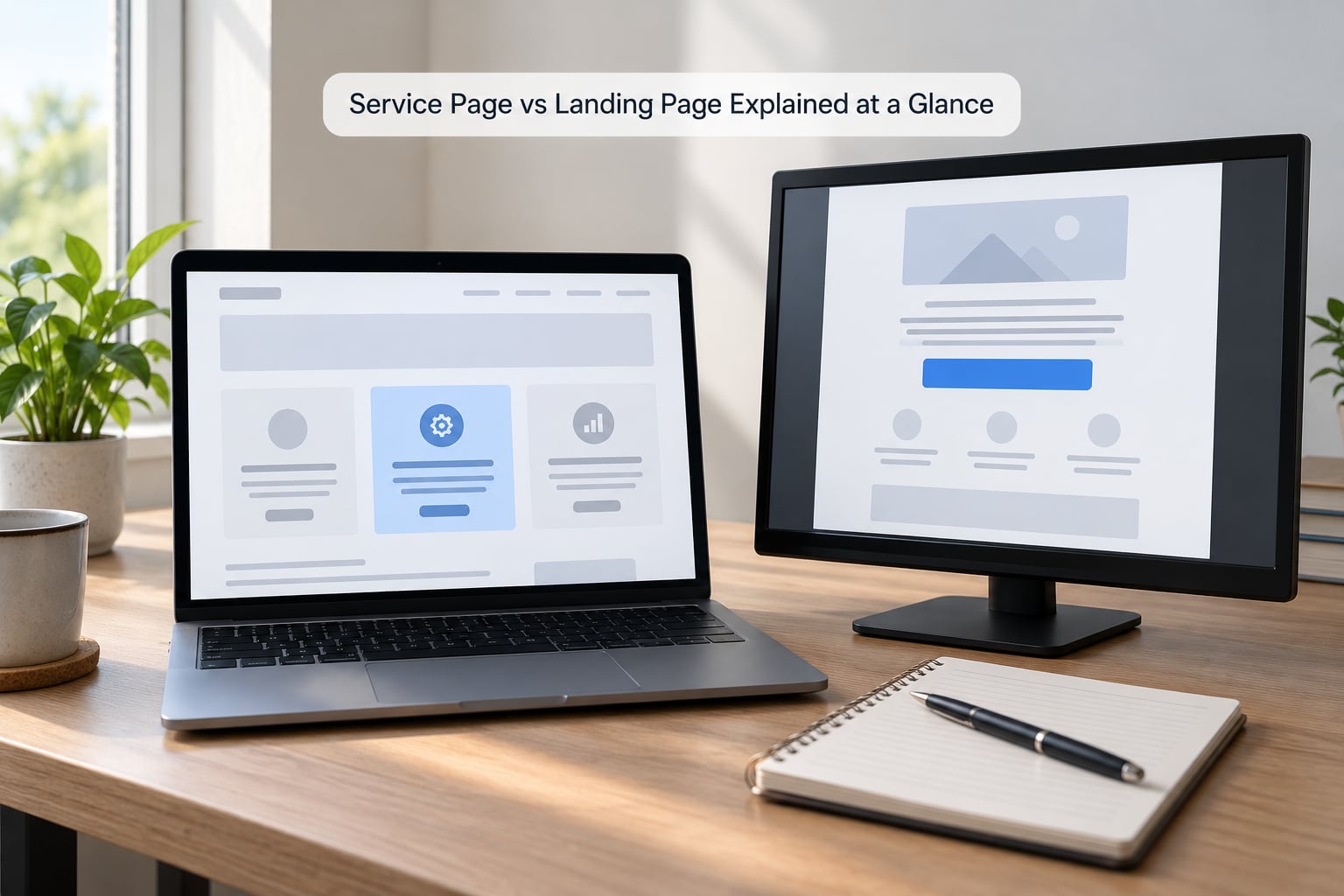
Read that table as a traffic map. The left column describes a page that expects to work for years across loose, varied search queries. The right column describes a page built for a specific promise made in a specific place, usually an ad or an email, and measured against a single number.
What Is a Service Page?
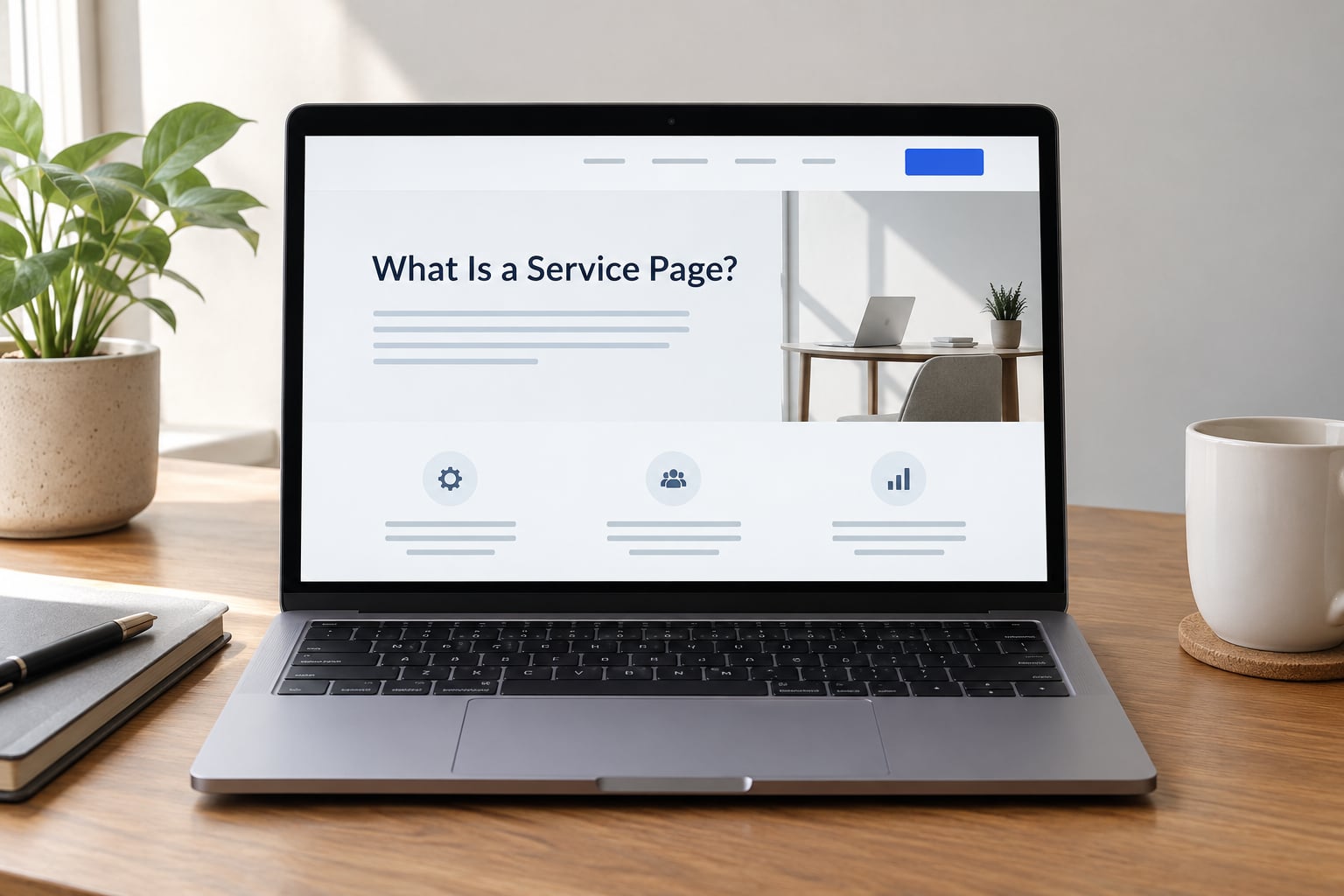
A service page is a permanent page on your website that explains one service you offer: what it includes, who it suits, how the work happens, what it costs and how to start. It sits inside your normal navigation, links to related pages and stays live for years.
Service pages do the slow, unglamorous work of convincing someone who has only just discovered you. Most people arriving on one typed something like vehicle wrap pricing or commercial signage quotes, and they are not ready to buy. They want to know whether you handle their situation, whether the job is within their budget, and whether you are a real business.
Where service pages sit on a website
A service page is one of the main menu items. A home page introduces the whole business, a service page goes deep on one offer, and a contact page collects details. That is the basic three-part structure most service businesses run on, alongside an about page and a portfolio or project gallery.
The reason service pages matter for discovery is that each one can target a different search term. A sign company might run separate pages for channel letters, monument signs and vinyl graphics, because each has its own material list, its own timeline and its own set of people searching for it. One page trying to cover all three usually reads as thin to everyone who lands on it.
Real examples of service pages
Concrete examples help. A vinyl wrap shop has a page for full vehicle wraps with sample galleries and a page for commercial fleet wraps with pricing per vehicle. An insurance broker has a page for each line they write, such as home, auto or contractors liability. A signage company has pages for each medium: signs, vehicle wraps and channel letters.
In every case the page stays up, gets linked from the menu, and earns organic traffic for years. If a neighbouring trade serves a different customer, the same three-part structure works there too.
What Is a Landing Page?
A landing page is a standalone page created for one campaign, offer or audience, built around a single call to action and stripped of site navigation. It is where traffic you sent yourself arrives: an ad click, an email link, a social post, a QR code on a van or a retargeting audience.
The defining feature is constraint. A landing page has one job, so it drops anything that could send the visitor elsewhere. There is usually no service menu, no blog links and no second offer competing for attention. The visitor either completes the form or leaves.
The landing page types you will actually use
Most small businesses run four kinds. A lead magnet page offers a checklist or a price guide in exchange for an email address. A registration page collects sign-ups for an event, a workshop or a seasonal promotion. A click-through page sells directly, usually a simple product or a booked appointment with a card payment. And a new location or new service page promotes one specific thing for a limited stretch.
One caution on that last type. A page built for a single promotion has a short shelf life, and once the promotion ends it usually should be archived rather than left in the navigation as a dead end.
How Do the Main Goals Differ?
A service page is built to persuade gradually. It has to earn attention from a visitor who arrived with half a question, answer enough of it to build confidence, and then hand the person a choice of next steps. Most service pages convert a small share of visitors, but they do it repeatedly across months and years.
A landing page is built to persuade once, for one traffic source. Because the person already clicked or tapped something with a promise attached, you are not starting from zero. Your job is to remove friction between the promise and the form.
Consider two pages from the same sign company. The service page for commercial signage has a materials breakdown, six recent project photos, an FAQ about permits and a phone number plus a quote form. Someone might land there from a Google search and read for two minutes before calling.
Now picture the landing page behind an ad offering a free quote on a vehicle wrap before the end of the month. The headline repeats the offer, a single form asks for name, phone, vehicle and postcode, and the only way out is the form or the browser back button. There is no menu and no other offer.
The two pages serve the same company, and neither is better in the abstract. What changes is the job. One page answers a question and lets the visitor decide. The other fulfils a promise the visitor was given thirty seconds earlier.
How Is Each Page Structured?
Structure is where the difference gets mechanical, and it is the part most owners under-apply. Service pages reward depth. Landing pages reward focus.
Service page anatomy, top to bottom
A service page that works usually follows this order. Start with a plain heading naming the service and a short paragraph saying who it is for in the visitor’s own words, not industry jargon. Follow with what is included, listed as specific items rather than vague benefits, so a reader can picture the finished job.
Next comes proof. Three to six real project photos or a short case study with location, scope and timescale beats any stock image. Then pricing guidance, and this is where many service businesses are too coy. A starting range or a typical hourly or project figure filters out people who were never going to buy and saves you both time.
After that, the process section answers what happens after they get in touch: how you quote, how long the work takes, what you need from them. Then an objection-handling section covering permits, weather, warranties, access or whatever your trade actually worries about. Then frequently asked questions. Then the calls to action, repeated at natural points rather than hammered at every scroll.
You will want internal links here. Link the service page to the portfolio page, the about page and the neighbouring service pages, because that link graph is part of how it ranks.
Landing page anatomy, top to bottom
A landing page keeps to one promise and repeats it. The first screen carries a headline, one line of supporting detail and the primary call to action button. Keep it above the fold on a phone, because most paid traffic on a local business lands on mobile first.
Second, an immediate benefit block. Three short points or icons, each one a reason to act now rather than a feature description. Third, the form, placed either immediately or directly after the benefit block, and kept short. Ask only for what you need to take the next step. On a quote request that might be name, phone, service and postcode, and nothing else.
Fourth, objection handling in a short list: what it costs, how long it takes, whether you cover their area, what happens after they submit. Fifth, proof in the form of testimonials with names and locations, or a review count from a real platform. Then repeat the same call to action once or twice more, and stop.
If the offer is a booking, the calendar itself becomes the call to action. If it is a paid download, the form plus a clear delivery promise does the job. Resist adding a second offer. Two competing calls to action reliably cost more than they earn.
Where a service page vs landing page split matters most in structure is navigation. If you keep the full menu on a campaign page, roughly half of paid visitors will click it and never come back, and you will pay for the privilege. That is why campaign pages usually ship without navigation.
Which Page Is Better for Search Traffic?
The service page wins for search, and it is not close. Service pages are built to be found: they target a search term, carry enough detail to be worth ranking, sit inside your internal link structure and are refreshed over time. That is the whole basis of how multi-page websites win organic traffic.
Think about one page per keyword. A roofing company that wants traffic for metal roofing, terracotta tile and storm damage repair needs three pages, because those are three different intents with three different sets of facts. Trying to serve all three from one page usually leaves each thin.
Watch out for cannibalization
Here is a mistake I see repeatedly. A business builds a service page for a term, then later runs a Google Ads campaign on the same term and points it at a landing page with nearly identical wording. Now two of your own pages compete for the same query, and search engines have to guess which one you meant.
Pick one page per search term. If a campaign targets a term you already rank for, send the click to that existing page and improve its conversion instead of building a near-duplicate. If the campaign targets something genuinely new, build a landing page for it and let it stay unindexed so it does not compete with the page you already have.
Do landing pages rank at all?
They can, but they rarely need to. Campaign pages are usually built for one offer with one exact phrase, and that is a thin target for organic results. Most businesses noindex them and keep the ranking power in their service pages, where the depth belongs.
Local traffic is worth a special mention. When someone finds you through Google Business Profile or a map search, they are looking for a service, not a promotion. Send that traffic to the service page that matches the search, and make sure the address, phone and service list are consistent across your site and your profile.
Service Page vs Landing Page Explained: Calls to Action
Calls to action are where the two formats part company most clearly, and they are the fastest way to tell which type of page you are looking at.
A service page offers a menu of next steps. Request a quote, call the office, browse another service, read the project gallery, check coverage. Three or four options is normal, placed at the top, after the proof section and at the end. The reasoning is simple: a visitor reading this page may be ready now, ready in a month, or still comparing, and pressing them toward one action loses the other two.
A landing page offers exactly one. Book a consultation, get a quote, download the price guide, register for the event. The same button repeats at three or four points down the page so the action is always one tap away, and usually that action is a form.
Form length and friction
On a service page, a longer form is acceptable because the visitor has already read a good deal and the page is setting expectations. On a landing page, every field is a place to abandon. Short forms win on paid traffic almost every time, and asking for one or two fields more than you need is a common and expensive habit.
Send people to a thank-you page after submitting. On a landing page that confirmation is part of the experience, and it gives you somewhere to add the calendar link or the next step. On a service page it is less critical, but still tidy.
Tracking should match the format. A landing page needs its own conversion event, because otherwise campaign results get buried in sitewide numbers and you cannot tell which ad produced the enquiry. Attribute it in Google Analytics, in your ad platform and in your CRM, using the same naming across all three. For a local business, matching a phone call back to the campaign matters as much as the form, and a dedicated tracking number is the simplest way to do it.
Which Should You Choose?
Start with the traffic, then work backwards to the page. The table below maps common situations to the format that usually fits.
| Your situation | Use | Why |
|---|---|---|
| Evergreen service people search for | Service page | Compounds organic traffic over years |
| Running Google Ads on a new term | Landing page | Message matches the ad exactly |
| Already ranking for the ad term | Existing service page | Avoids cannibalization, no extra build |
| Seasonal offer or limited promotion | Landing page | Focused promise, archive when it ends |
| Opening a new location | Landing page plus service page | Campaign first, evergreen page after |
| Building an email list | Landing page | Lead magnet needs its own page |
| Google Business Profile clicks | Service page | Searchers want detail, not a pitch |
| QR code on a van or invoice | Landing page | Attention is short and mobile |
| Complex offer needing research | Service page | Visitors need comparison detail first |
| Retargeting previous site visitors | Landing page | They need reminding, not educating |
How many of each do you need?
One service page per distinct, describable service. A shop with four services needs four pages, and a shop with one service spanning many variations needs one page that covers the variations well. Do not split a service into pages for every material, colour or model unless each has genuinely different facts behind it.
Landing pages should match your active campaigns, and nothing more. If you are running three ads, you need three landing pages. If you are running one ad on two terms with the same promise, one page will usually do. Teams that build dozens of campaign pages and then leave them running thin end up competing with themselves.
If you can only build one page first
Build the service page. It works for organic search, Google Business Profile traffic, referrals and direct visits, and it is the page a paid campaign can borrow later if the term already matches. A landing page built first only serves the one campaign it was made for, and it earns nothing while it waits for organic traffic.
That advice flips in one situation. If you are spending money on ads right now with no dedicated page, build the landing page first, because that is where the money is going out. Fix the leak before optimising the bucket.
What each one costs in effort
Neither is cheap to do badly, and the honest comparison matters more than the sales pitch. A service page takes considerably longer to build because it needs real detail, real project photos and honest pricing, and then it needs refreshing every few months to stay useful. It also needs someone to own it indefinitely.
A landing page builds faster since it is one section and one form, and the ongoing cost is smaller. But it is a perishable asset. Every new campaign means a new page, and every finished campaign leaves a page behind that someone has to decide whether to archive. Both costs are real, and most owners underestimate the maintenance side of landing pages.
When one page does both jobs
A hybrid page works when one offer has both strong organic demand and active campaign spend. Build a full service page, then add a focused call to action box at the top of it for the paid audience, and use that page as the ad destination. The visitor gets the depth they came for and the single action if they are ready.
The trade-off is real. A page with full navigation and a primary form at the top usually converts a little worse than a stripped campaign page, because there are more exits. In exchange you keep one page instead of two, avoid cannibalization, and the paid traffic also feeds your organic rankings. For a small business with one team running both marketing and delivery, that trade is usually worth it.
Frequently Asked Questions
What is a service page?
A service page is a permanent page inside your website that explains one service in depth: what is included, who it suits, how the work is done, what it costs and how to get started. It lives in your main navigation, links to related pages and works for years. Its job is to answer a searching visitor’s questions and build enough trust that they enquire.
Can a service page work as a landing page?
Yes, when one offer has both steady organic demand and active advertising behind it. Use a full service page, then add a focused call to action box near the top for paid visitors and send the ad there. The trade is a slightly lower conversion rate than a stripped campaign page, in exchange for one page instead of two and no risk of the two competing for the same search term.
Should landing pages be indexed by search engines?
Usually not. Most campaign pages are built for one exact phrase and one offer, which is a thin target for organic results, so businesses noindex them and keep their ranking strength in the deeper service pages. Index a landing page only when it answers a genuine search question with enough detail to be worth ranking. Never index two pages competing for the same term.
How many service pages does a small business need?
One for each distinct service you can describe clearly. Four separate services deserve four pages, each targeting its own search term, its own materials and its own customer situation. One service with many variations usually belongs on a single well-built page. Splitting a service across pages for every colour, material or model tends to produce thin pages that compete with each other.
Do service pages or landing pages convert better?
It depends on the traffic, not the page. A landing page pointed at a specific ad usually converts a higher share of its visitors, because the message matches what was promised. A service page converts fewer visitors but does so repeatedly, from organic search, map listings and referrals, often for years. Judge each on the source it is built for, not on a single conversion rate.
How do I track leads from each page type separately?
Give every campaign landing page its own conversion event and its own naming in your analytics tool, ad platform and CRM, so enquiry numbers stay attributable. For a local business, add a tracking number for phone calls as well, since plenty of customers will ring rather than fill the form. Service page leads are usually counted as general enquiries, which is one more reason campaign pages need their own reporting.
Conclusion
A service page earns you traffic for years and answers people who found you through search. A landing page converts one promise you made in one place, usually an ad or a QR code. Match the page to the traffic, and most of the confusion disappears.
Before you build or rewrite anything, write down one sentence describing the page’s single job, who it is for, and the one action you want them to take. If the answer is a service with several next steps and a place in your menu, build a service page. If it is a single offer to a single audience with one form, build a landing page.
Then pick the one gap that is costing you most, service pages for organic growth or landing pages for paid campaigns, and fix that first.