
A refund policy is a short document that tells customers, before they pay, whether they can return something, how to ask for money back, and how long that takes. Writing one takes about an hour once you know your own rules, and most of that hour is deciding five things: what qualifies, how long the window runs, how money comes back, what you exclude, and where the policy lives.
That last part is where most small businesses get burned. A policy buried in the footer, or printed only on a receipt, is the kind of thing that turns a friendly customer into a complaint, and a complaint into a chargeback. The drafting itself is not hard. Making it findable, specific and consistent with what your staff actually does is the work.
There is one mistake I see repeatably, in my own shop and in every owner’s: branding gets weeks of attention and the refund policy gets ten minutes, and then the relationship goes south over an email nobody could answer clearly.
Table of Contents
- What You Need
- Step-by-Step
- Define What Qualifies for a Refund
- Set a Clear Refund Deadline
- Explain Refund Methods and Processing Times
- Write the Terms in Clear Language
- Review and Publish the Policy
- Common Mistakes
- Frequently Asked Questions
- Are refund policies legally binding?
- Does a small business have to give refunds?
- How long should my return window be?
- What should I write in a cancellation policy for services?
- How do I professionally say no refund?
- How long does a refund take to reach the customer’s account?
- Conclusion
What You Need
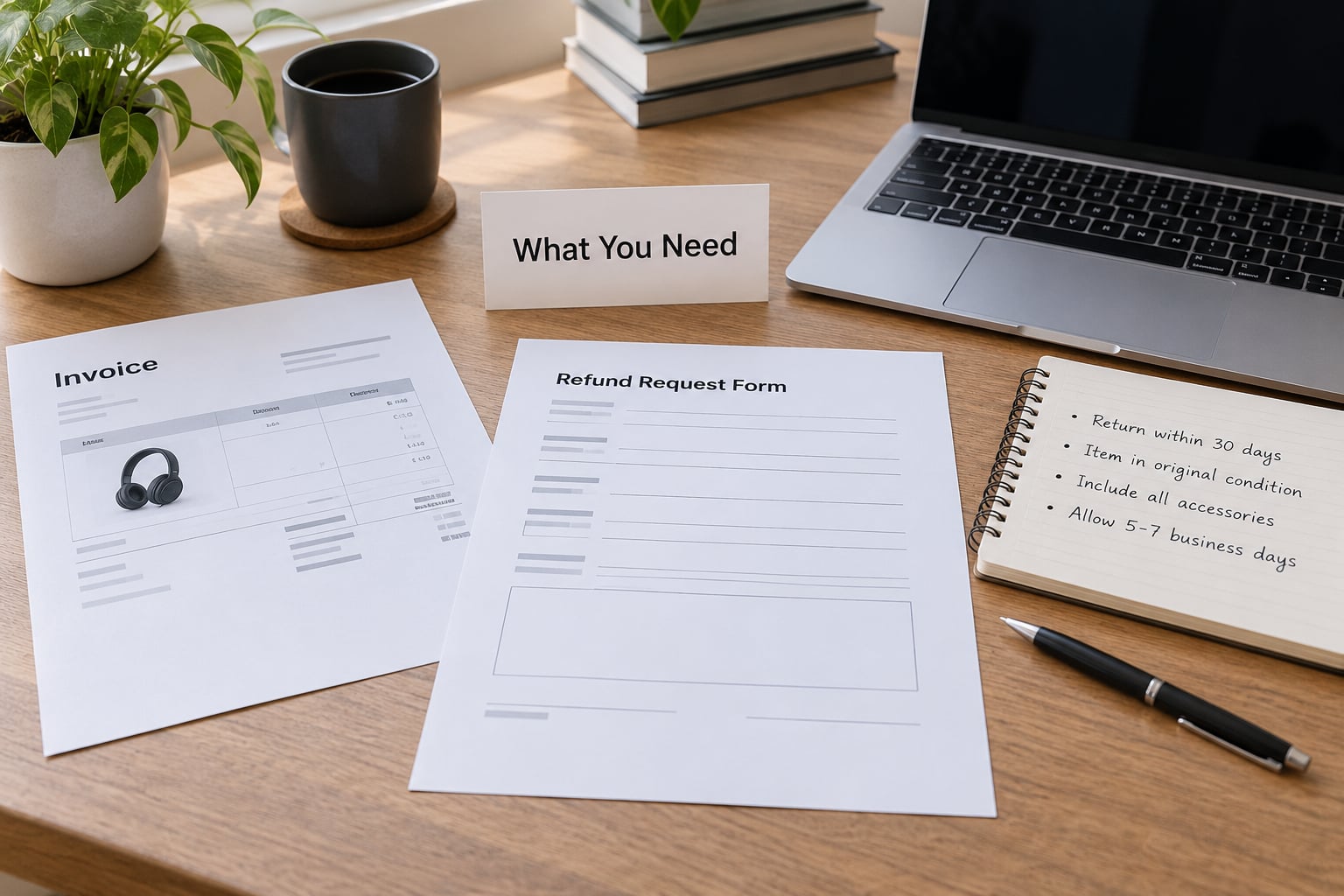
You cannot write a policy for a business you have not described to yourself yet. Gather these five things first and the drafting becomes mostly assembly.
- Business identity and contact details. Legal name, trading name, physical address, email address, and a phone number that a human actually answers. This is the block that goes at the top and bottom of the policy.
- What you sell. Every product type, service, or digital download. Note anything you know you cannot take back: perishable food, custom-made work, gift cards, downloadable files that have been opened.
- Your real customer expectations. Look at the last twenty refund or complaint emails you received. The language customers use is the language that belongs in the policy.
- Payment and fulfilment records. Which processor you use, when the money settles, whether you offer store credit, and whether you can issue partial refunds. Your payout timeline depends on this.
- Applicable legal requirements. Your state consumer protection statute, and for anyone shipping to the EU or UK, the distance-selling rules. Rules differ by state and change, so treat this as a starting point.
Owners on small business forums repeat one point consistently: a clearly stated policy is what lets you say no to a refund. Refusing is not the risk. Unclear terms are.
Step-by-Step
Define What Qualifies for a Refund
Write the eligibility rule first, because every other clause hangs off it. Decide which of these categories apply to you and say so in one sentence each.
- Changed mind. Bought a jacket, it does not fit. Does that get refunded, exchanged, or converted to store credit?
- Damaged or faulty on arrival. Almost always refunded or replaced, and usually with no return shipping charged to the customer.
- Wrong item shipped. Refunded in full once you confirm the error. Say that you will cover the return label.
- Not as described. This one is legally loaded. If your listing photographs a product you do not ship, that is your problem, not theirs.
- Service not delivered or cancelled. For trades, salons, coaching and courses, define what portion of the work was completed, because completed work is hard to un-ring.
Owners who sell multiple sizes or colours worry about customers ordering five, keeping one and returning four. You can address it directly: limit returnable quantities of a multi-pack item to one, or require that items are returned unused with original packaging and tags attached. Buyers respond better to a stated quantity limit than to a vague condition clause they suspect you will reinterpret later.
Set a Clear Refund Deadline
Pick a window, state it in days, and say how you count them. The counting question is where most arguments start. Say whether the clock runs from the order date, the delivery date, or the date the customer receives the item, and whether the customer needs to ship the item by the deadline or have it received by the deadline.
The postmark rule is the fairer choice. If the item is in the carrier’s system on day 29 of a 30-day window, the customer should not lose the refund because your warehouse was slow to process the box.
There is no legal requirement in most of the US to offer a specific return window, so 14, 30 and 60 days are all legal. Fifteen days feels tight in a way that costs you sales. Match the window to how long your customers realistically take to try something.
| Business type | Common window | Refund method | Who pays return shipping |
|---|---|---|---|
| Online store, general goods | 30 days from delivery | Original payment method | Customer, unless faulty |
| Brick-and-mortar retail | 14-30 days from purchase | Store credit or original payment | Customer |
| Apparel with fit risk | 30 days, tags on | Exchange or store credit first | Customer |
| Furniture and large items | 30 days, pickup or delivery | Original payment method | Customer, plus pickup fee if you send a truck |
| Services and trades | Set per project in writing | Refund for undelivered work | Not applicable |
| Digital products and courses | 7-14 days, download-based | Original payment method | Not applicable |
| Food, beauty, perishable goods | Same day or quality issue only | Store credit or refund | Not applicable |
One common compromise among owners is a 30-day window with store credit offered as the default alternative to cash, and no returns on items already marked down. It keeps the goodwill while protecting your margin.
Explain Refund Methods and Processing Times
Separate two clocks in your customer’s head: how long you take to approve the refund, and how long the bank takes to show it. Owners routinely get complaints about the second one, when the money left their account days earlier.
A workable default: approve or decline within two business days of receiving the returned item, then issue to the original payment method. Card and bank refunds typically take another five to ten business days to appear on a statement. Store credit is instant, which is exactly why it works as your default alternative.
Name the methods you actually offer. Original payment method, store credit, exchange for a different size or colour, and partial refund for a partial return are the usual four. If you hold the refund until the item is physically back in your hands, say that in the policy, because a customer who assumes otherwise will read it as you sitting on their money.
Write the Terms in Clear Language
Short sections, short sentences, one idea per clause. A customer should be able to find the answer to their question in under a minute without a lawyer or a support ticket. If a sentence needs a second read, rewrite it.
State conditions concretely so a customer can self-check: unused, original packaging, tags attached, proof of purchase or order number, return authorization requested before shipping. Vague phrases like “in acceptable condition” are the ones that generate disputes, because two people read them differently.
For everything you will not accept, use a single named section rather than burying exclusions in the middle. Final sale items, perishable goods, custom or personalised items, gift cards, and downloads already delivered are the usual list. Custom-made work is the strongest exclusion you can justify, because it cannot be resold. Refusing to refund a delivered course is weaker ground in the eyes of consumers, so if you sell one, set the expectation in the sales page before purchase.
Review and Publish the Policy
Read the draft against your actual practice, clause by clause. If you wrote “refunds processed within 24 hours” and your processor takes four, the policy is now a commitment you have broken on day one.
Then place it where customers can find it before they buy: a dedicated Returns and Refunds page, a link in the site footer, a checkbox or link at checkout, and a copy in every order confirmation email and receipt. On the product page itself, a one-line summary of the window and any exclusions prevents most surprises.
Give the policy an effective date and review it annually. Legal content goes stale, and your shipping costs and product mix change faster than the law does.
Common Mistakes
Vague promises. “Refunds available on a case-by-case basis” commits you to nothing and gives the customer nothing. Replace it with the specific conditions you listed.
Conditions buried in clause eight. Exclusions customers never read are the ones that end up in a complaint. Give final sale and perishable items their own labelled section near the top.
No deadline at all. A policy that never closes leaves the decision to whoever answers the email that day, and it invites the customer who returns something a year later expecting a refund.
No way to ask for a refund. If there is no email address, form or named contact, people skip you and go straight to a chargeback.
Unfair exceptions. Excluding damaged goods, faulty items or your own shipping errors is the kind of clause that generates bad press and regulator attention. Exceptions should cover what you genuinely cannot resell, not what you would rather not deal with.
Non-refundable items with no explanation. A refusal that names the reason and offers an alternative reads as reasonable. The same refusal with no reason reads as a trap.
A policy your staff does not follow. This is the expensive one. If the website promises free return labels and the counter clerk charges nothing either way, or worse, refuses, you have created the dispute you were trying to prevent. Train the team on the same document and keep a copy at the register.
Frequently Asked Questions
Are refund policies legally binding?
Usually, yes. A refund policy published on your website, at checkout, or on receipts generally becomes part of the sales contract, and many US states require a policy to be clear and conspicuously posted to be enforceable at all. The practical risk is the opposite of what owners fear: a generous written policy is hard to walk back later. Check your own state rules before relying on that, because they differ.
Does a small business have to give refunds?
In the US, generally no. No federal law requires a private business to refund a purchase, and most states leave it to you, provided your policy is clearly posted and you honour what it says. A few situations are different: faulty or misdescribed goods can trigger state consumer protection claims, and EU and UK buyers keep a statutory 14-day right when goods are sold at a distance. Rules vary by state and change.
How long should my return window be?
Thirty days is the most common choice for physical goods because it matches how long people actually take to decide. Fourteen days works for in-store purchases where the customer handled the item first. Services and digital products usually run shorter, around seven to fourteen days, because once the work is delivered there is nothing to put back on a shelf. Match the window to your product, not to a competitor’s.
What should I write in a cancellation policy for services?
Cover four things: the notice period a client must give, whether a fee applies to late cancellation, what happens if you cancel, and what is refundable if the job is partly done. Owners who put these terms directly in the client agreement report far fewer disputes than those who rely on a separate webpage. State the refund amount for undelivered or partially delivered work, and how quickly it is paid back.
How do I professionally say no refund?
Name the rule, cite the date, and offer an alternative. For example: our 30-day window closed on the date of purchase, so I cannot refund this as a return, but I can offer store credit or a repair. Some owners add a goodwill partial refund, refunding the cost of the item plus a small bonus when the amount is small enough to make the gesture worth it.
How long does a refund take to reach the customer’s account?
Two clocks are running. Approval is yours, and one or two business days after the returned item arrives is a fair commitment. Settlement belongs to your payment processor and the card networks, and typically takes five to ten business days more before the customer sees it on a statement. Print both timelines in the policy, because the wait after you press send is where most refund complaints actually come from.
Conclusion
Start with the two lines everyone forgets: what qualifies for a refund, and how many days the customer has. Write them today, put them on a page customers can reach before checkout, and build the rest of the document around them. Everything else on this list is detail those two sentences depend on.