
To build business credit from scratch, you need to make the business a separate legal entity with an EIN, open a business bank account in its name, get on net-30 payment terms with two or three suppliers that report to a business credit bureau, add a business credit card, and then pay every one of those accounts on time, month after month. Most new owners can do the paperwork in a few weeks. The score takes a year to build properly.
Here is the part nobody tells you at the start. Business credit is not separate from your personal credit the way people assume. Almost every business card and most business loans require a personal guarantee, which means the lender can come after you personally if the business stops paying. Forming an LLC protects you from the ordinary liabilities of the business. It does not protect you from a defaulting credit card.
So the goal here is not just a number. It is a documented operating history that a lender can verify, and habits that survive a bad quarter. I have watched owners spend six months chasing a score while mixing personal and business money, and none of that shows up anywhere. Get the structure right first, then let the payments do the work.
This is educational information, not financial, tax, or legal advice. Rules and lender policies vary by state and change over time.
Table of Contents
- What You Need
- Step-by-Step: How to Build Business Credit From Scratch
- 1. Establish Your Business and Get an EIN
- 2. Open a Dedicated Business Bank Account
- 3. Apply for an SBA or Guaranteed Business Card
- 4. Use Invoices and Purchase Orders Responsibly
- 5. Pay Suppliers and Credit Accounts on Time
- 6. Check Business Credit Reports and Dispute Errors
- Common Mistakes
- How Long Does It Take to Build Business Credit?
- Frequently Asked Questions
- Can I build business credit without an EIN?
- How long does it take to build business credit from scratch?
- Does a business bank account build credit?
- Is an SBA business credit card better than an unsecured business card?
- Do business credit cards require a personal guarantee?
- How do I check and correct my business credit report?
- Start With the Basics
What You Need

Before you apply for anything, gather the paperwork. Most owners who get turned down are turned down for boring administrative reasons: a mismatch between the name on the formation documents and the name on the bank account, or an address that changes two months later.
- Formation documents. Articles of organization or incorporation, plus your operating agreement or bylaws. Keep the filed copies, not just the ones the formation service emails you.
- EIN confirmation letter (CP 575). The IRS assigns this free. You get one on paper; the letter itself is not a score booster, but you cannot open most business accounts without the number.
- Business bank account. In the exact legal name of the entity. Not a personal account with a business label.
- Ownership records. Who owns what percentage, and the operating agreement that says so.
- A filing calendar. Annual reports and franchise taxes are public record. A missed annual report gets an LLC marked as delinquent in state records, and underwriters do look.
- An invoice system. Even a spreadsheet. Numbered invoices, dated, with payment terms stated on them.
- A calendar for bills. Not optional. This is the single most important tool in the whole process.
- A way to check reports. Dun and Bradstreet, Experian, and Equifax all publish a business credit report you can request. You do not need a paid subscription to read them.
Three identifiers get confused constantly, so here they are side by side.
| Identifier | What it is | Who issues it | What it unlocks |
|---|---|---|---|
| EIN | A federal tax ID for the business | IRS | Business bank accounts, business cards, SBA loan applications, some vendor accounts |
| D-U-N-S number | A business location identifier used to create and update a credit file | Dun and Bradstreet | Being found in bureau records; many suppliers look you up by it |
| Business bank account | An operating account held in the entity’s name | A bank or credit union | Clean separation of finances; a transaction history lenders can read |
None of these three is the same as a credit score, and none of them creates a score on its own. People mix them up because the D-U-N-S number is attached to the file that produces a score, so people assume it is the score. It is an identifier, not a rating.
Step-by-Step: How to Build Business Credit From Scratch
1. Establish Your Business and Get an EIN
Register the business as an LLC or corporation with your state, not just a DBA name. A registered DBA on your personal identity does not give you a separate credit profile. The legal entity does.
Then get an EIN from the IRS. It is free, it takes a few minutes online for most business types, and the confirmation letter arrives by mail in about two weeks. Never pay a third party to get one for you. If someone charges you for an EIN lookup, close the tab; the IRS does not charge for this.
Pick the right NAICS or SIC industry code when you register. This code is how bureaus and suppliers classify what you sell, and it decides which trade lines you are even offered. A contractor who registers as general services may get different supplier accounts than one registered under their actual trade. Get it right now rather than re-filing later.
How to verify it worked: you can pull a business credit report from Dun and Bradstreet and see a file under your legal name and address. It may be empty, but it should exist.
2. Open a Dedicated Business Bank Account
Open an account in the legal name of the entity. Some banks and credit unions will open accounts for a newly formed business with no revenue history, others want three to six months of statements. Shop a few and read what each requires for a new entity.
From day one, run every payment through this account. No exceptions for the first purchase, no running a card at the grocery store for the business to grab a receipt. That habit is what separates an entity that keeps its corporate veil from one that gets commingled, and it is also what gives a lender a transaction history to read.
Keep monthly records: a profit and loss statement, a balance sheet, and an accounts payable list with due dates. Owners who reach the six-month mark with real numbers have a far easier time than owners who reach it with twelve months of receipts in a shoebox.
How to verify it worked: after 60 to 90 days you have a statement showing recurring activity, and you can compute a quick ratio (cash plus receivables divided by current liabilities) that a lender will ask for.
3. Apply for an SBA or Guaranteed Business Card
Start where you can get approved. An SBA-backed business card still requires a personal guarantee and a personal credit check, but the underwriting criteria published through the SBA are somewhat more forgiving of a young business with no history than a conventional commercial card.
A secured business card, where you deposit a cash amount that becomes your limit, is the other realistic starting point. You use it, you pay in full, the issuer reports the account to a bureau, and after a stretch of on-time payments some issuers convert it to an unsecured card and raise the limit. That reporting history is the part that actually matters.
When you compare offers, look at four things and ignore the rest: the annual fee, whether the issuer reports to Dun and Bradstreet, Experian, or Equifax, whether it offers a preset intro APR for the first year, and what the credit limit is relative to any deposit. Confirm the reporting question before you apply. An issuer that does not report gives you a payment history nobody can see.
How to verify it worked: after 30 to 45 days, the account appears on your business credit report with a reported status of current.
4. Use Invoices and Purchase Orders Responsibly
This step is where trade credit starts, and it is the one most owners skip. Ask two or three suppliers you already do business with for net-30 or net-60 terms instead of paying on delivery. A supplier who extends terms is extending credit, and if they report to a bureau, that becomes a tradeline on your file.
Before you sign up, ask directly: does this account report to Dun and Bradstreet, Experian, or Equifax? If the answer is no or vague, ask what data they do share. Plenty of suppliers will tell you plainly. Uline, Grainger, and similar industrial distributors are frequently named by owners as early tradelines, along with fuel suppliers, freight carriers, and office supply houses. Treat any name as a starting point and verify the reporting yourself.
For customer work, issue proper invoices with a number, date, line items, and stated terms. Save purchase orders and confirmations. When you eventually apply for a line of credit or an equipment loan, the underwriter will ask how long you have been in business and what your suppliers say about you, and documentation is what answers both.
How to verify it worked: the supplier appears as an open tradeline on your business credit report, usually within 60 to 90 days of the first invoice.
5. Pay Suppliers and Credit Accounts on Time
This is the whole game. Payment history carries the most weight in every business scoring model, and on-time payment is the one factor you control completely.
Set up a system rather than relying on memory. I use two recurring calendar entries per account: one 15 days before the due date as a warning, one on the due date. Autopay at least the minimum on every account so a low balance or a slow week never turns into a late payment. If you can pay the balance in full, do it; revolving balances that carry month to month are the fastest way to depress your utilization.
Keep reported utilization under 30 percent of your total limits. On a combined limit of 20,000, that means keeping the reported balance under 6,000. High reported balances tell a lender you are stretched, even when you pay every bill on time.
When you do miss one, act the same week. Call the supplier, pay it, ask whether it has already reported. Many will correct or delete a first late notice that was reported in error or reported before you had a chance to pay. Silence is what turns one late payment into a pattern.
6. Check Business Credit Reports and Dispute Errors
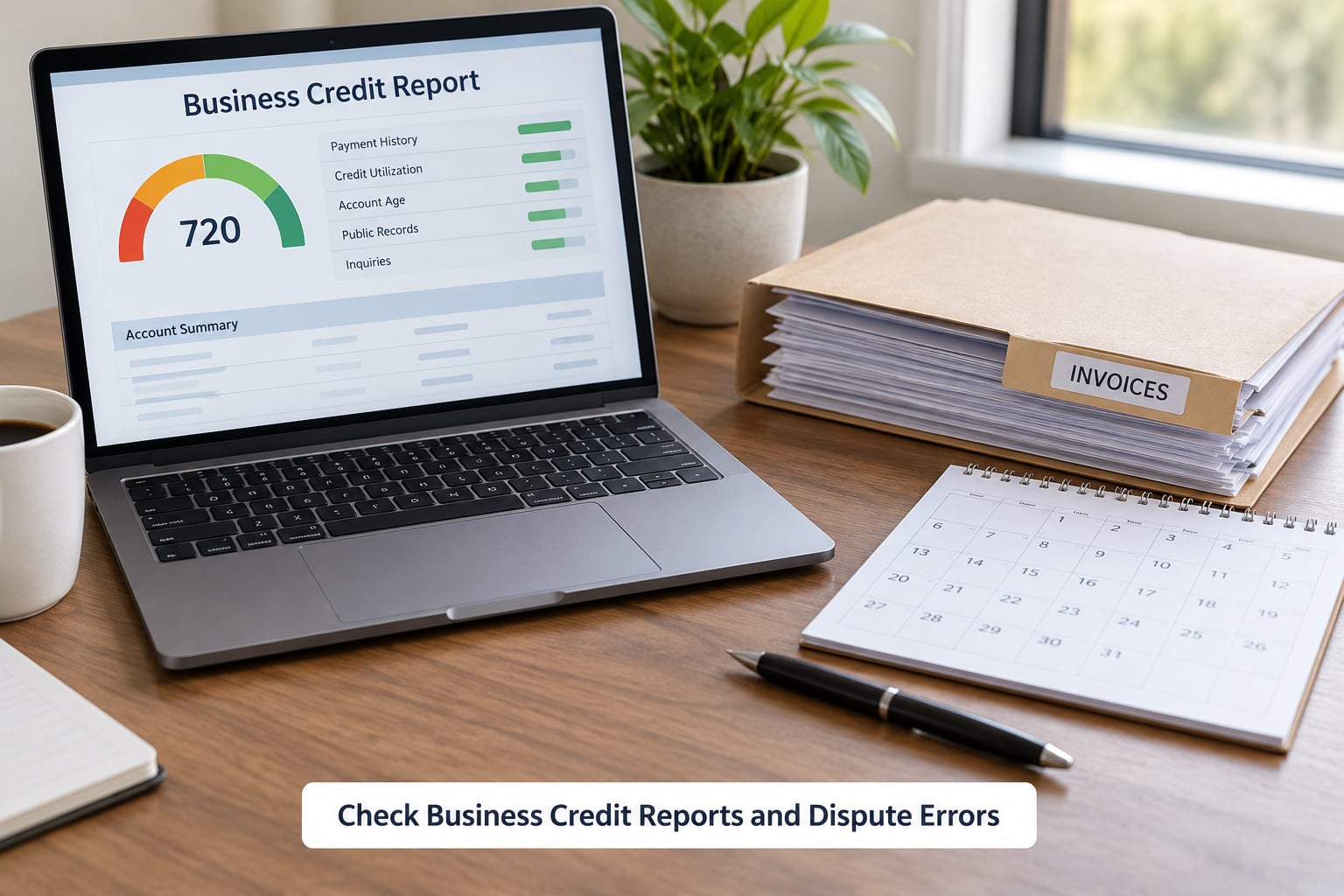
There are three main US business credit bureaus: Dun and Bradstreet, Experian, and Equifax. Each builds its file differently, and they will not show you the same tradelines at the same time. A supplier that reports to one may never report to another. So review all three, not just the one you think is the important one.
Scoring varies by bureau. Dun and Bradstreet’s PAYDEX runs 0 to 100, where 80 or above is generally treated as strong. Experian’s Intelliscore Plus also runs 0 to 100, with 76 or above commonly cited as a good result. Equifax uses its own commercial scoring model. None of these is a FICO, and none of them is the number a bank will necessarily quote you.
On each report, check for: accounts that belong to a different business with a similar name, tradelines you closed years ago still listed as open, duplicate entries, inaccurate payment status, and negative entries older than the bureau’s reporting period. Also check that your legal name, address, and status are current.
To dispute, write to the bureau, not the supplier. Include the account number, why the entry is wrong, and a copy of supporting documentation such as your formation filing or a paid invoice. Send it by a method you can prove, and follow up in 30 days. Most errors are clerical and clear quickly once someone is asked.
How to verify it worked: your report shows the corrected status and your own legal name and address at the top.
Common Mistakes
- Mixing personal and business money. The fix is immediate and non-negotiable: everything through the business account, starting today, with owner draws documented as draws.
- Applying for several cards at once. Multiple hard inquiries in a short window read as desperation. Space them out, and confirm first whether a business inquiry even affects your personal file.
- Maxing out a card. High reported utilization is the second thing a lender looks at after payment history. Pay balances down before the statement closes, not after.
- Closing the first account too early. The oldest open tradeline is part of your history length. Keep it open, keep it paid, and use it for small recurring costs.
- Relying on vendor scores alone. A single high supplier score is not a credit profile. You want a mix of card, trade, and eventually a line of credit, plus payment history with each.
- Paying for a D-U-N-S number. It is free from Dun and Bradstreet. Resellers charge a fee for what is a free lookup, and the advice to avoid them appears repeatedly in small business owner communities.
- Ignoring report errors. A duplicate or misreported tradeline drags every derived score down. Spend an hour a quarter reviewing all three reports.
- Building credit with no revenue. Without cash flow, you cannot carry a balance responsibly, and a card you never use adds very little. Get revenue first, then build.
How Long Does It Take to Build Business Credit?
Roughly a year of consistent behavior gets you a profile a lender will take seriously. Six months gets you started. Anything faster than that usually means something was misreported.
| Time range | What usually exists | What a lender sees |
|---|---|---|
| 0 to 3 months | EIN, business bank account, business credit file opened, first card application | A legal entity that exists and separates its finances |
| 3 to 6 months | First card account reporting, first two or three net-30 tradelines | Several months of on-time payments |
| 6 to 12 months | A full payment history across card and supplier accounts, PAYDEX moving into the 70s or higher | A pattern they can underwrite |
| 12 to 24 months | Longer history, credit mix, possibly an unsecured line of credit | Terms comparable to an established small business |
What changes the pace: whether you have real revenue to show, whether the issuers you chose actually report, how many accounts you opened and closed, and how many hard inquiries you made. Owners with steady revenue and clean records move at the fast end. Owners with irregular cash flow sit at the slow end no matter what the timeline chart says.
I want to be straight about this: no timeline is a promise. Scores move for reasons that are not fully transparent, and bureau algorithms change. Treat the milestones as progress markers, not deadlines.
Frequently Asked Questions
Can I build business credit without an EIN?
Not really. Nearly every path to business credit runs through an EIN: banks require it to open an account in the entity’s name, card issuers ask for it on the application, and the SBA wants it with a loan request. You can technically operate without one, some single-member LLCs file using their owner’s Social Security number, but you will hit a wall quickly. If you have no EIN, getting one from the IRS is free and should be your first move.
How long does it take to build business credit from scratch?
Plan on about six months to get accounts reporting and a year before a profile looks established to a lender. The first three months cover the EIN, the bank account, and your first applications. Months three to six bring supplier tradelines and card history. By the twelve-month mark you have a payment record long enough to underwrite. No timeline is guaranteed, and accounts that do not report will never move your score at all.
Does a business bank account build credit?
It builds the foundation, not the score. A bank account does not report to Dun and Bradstreet, Experian, or Equifax, so it will never appear as a tradeline. What it does is separate your finances, produce months of statements a lender can read, and let you demonstrate real operating revenue. It is the platform everything else sits on, and skipping it is one reason new businesses get declined.
Is an SBA business credit card better than an unsecured business card?
It is usually easier to get approved for, because SBA-backed issuers apply published criteria that are somewhat more forgiving of a young business. The trade-offs are a personal guarantee, sometimes a personal credit check, and fewer premium perks. If you are brand new, approval odds matter more than lounge access. Start with whichever you can actually open, then graduate once your payment history has some months behind it.
Do business credit cards require a personal guarantee?
Almost always, yes. The card issuer wants the owner’s promise behind the balance, which is why most issuers run a personal credit check even for an LLC. This is the detail new owners most often miss, and it matters: an LLC protects you from ordinary business liabilities, but not from a credit card balance the business stops paying. Read the guarantee language before you sign.
How do I check and correct my business credit report?
Request a report directly from Dun and Bradstreet, Experian, and Equifax, and review all three because they build different files. Look for tradelines that belong to another business with a similar name, accounts still shown open after you closed them, and inaccurate payment status. To dispute, write to the bureau with the account number, what is wrong, and your documentation, then follow up in 30 days. Most errors are clerical and clear out fast.
Start With the Basics
Here is the week-one version. File or confirm your LLC with the state and pick your industry code. Apply for the EIN at the IRS. Call two banks and ask specifically what a newly formed business with no revenue needs to open an account. Then ask your two most frequent suppliers for net-30 terms and whether those accounts report to a bureau.
Everything after that is repetition: separate money, clear payment terms, invoices numbered and saved, every bill paid before or on its due date, reports reviewed once a quarter. Owners who build business credit from scratch without a revenue stream tend to stall, so put the credit work behind actual sales rather than in front of it.
The habits that matter are unglamorous. Consistent documentation, on-time payments, and accurate reporting beat any trick, and they are the only parts of this that hold up when a lender pulls your file.
Rules, bureau scoring models, and lender requirements differ by state and institution and change over time, so confirm current requirements with the IRS, the bureaus, and the issuer before you rely on a specific figure.