An inland marine policy for tools is a form of commercial property insurance that covers a business’s tools, equipment, and materials while they are away from the business’s own premises — in transit between job sites, staged at a customer location, or stored somewhere temporarily. It exists because a standard commercial property policy only covers property at a listed address, and a general liability policy covers damage to other people’s property, not your own gear.
That gap is where most contractors get burned. A $40,000 saw, a skid steer, or a trailer of copper pipe sitting at a job site three towns over is often covered by nothing at all.
Table of Contents
- What an Inland Marine Policy for Tools Is
- Where it sits in your insurance stack
- Why the Name Is Inland Marine, and Why Policies Are Called Floaters
- What an Inland Marine Policy for Tools Covers
- Scheduled equipment
- Blanket coverage
- Property in transit
- Off-premises and temporary storage
- Rented and borrowed equipment
- Materials
- When Coverage Applies: Transit, Job Site, or Temporary Storage
- What an Inland Marine Policy for Tools Does Not Cover
- Inland Marine vs. General Liability vs. Commercial Property vs. Builder’s Risk
- Scheduled vs. Blanket Coverage: Which One You Want
- How Is the Value of a Tool Determined?
- Actual cash value
- Replacement cost
- Fair market value
- Agreed value
- Equipment Floater vs. Installation Floater
- How Much Inland Marine Insurance Do You Need?
- Pick limits that survive one bad day
- Choose a deductible you can actually pay
- Understand sub-limits
- Review limits when the fleet changes
- What moves the premium
- Do I Need Inland Marine Insurance for My Tools?
- What an Inland Marine Claim Pays For, and What It Doesn’t
- What you need before the adjuster calls
- The first 48 hours
- What slows claims down
- What the settlement doesn’t include
- How to Choose an Inland Marine Policy
- Frequently Asked Questions
- Does an inland marine policy cover tools stolen from my truck overnight?
- Is contractor’s equipment coverage the same as inland marine insurance?
- How is a tool’s value decided when a claim is paid?
- Do I need inland marine insurance if I already have a business owners policy?
- Can I insure tools my employees own?
- How long does an inland marine claim take to settle?
- Key Takeaways
What an Inland Marine Policy for Tools Is
In plain terms, inland marine is property insurance that follows the property instead of the address. You tell the carrier what you own and what it’s worth, and the policy responds wherever that property goes, provided it stays in your care and is being used for your business.
You’ll see the same thing written several ways on quotes and declarations pages: inland marine, equipment floater, contractor’s equipment coverage, tools and equipment floater, or mobile equipment coverage. They’re the same product with different marketing names. Some carriers write it as a standalone policy; others attach it to a business owners policy as an endorsement or a separate section.
Where it sits in your insurance stack
Most small businesses carry three or four policies that each cover a different piece of the operation. Inland marine is the one that covers your own movable property when it isn’t sitting on your premises.
- General liability covers third-party injuries and third-party property damage caused by your work.
- Commercial property covers your building and the contents inside it at a scheduled location.
- Business owners policy bundles property and liability for smaller operations, usually at one location.
- Inland marine covers your tools, equipment, and materials away from that location.
Workers compensation, auto, and equipment breakdown are separate again. Inland marine doesn’t replace any of them; it fills the off-premises hole left by the first two.
Why the Name Is Inland Marine, and Why Policies Are Called Floaters
Marine insurance is the oldest form of property insurance, and it grew out of shipping — hulls, cargo, and the risk of losing a vessel or its load on open water. Inland marine kept the marine law and the marine contract wording, but applied it to goods moving over land instead of across water.
The word floater comes from the same idea. A floater policy “floats” with the property wherever it goes, rather than staying pinned to a fixed location the way a standard building policy does. When a carrier writes “equipment floater,” they mean inland marine coverage for tools and machinery.
It’s worth knowing that marine insurance still follows a set of traditional principles, including the doctrine of insurable interest (you can only insure property you would actually lose), the doctrine of utmost good faith on both sides, the doctrine of proximate cause, indemnity (you can’t profit from a loss), and the doctrine of subrogation (your insurer can’t recover from a party they compensated you for). Those principles are why marine forms are wordy and why agents ask so many questions on the application.
What an Inland Marine Policy for Tools Covers
Coverage usually falls into a few buckets: individually scheduled equipment, blanket coverage for unlisted tools, property in transit, off-premises and temporary storage, rented or borrowed equipment, and sometimes materials and parts.
Scheduled equipment
High-value items are listed one by one on a schedule with an agreed value. An excavator, a scissor lift, a camera body, a laser total station, or a pressure washer fleet usually lives here. If you can name it in a list, schedule it.
Blanket coverage
Blanket coverage applies to tools you didn’t schedule. It’s typically written with a per-item limit and an aggregate limit — say, any one unlisted tool up to a few thousand dollars, with a ceiling on everything unlisted combined. This is where hand tools, saws, drills, and small gear live, because itemizing a socket set would be silly.
Property in transit
Equipment being moved between your shop, a storage yard, and a job site is covered, subject to conditions. Transit coverage matters on long hauls, on overnight stops, and whenever equipment sits unattended overnight in a parking lot or rest area.
Off-premises and temporary storage
Tools stored at a rented yard, a customer-supplied lockup, or a shared job-site trailer while you’re not there are covered, provided the location is declared or falls within the blanket description.
Rented and borrowed equipment
Equipment you rent for a job, or borrow from another contractor, is often covered — but only up to a limit, and often only if the borrowed property is reported before the loss. An endorsement covering borrowed tools is cheap and worth asking about.
Materials
Some policies extend to materials, consumables, and parts in transit or in temporary storage, such as a pallet of lumber or a load of pipe. Many carriers keep this in a separate section with its own limit.
When Coverage Applies: Transit, Job Site, or Temporary Storage
Most inland marine policies are written around three everyday scenarios, and if your business lives in one of these, the policy is built for you.
| Property type | Where it usually is | Coverage question to ask |
|---|---|---|
| Hand and power tools | Van, truck bed, job site, storage locker | Is there a blanket limit, and is there a per-item cap? |
| Heavy machinery | Yard, job site, in transit | Is it scheduled with an agreed value? |
| Trailers | Towed, parked, at job sites | Is the trailer itself covered, or only its contents? |
| Electronics and test gear | Office, vehicle, remote site | Is there a sub-limit for electronics? |
| Materials and parts | In transit, staged on site | Is there a separate materials limit? |
| Rented or borrowed equipment | Anywhere | Does the policy cover borrowed property and up to what limit? |
There’s a fourth scenario people forget: equipment that’s on your property but not inside the building, such as a rack of pipe in the yard or a trailer parked behind the shop. Whether that’s covered depends on whether your commercial property policy has an outdoor property provision and how the inland marine schedule is written.
What an Inland Marine Policy for Tools Does Not Cover
Exclusions are where claims die, and the standard forms all start from the same set. Read the exclusions in your own policy rather than trusting a summary on a website.
- Wear, tear, and maintenance — a saw blade that wears out, a hydraulic hose that ages, or a machine with a mechanical breakdown. Inland marine covers sudden accidental loss, not gradual deterioration or defects.
- Intentional damage — anything you or your crew deliberately damaged, or damage from an illegal act.
- Theft from an unattended vehicle without forced entry — this is the big one. If a breaker bar was used on the truck, coverage can respond. If the truck was unlocked with the keys in it and a laptop vanished, many carriers deny it.
- Property already covered elsewhere — if a piece of equipment is already insured under another policy with the same carrier, you usually don’t get paid twice.
- Licensed vehicles and their bodies — cars, trucks, and trailers are generally treated as vehicles and handled by the auto policy, though the contents of a trailer may be covered under the equipment section.
- Tools left permanently at a home address — a garage full of tools used for side work is usually a homeowners policy question, not a business one.
- Confiscation, war, and nuclear risks — the standard political-perils exclusions still apply on marine forms.
Two of those deserve a closer look. The unattended vehicle exclusion is worth discussing with your agent before you buy rather than after a theft, because some carriers will write an endorsement that narrows it in exchange for a small premium increase. And the vehicle exclusion for trailers has generated real disputes, where the contents of a stolen trailer get paid but the trailer itself stays contested.
Inland Marine vs. General Liability vs. Commercial Property vs. Builder’s Risk
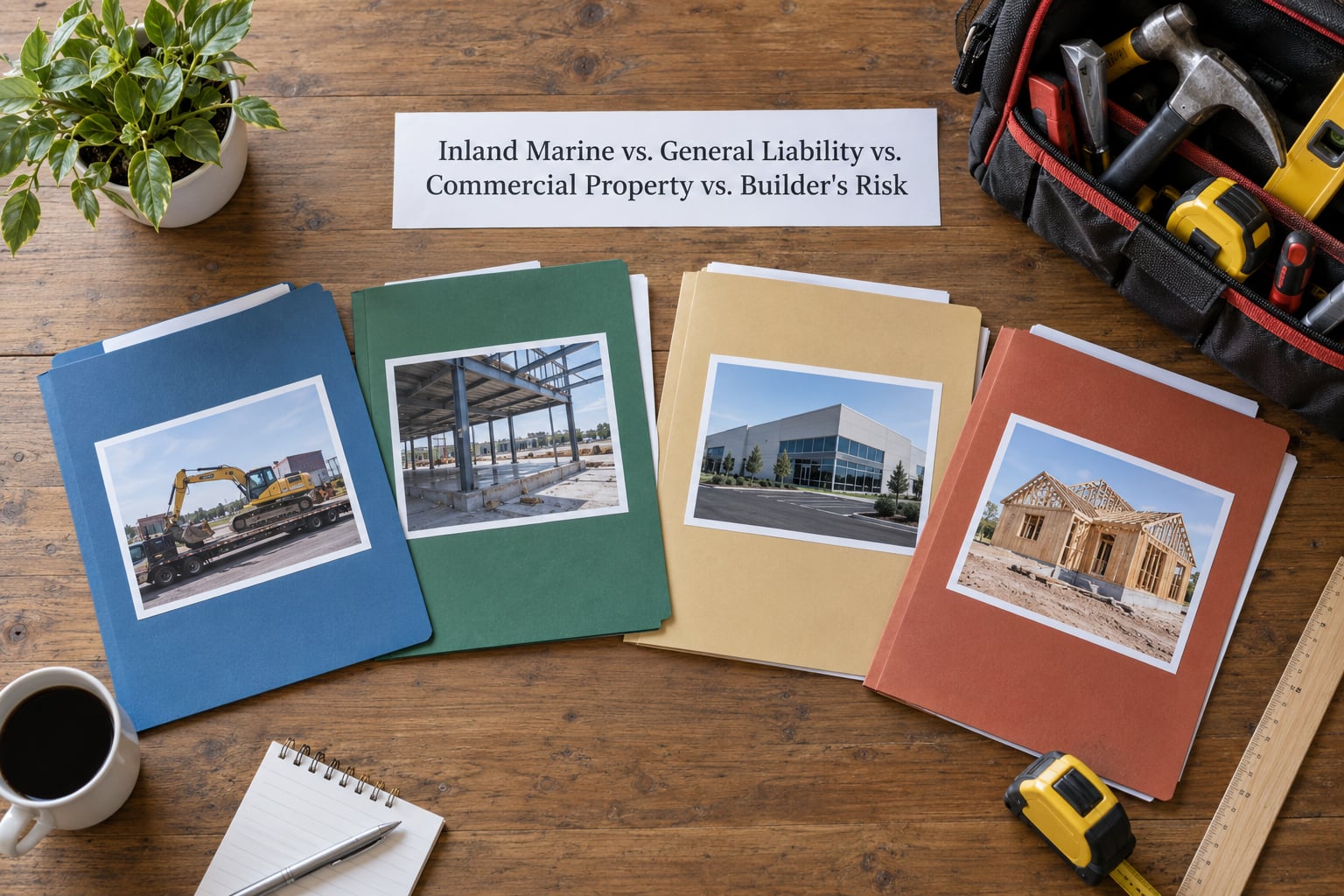
These four policies answer four different questions about your business, and tools usually land squarely in the gap between them. Here’s how each one behaves.
| Question | Inland marine | Commercial property | General liability | Builder’s risk |
|---|---|---|---|---|
| Does it cover my own tools? | Yes, when off premises | Only at the listed location | No | Materials on the project only |
| Does it follow my tools to a job site? | Yes | No | No | Sometimes, by project terms |
| Does it cover my building? | No | Yes | No | Structure during construction |
| Does it cover injury or damage I cause to others? | No | No | Yes | Sometimes, as a condition of the contract |
| Typical trigger | Tools and equipment away from premises | Named location, named property | A third party is harmed | Project in the build phase |
| Who needs it | Contractors, trades, mobile and event businesses | Anyone owning or leasing a building | Almost every business | Owners and developers mid-project |
The practical takeaway: general liability will never pay for your own stolen saw, and commercial property will not pay for the same saw once it leaves your shop. If you carry both and skip inland marine, you have an uncovered exposure that only shows up on the worst day of the year.
Scheduled vs. Blanket Coverage: Which One You Want
Most policies combine the two. Schedule the big-ticket items where an underwriter needs a specific value and a specific risk, and use blanket coverage for everything that would be unreasonable to itemize. Pure blanket coverage is cheaper to set up but leaves you arguing about value after a loss, because the insurer never agreed to a number for any individual item.
| Factor | Scheduled | Blanket |
|---|---|---|
| Best for | Machinery and high-value electronics | Hand tools, small power tools, general gear |
| Per-item treatment | Individual agreed value | Per-item cap plus an aggregate cap |
| Documentation needed | Invoices, appraisal, serial numbers, photos | Inventory list, ideally by model and serial |
| Claim friction | Lower, the value was agreed in advance | Higher, value gets argued after the loss |
| Underwriting | Insurer reviews each item and its use | Insurer reviews the aggregate and your trade |
If you’re ever choosing between a higher deductible and a higher limit, look at your inventory honestly. Schedules take real work, and contractors who can produce a current list by model and serial number consistently get better terms than those who guess.
How Is the Value of a Tool Determined?
The valuation method on your declarations page controls what you actually collect after a total loss, and it is often the single most important line in the whole policy.
Actual cash value
Replacement cost minus depreciation. A ten-year-old machine with 4,000 hours on the clock gets depreciated heavily, and the gap between what you owe and what you get can be large. This is the default on some inland marine forms.
Replacement cost
You get paid for a comparable new item, subject to limits and coinsurance conditions. If you’ve bought up — new generation tools at current prices — replacement cost reflects that.
Fair market value
What the item would sell for on the open market today, used. It’s narrower than actual cash value because it doesn’t account for the cost of putting the item back into service.
Agreed value
You and the insurer agree on a number up front. On a total loss the carrier pays that number, which removes depreciation from the argument. This is the smoothest way to hold machinery, and it’s why scheduled items usually carry agreed value.
Whichever method you land on, the documentation is the same: dated receipts, invoices, appraisal letters for heavy equipment, serial numbers, photographs, and a maintenance log. Equipment appraisals for high-value machinery are standard practice and worth paying for.
Equipment Floater vs. Installation Floater
Inland marine splits into two families, and they’re built for different risks.
An equipment floater insures portable tools, machinery, and mobile equipment that you own or that you’re responsible for, wherever it goes. This is the contractor’s version and the one most people mean when they say inland marine.
An installation floater insures materials and property from first delivery until the installation is complete, including while stored on the project site. It’s aimed at contractors and owners managing a build, where the material is exposed to the project rather than to transit.
Some carriers write them as one policy with two sections. It matters for you because an installation floater’s limits and deductibles are structured around the value of a project’s materials, not around the value of your fleet.
How Much Inland Marine Insurance Do You Need?
Set the limit at the current value of the property you want protected, minus what you can afford to absorb, and then apply the coverage form correctly. Not less, and not a round number someone picked to make the premium look tidy.
Pick limits that survive one bad day
Your aggregate limit should cover the largest realistic total loss — for many contractors, the whole scheduled list. If you buy a skid steer, a trailer, and $80,000 of machinery, a $25,000 policy is documentation of an unfunded exposure.
Choose a deductible you can actually pay
Deductibles on inland marine commonly run from a few hundred dollars on up, and larger deductibles usually bring meaningful premium relief. Pick a number you could write a check for the week after a loss.
Understand sub-limits
A sub-limit is a ceiling that applies to a category inside your overall limit — electronics, tools over a certain value, property in transit, or newly acquired equipment. Two categories with the same $100,000 aggregate can behave very differently if the sub-limits differ.
Review limits when the fleet changes
Adding a $40,000 machine or buying out a partner’s half of the fleet changes your exposure. Endorsements add items mid-term, but they don’t always lower automatically, so ask for a review at renewal rather than assuming.
What moves the premium
Five factors do most of the work: the total value scheduled, the type of equipment and how it’s secured, the deductible you chose, the claims history of the business, and the territory. Beyond those, carriers look at trade, overnight storage practices, and whether you run GPS or asset tracking. Rate also varies by state and changes over time, so treat any range you read as a starting point for a conversation, not a quote.
Do I Need Inland Marine Insurance for My Tools?
You probably do if your property regularly leaves your premises and you would have trouble paying to replace it. Construction and specialty contractors, landscapers, HVAC and plumbing companies, roofers, surveyors, event production crews, photographers, mobile medical and service operators, and anyone moving equipment between sites are the usual buyers.
There are cases where existing coverage is enough. If you own a building, keep everything in a locked building, never transport anything, and have no machinery, your commercial property policy may do the whole job. Adding inland marine in that situation mostly adds cost.
The middle case is the common one: a business owners policy carrying some off-premises coverage with a modest tools limit. That can be a perfectly sensible starting point for a handyman with $6,000 in hand tools. It stops being sensible the first time you buy a $30,000 piece of equipment, start sleeping with a trailer of tools, or take a subcontract on a site two hours away.
One more trigger worth mentioning: some general contractors and public owners require inland marine coverage in the subcontractor agreement, with a named limit, before they let you start work. Check your contracts before you quote.
What an Inland Marine Claim Pays For, and What It Doesn’t
A claim pays for covered physical loss to covered property, valued by the method in your policy, minus your deductible, up to your limits. That’s it. Everything that complicates it comes from documentation, timing, and how the loss is classified.
What you need before the adjuster calls
A list of the missing items with make, model, and serial number. Receipts, invoices, or bank records proving purchase and date. Photos from before the loss if you keep them. A police report number for any theft. And the serial numbers of every item on the list that isn’t being claimed, because the insurer will ask what else was in the trailer.
The first 48 hours
Report the loss to your carrier and your agent immediately, and get a police report. Photograph everything before you move it. Do a genuine inventory sweep instead of a from-memory list — after a theft people reliably remember four items they never had. Notify the manufacturer or dealer if the item carries a recovery service or title.
What slows claims down
Valuation disputes are the big one. Without receipts or an appraisal, the carrier falls back on their own research and the conversation becomes a negotiation. Ambiguity about whether a trailer is a vehicle or an item of equipment can add months, because the claim stops being a fact question and becomes a contract interpretation. Missing documentation is the third, and it’s the easiest one to fix in advance.
What the settlement doesn’t include
Depreciation, if you’re on actual cash value. Damage from wear, tear, or a mechanical defect. Loss of use or lost revenue while the equipment is out of service, unless you buy that coverage. Legal fees, unless a separate endorsement adds them. And any amount above your per-item or aggregate limits, no matter what it cost to replace.
How to Choose an Inland Marine Policy
Work through this list with an agent or broker who writes the form themselves, not just a comparison portal. Inland marine is one of the least standardized products in commercial insurance, and the difference between two quotes for the same limits can be entirely in the wording.
- Get the form and read the exclusions. Ask which form is being used — open perils, named perils, or a modification of a standard commercial property form — and get the exclusion list before you compare anything.
- Compare valuation methods. Replacement cost, actual cash value, or agreed value. This single choice can be worth more than any discount.
- Check the sub-limits, not just the total. Electronics, transit, borrowed property, newly acquired equipment. Sub-limits quietly cap the big numbers.
- Ask how unattended vehicle theft is treated. Forced entry requirement, keys left in the vehicle, overnight parking rules.
- Confirm what happens to a trailer. Whether the trailer itself is covered or only the contents, and whether it must be declared.
- Ask about borrowed and rented equipment. The limit, and whether prior notice is required.
- Check the claims service. Who adjusts, in what territory, and how long claims typically take with that carrier.
- Shop at least twice. Quotes for identical limits and wording vary a wide amount between carriers and between brokers.
- Bring a current inventory. Underwriters price what they can see, and a list with serial numbers is the single most useful document you can hand them.
Frequently Asked Questions
Does an inland marine policy cover tools stolen from my truck overnight?
Usually only if there was visible forced entry. Most inland marine forms exclude theft from an unattended vehicle without signs of forced entry, and unlocked trucks with keys inside are the classic denial. Some carriers will narrow that exclusion by endorsement for an extra premium, and others apply a higher deductible to overnight parking situations. Ask your agent in writing how the form treats it before you buy, not after the loss.
Is contractor’s equipment coverage the same as inland marine insurance?
Yes. Contractor’s equipment coverage, equipment floater, and tools and equipment floater are all marketing names for inland marine coverage written on movable business property. The one variation to watch for is an installation floater, which is also inland marine but is structured around materials on a construction project rather than a fleet you operate. Confirm which section your quote is pricing.
How is a tool’s value decided when a claim is paid?
It depends on the valuation method printed in your declarations. Actual cash value deducts depreciation, replacement cost pays for a comparable new item subject to any coinsurance condition, fair market value reflects the used market price, and agreed value pays the number you and the insurer settled in advance. Agreed value removes the depreciation argument, which is why high-value machinery is usually scheduled with it.
Do I need inland marine insurance if I already have a business owners policy?
Only if your tools leave the premises. A business owners policy covers property at your listed location, and its off-premises coverage is usually modest and capped. If you travel to job sites, haul a trailer, or own equipment worth more than you could absorb in a single bad week, a separate or attached inland marine section is usually worth it. Stay with the same carrier if possible, because carriers negotiate overlap disputes more easily.
Can I insure tools my employees own?
Some inland marine forms include employees’ tools as a courtesy, usually with a small per-person limit such as a few hundred dollars and often only for tools used on your jobs. That limit rarely replaces a policy the employee already owns. If your crews carry expensive personal gear, tell your agent, because the fix may be an endorsement on the policy or simply an instruction to your people.
How long does an inland marine claim take to settle?
A documented claim on a scheduled item with agreed value can move in a few weeks. A theft with no receipts, an appraisal you have to order yourself, or an argument about whether a trailer is covered can stretch into several months. Those delays come from missing documentation and coverage interpretation, not from the carrier’s workload. A current inventory with serial numbers is the cheapest way to shorten the timeline.
Key Takeaways
An inland marine policy for tools covers the property your other policies ignore: your own equipment and materials, away from your premises, in transit, at job sites, and in temporary storage. The decisions that matter are the valuation method, the scheduled versus blanket structure, the sub-limits, and the treatment of unattended vehicle theft.
Start with an inventory. List every tool and machine by make, model, and serial number, keep the receipts somewhere off the truck, and read your current declarations to see exactly where the gap is. Then take that inventory to an agent or broker, ask for the exclusions and the valuation method in writing, and get more than one quote on identical wording.
Coverage terms, filing rules, and rates vary by state and change over time, so treat this as a framework for your own research rather than as advice about your specific situation.