A single storefront sign typically runs between $800 and $5,000 installed, and most small businesses land somewhere in the $1,500 to $3,500 band. Cut vinyl window graphics can be had for a couple hundred dollars, while illuminated channel letters on a high-traffic retail facade regularly reach $10,000 or more. Every figure below is a typical US range, not a quote: prices move with city, size, material, illumination and how much electrical and permitting work the job needs.
The single biggest reason a sign quote shocks an owner is that the price is bundled. You see one number and no way to tell fabrication from installation from permit fees. Once you know which pieces are separate line items, the number stops being mysterious and starts being manageable.
Table of Contents
- How Much Does Storefront Signage Cost? Typical US Ranges
- How to estimate signage cost per square foot
- What channel letters are, and what they cost
- How much is digital signage
- Why the same sign costs more in some cities
- What Affects the Price
- Size and letter count
- Material and fabrication method
- Number of faces and mounting method
- Illumination and electrical work
- Permits, engineering and the rest
- Ways to Save
- 1. Get three quotes written on the same specification
- 2. Reface the cabinet instead of replacing it
- 3. Simplify the design
- 4. Bundle and order everything at once
- 5. Reuse approved artwork
- 6. Defer illumination if it is not needed yet
- 7. Take window graphics and sidewalk signs local, and fabrication local too
- 8. Ask what is not included
- Frequently Asked Questions
- How much does a storefront sign cost on average?
- Are cheap storefront signs worth it?
- Do I need a permit for a storefront sign, and what does it cost?
- How much do illuminated channel letters cost?
- Is sign installation charged separately from fabrication?
- How do I compare two sign quotes and know which one is fair?
- Conclusion
How Much Does Storefront Signage Cost? Typical US Ranges
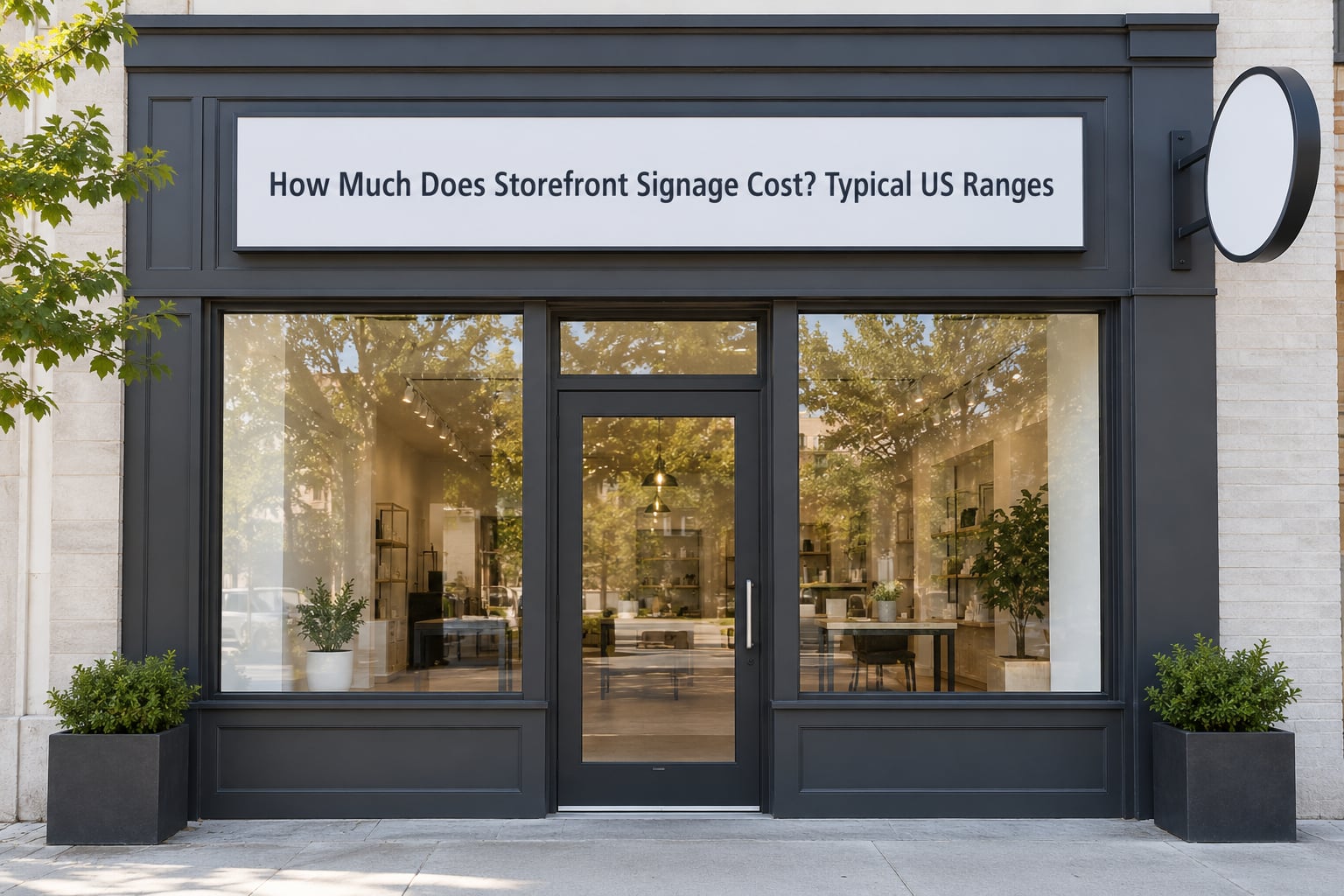
Here is the breakdown by sign type. These are the ranges you will see most often in US quotes, and each one assumes a standard retail frontage with straightforward installation.
| Sign type | Typical range (fabricated and installed) | What moves the price |
|---|---|---|
| Cut vinyl window graphics | $150 – $900 | Number of windows, coverage percentage, perforated or frosted film |
| A-frame or sidewalk sign | $75 – $350 | Material, double-sided graphics, whether it folds |
| Non-illuminated dimensional letters | $500 – $2,500 | Letter height, material, stud-mounted vs. flush-mounted |
| Blade or projecting sign | $900 – $3,500 | Double-sided graphics, bracket type, projection distance |
| Awning sign | $1,200 – $4,500 | Width of the awning, fabric versus rigid panels, frame |
| Lightbox or cabinet sign | $1,800 – $6,000 | Face size, number of illuminated faces, whether refacing only |
| Illuminated channel letters | $2,500 – $9,000 | Letter count and height, front-lit vs. halo-lit, return depth, electrical |
| Monument or pylon sign | $4,000 – $20,000 | Structure height, engineered footings, number of tenant panels |
| Digital signage | $5,000 – $100,000+ | Screen size, outdoor-rated brightness, mount and power, content software |
Refacing an existing cabinet usually costs between $800 and $2,500 rather than the full replacement price. That is the shortcut most owners hear about from a fabricator who has seen a hundred lightboxes with faded faces and perfectly good housings inside.
How to estimate signage cost per square foot
Fabricators price flat panels by area and dimensional signs by the letter. For a flat face such as a lightbox panel, window graphics or a monument face, a usable planning number runs roughly $35 to $95 per square foot fabricated, and $60 to $150 per square foot installed. A 4 by 8 foot face is 32 square feet, which puts a mid-range illuminated cabinet at about $1,900 to $4,800 before electrical work.
Letter signs get priced per letter instead, because labor scales with the number of pieces, the bends, and the wiring behind each one. Industry participants put the ballpark at $75 to $150 per letter, but that number only means something alongside letter height and lighting type. A 12-inch front-lit acrylic letter on a raceway and a 30-inch halo-lit aluminum letter are priced from entirely different sheets.
What channel letters are, and what they cost
Channel letters are the individual three-dimensional letters that make up most storefront names. Each one is a shaped metal or acrylic shell, an LED light source inside it, and a mounting method that holds it off the wall. Front-lit letters push light out of the face. Halo-lit letters wash light backward against the wall so the sign glows around the edge. Halo lighting costs more because of the standoff depth and the extra wiring, but it reads better at night.
For a typical business name, expect $2,500 to $9,000 installed. Small shops with four to eight letters land closer to the bottom of that range. Retail names in high-visibility positions run higher.
How much is digital signage
Outdoor digital signs start around $5,000 for a single small screen on a simple wall mount and climb past $100,000 for multi-screen pylons with structural engineering. Most small businesses are looking at the low end, where you are buying a weather-rated display, a bracket, a power drop and a content subscription rather than anything exotic.
Why the same sign costs more in some cities
Labor rates, permit fees and real estate costs all feed the final number, so two identical channel letter signs can differ several thousand dollars apart. Shopping center tenants also pay a premium because landlord sign criteria often mandate specific materials, illumination and mounting methods that would be optional on a free-standing building. A tenant who ignores the criteria risks having the sign removed.
What Affects the Price
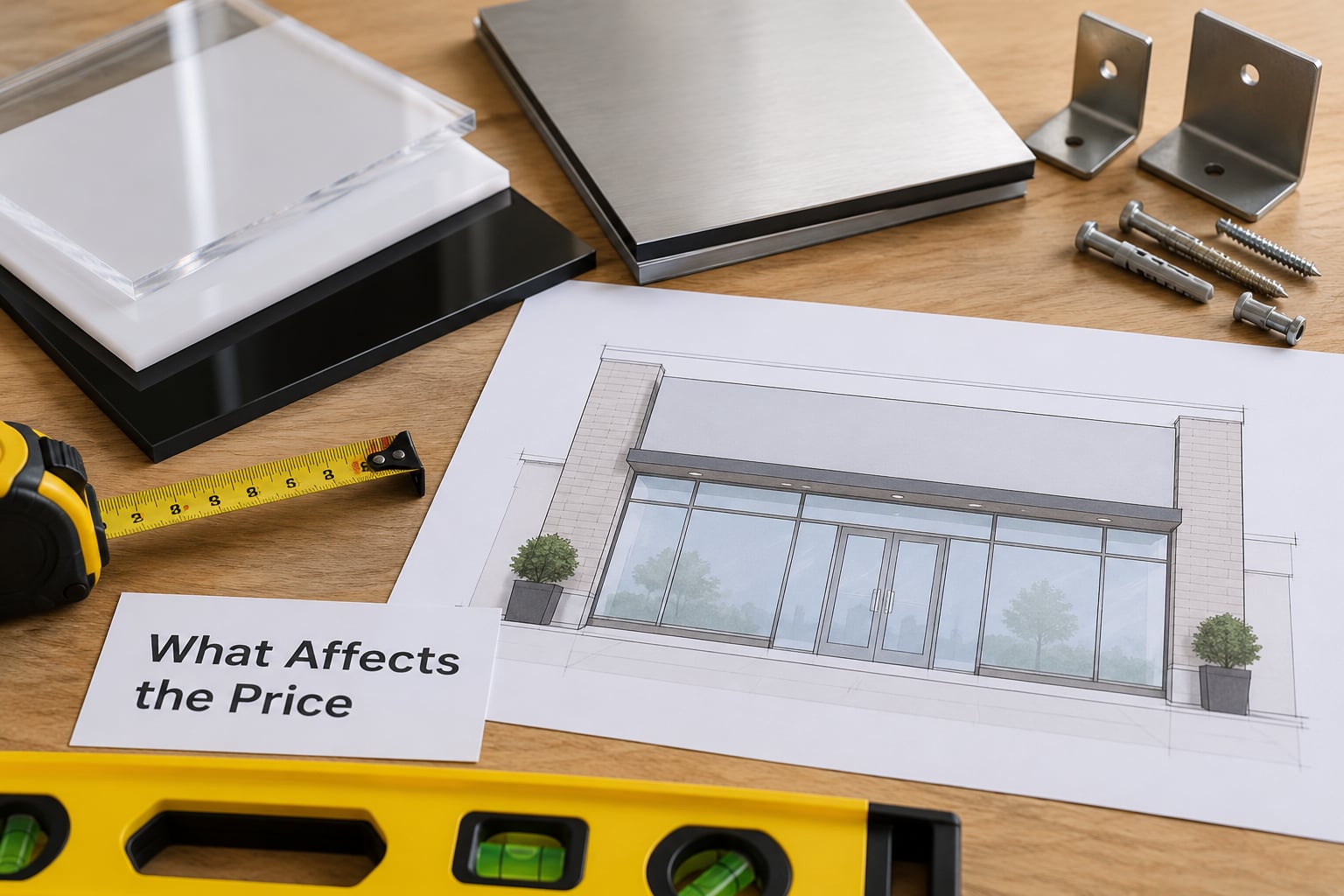
Five inputs do most of the work: sign type, size, material and illumination, installation difficulty, and permitting. Everything else is smaller. Here is how each one moves the number.
Size and letter count
Price scales close to linearly with area for flat panels and with letter count for dimensional signs. Going from a 3 by 5 foot lightbox face to a 4 by 8 foot face roughly doubles the panel cost. Doubling letter height doubles the material per letter and usually pushes a quote up by more than double, because bigger letters need heavier mounts and more electrical capacity.
Material and fabrication method
PVC and HDU are the budget faces. Acrylic and aluminum composite panel cost more but take weather and UV better, which matters for anything sun-exposed. Returns, bevels and multi-color paint add labor rather than material, and complex script fonts are quoted higher because each letter takes longer to bend or fabricate.
Number of faces and mounting method
A single-sided sign costs less than a double-sided one. Raceway mounts are the standard, tidiest option and cost more in labor. Flush mounting is cheaper and looks fine on a brick or stucco wall but leaves the return sides of letters visible, which matters if your landlord or code requires returns to match the face color.
Illumination and electrical work
This is the most common shock. A transformer, timer or photocell, and the labor to run a concealed circuit back to a panel can add several hundred dollars on top of fabrication. If the building has no sign circuit at all, the electrical portion can run into the thousands. Ask early whether a suitable circuit exists; it changes the quote more than any finish option you pick.
Permits, engineering and the rest
Soft costs are where first-time owners get surprised. These usually sit outside the fabrication price, so ask for them itemized.
| Line item | Typical range |
|---|---|
| Sign permit and application fee | $50 – $500 |
| Plan review or zoning review | $100 – $800 |
| Structural engineering (ground signs, canopy mounting) | $500 – $2,500 |
| Electrical hookup | $300 – $3,000 |
| Removal of the existing sign | $200 – $1,200 |
| Bucket truck or lift rental | $250 – $900 per day |
| Installation labor | $95 – $250 per hour per technician |
| Design or file preparation | $150 – $1,500 |
| Rush production surcharge | 15% – 40% |
| Project management fee | 5% – 12% of project total |
Sign area is checked against your frontage. Most jurisdictions cap the total sign area per linear foot of building frontage, so a wide facade gives you room and a narrow one does not. Sign shops quote the same sign differently in two cities because the local code review and the inspector’s expectations differ.
One more factor worth naming: some quotes come from a broker who passes the job to a manufacturer, and others come straight from the shop that fabricates it. Both are normal. Just know which one you are dealing with, because it changes how much room you have to negotiate.
Ways to Save
1. Get three quotes written on the same specification
A quote for a 4 by 8 foot double-sided illuminated cabinet is not comparable to a quote for a 3 by 5 foot single-sided panel. Write the dimensions, materials, illumination and mounting method into the request so every vendor prices the same object. Then compare line by line rather than by total.
2. Reface the cabinet instead of replacing it
If the housing, mounts and electrical are sound, a new translucent face with new LED modules gets you a sign that looks new for a fraction of the replacement cost. This is the highest-value shortcut on most storefronts.
3. Simplify the design
Curved returns, multi-color paint, layered logos and script fonts all add fabrication labor. A flat-faced, two-color sign with a standard font is meaningfully cheaper and usually looks cleaner on a small storefront than a busy design scaled down.
4. Bundle and order everything at once
Shops running several signs for one building give a better price than the same shop doing them one at a time. Bundling also collapses two mobilization fees into one, which is often a larger saving than the fabrication discount.
5. Reuse approved artwork
If you already own vector artwork that a landlord or previous tenant approved, say so. Design and file preparation runs $150 to $1,500 depending on who draws it, and approved files often remove the permitting question too.
6. Defer illumination if it is not needed yet
Fabricate the cabinet, raceway or panel now and add LED modules and wiring later. Specify a transformer with spare capacity at the start so the second phase is a small job instead of a rewire.
7. Take window graphics and sidewalk signs local, and fabrication local too
Online vendors win on simple decals, banners and A-frames because those are pure product with no site work. Anything requiring a permit, a lift or a landlord review is cheaper and far less painful through a shop that will visit the building.
8. Ask what is not included
Before signing, get a written list of exclusions: permits, engineering, electrical, removal, lift rental, landlord review fees. One short email now prevents the invoice conversation later. A shop that will not itemize is telling you something.
Frequently Asked Questions
How much does a storefront sign cost on average?
A single storefront sign typically costs between $800 and $5,000 installed, and most small businesses spend between $1,500 and $3,500. Flat window graphics sit at the low end, lightboxes and awnings fall in the middle, and illuminated channel letters on a busy retail facade can reach $9,000 or more.
Are cheap storefront signs worth it?
Budget signs are worth it when the sign is simple, the material matches the exposure, and it will be replaced in a few years. A printed vinyl banner outdoors in full sun fades within a season, while a PVC or HDU panel in the same position holds up far longer. The most common regret is buying a short-lived sign in a spot that needs a durable one.
Do I need a permit for a storefront sign, and what does it cost?
It depends on your jurisdiction and the sign. Most places require a permit for anything illuminated, over a certain height, or projecting into the public right of way, while small flush-mounted window graphics often need none. Application fees usually run $50 to $500, with plan or zoning review adding $100 to $800.
How much do illuminated channel letters cost?
Installed illuminated channel letters generally run from $2,500 to $9,000 for a typical business name. The price is driven by letter height, letter count, whether they are front-lit or halo-lit, return depth, mounting method and electrical work. Front-lit acrylic letters on a raceway sit at the lower end; large halo-lit aluminum letters sit at the upper end.
Is sign installation charged separately from fabrication?
Sometimes. Some shops quote fabrication and installation as one number, others list them separately, which makes the real comparison harder. Ask for a breakdown either way, and ask who pays for the bucket truck or lift, the electrical hookup and removal of the old sign. Those three items are where a low-looking quote quietly stops being low.
How do I compare two sign quotes and know which one is fair?
Compare them on the same specification: exact dimensions, material, face count, illumination type, mounting method and what the quote excludes. If two totals differ by more than about 30 percent, the gap is usually scope rather than quality. Ask each vendor to state whether they fabricate the sign themselves or broker it to a manufacturer.
Conclusion
Storefront signage cost comes down to five things: type, size, material and illumination, installation difficulty, and permitting. Once those are separated in the quote, the price stops being a mystery and starts being a decision you can actually make.
Start by measuring the sign area and the frontage available, then decide which sign types you actually need rather than the full package someone offers you. Confirm your local permit rules and your landlord’s sign criteria before any artwork is finalized, because both can force expensive redesigns. Then request three itemized quotes written against the identical specification and compare them line by line.