
What medical payments coverage does on a car policy? It pays accident-related medical bills for you, your household and your passengers no matter who caused the crash, and it usually pays only after your health insurance has run its course. Most policies treat it as a first-party coverage with no fault requirement and, in many states, no deductible.
Carriers shorten the name to MedPay. The rest of this guide covers what it reimburses, who it covers, how the limits work, and the parts people usually misread.
Table of Contents
- What Medical Payments Coverage Does on a Car Policy?
- What Does Medical Payments Coverage Typically Pay For?
- Emergency and transport
- Hospital and surgical
- Follow-up and rehabilitation
- Who Can Be Covered Under Medical Payments Coverage?
- How Much Does Medical Payments Coverage Usually Pay?
- What Does Medical Payments Coverage Not Cover?
- How Is Medical Payments Coverage Different From PIP and Health Insurance?
- How to Check Your Car Policy Before You Buy
- Frequently Asked Questions
- Is medical payments coverage the same as health insurance?
- Does medical payments coverage cover passengers in my car?
- Do I have to have a deductible for medical payments coverage?
- Can medical payments coverage pay for injuries from a car accident?
- Does medical payments coverage cover injuries when I am at work?
- Is medical payments coverage required in every state?
- Conclusion
What Medical Payments Coverage Does on a Car Policy?
Medical payments coverage is an endorsement on an auto policy that pays medical expenses arising from an auto accident. It is sometimes sold as part of a package and sometimes written as a separate endorsement with its own limit.
Three rules define it. It is first-party, meaning it belongs to your policy rather than to the other driver. It is no-fault, so the insurer does not fight over who was at fault before paying. And it is usually secondary to health insurance, so your health plan pays first and MedPay covers what remains.
That last rule causes more confusion than anything else. If you carry a high-deductible plan, MedPay handles the deductible, co-pays and co-insurance. If you have no health coverage at all, MedPay becomes the primary payer and often the only money you see.
One condition catches families off guard: carriers generally require you to keep liability coverage on the same policy. Drop your liability limits and MedPay can be cancelled too.
What Does Medical Payments Coverage Typically Pay For?
The list below is the usual set. Wording varies by carrier, so check your own policy before you assume an expense qualifies.
Emergency and transport
- Ambulance and EMT fees
- Emergency room admission and emergency physician bills
- Emergency transport between facilities
Hospital and surgical
- Hospital room, nursing and facility charges
- Surgery, anesthesia and assistant surgeon fees
- X-rays, CT scans, MRIs and other diagnostic imaging
- Laboratory work, blood tests and prescription medication
Follow-up and rehabilitation
- Follow-up doctor visits and specialist consultations
- Physical therapy and rehabilitation after an injury
- Chiropractic treatment tied to the collision
- Dental and vision injury treatment
- Prostheses, prosthetics, orthotics and rental of medical equipment
- Professional nursing services in the home
- Funeral expenses for an insured person in some policies
What it usually will not touch: routine check-ups, elective procedures, non-injury illness, and anything that is not tied to the accident itself.
Who Can Be Covered Under Medical Payments Coverage?
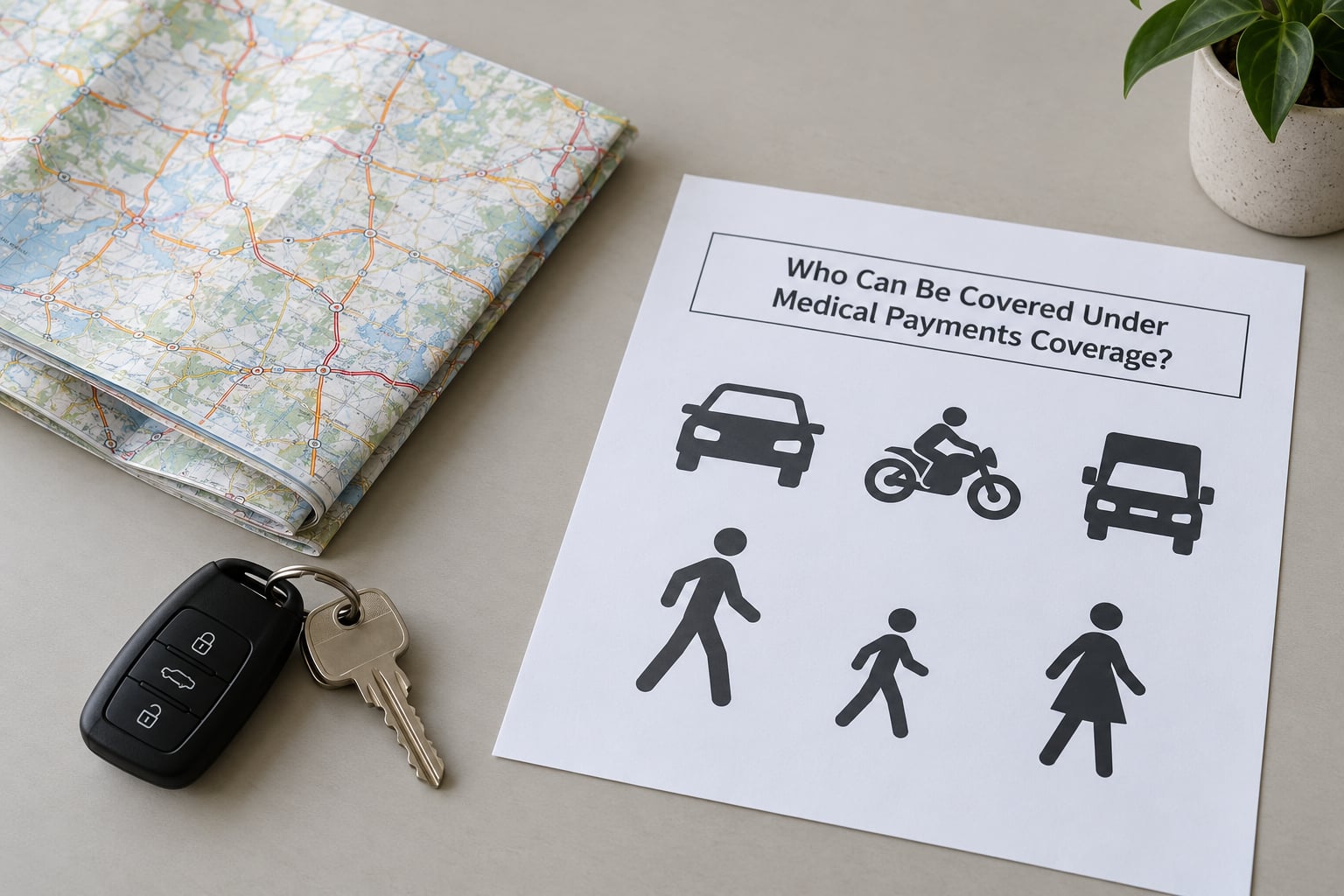
The named insured is covered. Many policies extend the same benefit to household members who are not separately named, which matters if your partner or an adult child drives your car.
Passengers riding in your vehicle are covered too, including friends and coworkers. Because the benefit is written per person per accident, several injured occupants can each draw on the limit. One injured person cannot, though. The limit is a ceiling for that person, not a pool to share.
The phrase people remember is that MedPay follows you, not your car. Walkers, joggers and cyclists struck by your vehicle are often covered as well, and a few policies extend protection to pedestrians injured by the vehicle regardless of fault.
If you are injured while riding in someone else’s car, their MedPay is usually first. Yours may act as a backup under the other insurance provision, but expect a fight over which policy pays first.
How Much Does Medical Payments Coverage Usually Pay?
Limits come in tiers, and carriers advertise the per-person figure. Check both the per-person and per-accident numbers on your declarations page; if a single accident involves two covered people, the per-accident cap may be the real ceiling.
| Limit | What it realistically covers | Who it suits | The downside |
|---|---|---|---|
| 1,000 dollars | Ambulance plus a short ER visit | Drivers with solid health coverage and savings | Runs out during a hospital stay |
| 5,000 dollars | ER, imaging, a short hospital admission, follow-up visits | Most drivers with a high-deductible health plan | Short surgeries can exhaust it |
| 10,000 dollars | Emergency surgery plus initial rehabilitation | Anyone carrying passengers regularly | Higher premium, rarely needed by one driver alone |
| 50,000 dollars | Extended treatment and rehabilitation | Rural drivers with long travel to specialists, families, commercial-adjacent drivers | Meaningful premium on the policy |
A simple worked example shows how the pieces meet. Assume a 1,500 dollar emergency room bill with a 1,000 dollar health insurance deductible and 20 percent co-insurance on the remainder. Your share after insurance is 1,000 dollars plus 20 percent of the remaining 500, which is 100 dollars, for a total of 1,100 dollars. Against a 5,000 dollar MedPay limit with a 1,000 dollar deductible, the payout is 100 dollars.
That last number surprises people. A MedPay deductible means the first slice of the claim is yours, and co-insurance reduces what remains. Buy a higher limit than you think you need if you want a real cushion.
Limits also expire. Many policies give you one to three years to incur and submit each expense, so keep every bill and invoice, not just the summary.
What Does Medical Payments Coverage Not Cover?
Lost wages and loss of earning capacity are out. Medical payments pays medical bills, not income you miss while recovering. That is the line that most often separates MedPay from personal injury protection.
Also excluded, in most policies:
- Pain, suffering and emotional distress
- Long-term or permanent impairment damages
- Damage to your vehicle or other property
- Injuries from work or during a work-related activity when workers compensation applies
- Injuries sustained while doing something illegal or intentional
- Vehicle use for delivery, ride-sharing or paid hauling, which needs a commercial policy
- Bills already settled by another payer, unless the policy says otherwise
- Pre-existing conditions and problems unrelated to the collision
One trap worth naming: once MedPay pays a bill, some health insurers hold the claim until that amount is used up before they process anything else. Ask both carriers in writing which is primary, and never tell a hospital that your auto policy has paid until you have the check number and the explanation of benefits.
How Is Medical Payments Coverage Different From PIP and Health Insurance?
The four coverages overlap heavily, and the differences are where claims go wrong.
| Coverage | Fault basis | What it pays | Lost wages | Deductible | Availability |
|---|---|---|---|---|---|
| Medical payments (MedPay) | None | Medical bills for you, household and passengers | No | Sometimes | Optional in most states |
| Personal injury protection (PIP) | None | Medical bills plus wage loss, funeral and disability | Yes | Sometimes | Mandatory in a handful of states, including Michigan, New Jersey, New York, Pennsylvania, Florida and Kentucky |
| Bodily injury liability | The other driver was at fault | Medical bills, lost wages, pain and suffering for others you injure | Yes | Rarely | Required in nearly every state |
| Health insurance | Not fault-based | All covered care, accident or illness | Sometimes, through disability riders | Usually yes | Independent of your auto policy |
If you live in a state with mandatory PIP, MedPay often adds little because PIP already handles the same medical bills. Where PIP is not offered, MedPay becomes the practical stand-in.
Uninsured motorist coverage is the other layer worth understanding. If the at-fault driver has no insurance, uninsured motorist pays your injury losses. MedPay does not do that job; it simply keeps the medical bills moving while the longer claim is worked out.
How to Check Your Car Policy Before You Buy
Start at the declarations page, the one-page summary at the front of your policy. Find the medical payments line and read the limit, the deductible and any per-accident maximum.
Then confirm the rest with an agent before you buy or renew.
- Check whether your state requires the endorsement, requires the carrier to offer it, or leaves it entirely optional. Where an offer is mandatory, a signed rejection form is what proves you declined.
- Compare the per-person and per-accident limits, and note whether the deductible applies per person or per claim.
- Ask which expenses the policy names specifically. A carrier that lists dental, prosthetics and funeral expenses in writing is giving you more than one that says reasonable medical expenses.
- Check the vehicle-use rules. If you deliver food or drive for a ride-share platform, confirm the coverage applies to that use or get a commercial endorsement.
- Ask about the time limit for submitting bills and where an appeal goes if a claim is denied.
- Compare quotes with the same limit and the same deductible, then save a copy of the declarations page with your proof of coverage.
Ask one extra question that most people skip: whether the endorsement requires you to keep liability limits at a certain level. Dropping liability below the carrier’s requirement can void the medical payments benefit.
Rules and wording differ by state and by carrier, and they change. Treat the sections above as a way to know what to ask, not as a statement of what your policy says. Confirm every limit, deductible and exclusion with your declarations page or a licensed agent before you rely on it.
Frequently Asked Questions
Is medical payments coverage the same as health insurance?
No. Health insurance covers all care, illness and injury, subject to its own deductible and network rules. Medical payments coverage pays only accident-related bills tied to a covered vehicle event, usually after health insurance pays first. Its job is the leftover layer: deductibles, co-pays and co-insurance on crash injuries.
Does medical payments coverage cover passengers in my car?
Usually yes. Passengers riding in your vehicle are covered under the same no-fault rule, including friends and coworkers who are not listed on the policy. Most endorsements set the limit per person per accident, so two injured passengers can each reach the limit, while one passenger cannot draw more than the stated amount for a single injury.
Do I have to have a deductible for medical payments coverage?
It depends on the policy. Many endorsements carry no deductible, which means the insurer pays eligible bills from the first dollar up to the limit. Others apply a deductible per person or per claim, and some also apply co-insurance. Read the declarations page carefully, because the deductible changes what a 5,000 dollar limit actually pays.
Can medical payments coverage pay for injuries from a car accident?
That is exactly what it is for. It pays medical expenses caused by an auto accident regardless of who was at fault, so your own claim qualifies even when you caused the crash. The expenses must be tied to the collision and must be listed or described as reasonable medical expenses in the policy, and the amount cannot exceed your per-person limit.
Does medical payments coverage cover injuries when I am at work?
Usually not. When an injury happens on the job or on the way to work, workers compensation is the primary payer, and a standard auto endorsement excludes work-related injuries. Some policies offer a limited benefit for commuting injuries, but that is an exception worth asking about in writing rather than assuming. Keep the claim with workers compensation first.
Is medical payments coverage required in every state?
No. A small number of states require the endorsement outright, and a larger group requires carriers to offer it with a signed rejection form if you decline. In most states it is entirely optional. A handful of states do not offer it at all because mandatory PIP handles medical payments. Your state insurance department publishes the current rules.
Conclusion
Start with the declarations page. Find the medical payments line, read the per-person and per-accident limits, and note the deductible and any co-insurance.
Then ask an agent to walk you through the exclusions, the time limit for submitting bills and the state rules that apply where you live. Medical payments coverage is cheap relative to what it covers, but only if the limit matches your health plan and the endorsement survives a claim.