Cyber liability insurance is a business policy that shifts the financial risk of a data breach, ransomware attack or fraudulent wire transfer to an insurer. It pays for your own costs, the legal defense and settlements owed to customers and partners, and the regulatory and notification expenses that follow. Most general liability and business owners policies leave all of that uncovered.
Small businesses get targeted constantly because attackers know the defenses are thin. A single incident can stack up legal fees, forensic work, notification calls, downtime and lost customers in the same month. This guide walks through what a policy actually pays for, where the gaps sit, what the coverage tends to cost, and what happens when you file a claim.
Table of Contents
- What Is Cyber Liability Insurance?
- What Does Cyber Liability Insurance Cover?
- First-party coverage
- Third-party coverage
- Cyber Liability Insurance Basics: Key Policy Terms
- What Cyber Incidents Can Trigger a Claim?
- What Does Cyber Liability Insurance Usually Exclude?
- How Much Does Cyber Liability Insurance Cost?
- How to Choose a Cyber Liability Policy for Your Business
- How Does Making a Cyber Insurance Claim Work?
- Frequently Asked Questions
- Does cyber liability insurance cover ransomware?
- Is cyber liability insurance required for a small business?
- How much cyber liability insurance does a small company need?
- Does cyber insurance cover losses caused by a hacker or phishing attack?
- Can cyber liability insurance cover costs from a data breach?
- What Should a Small Business Do First?
What Is Cyber Liability Insurance?
Cyber liability insurance, also called cyber risk insurance or data breach insurance, is a business insurance policy that transfers the financial risk of a cyber incident to an insurer.
A cyber incident is any event that lets an unauthorized party get at your systems or data, or any fraudulent transfer of funds triggered by a deception. Once a claim is covered, the insurer picks up costs like forensic investigation, data restoration, breach notification, credit monitoring for affected people, legal defense, settlement payments and lost revenue during the outage. Coverage for regulatory fines depends on the policy and on state law, since some fines are not insurable.
Businesses that handle customer or employee personal data, process card payments or store records in the cloud are the ones I see shopping this coverage first. So are professional services firms, healthcare practices, nonprofits, real estate agencies, and any company whose clients or vendors demand a certificate of cyber insurance before work begins. Most policies are written as a one-year contract and renewed annually, and the carrier will audit your security controls before it issues or renews one.
What Does Cyber Liability Insurance Cover?
Two buckets matter: what the policy pays for your own losses, and what it pays for claims other people bring against you.
First-party coverage
First-party coverage pays the costs you incur directly. That typically includes breach response services, forensic investigation to find out what happened and what was exposed, notification and credit monitoring for affected individuals, ransom negotiation where a payment is lawful, public relations support, system restoration and data re-creation, and the extra expense or lost revenue from business interruption. Insurers also test limits for social engineering, where a staff member is tricked into wiring money.
Third-party coverage
Third-party coverage responds to claims from outside your business: customers, clients, vendors, patients or regulators. A typical policy includes privacy liability for failing to safeguard personal information, network security liability for outages or data loss that hurt a third party, and media liability for defamation, copyright or advertising claims spread through your website, email or social accounts. Defense costs usually sit outside the policy limit, which is why the legal defense is often the part that matters most in practice.
Not every policy carries every section. Read the declarations page rather than the sales brochure, because coverage grants, sub-limits and endorsements differ from carrier to carrier.
Cyber Liability Insurance Basics: Key Policy Terms
Occurrence-based versus claims-made is the first thing to understand. A claims-made policy covers claims made during the policy period, and it usually comes with an extended reporting period so a claim can still be filed after the policy expires. An occurrence-based policy responds to incidents that happened during the period, even if the claim arrives later. Claims-made dominates the small-business market because it is cheaper, but it leaves a gap if you switch carriers and do not buy the tail.
Limits come next. An aggregate limit is the most the insurer will pay across the whole policy year. A per-occurrence limit is the most it will pay for one event, which is usually lower. Sub-limits cap individual items inside those numbers, and social engineering or business interruption sub-limits often land well below the headline limit, sometimes in the 25,000 to 50,000 USD range.
The self-insured retention is your out-of-pocket share, and it can be either a flat dollar amount or a percentage of the claim. Anything above the retention is coinsurance, your share of the rest. Exclusions are the listed events the policy will never pay for, and they sit in the base wording rather than being hidden. Read the endorsement schedule too, because that is where carriers add, cut or sub-limit coverage.
What Cyber Incidents Can Trigger a Claim?
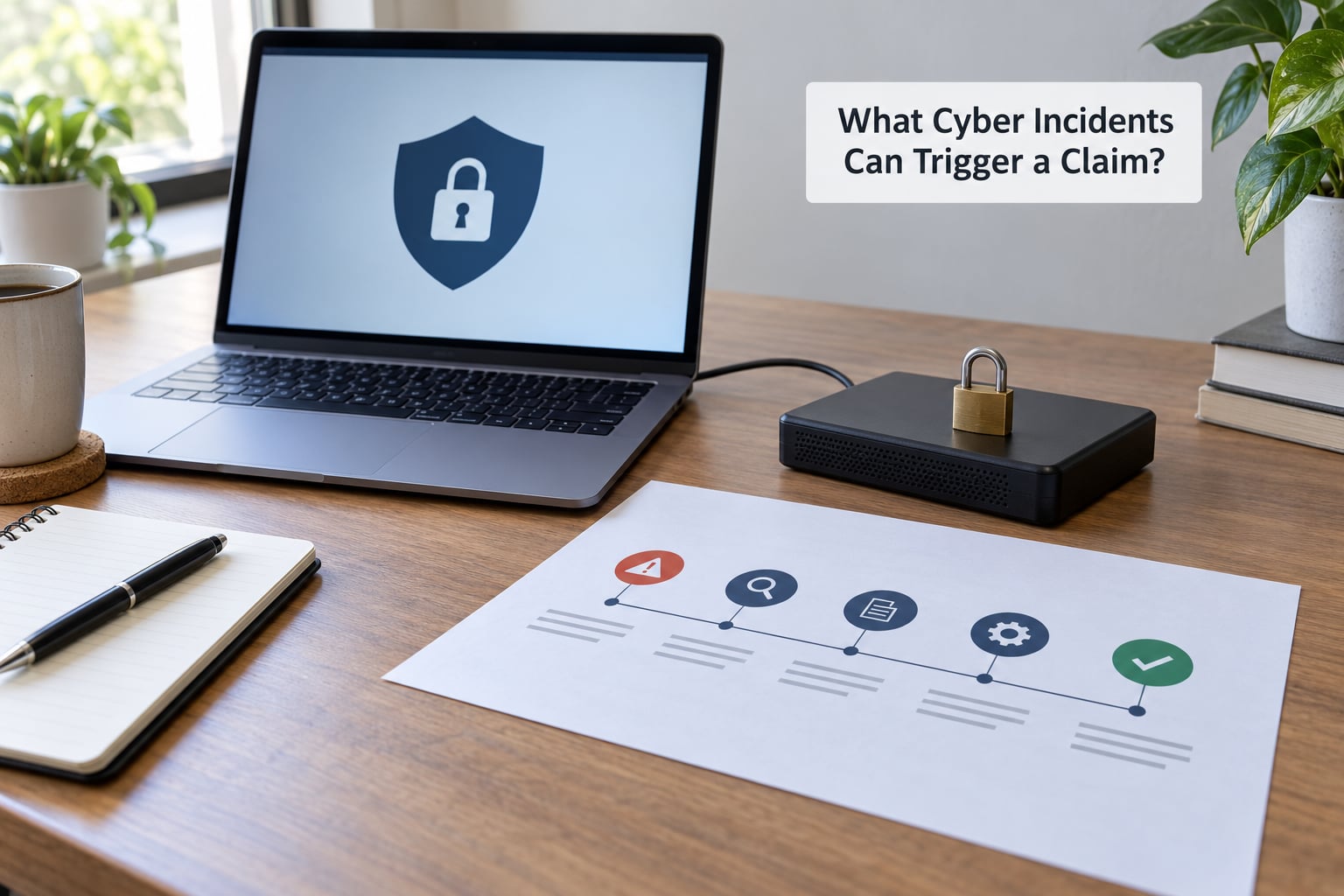
The realistic small-business claim is rarely a Hollywood hack. It is one of these.
Customer data exposure. An employee forwards a spreadsheet of client records to the wrong address, or a misconfigured cloud folder becomes briefly public. The insurer pays for forensics, notification, monitoring and the claims customers bring afterward.
Ransomware. Files are encrypted and operations stop for days. Coverage usually addresses the ransom itself only where it is lawful, plus the restoration work, the extra costs of running the business elsewhere and the lost income during the interruption period.
Business email compromise. Someone poses as a vendor and talks your bookkeeper into sending a 46,000 USD invoice to a new account. This is a social engineering loss, and many policies only cover it through a separate endorsement with its own sub-limit.
Payment fraud and vendor breach. Card skimmers or a compromised payment processor expose customer payment data, or a vendor you rely on gets breached and your customers’ data is caught in it. Your contract may push responsibility onto you, and third-party liability is where that surfaces.
Accidental disclosure and insider mistakes. A staff member sends a confidential file to the whole company, or a departing employee keeps access they should have lost. Coverage for employee dishonesty is usually limited, and the underlying negligence may be yours.
A policy responds to these events only when its terms fit them. Nothing is automatic just because an incident happened.
What Does Cyber Liability Insurance Usually Exclude?
| Common exclusion | Why it matters for a small business |
|---|---|
| Intentional or criminal acts by an insider | Fraud or sabotage by an employee usually falls outside the policy, which protects against accidental losses and outside attackers. |
| Known or preexisting incidents | Anything you knew about, suspected or should have discovered before the policy or renewal date is not covered. |
| Breach of a contract or a confidentiality agreement | Contractual damages and indemnity owed to a client often need a separate endorsement or Technology E&E coverage. |
| Failure of your internet, telecom or power provider | Infrastructure failure at a third party is treated as a utility problem, not a breach you caused. |
| Fines and penalties where the law forbids insuring them | Some regulators levy fines that state law treats as uninsurable, and insurers dispute those even when they appear on the form. |
| Failure to meet required security controls | Carriers condition the policy on measures like multi-factor authentication, tested backups and prompt offboarding, and can refuse payment for a breach tied to missing controls. |
| Outdated or upgraded systems and better technology | Upgrading hardware or software during the claim is generally a business expense, not a covered loss. |
| Late or misleading notice | Late reporting, or answers on the application that turn out to be wrong, are among the most common reasons a cyber claim is denied. |
Two more exclusions catch owners off guard. Losses that existed before the policy period, and claims you agreed to settle privately without telling the carrier. Also ask whether your policy has a requirement to use approved incident response vendors, because using your own lawyer first can complicate reimbursement.
How Much Does Cyber Liability Insurance Cost?
For a US small business, a policy with roughly 1 million USD in limits commonly runs from about 600 to 3,000 USD a year. Companies with more sensitive data, heavier regulatory exposure or a demanding client contract pay more. These are typical ranges rather than quotes, and premiums vary by state, carrier, industry and risk profile, and they change over time.
| Business profile | Typical annual premium range | What drives the price |
|---|---|---|
| Very small business, few employees, no sensitive records | 600 to 1,500 USD | Low revenue, no card data, solid basic controls |
| Small business, 10 to 50 employees, general commercial exposure | 1,200 to 3,500 USD | Employee count, revenue band, customer data volume |
| Professional services, accounting, legal or consulting | 2,000 to 6,500 USD | Client contracts, fiduciary-type data, Technology E&O needs |
| Healthcare practice or vendor handling patient records | 2,500 to 8,000 USD | Regulatory oversight, sensitive records, breach notification duties |
| Retail, hospitality or e-commerce processing card data | 2,500 to 9,000 USD | Cardholder data, point-of-sale exposure, seasonal volume |
| Managed service provider or IT consultancy | 6,000 to 25,000 USD or more | Access to many clients at once, contract indemnity demands |
The levers you control are straightforward: enforce multi-factor authentication everywhere including email and remote access, keep tested and isolated backups, document employee training, run a documented offboarding process that removes access on the last day, and add endpoint protection. Those steps show up in every application, and removing a single gap often moves the quote more than anything else. Some carriers also offer credits for email security training, which lowers both the premium and the odds of a business email compromise claim.
How to Choose a Cyber Liability Policy for Your Business
Work through this in order rather than comparing premium quotes side by side.
- Map what you hold. List customer, employee and health data, where it lives, which systems process it and which vendors store it. You cannot insure or secure what you have not written down.
- Check your readiness. You need a named person to call, an incident response process, a backup restore you have actually tested, and a current list of who to notify. Most policies require you to use the carrier’s response line or approved vendor.
- Decide standalone policy or BOP endorsement. A business owners policy endorsement is cheaper and sits inside a broader package. A standalone cyber policy is broader, usually carries higher limits and offers more control over wording. Read the declarations page to see which one you actually hold, because it determines where you file a claim.
- Map the coverage to real losses. Compare each section against the scenarios from earlier: breach response, interruption, wire fraud, third-party claims, fines. Note any sub-limit that sits below what you could realistically lose.
- Pick limits from your exposure. A common floor for a small business is 1 million USD in limits, but match it to what a customer contract or a regulator could realistically demand, and to the value of the data you hold.
- Set a retention you can absorb. Higher retentions cut the premium. Choose one you could pay out of pocket on the day of the incident.
- Read the wording, not the pitch. Compare exclusions, sub-limits, the extended reporting period and the definition of a claim. Two quotes at similar prices can be very different policies.
- Check contract requirements. If clients or tenants require a certificate of insurance, confirm the wording and limits meet their spec before you bind, and note that certificates only evidence coverage, they do not change it.
Ask whether the broker is independent. Owners on industry forums often regret buying the policy through the same IT vendor who recommended it, because nobody is pushing back on the price or the wording.
How Does Making a Cyber Insurance Claim Work?
Speed matters more than most owners expect, because late notice is a common reason for denial.
The sequence usually runs like this. First, stop the bleeding: contact your carrier’s breach response line as soon as you suspect an incident, and if funds were fraudulently transferred, call your bank immediately to attempt a recall. Then, limit further damage yourself and document everything: what you found, when, what systems were touched, what you changed. Preserve evidence rather than wiping machines, since an investigator will need them.
After that, the insurer reviews the claim against the policy. They confirm the incident falls inside a coverage grant, check that your controls met the policy conditions, and look at whether the answers on your application were accurate. Non-covered parts of the loss get ruled out here, which is why reading the exclusions before an incident pays off.
From there, the carrier coordinates approved breach response services: a forensic firm to scope the exposure, an attorney, and a notification plan. Costs above your self-insured retention are advanced while the claim runs. Third-party claims are defended and settled within limits, and the final payment settles the covered portion. You keep the duty to mitigate, which means taking reasonable steps to prevent further loss even while the claim is open.
Owners frequently report that the response team, not the check, is what they value most after an incident. That is the part to interrogate before renewal: who responds, how fast, and are they on your plan’s approved list.
Frequently Asked Questions
Does cyber liability insurance cover ransomware?
Usually yes, with conditions. Most policies cover the cost of restoring systems, the extra expense of operating elsewhere, lost revenue during the interruption period, notification, forensics and legal defense. Paying the ransom itself is often covered only where the payment is lawful, and frequently sits under a sub-limit well below your headline limit. Coverage can be reduced or lost if backups were not tested or multi-factor authentication was not enforced on remote access. Read the sub-limits and conditions before you assume the full amount is available.
Is cyber liability insurance required for a small business?
In most states it is not legally required, so the answer is usually contractual or financial. You may need it because a client, landlord, lender or vendor requires a certificate of insurance naming them, and increasingly because professional and vendor agreements require a minimum limit. Beyond contracts, the practical test is whether you could absorb the cost of forensics, notification, legal defense and downtime from cash. If you hold sensitive data or process card payments, most brokers and IT advisers treat it as necessary.
How much cyber liability insurance does a small company need?
There is no single right figure, but $1 million in limits is the common starting point for a small US business, and many client contracts require that amount or more. Size the limit to the largest plausible claim: the notification and monitoring cost for your customer list, plus the legal exposure a customer or regulator could bring. Check the sub-limits for business interruption and wire fraud, because a $1 million policy can still cap those items well below the headline number. Confirm the limit satisfies every contract you are bound by.
Does cyber insurance cover losses caused by a hacker or phishing attack?
Phishing that leads to stolen credentials or a fraudulent wire is covered on most policies, though wire fraud frequently needs a social engineering endorsement with its own sub-limit. Costs from a successful intrusion, including forensics, restoration, notification and third-party claims, fall inside first-party and third-party coverage. The gaps appear when the attack is still in progress and nobody reported it, when required controls such as multi-factor authentication were missing, or when the incident started before the policy period. Report suspected incidents promptly, even unfinished ones.
Can cyber liability insurance cover costs from a data breach?
Yes, that is the core purpose of the policy. First-party costs such as forensic investigation, breach notification, credit monitoring, system restoration and public relations fall under first-party coverage, while defense costs, settlements and regulatory response fall under third-party. Coverage for fines depends on the policy and on state law, since some penalties cannot be insured. Two things regularly interrupt the response: reporting late, and gaps in required security controls at the time of the breach.
What Should a Small Business Do First?
Start by writing down what data you hold, where it sits and which vendors touch it. You cannot price a risk you have not described.
Then inventory your systems and third parties, and close the basics: multi-factor authentication on email and remote access, tested backups kept separate from your main network, documented training, and offboarding that removes access on an employee’s last day. Those four items are what carriers check, and they are also what auditors look for when a claim is denied.
After that, compare policy wording rather than premium alone. Line up the exclusions, the sub-limits, the extended reporting period and whether coverage is standalone or an endorsement on your business owners policy. Get advice matched to your industry and your state, and treat any coverage figure as a starting benchmark rather than a quote, since rates change with the market.
One last caveat. This is general information about how cyber liability insurance works in the US. Rules, availability and pricing differ by state and by carrier, so talk to a licensed professional before you bind.