Shop for car insurance 30 to 60 days before your policy renewal date, and shop again immediately whenever something real changes: you buy or sell a vehicle, move to a new ZIP code or state, add a driver to the household, or get a rate increase notice in the mail. That two-month window is the one time your current insurer has to compete for your business, so it is when a quote comparison actually pays off.
Most drivers shop too late. They open the renewal notice, see a higher number, and either accept it on the spot or start panicking about a coverage gap two weeks before the policy expires. Neither outcome is good.
A few honest caveats before we get into the timing. Auto insurance rules, required minimums and rate filings differ by state, and what counts as a valid reason to switch in California may be irrelevant in Michigan. Check with your state insurance department before acting on anything specific. What follows is general guidance for US drivers, not individual financial advice.
Table of Contents
- When Should You Shop for Car Insurance?
- When to Shop for Car Insurance: Key Times to Request a New Quote
- How Often Should You Compare Car Insurance Rates?
- What Can Change Your Car Insurance Rate?
- Should You Shop Before Your Policy Expires?
- How to Compare Car Insurance Quotes
- When It May Not Be Worth Switching Insurers
- Frequently Asked Questions
- How far in advance should I shop for car insurance?
- Does switching car insurance lower my rate automatically?
- Can I shop for car insurance without canceling my current policy?
- How long does it take to compare car insurance quotes?
- Should I get a new quote after moving to a different state?
- What information do I need to request a car insurance quote?
- Put the Reminder in Your Calendar Now
When Should You Shop for Car Insurance?
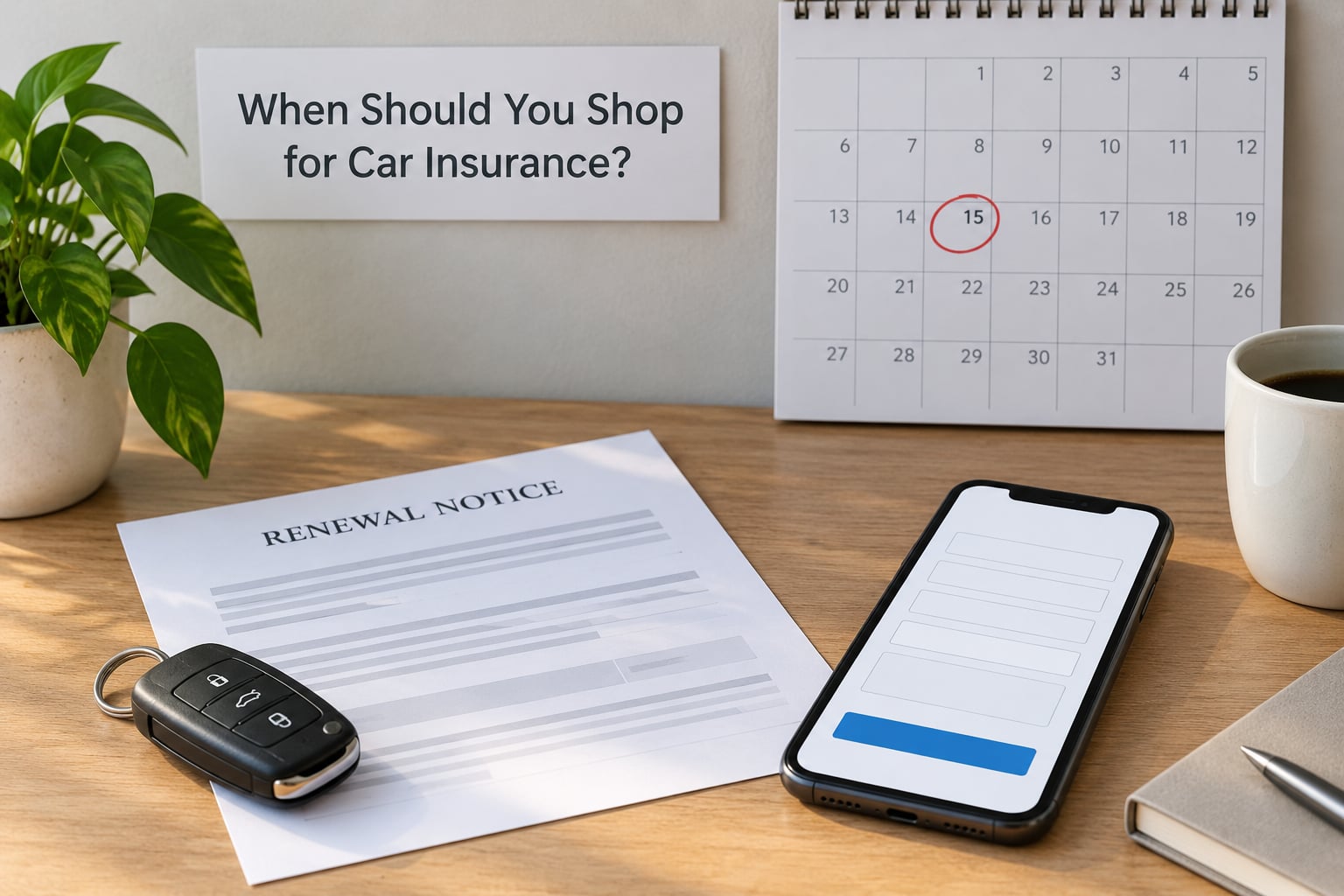
Shop when a major life or coverage change happens, when your renewal notice arrives, when your rate jumps without explanation, or when your current policy simply no longer matches how you drive and what you drive. Those are the four buckets, and each one has its own lead time.
| Trigger event | When to start shopping | Lead time needed |
|---|---|---|
| Policy renewal date | 30 to 60 days before renewal | 2 to 4 weeks |
| Buying a new or used car | Before you sign final paperwork | Same day to 1 week |
| Moving to a new ZIP code or state | 2 to 4 weeks before the move | 1 to 2 weeks |
| Adding a driver, including a teen | Before the driver gets behind the wheel | 1 to 3 days |
| Traffic ticket or at-fault claim | Immediately, and before renewal | 2 to 4 weeks |
| Rate increase notice | As soon as it arrives in the mail | 2 to 4 weeks |
| Paying off a vehicle loan | Within 30 days of payoff | 1 week |
| Adding a boat, RV or trailer | Before you tow or launch anything | 1 to 3 days |
When to Shop for Car Insurance: Key Times to Request a New Quote
Buying a new or used car. Coverage has to be active before you drive off the lot or sign the final purchase paperwork. If you are financing or leasing, the lender will require proof of insurance before it releases the vehicle. Have the VIN, the purchase price and your driver’s license ready, because that is most of what an insurer needs to bind a policy the same day.
Moving. Even a move across town changes your ZIP code, and ZIP code is one of the heaviest inputs into an auto rate. A move to another state is a bigger deal: minimum limits, no-fault rules and rate filings all change at the state line. Most states give you a short grace window, commonly 7 to 30 days depending on the insurer and the state, to add the new vehicle or new residence to an existing policy. Do not assume your old policy followed you.
Adding a driver. Adding a spouse or a teenager changes the rate dramatically. Teen drivers typically cost more than their age suggests until they have a licensed period under their belt, and many insurers offer a young driver discount that shrinks as the driver ages. Get the quote before anyone drives, not after.
Finishing a driver’s education period. This one runs the other way. Many carriers offer a discount that expires when a new driver completes their education period or holds a license long enough. When that milestone lands, ask what discount you qualify for now, because the timing matters more here than with most triggers.
Marriage or divorce. Marriage can open up multi-policy bundle discounts. Divorce usually means one household member leaves the policy entirely, and you need both the removal and the new coverage lined up so nobody is uninsured in the transition.
Buying a boat, RV or trailer. Most personal auto policies exclude towing, watercraft and large trailers. Those need separate coverage, and lenders require proof before they hand over the keys.
Starting a business or adding a work vehicle. Personal policies exclude commercial use. A business-owned vehicle or an employee driving on the clock needs a commercial auto policy, and mixing the two is one of the most common ways people end up with a denied claim.
Receiving a rate increase or a traffic ticket. Insurance forums keep repeating the same complaint: the bill jumped 30 to 50 percent in a single cycle with no warning. When that happens, collect two or three competing quotes before you decide anything. New applications can also carry a 20 to 30 day hold, which is exactly why you start early instead of the week of renewal.
The end of the policy term. Whatever else happens, this is the annual checkpoint. A policy term is usually six or twelve months, and at the end of it the insurer re-rates you using your claims, your driving record and market-wide cost trends.
How Often Should You Compare Car Insurance Rates?
Once a year, before renewal, is the right rhythm for nearly everyone. You are not trying to hop insurers constantly, you are trying to hold a credible alternative in your back pocket when the renewal notice lands.
There is a reason this matters more than it used to. Insurers price what they can predict, and a customer who never asks for a quote is a customer who will accept almost anything. Analysts call this price optimization, sometimes called loyalty pricing: the carrier quietly raises the renewal rate of customers unlikely to leave. Several states now restrict or ban the practice outright, but where it is allowed it is a large part of why a loyal customer’s rate drifts upward year after year.
Research cited by Consumer Reports and LendingTree puts the median saving among people who switched insurers at roughly 461 dollars a year, with most switchers saving more than 100 dollars. That gap is not exotic. It is the ordinary result of two carriers pricing the same risk differently.
On a six-month policy, the calendar gets busier, because you now have two renewal dates a year. That is also why people ask whether some months are cheaper. There is no reliable evidence that shopping in a particular month or on a particular weekday produces a better rate. Rates are calculated from your risk profile and the carrier’s filed rates, not from when you happen to click the button. Save the seasonal-shopping theory for airline tickets.
A reasonable schedule: one full comparison in the 30 to 60 day window before each renewal, plus a quick check whenever a trigger event from the table above happens. If your policy is mid-term and nothing has changed, let it ride.
What Can Change Your Car Insurance Rate?
Knowing what moves the number helps you tell a genuinely better quote from a quote that simply has different coverage attached.
- Location. Your ZIP code carries more weight than most drivers expect, because it proxies for traffic density, repair labour costs, weather claims and local theft rates.
- Driving record. Violations, at-fault accidents and how long you have held a license all feed the record insurers pull.
- Vehicle value and repair cost. The make, model, year and VIN determine parts and labour pricing, which drives the collision and comprehensive portion of your premium.
- Claims history. This is the single biggest mover at renewal. A claim often means a higher rate for several policy terms.
- Annual mileage. Low-mileage drivers are often eligible for a discount, and high-mileage drivers should expect the opposite.
- Credit-based information, where permitted. Some states restrict or ban using credit data in auto rates, including California, Hawaii, Massachusetts, Michigan, Oregon and Utah. Elsewhere it can matter, and the Insurance Information Institute has documented the effect.
- Your coverage choices. Liability limits, collision and comprehensive deductibles, personal injury protection and uninsured motorist coverage are levers you control directly. Raise a deductible and the premium usually falls; raise it too far and you carry more out-of-pocket exposure in a bad quarter.
- Discounts you qualify for but have not claimed. Multi-policy bundling, paperless documents, safe driver programs and accident forgiveness. Ask, because a discount that is never applied is money you never see.
Which brings up a fair question: is your current rate even reasonable? There is no single national benchmark that fits every state and ZIP code, but two habits help. Pull your own loss history from your current insurer so you know exactly which claim is sitting in their file, and write down the coverage limits and deductibles on your declarations page before you compare anything.
Should You Shop Before Your Policy Expires?
Yes, and earlier than most people assume. Your renewal notice typically arrives 30 to 45 days before the policy expires, which sounds like enough time until you remember that a new policy can take a couple of weeks to bind if the carrier wants to underwrite it.
The 30 to 60 day lead window exists because of that friction. Shop at 60 days and you have slack. Shop at 10 days and you are negotiating against a deadline with a stranger’s underwriting department.
The sequencing rule is the one thing to get right. Do not cancel your current policy until the replacement is bound and you have proof of insurance in hand. Not a promise of a call back, not a quote number, an actual bound policy with a declarations page and an effective date. Canceling first is how drivers end up with a lapse, and a lapse is treated as a high-risk signal that makes the next policy considerably more expensive.
If you are keeping your current carrier, the shopping still does work for you. Collect two competing quotes, then call your agent and ask them to match the coverage and the price. That conversation goes much better after you have a real number in hand than before you have one. Some carriers will match it, some will not, and either way you learn where you stand.
How to Compare Car Insurance Quotes
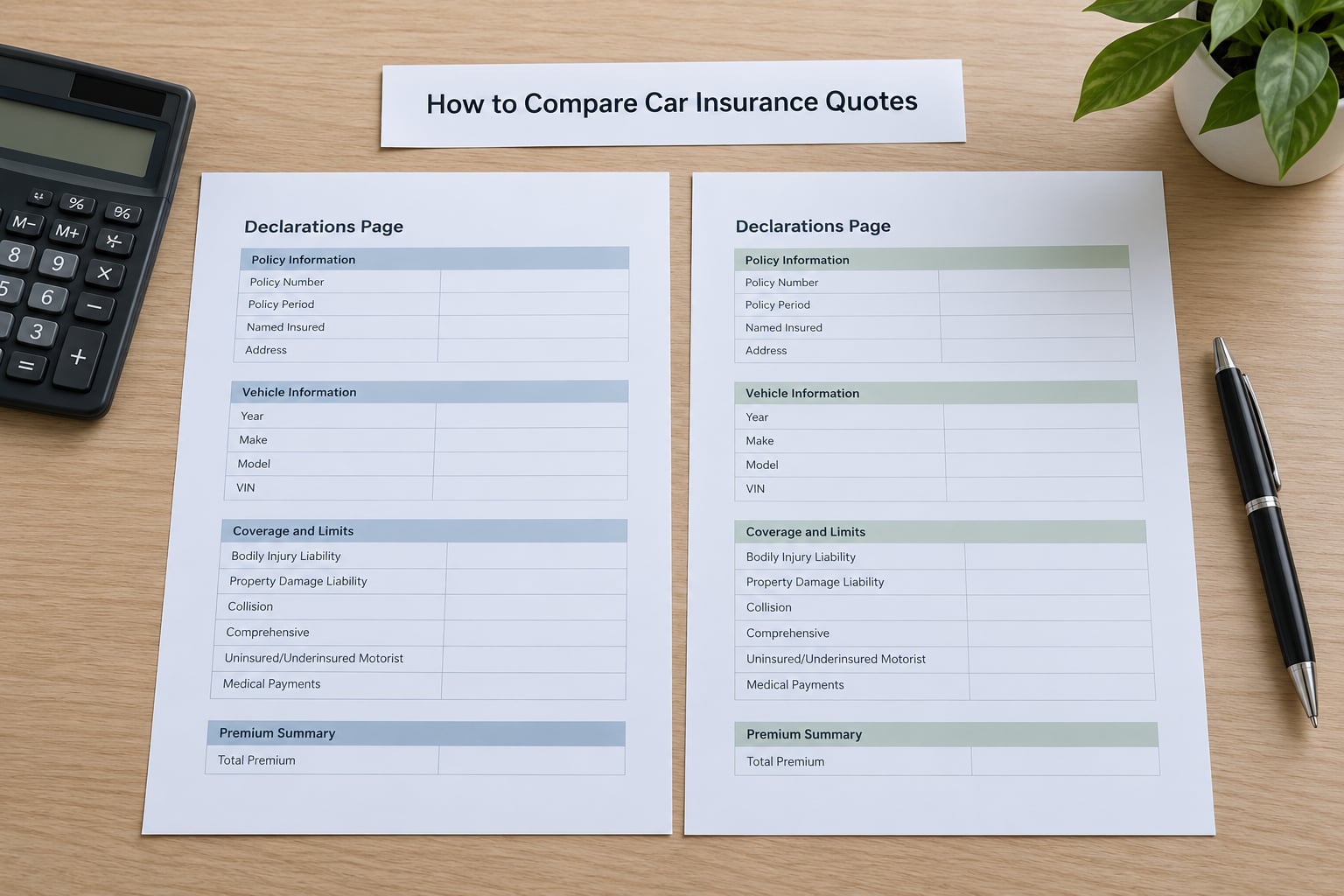
Two quotes are only comparable if they cover the same thing at the same level. A lower premium with thinner liability limits is not a better deal, it is a different policy. Work through these steps in order.
1. Pull your current declarations page. That one page lists your liability limits, deductibles, coverage types, vehicles, drivers and endorsements. It is the template for everything that follows, so start there rather than filling out a form from memory.
2. Gather your documents. Drivers licenses, date of birth for every driver, VINs for every vehicle, the annual mileage estimate, your address and where the cars are garaged, and your current policy number. Some carriers will also pull your motor vehicle record, which is why quotes run a few days rather than ten minutes when you are buying fresh.
3. Fix the coverage before you compare price. Pick your liability limits, collision and comprehensive deductibles, personal injury protection and uninsured motorist limits, and write those numbers down. Then request every quote against that identical specification.
4. Read the declarations pages side by side. Look at limits first, then deductibles, then exclusions and endorsements. Watch for optional add-ons like rental reimbursement, accident forgiveness and roadside assistance, since those often cost real money and are easy to miss in a headline premium.
5. Vet the carrier, not just the price. Check the NAIC Complaint Index for complaint patterns, look up the company’s financial strength rating from AM Best, and read service surveys from J.D. Power. A cheap policy from a carrier that raises premiums without filing notice in your state is a bad trade.
6. Pick a channel. A captive agent writes for one company. An independent agent compares several and can be a good fit if you have multiple policies. A comparison site gets you multiple quotes fast but does not help you when a claim goes sideways. Going direct to a carrier online is quick and self-serve. If you want help through a claim, an agent is worth more than a slightly lower number.
7. Bind before you cancel. Confirm the effective date, pay what is due, download the proof of insurance, and only then contact the old carrier to cancel. Note the cancellation date and keep the confirmation.
When It May Not Be Worth Switching Insurers
Switching is not automatically the smart move. There are real cases where the new quote is worse, and the drivers who figure that out early tend to keep their coverage and their money in better shape.
- You are losing a loyalty discount. Long tenure discounts, accident forgiveness and claim-free benefits are attached to your current carrier. They are not always replaceable, and a new policy underwrites you fresh.
- Mid-term switching can cost more. A new carrier sees no history with you, so it prices conservatively. Switching six months into a term to save 15 dollars is often a mistake dressed up as thrift.
- New underwriting means a fresh look at you. A lapsed policy, a recent move or a claim in the last year looks different to an underwriter than it did to your incumbent, who already priced you in.
- Binding can take time you do not have. Reports of 20 to 30 day holds on new applications are common enough that a last-minute switch has a real chance of not completing before your old policy ends.
- The claims service is unfamiliar. The cheapest quote is a poor trade if your carrier handles claims slowly when you actually need it.
- The savings are too small to matter. If the gap is under 50 dollars a year, you are trading a known process for an unknown one. That is rarely worth it.
The reverse also holds. Do not shop right after a coverage lapse, and think carefully about a quote taken in the days immediately following an at-fault accident. If you are unsure whether a rate is fair, collect quotes and let them tell you.
Frequently Asked Questions
How far in advance should I shop for car insurance?
Start 30 to 60 days before your renewal date. That gives you time to gather quotes, compare coverage on identical limits and deductibles, and let a new policy bind before your old one expires. Shopping in the final week leaves no room for underwriting delays, and new applications occasionally carry a 20 to 30 day hold.
Does switching car insurance lower my rate automatically?
No. Switching changes nothing by itself. A lower premium comes from a different carrier pricing your risk differently, your coverage limits, or your deductibles. Consumer Reports and LendingTree research cited a median saving of roughly 461 dollars a year among switchers, which comes from comparison rather than from the act of switching.
Can I shop for car insurance without canceling my current policy?
Yes, and you should. Getting quotes involves no obligation and does not touch your existing coverage. Do not cancel anything until the replacement policy is bound, you have paid what is due, and you hold proof of insurance with a confirmed effective date. A lapse in coverage is treated as a high-risk signal and raises your next premium.
How long does it take to compare car insurance quotes?
The comparison itself takes an evening once you have your declarations page and documents ready. Filling out a quote online often takes about ten minutes, though a carrier needing your motor vehicle record can take several days. Bind time is the variable to watch, which is why starting 30 to 60 days out matters more than the speed of the quote form.
Should I get a new quote after moving to a different state?
Almost always, because the new state sets its own minimum liability limits, no-fault rules and rate filings, and your coverage does not automatically transfer. Give yourself two to four weeks before the move. Some states and insurers allow a 7 to 30 day grace period to update an existing policy, but a state-to-state move usually warrants a fresh comparison.
What information do I need to request a car insurance quote?
Have your driver’s license and date of birth for every driver in the household, the VIN for each vehicle, the annual mileage you expect to drive, where each car is garaged, your address, and your current policy details. For a new purchase, add the purchase price or financing terms and the lender’s name. Keeping this list current saves a round trip.
One last rule worth repeating, because it is the one that costs the most when broken: never cancel your existing policy until the new one is active and you have proof of insurance.
Put the Reminder in Your Calendar Now
Open your policy, find the renewal date, and set a reminder for 60 days out. That is the single highest-value thing in this article, and it costs about two minutes.
When the reminder fires, pull your declarations page, request three quotes against the same limits and deductibles, and see where you land. If a competitor undercuts your current rate by a meaningful margin, decide then, with six weeks of room to make the switch cleanly. If nobody beats it, stay put and enjoy being the customer your carrier least wants to lose.
Rules, minimums and rate filings vary by state, so confirm the details that apply where you live before you act.