The rule is simple: buy and bind the new policy first, confirm its effective date in writing, and only then ask your old insurer to cancel. Give the two policies the same start date and the switch stays continuous. Cancel first and you are driving uninsured, which is illegal in nearly every state.
The whole process takes a few days of shopping and one phone call. Updated for 2026, here is the order that works.
- Pull your declarations page and note your limits, deductibles and renewal date.
- Get three to five quotes with identical limits and deductibles.
- Buy the new policy and get the effective date confirmed in writing.
- Download your ID cards and confirm the lender or lease company is listed as loss payee.
- Cancel the old policy effective on the new start date, or let it expire on its own.
- Keep written proof of both the new coverage and the cancellation for 30 days.
One bit of terminology first, because it trips people up constantly. A coverage gap is a stretch of time, sometimes a single day, when your vehicle has no active policy. Gap insurance is a product that pays off what you still owe on a financed car after a total loss. They are unrelated, and if a search result is selling you a gap insurance policy you are on the wrong page.
Table of Contents
- What You Need
- Step-by-Step: How to Switch Car Insurance Without a Coverage Gap
- 1. Review Your Current Policy and Coverage Needs
- 2. Time the Switch Around Your Renewal Date
- 3. Compare Quotes From Multiple Insurers
- 4. Buy the New Policy and Verify Its Effective Date
- 5. Cancel the Old Policy Last: The Exact Sequence to Avoid a Coverage Gap
- 6. Confirm the Old Insurer Has Processed the Switch
- Common Mistakes
- Frequently Asked Questions
- Can I cancel my current car insurance before buying a new policy?
- Should I have overlap between two car insurance policies?
- When is the safest time to switch car insurance?
- Will I get a refund if I cancel my policy early?
- Does my new car insurance need to be listed with my state DMV?
- What should I do if my old insurer says the policy is still active?
- Conclusion
What You Need
Most switch problems happen because someone started quoting before they knew what they were quoting against. Gather this first.
- Your declarations page (dec page). The one-page summary of your policy. It lists liability limits, collision and comprehensive deductibles, uninsured and underinsured motorist limits, personal injury protection, rental reimbursement and roadside assistance.
- Billing and premium records. The last two payment confirmations. They prove you were current, which matters if your old insurer later reports a lapse.
- Vehicle details. VIN, year, make, model, garaging address, annual mileage and whether the car is financed, leased or titled to someone else.
- Driver information. License numbers for everyone who drives the car, plus any exclusions you carry.
- Lender or lease company details. Name, address and loan number. Your new insurer will need them to list a loss payee.
- The last three to five years of tickets, claims and violations. Nearly every insurer pulls a motor vehicle report and a CLUE report. Expect the same questions from every quote you request.
- Your quotes, lined up on the same limits. More on that in step 3.
If the vehicle is titled to a spouse or parent, make sure that person is named or excluded properly. Insurable interest is the legal requirement that ties the car to the person carrying the policy, and it gets checked at claim time, not quote time.
Step-by-Step: How to Switch Car Insurance Without a Coverage Gap
The sequence below is ordered so that coverage is continuous the entire time. Each step has a check you can run to confirm it worked before moving on.
1. Review Your Current Policy and Coverage Needs
Open your dec page and write down your liability limits, your collision deductible and your comprehensive deductible. Note whether you carry personal injury protection, rental reimbursement, roadside assistance and accident forgiveness.
Compare those against what you actually want to buy. Switching is a good moment to raise a low liability limit, because most personal liability policies still sit well below what a serious injury claim costs. The widely used benchmark is 100/300/100: 100 thousand per person, 300 thousand per accident for bodily injury, and 100 thousand for property damage.
How it worked: you have a current, complete picture of your protection and a specific list of changes. If the new quote ends up thinner than your current policy on any line, you know it before you sign.
2. Time the Switch Around Your Renewal Date
Auto insurance has no open enrollment period. You can cancel and buy a new policy on any day of the year, which is exactly why timing is the part people get wrong.
Set the new policy’s effective date to match your current policy’s expiration date, down to the hour. Most insurers start coverage at 12:01 AM on the effective date, so a new policy beginning the same morning your old one ends gives you a continuous record with no gap and no meaningful double billing.
| Timing approach | How it works | Watch for |
|---|---|---|
| Renewal-date switch | New policy starts the morning your old policy expires | Quote several weeks ahead; renewal prices move |
| One-day overlap | New policy starts one day before the old one ends | A few extra dollars of premium, well worth the margin |
| Mid-term same-day switch | New policy starts the day you cancel the old one | You pay away unearned premium on the old policy |
If you switch mid-term, ask the old insurer for a pro-rated quote so you can see the refund before you commit. Also check whether the state you live in requires you to notify the DMV of a change in financial responsibility coverage. Several states do, and electronic insurance verification records are the reason lapses often surface weeks later than they happened.
Common reasons people move outside renewal: a rate increase that outran your budget, a marriage or a move that changed who drives the car or where it is garaged, a ticket or accident that aged off the record, or a new vehicle arriving. Any of those is a perfectly reasonable trigger. The mechanics do not change, though. The new policy still gets bound first.
If you have already had a lapse and are trying to get back on, expect the process to take longer than a normal switch. Insurers price with the gap on their record, some states require a certificate of financial responsibility such as an SR-22 rather than the usual limits, and registration may need to be reinstated before an insurer will issue a policy at all. Call your state DMV first to find out what they have on file, then approach carriers. Buying first and hoping nobody noticed is what turns a bad week into a bad year.
3. Compare Quotes From Multiple Insurers
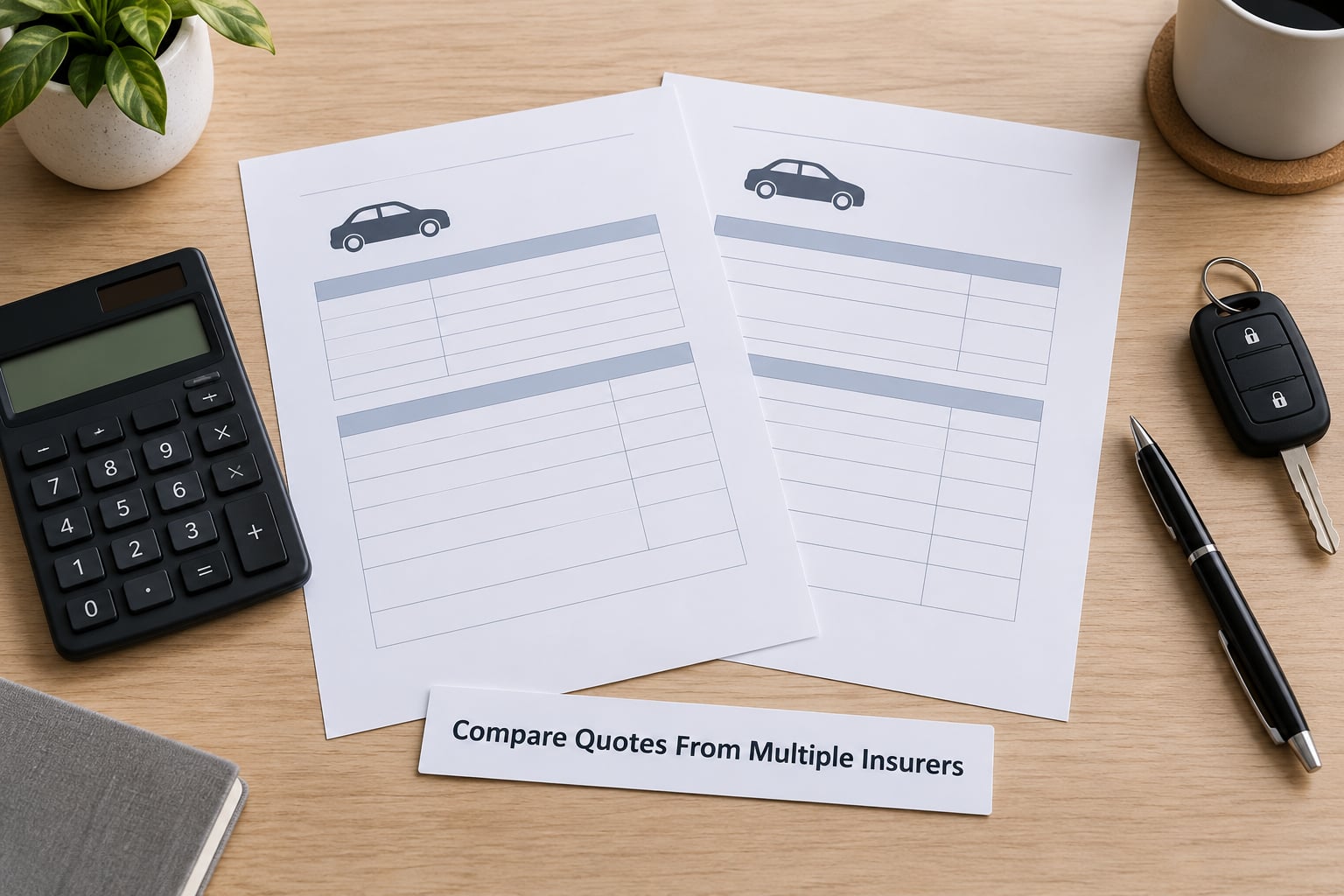
Request at least three quotes, and send every insurer the exact same limits and deductibles. If one quote carries a 500 dollar comprehensive deductible and another carries 1,000, the comparison is meaningless and the cheaper-looking premium is hiding a bigger out-of-pocket cost.
Line up more than the number. Compare the total six-month or twelve-month premium, the discounts applied and what triggers them, policy fees, payment options, and the exclusions that matter to you.
Rental reimbursement, roadside assistance, accident forgiveness and telematics discounts are where quotes quietly diverge. One carrier may include unlimited rental days, another may cap it at 30. One may forgive the first accident, another may not. These are worth real money after a crash and rarely show up in the headline premium.
Ask every carrier one question: does switching affect my claims history? The answer is no. A CLUE report follows you across insurers, and your new policy is priced with it. Changing carriers changes who insures you, not what they can see.
How it worked: you have three or more written offers on identical coverage, and you know exactly which line items differ.
4. Buy the New Policy and Verify Its Effective Date
When you buy, give accurate driver and vehicle information. A mismatch between what you told the agent and what the DMV has is a common reason a claim gets disputed later.
Then verify three things before you touch the old policy: the effective date and time, the named insured matching your driver’s license, and the loss payee if the car is financed or leased. If the car is leased, the leasing company usually requires both the lender’s standard coverage limits and a specific collision deductible, often 1,000. Deviating from that requirement can leave you responsible for the difference in a total loss.
Save the declarations page and your insurance ID cards the moment the policy is issued. Have the lender or leasing company added as loss payee, then send them the new certificate. Doing this yourself is faster and cleaner than waiting for the insurer to mail paperwork.
How it worked: you have a declarations page, ID cards, and written confirmation that the new policy is bound with a start date of your choosing. Only now do you move to cancellation.
5. Cancel the Old Policy Last: The Exact Sequence to Avoid a Coverage Gap
Call your old insurer and ask for cancellation effective on the day your new policy begins. Use that exact phrasing. Some carriers will process a cancellation as “today” if you leave the date vague, which is how people end up uninsured by accident.
Also ask for three things on the same call: written cancellation confirmation showing the effective date, the refund amount and the refund method, and confirmation that your lender or lease company has been told the policy is ending so no force-placed coverage gets triggered.
If your old policy simply expires at renewal, you do not need to do anything. Just confirm that the renewal payment is not set to auto-debit, because that is how most accidental lapses start.
| Refund method | What you get back | Typical use |
|---|---|---|
| Pro-rated return of unearned premium | The unused portion of your premium, straight back to you | Insurer-requested cancellation or switching carriers |
| Short-rate cancellation | Less than the unused portion; the insurer keeps a penalty | When you cancel mid-term on your own |
| Flat cancellation fee | A fixed fee charged instead of a percentage | Mostly policies written by captive agents |
Your new insurer cannot cancel your old policy for you. Only you or the old carrier can do that, which is why step 5 is a phone call you make yourself rather than something to delegate.
How it worked: you hold written confirmation that the old policy ends on or after the day the new one starts.
6. Confirm the Old Insurer Has Processed the Switch
Do not assume the cancellation went through because the call ended politely. Within about two weeks, log into the old insurer’s account and confirm the policy status shows canceled with the date you requested.
Then check the other side. Your new insurer’s records should show the policy active, and your state’s electronic insurance record should list the new carrier as the one responsible for financial responsibility coverage on that vehicle.
Replace the paper ID cards in the car. Old cards in the glove box cause stopped vehicles and confusing conversations with officers, who in most states are entitled to ask for proof of coverage.
Keep everything: the new declarations page, both sets of ID cards, the cancellation confirmation and the refund receipt. Hold on to them for at least 30 days. If a lender or the DMV queries your coverage later, that documentation is what settles it quickly.
How it worked: the old policy shows closed, the new one shows active, and you have the paper trail to prove both.
Common Mistakes
- Cancelling first. The expensive one. A gap can mean fines, registration or license suspension, vehicle impoundment, higher future premiums, and full personal liability for anything you hit. Fix: bind the new policy before you make a single call to the old carrier.
- Comparing quotes that are not the same. A lower premium with higher deductibles is not a better quote. Fix: request every quote at your current limits and deductibles.
- Trusting a verbal effective date. Fix: get the date and time in writing, on the declarations page, before you cancel anything.
- Forgetting the lender. If the loan requires notification and you go silent, the lender may buy force-placed coverage on your car, usually at several times your normal premium, and add it to your loan balance. Fix: notify the lender yourself with the new certificate.
- Losing an SR-22 or FR-44 requirement at the switch. A court-ordered certificate is a state filing attached to a specific insurer. Fix: tell the new insurer about the requirement in writing at application, and confirm the new carrier will file the certificate with the state.
- Assuming a lapse gets forgotten. Forum users on r/Insurance and r/DMV report insurers and DMVs reporting lapses they never knew about, including lapses created by a failed autopay or a filing error. Detection is often delayed and cross-checked against state lists, which means a single uninsured day can still surface weeks later. Fix: correct the record immediately with your insurer and your DMV if it happens.
- Letting the old cards stay in the car. Fix: destroy them once the new ones are in place.
Two more situations worth planning for. If a claim is still open on the old policy, that claim stays with the old carrier; your new policy starts fresh, so confirm your new deductible and limits before the next accident. And switching multiple vehicles in a household is usually cheaper than one at a time, since most carriers offer a multi-policy bundling discount.
Frequently Asked Questions
Can I cancel my current car insurance before buying a new policy?
Technically yes, and that is exactly how people end up uninsured. Canceling first leaves you exposed from the moment the old policy ends until the new one starts. Insurers and lenders treat an unexplained gap seriously, so buy the new policy first, confirm the effective date in writing, then cancel the old policy on that same date.
Should I have overlap between two car insurance policies?
A small overlap is harmless and often smart. If the new policy starts the day before the old one ends, you pay one extra day of premium for a cushion against a processing delay. You are not double-claiming anything, because a claim is always paid by the policy that was active on the date of the incident.
When is the safest time to switch car insurance?
Your renewal date is safest, because the new policy can start the morning the old one expires and you never carry two policies at once. That said, nothing stops you from switching mid-term. Just set the new effective date first, buy it, then cancel the old policy for that same date.
Will I get a refund if I cancel my policy early?
Usually some of it. If the insurer cancels or you switch to another carrier, you generally receive a pro-rated return of the unearned portion of your premium. If you cancel mid-term yourself, a short-rate table often applies and the insurer keeps more. Ask for the refund figure on the call, before you authorize the cancellation.
Does my new car insurance need to be listed with my state DMV?
Rules vary by state and change, so check your own DMV’s requirements. Many states require you to notify the agency when financial responsibility coverage changes. Most also use electronic insurance verification, so the new carrier reports your policy to the state automatically, but confirming it yourself closes any mismatch quickly.
What should I do if my old insurer says the policy is still active?
Ask for the date on record in writing and compare it with your new policy’s start date. If the insurer reports a gap, request the cancellation record and the effective date they filed with your DMV, then correct it with both the insurer and your state. Keep copies of everything, because DMV record errors are common and slow to clear.
Conclusion
To switch car insurance without a coverage gap, do things in one order: shop first, buy the new policy with a start date you choose, verify that date in writing, then cancel the old policy for that same date. Start by pulling your declarations page and getting three quotes at identical limits. Notify your lender or leasing company yourself, and keep your new proof of coverage and cancellation confirmation for 30 days.
Rules and requirements vary by state and change, so treat this as a solid process rather than legal or financial advice for your situation.