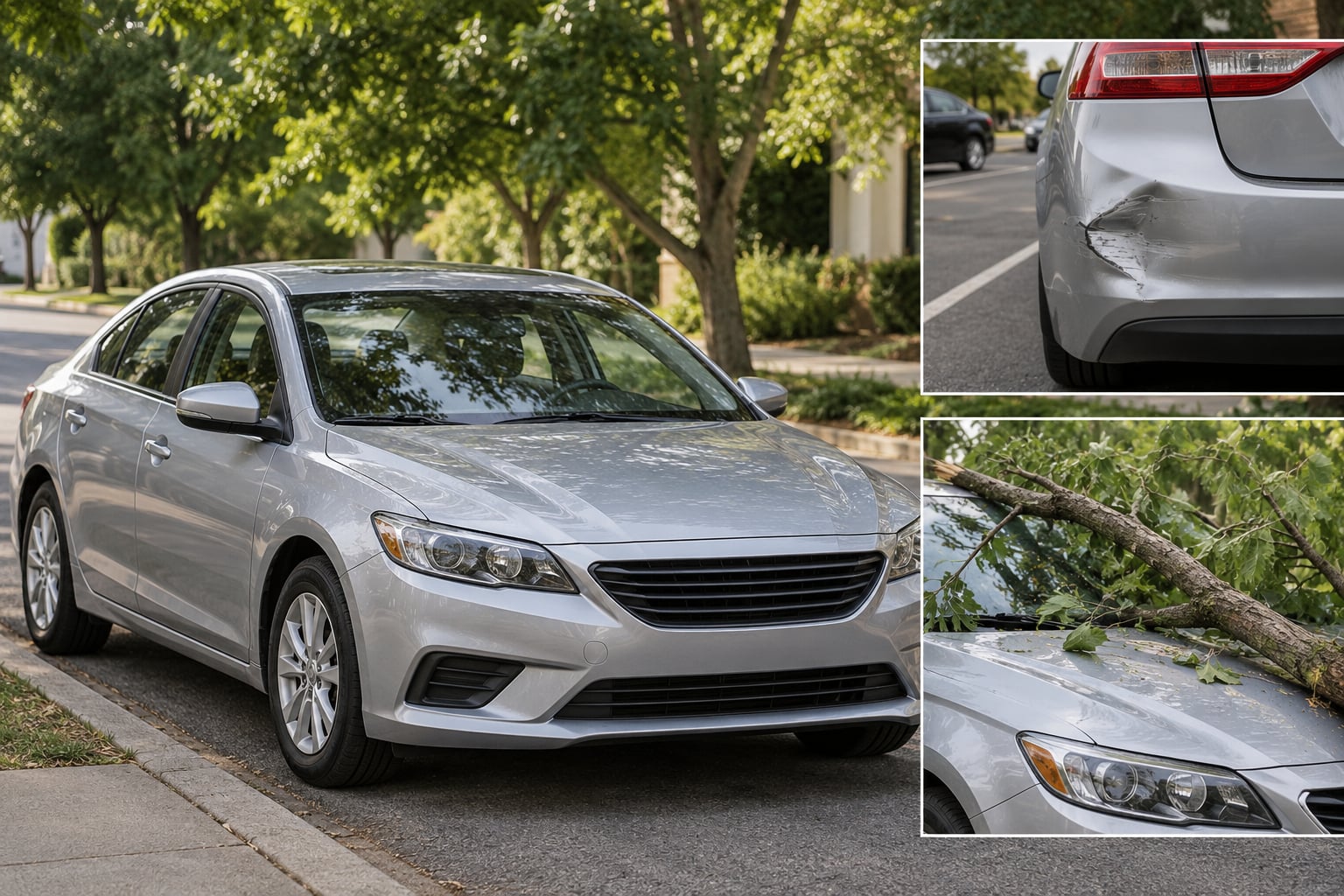
Collision coverage pays to repair or replace your car after you crash into another vehicle or a stationary object. Comprehensive coverage pays for that same car when the damage comes from anything that is not a crash: theft, vandalism, hail, flooding, fire, falling objects and animal strikes. Both sit inside physical damage coverage, and neither one pays for your injuries or for someone else’s car.
The mix-up is easy to understand, since both coverages sit on the same declarations page, use the same deductible format and settle the same way. The only dividing line that matters is the trigger. One answers “what did I hit?” The other answers “what happened to my car while it was sitting there?”
Table of Contents
- Collision vs Comprehensive Coverage at a Glance
- What Does Collision Coverage Pay For?
- What Does Comprehensive Coverage Pay For?
- Collision vs Comprehensive: The Main Differences
- The trigger decides everything
- The claims behave differently in practice
- Which coverage pays for a specific incident
- State law versus lender contract
- Do Either Policies Cover Injuries or Other Vehicles?
- How Deductibles Affect the Cost of a Claim
- Which Coverage Should You Choose?
- Frequently Asked Questions
- Is it better to get comprehensive or collision coverage?
- Is it better to have a 500 dollar or 1,000 dollar deductible?
- Is hitting a mailbox collision or comprehensive coverage?
- Do I need both collision and comprehensive coverage?
- Does collision coverage pay when I am not at fault?
- What does full coverage mean on an auto policy?
Collision vs Comprehensive Coverage at a Glance
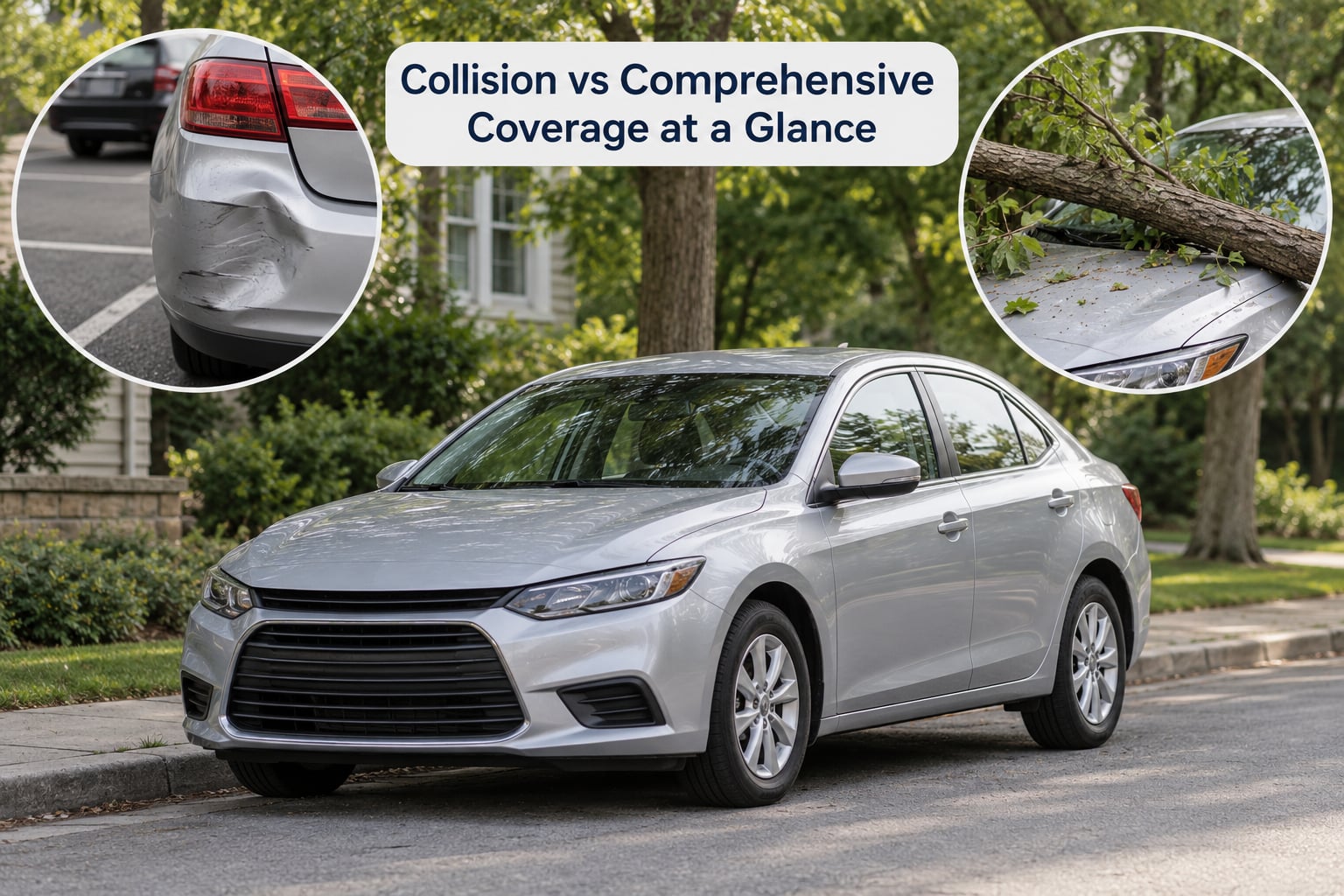
Here is the short version before the detail. Everything about how a claim is filed, adjusted and paid is the same for both coverages. What changes is the event that has to happen before the policy responds.
| What to compare | Collision coverage | Comprehensive coverage |
|---|---|---|
| What it covers | Damage from crashing into another vehicle or a stationary object | Damage from events that are not a crash, such as theft, weather, animals and vandalism |
| Does fault matter | No. It pays whether the other driver was at fault, you were at fault, or no one was | No. The trigger is the event, not who caused it |
| Typical covered events | Another car hitting you, a rear-end crash, hitting a tree, guardrail, mailbox or sign, a single-car rollover | Theft and attempted theft, vandalism, fire, hail, wind, flooding, falling trees or branches, animal strikes, shattered glass |
| What it does not cover | Theft, weather, vandalism, mechanical breakdown, wear and tear, your injuries | Any crash with another vehicle or object, mechanical breakdown, wear and tear, your injuries |
| Does it cover someone else’s car | No. That is property damage liability | No. That is property damage liability |
| Required by state law | Almost nowhere. It is optional everywhere | Almost nowhere. It is optional everywhere |
| Required by a lender | Yes, on any financed or leased vehicle | Yes, on any financed or leased vehicle |
| Deductible | Usually chosen separately, commonly 500 to 1,000 dollars | Set separately from collision, sometimes lower because claims are smaller |
| Payout ceiling | Actual cash value of the car minus the deductible | Actual cash value of the car minus the deductible |
| Part of “full coverage” | Yes | Yes |
One row deserves more attention than the rest. Drivers often assume that because they were not at fault, nothing pays. That is backwards for collision: your own collision coverage pays for damage to your car whether the other driver caused it, you caused it, or the driver who hit you never stopped.
What Does Collision Coverage Pay For?
Collision coverage is the one that responds to contact. It pays to repair or replace your vehicle after it crashes into another vehicle, into a stationary object, or when it overturns on its own.
In practice that includes another driver hitting you, you hitting a tree, a guardrail, a utility pole, a mailbox or a road sign, a single-car rollover where no other vehicle is involved, and a car pushed or dropped onto by something. A backed-into bumper counts the same as a highway crash.
Fault does not enter into it. That is the part that confuses people, because Americans expect insurance to punish the bad driver. Collision coverage on your own policy is not that. It is simply first-party protection for your car, which is why it pays in a hit-and-run, why it pays when a parking lot gives you a parking-scarred door, and why the other driver is pursued separately, if at all.
Two limits are worth holding onto. The payout tops out at your car’s actual cash value, meaning the pre-accident value including depreciation, minus your deductible. And if the damage is worth more than that value, the insurer declares it a total loss and pays the value minus the deductible instead of repairing it.
What Does Comprehensive Coverage Pay For?
Comprehensive coverage is sometimes written on the declarations page as other than collision, or OTC. That phrase tells you the whole idea: it pays for your vehicle’s damage from anything that is not a crash.
The named events are theft and attempted theft, vandalism, fire and smoke, hail, windstorm, flooding, a tree or heavy branch falling onto the car, an animal strike such as a deer, and glass or a windshield shattered without a crash. Some policies also fold in things like a car sinking in a flooded street or a rock thrown through a window.
Glass is the one most drivers get wrong. A windshield cracked by a road kick or a stone is comprehensive, not collision, unless it happened during an actual crash. If you hit something and the windshield goes at the same time, the whole claim runs through collision.
The exclusions matter as much as the inclusions. Neither coverage pays for mechanical breakdown, worn brakes, a dead battery, a bad wheel bearing, rust or ordinary wear and tear. Neither pays for the laptop, the golf bag or the jacket you left in the car, even if the car was stolen with the door closed. Earthquakes and government nuclear activity are commonly excluded too, and flood damage often requires a separate endorsement depending on where you live.
Collision vs Comprehensive: The Main Differences
Strip away the wording and there are four real differences, plus a set of grey cases where carriers interpret the same event differently.
The trigger decides everything
Collision is triggered by contact between vehicles or with an object. Comprehensive is triggered by a listed non-collision peril. Every other difference on the page, the deductible, the limit and the payout, follows from that one question.
The claims behave differently in practice
Collision claims are fewer and larger. They involve towing, rental cars, body work and sometimes litigation over fault. Comprehensive claims are frequent and small: a hail dimple cluster, a broken window, a stolen catalytic converter. The same 1,000 dollar deductible is felt very differently against a 300 dollar glass repair than against a 9,000 dollar bumper and paint job.
Which coverage pays for a specific incident
| What happened | Coverage that pays for your car |
|---|---|
| You rear-end another driver at a light | Collision |
| A car hits your parked vehicle and drives off | Collision |
| A shopping cart rolls into your parked door | Collision on most policies, since it is contact with an object. Check the wording, because a few carriers treat stray objects as comprehensive |
| You hit a mailbox, guardrail, tree or sign | Collision |
| Your car rolls over in a parking lot with no other vehicle | Collision |
| Hail dents the roof and hood | Comprehensive |
| A tree or heavy limb falls on the car while parked | Comprehensive |
| A storm drives debris into the side of the car | Usually comprehensive under falling object or debris language. This one is genuinely carrier-specific, so read the exclusion page |
| Theft, or a break-in where nothing was taken | Comprehensive |
| Fire or smoke damage | Comprehensive |
| Flooding | Comprehensive, often only with a flood endorsement |
| A deer steps in front of you and you hit it | Comprehensive, treated as an animal strike rather than a crash |
| Windshield shattered by a stone with no crash | Comprehensive |
State law versus lender contract
Neither coverage is required by state minimums in practically any state. What forces them on you is the contract for a financed or leased vehicle. Lenders require both because their collateral is the car, and a car stolen or totalled without physical damage coverage puts them in an awkward position. Once the loan is paid off and you own the title outright, the contract requirement disappears with it.
Do Either Policies Cover Injuries or Other Vehicles?
No. This is the second biggest source of confusion after the deductible, and it is worth being blunt about it. Collision and comprehensive are first-party coverages. They only ever pay for damage to the vehicle named on your policy.
Injuries to you and your passengers come from personal injury protection in no-fault states, and from medical payments coverage in most of the rest. Injuries to the other driver come from their bodily injury liability coverage, which is also where their car and property damage claims go. If the other driver has no insurance at all, your own uninsured motorist coverage is what responds, and that is a separate limit you should look at on your declarations page.
So a single parking-lot fender bender produces up to three separate claims from three different policies, paid to three different people. Your collision coverage repairs your bumper. Their liability coverage repairs your bumper as well, which is what subrogation is about: after the other insurer pays you, your insurer may seek reimbursement from theirs. Nobody is paid twice for the same damage.
How Deductibles Affect the Cost of a Claim
A deductible is the amount you keep before the insurer starts paying. It applies per claim, which means a bad month with two claims costs you the deductible twice.
Collision and comprehensive deductibles are set separately, and plenty of carriers default them to the same number even though the claims are wildly different in size. A lower comprehensive deductible is often cheap, because the claims it catches are small.
The payout math is the same for both. Suppose your car is worth 14,000 dollars as actual cash value. You back into a pole and the damage comes to 2,600 dollars. With a 500 dollar collision deductible, you pay 500 and the insurer covers the rest, capped at actual cash value. Raise the deductible to 1,000 and you pay 1,000 instead. Same accident, same repair, twice the money out of your pocket, and a lower annual premium in exchange.
Now take the total loss case. If repairs come to 15,000 dollars on a car worth 14,000, the insurer does not pay 15,000. It pays actual cash value minus the applicable deductible, so 13,000 with a 1,000 dollar deductible. Depreciation is not covered, and that gap is exactly what a replacement cost endorsement exists to soften on newer vehicles.
Which Coverage Should You Choose?
The decision is mostly arithmetic about one number: what the car is worth to you today. Start with the vehicle’s actual cash value, not what you paid or what you owe.
Keep both coverages when the car is worth materially more than you could replace out of pocket, when you park on a street rather than in a locked garage, when your ZIP code has a theft problem, or when you live somewhere with hail, ice storms or heavy tree cover. Financed and leased cars have no decision to make, because the lender already made it.
Start looking at dropping one when the annual physical damage premium approaches 10 percent of the car’s market value. At that point you are paying a large fraction of the car’s worth to insure a car you would be unlikely to replace at that price anyway. A common benchmark in the industry is dropping comprehensive on a paid-off car worth under 5,000 dollars, and dropping both once a vehicle is old enough that a repair exceeds a sensible fraction of its value.
There is a middle path that a lot of drivers take: keep comprehensive, drop collision. Comprehensive tends to cost noticeably less, and the events it covers are the ones you have the least control over. A storm does not care how carefully you drove. That said, the parking-lot and hit-and-run scenarios stop being covered, so weigh how often you park in exposed spots.
Whichever way you go, read the declarations page before you decide. Find the collision and comprehensive lines, note the two deductibles separately, then check whether you carry rental reimbursement and gap coverage. Those endorsements become far more useful once physical damage coverage is in place, and a lot of policyholders pay for physical damage without noticing they have neither.
Frequently Asked Questions
Is it better to get comprehensive or collision coverage?
If you are deciding between one and the other, collision usually matters more because crashes are more common and more expensive than the events comprehensive covers. Most drivers who drop one keep comprehensive, since it costs less and covers hail, theft and animals. Neither is required by state law, so the real test is what the car is worth and what it would cost you to replace it.
Is it better to have a 500 dollar or 1,000 dollar deductible?
A 1,000 dollar deductible lowers your annual premium but keeps more of a small claim in your own pocket. If you have a 500 dollar deductible, a 900 dollar hail repair is mostly reimbursed. With a 1,000 dollar deductible you would absorb the entire repair and file nothing. Pick the higher deductible only if you keep a matching emergency fund and expect few claims this year.
Is hitting a mailbox collision or comprehensive coverage?
Hitting a mailbox with your car is collision coverage. It is contact between your vehicle and a stationary object, which is exactly what collision is written for. Your mailbox and post itself fall under property damage liability, which pays what the other driver owes if there is one. The mailbox repair is usually a few hundred dollars and often handled through the carrier’s roadside or single-property-damage process.
Do I need both collision and comprehensive coverage?
Neither is legally required in essentially any state. Both are required by contract on a financed or leased vehicle. If you own the car outright, you decide based on value: keep both when the car is worth more than you could comfortably replace out of pocket. Many owners on older vehicles keep comprehensive alone, or drop both once the annual premium approaches 10 percent of the car’s value.
Does collision coverage pay when I am not at fault?
Yes, and this is the part most drivers get backwards. Your collision coverage pays for damage to your car whether the other driver caused it, you caused it, or the driver who hit you drove away without stopping. Liability coverage from the other driver’s policy is what recovers your money later. If the other party has no insurance, your own uninsured motorist property damage coverage handles it.
What does full coverage mean on an auto policy?
Full coverage is not an official term and it is not a coverage type. It informally means liability plus collision plus comprehensive, and often includes uninsured motorist and personal injury protection. Because the phrase is used loosely, ask your insurer to list the individual coverages and limits on your declarations page so you know exactly what you are carrying.
Start with one page of homework: pull out your declarations and find the collision line, the comprehensive line and the two deductibles. Everything else in this collision vs comprehensive coverage explained guide follows from those three numbers, and from what your car is actually worth today.