Roadside assistance coverage works by dispatching help to a vehicle that can no longer be driven, usually a tow truck or a technician who can handle a tire, a dead battery, a locked door or an empty fuel tank. It is a service rather than a repair policy, and every plan caps it by miles, service calls and geography.
The catch is that “covered” never means unlimited. Two plans can both advertise roadside help and behave completely differently on the shoulder of I-80 at 2 a.m., because one includes 40 free miles and the other includes 100.
Here is the short version. Before you need the service, find out where your coverage came from, how many miles of towing are included, how many service calls you get per year, and whether anyone other than you can trigger it. Then save the dispatch number somewhere you can reach without unlocking your phone.
Table of Contents
- How Roadside Assistance Coverage Works
- What Roadside Assistance Usually Covers
- How Each Part of Roadside Assistance Coverage Is Limited
- What Is Usually Not Covered
- Membership, Insurance, or Another Benefit?
- How to Use Roadside Assistance and Handle Reimbursement
- What to Do When a Driver Is Stranded
- Questions to Ask Before Choosing a Plan
- Frequently Asked Questions
- Is roadside assistance the same as auto insurance?
- Does roadside assistance cover a flat tire or battery?
- How much towing is included in roadside assistance?
- Can a credit card reimburse roadside assistance expenses?
- Can anyone on my household use my roadside assistance membership?
- Conclusion
How Roadside Assistance Coverage Works
The mechanism is simple and rarely changes. You contact the provider through a 24/7 hotline or an app, an operator takes your location and the problem, checks your plan, and sends the nearest approved truck or technician. Help arrives, the driver fixes what can be fixed at the roadside, and anything that cannot gets towed to a destination your plan allows.
What people get wrong is the assumption that this is insurance. Roadside assistance is a membership or vehicle-service benefit, and the difference matters when a bill arrives. Dispatch service means the provider sends help and handles payment within the plan’s terms. Reimbursement means you pay a shop or a truck driver yourself and then ask, later, whether the plan will reimburse you. Some plans do one, some do the other, and credit card benefits almost always do the second.
Coverage reaches you through one of a few doors. Knowing which door matters, because each one carries different terms.
| Where it comes from | What it actually is | How you activate it |
|---|---|---|
| Membership plan (clubs like AAA) | A paid service membership sold on tiers, billed monthly or annually | Hotline or member app, using your member number |
| Auto insurance add-on | An endorsement or discounted rider on a policy you already hold | The insurer’s hotline, or a button in the insurer’s app |
| Credit card benefit | A card perk that usually pays a flat amount toward towing after you pay | Call the number on the back of the card before the service happens |
| Manufacturer program | Complimentary assistance tied to a new vehicle’s warranty period | A button inside the car, a phone app, or roadside line |
| Dealership or service plan | A prepaid maintenance or service contract that may bundle assistance | The dealer’s service department, often required to use its own service |
Owners of a vehicle still under warranty often have the most generous help available, and it costs nothing. One manufacturer terms quoted publicly for cars and light trucks run five years or 100,000 km, whichever comes first. Volvo owners can press an on-call button inside the car and reach an operator directly, which is a nice touch when the battery is already dead and the phone is at four percent.
What Roadside Assistance Usually Covers
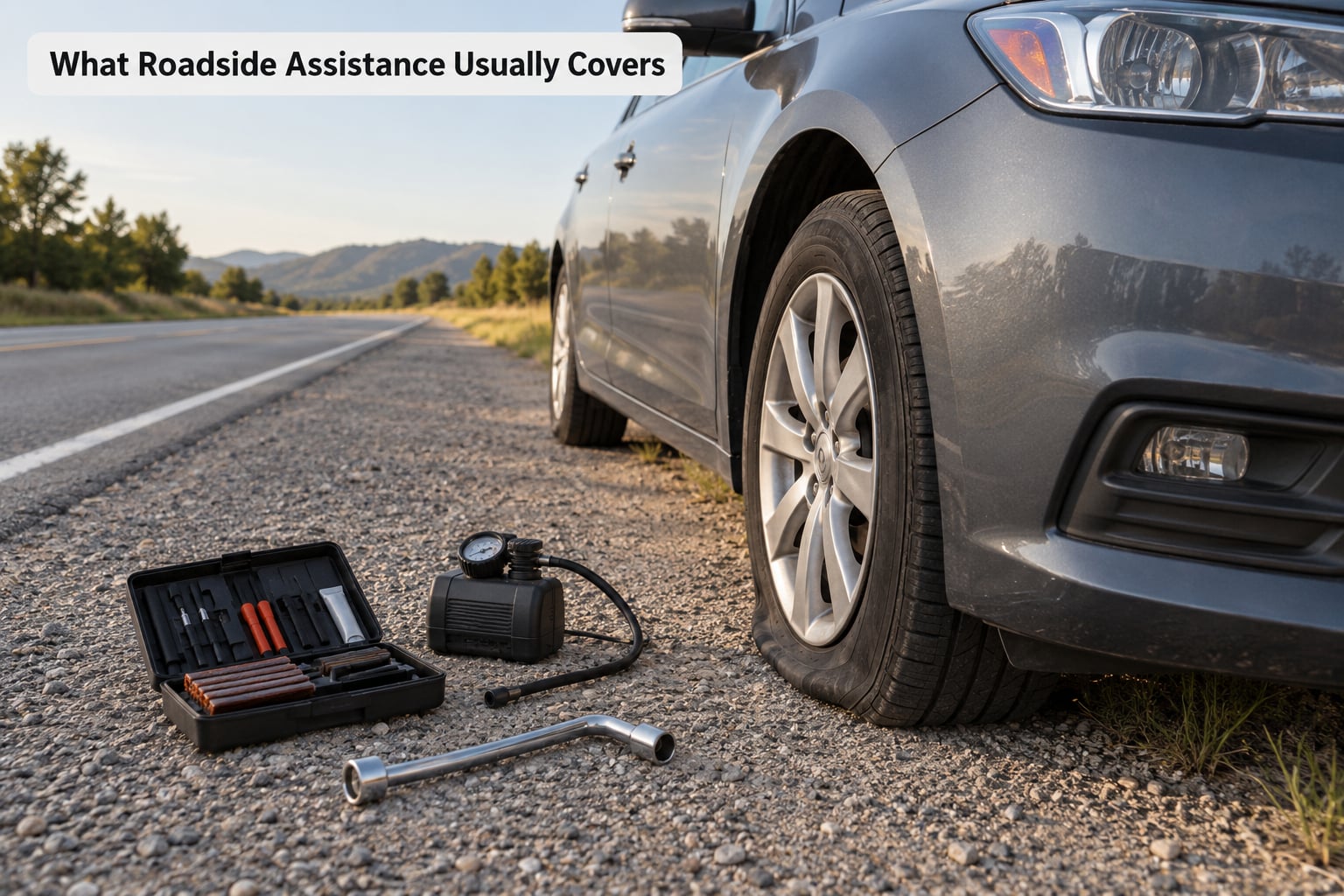
Every plan covers the same core set of problems, though the limits attached to each one vary widely. Knowing how roadside assistance coverage works in practice means reading each of these caps rather than the headline list. These are the standard services.
- Battery jump-start — a technician brings a booster or battery, and often tests the alternator before they leave.
- Flat tire change — a spare or temporary repair, with a stated service radius and a limit on how many tires per call.
- Lockout service — entry into a locked vehicle, sometimes a locksmith, sometimes a specific method the provider will not explain.
- Fuel delivery — a few gallons of gas or diesel, usually capped, with the fuel cost and sometimes a service fee charged to you.
- Towing — from a set number of included miles out to a repair facility, home, or a shop you choose under higher tiers.
- Minor roadside repairs — a stuck battery terminal, a loose belt, a broken hose, anything the technician can fix in minutes.
- 24/7 dispatch — a staffed line or app request at any hour, in most cases including holidays.
Higher tiers add things like longer tows, vehicle storage after a repair, repatriation of a car driven out of state, courtesy transport or a rental car, and legal or medical assistance. A Reddit thread on flat-tire help quotes one plan limiting flat-tire service to 50 miles, which is a good reminder that a single service can carry its own separate cap even when towing is generous.
How Each Part of Roadside Assistance Coverage Is Limited
Providers publish different numbers because each one buys service from a network and passes through what that network costs. A dense metro market costs the provider less per tow than a rural one, and the same flat monthly fee cannot absorb both. Tiers exist to price that spread, so the cheaper plan is usually the one with the tighter limits.
| Limit | What you will typically see | Why it varies |
|---|---|---|
| Tow miles included | From around 5 miles on an entry plan up to 100 or more on a premium tier | Set by the plan’s tier and the provider’s cost per mile |
| Tow type | Flatbed, wheel lift or both, sometimes with a surcharge for one | Depends on the vehicle and the equipment needed |
| Per-mile charge beyond the limit | Overage billed by the mile once you pass the included distance | Regional rates and the distance to the nearest shop |
| Service calls per policy period | A small set number, often three to five, resetting annually or per term | Bundle price and total network volume |
| Flat tire service | A radius from the vehicle, a tire count, sometimes a separate mile cap | Roadside tire work is slower and needs equipment |
| Fuel delivery | A gallon amount, and often a separate service fee on top of the fuel | Fuel cost has to be recovered somehow |
| Lockout service | Number of attempts per incident, vehicle-age rules for key programming | Key programming requires a specific vehicle and equipment |
| Tow destination | Nearest qualified facility, or your home, or a shop you pick, or all three by tier | Longer, more specific tows are more expensive to serve |
| Territory | Usually the country of issue, with a different allowance per mile when out of state or abroad | Cross-border and out-of-area calls cost the provider more |
| Vehicle eligibility | A class of vehicle, age, weight, and sometimes a requirement on registration | Heavy vehicles and trailers need different trucks |
Two details trip up even careful readers. First, a service-call balance resets on a schedule that may not be the calendar year, and a plan with four calls a year can be empty by October. Second, some plans require a waiting period, commonly 48 hours, before assistance begins, which matters if you signed up while already stranded.
What Is Usually Not Covered
Exclusions are where roadside assistance gets expensive, and the pattern repeats across providers. A tow is not approved if the vehicle was disabled in a way the plan does not recognize, or if the request went through a channel the provider did not authorize.
Recovery after a collision sits in an awkward space. Many plans treat accident recovery as a separate benefit, and the insurer’s own roadside rider often covers a disabled vehicle but not a vehicle that was being towed when the crash happened. Flooding, storm and ice damage fall under acts of nature and are frequently excluded as well.
Drivers on r/Insurance and r/towing threads describe the same pattern: a call is refused because the damage was pre-existing, the cause was vandalism, or the driver had already arranged a private tow before phoning. Once a private truck is on the way, the plan is generally out of the picture, and the invoice is yours.
Other common exclusions: replacement parts, tires, batteries, glass, fluids and repair labour beyond a small allowance; a service requested after driving an unregistered or illegally parked vehicle; work started without a dispatcher on the line; and anything beyond the plan’s territory or past its included miles. The mechanic rule is a common one. Providers routinely say a tow may go to a repair facility, not that a provider-authorized mechanic may start work on your bill.
Membership, Insurance, or Another Benefit?
If you already pay for auto insurance, an add-on is usually the cheapest route, and owners on a Subaru forum thread agree that the roadside option through their policy cost less than a separate club membership. A credit card benefit works differently: the card typically pays a flat amount toward a tow after you have paid a shop, so you still front the money and still have to remember to call the number first.
Manufacturer help wins on new vehicles during the warranty window, since it is complimentary and often the most generous version you will ever hold. Dealership service plans are the most restrictive, because they commonly require the vehicle to return to that dealer and may count as a maintenance visit.
None of these is insurance in the technical sense, and adding one does not increase your collision or comprehensive coverage. Mechanical breakdown insurance, sometimes called a vehicle service contract or extended warranty, sits in another category altogether: it pays for a covered part failing, subject to a deductible, exclusions and a per-contract claim limit. Roadside help gets the car to a shop. Breakdown cover pays the shop. Drivers who assume the first gives them the second get an unpleasant surprise at the counter.
Plans differ on one more point worth checking. Calling roadside assistance is not a claim, so it does not appear on your claim history and does not move your rate. That holds for both a membership and an insurance add-on, though a private tow paid out of pocket may end up on a reimbursement request the insurer reviews.
How to Use Roadside Assistance and Handle Reimbursement
Follow the process the provider actually specifies, because steps skipped in the wrong order are the leading cause of denied reimbursement. Start with eligibility, use the designated channel, and keep the paperwork.
- Confirm the plan is active and which channel is required. Some insurer benefits must be requested through the insurer’s app or hotline so the request is logged against the policy. A call to the club on a policy that runs through the insurer can arrive at the wrong queue.
- Reach dispatch through the 24/7 hotline or the member app. Note the time and the reference or ticket number. For credit card benefits, call the number on the back of the card before any service is arranged, because the benefit is usually void if the truck was booked independently.
- Give precise details. Exact location with direction of travel, make, model and year, color, plate number, symptoms, fuel level if a tow is likely, and a callback number. A vague “near the Walmart” is a good way to burn an hour of a truck’s time.
- Ask for coverage confirmation before the driver arrives. The operator will say whether the service is covered, whether it is a roadside fix or a tow, and where the tow may end. The destination question is where tiers differ most: the nearest qualified facility, your home, or a repair shop you select.
- Approve any extra work explicitly. Anything beyond the plan, such as a second tow, extra miles, a key replacement or a manual entry, needs a yes from you first. Say yes out loud and ask the driver to note it.
- Keep the receipt and the dispatch reference. Overage miles, fuel and service fees are normally billed to you, and reimbursement, where it exists, needs proof of payment within a deadline stated in the terms.
- Submit reimbursement inside the window. Membership plans often require a claim within a set number of days. Late submissions are the most common reason a legitimate expense is never returned, so check the deadline the same day the tow happens.
A provider may pay a garage directly when the tow ends at a facility it approves, which is why a private towing company operating in your area may recommend itself and still be outside your plan. Some providers also pay a repair shop for a covered repair, so it pays to mention your roadside plan when you drop the car off.
What to Do When a Driver Is Stranded
Put safety ahead of coverage. If the vehicle is in traffic, in an unsafe parking area, on a curve or near moving traffic, the first call is to emergency services. Hazards on, seat belt on, and out of the vehicle as quickly as you can manage, moving to a safe place away from the direction of traffic if you can do it safely.
Switch on the hazard lights, follow the vehicle’s owner’s manual for warning triangles or a reflective vest, and never attempt a tyre change in a live traffic lane. If you are on a highway, get behind the barrier if one exists. Turn on the low-beam headlights at night so approaching drivers can see you.
Stay with the vehicle unless it is unsafe to do so, keep your phone charged, and note your exact direction of travel and the nearest exit or mile marker, since dispatch will ask for it. Do not agree to an improvised repair from someone who approaches offering help, and do not diagnose the fault yourself if the fix involves touching hot, moving or electrical parts. Follow the manual, and let the technician decide what is safe on the shoulder.
If you are cold, hurt, travelling with children, or the vehicle sits somewhere vehicles are passing close, tell the dispatcher so. Providers can often escalate a request and sometimes skip a distant truck for a closer one.
Questions to Ask Before Choosing a Plan
Coverage is only as good as its fine print, and the fine print is where the two plans that look identical part ways. Ask these questions before you pay for anything, and keep the answers in a note.
- How many miles of towing are included, per incident, and what is the per-mile charge beyond that?
- Which tow type is included, and would my vehicle or trailer need anything extra?
- How many service calls do I get per policy period, does the balance carry over, and how do I check what I have remaining?
- Where can the vehicle be towed: nearest qualified facility, my home, or a repair shop I choose?
- Can it be a motorcycle, an electric vehicle, a trailer or a large truck, and are there separate limits for each?
- What is the service area, and does that change when I drive out of state or into another country?
- What is the promised response time, is an estimate visible in the app, and what happens in heavy weather?
- Can I use a shop I choose for the repair, and can I request reimbursement for a service I paid for myself?
- Who else can use the plan: a spouse, another licensed driver in the household, or anyone with permission to drive the car?
- Is there a waiting period, and does the plan renew automatically, and what is the cancellation term?
Owners on r/towing report that wait time during busy periods, holiday weekends and severe weather is the complaint they hear most often against otherwise good service, and several describe waiting close to two hours with no estimate in the app. Ask what the provider promises and where you can see progress. If a plan has no visible tracking, that is worth weighing against a competing plan that does.
Frequently Asked Questions
Is roadside assistance the same as auto insurance?
No. Auto insurance pays for damage from collisions, theft, weather and liability, subject to a deductible and policy terms. Roadside assistance is a service benefit that dispatches a tow truck or technician for a disabled vehicle. It sits alongside insurance as an add-on, a membership or a card perk, and it does not raise or lower your collision coverage. Using it is not a claim and does not appear on your claim record.
Does roadside assistance cover a flat tire or battery?
Usually both. A battery jump-start and a tyre change are core services on nearly every plan, though each carries its own cap. Flat tire help often includes a service radius, a limit on tyres per call, and sometimes a separate mile limit. Battery service commonly covers a jump and a test, not a replacement battery. Check the terms for vehicle-age rules on key and lockout work too, since those exclusions are common.
How much towing is included in roadside assistance?
It depends on the plan, and there is no single answer, which is why understanding how roadside assistance coverage works matters before you buy. Entry-level memberships may include as little as 5 miles, mid-tier plans commonly run 40 to 60, and premium tiers such as the well-known 100-mile level give far more room. Once you pass the included distance, the overage is billed by the mile. Providers also differ on destination: nearest qualified facility only, or your home, or a repair shop you choose.
Can a credit card reimburse roadside assistance expenses?
Often, yes, but with conditions. Most card benefits cover towing and roadside service up to a flat dollar limit, require you to pay first, and ask you to call the number on the back of the card before service is arranged. A tow booked independently can void the benefit. Some premium cards cover lockout service, fuel delivery and a rental car, while basic cards cover towing alone. Keep the receipt and submit the claim within the card’s filing window.
Can anyone on my household use my roadside assistance membership?
That depends on the plan, so read the eligibility wording. Memberships usually list the member plus household drivers, or anyone driving the enrolled vehicle with permission. Insurer add-ons often follow the policyholder and listed drivers, which leaves out a partner who is not on the policy, even if the car belongs to the household. Ask the provider whether the person is covered before they dispatch, since a non-covered driver can turn a covered tow into a private bill.
Conclusion
Start by reading the terms that apply to your coverage in 2026, not a marketing summary. Understanding how roadside assistance coverage works takes ten minutes with the policy document and saves an argument at the tow yard. Find the included tow miles, the number of service calls remaining, the per-mile overage rate, and the reimbursement deadline, then write the dispatch number on a card in the glove box and in your phone.
Most drivers who regret their roadside plan regret one of two things: they had an empty call balance at the worst possible moment, or they booked a private tow before phoning. Everything else tends to sort itself out once a truck is on the way.