
Most owners searching how to lower commercial insurance premiums get the same result: they audit what they already pay for, fix the risks an underwriter can actually see, then shop the renewal with matching limits. Seven steps do most of that work, and several of them cost nothing more than attention. Savings usually show up at renewal rather than immediately, so the prep starts 60 to 90 days before the effective date.
Rates, rules and required coverage vary by state and by industry, so treat the ranges below as typical US patterns rather than quotes. Nothing here is individual insurance advice. If a single claim or class code is driving your bill, a licensed broker or agent in your state is the person who can price it.
Table of Contents
- What You Need
- How to lower commercial insurance premiums step by step
- 1. Review your current coverage and loss history
- 2. Reduce the most important business risks
- 3. Set appropriate deductibles and coverage limits
- 4. Improve safety and security systems
- 5. Bundle eligible policies or review discounts
- 6. Shop among suitable insurance options
- 7. Ask for documentation and schedule the right renewal
- Common mistakes that undo savings
- Frequently Asked Questions
- Why is my commercial insurance so high?
- What can businesses do to decrease their insurance premiums?
- What is the best way to lower commercial insurance premiums?
- Does bundling commercial insurance save money?
- How does experience mod affect workers compensation premiums?
- What is the 80% coinsurance rule for commercial property?
- Conclusion
What You Need
You cannot negotiate a number you cannot describe. Before you contact anyone, pull together the material that lets an underwriter see your business the way you see it.
- Your current policy, including declarations pages, all endorsements and the premium invoice. Write down every limit, deductible and exclusion.
- Five years of loss runs, plus a list of any claim still open. Insurers use this history more heavily than most owners expect.
- Annual gross revenue, payroll broken out by job classification, headcount, and annual sales by category if you are a retail or distribution business.
- Property values: what each building, vehicle, machine and inventory item would cost to replace today, not what it cost when you bought it.
- Safety records: written safety program, training logs, incident reports, maintenance schedules, fire extinguisher and sprinkler service invoices, alarm monitoring contracts.
- A short list of risk-control projects you finished or started in the last year, with dates and receipts.
Keep it in one folder. When the renewal quote lands, you can answer the underwriter’s questions the same day instead of losing a week to email.
How to lower commercial insurance premiums step by step
1. Review your current coverage and loss history
Start by comparing what you pay for against what you actually do. Businesses change faster than policies do: you added equipment, moved a warehouse, hired seasonal crews, or started taking customer vehicles that were never listed.
Read the loss runs line by line. One claim in five years can cost more than a decade of careful rate shopping, and reserve money on an open claim is part of your exposure right now. Ask the carrier to explain the reserve, and ask what specifically changed in the rate.
Then hunt for the expensive leftovers. Coverage you bought for a contract that ended, a duplicate option buried inside a business owner’s policy, a limit that no longer matches your equipment values, or an endorsement priced for an activity you stopped doing. Removing those is often the fastest saving available, and it costs you nothing.
2. Reduce the most important business risks

The single strongest lever on a premium is reducing the likelihood and severity of loss in the operations that drive the rate. Underwriters do not guess about this. Documented controls, dated photos and service invoices are what turn a claim into a discount.
Work outward from your worst exposures. For most businesses that means fire and water, vehicle incidents, employee injuries, and premises liability. A documented inspection program that logs weekly checks, a written lockout procedure for equipment, scheduled forklift or vehicle maintenance, and a documented training log for new hires all cost hours rather than capital.
Self-insuring small losses is worth a look too. One facility owner in forum discussions reported holding claims under roughly a thousand dollars themselves for three straight years and saving about fifteen percent on premium. That works only with real cash reserves and only if the loss ceiling is written into a plan you actually follow.
3. Set appropriate deductibles and coverage limits
Deductibles are the fastest lever you control without buying anything. Raising the general liability or property deductible by a tier often shaves single-digit percentages off the premium, because you are telling the insurer you will absorb more of the small stuff.
Watch the limit side too. Under-insuring to reduce the premium is the classic way owners lose money. If a building is insured for less than the coinsurance threshold in the policy, a partial loss can be settled proportionally, and you eat the gap. A truck insured for less than its replacement value faces a similar problem.
Set each deductible against a real number: what you could pay out of pocket without straining payroll. A twenty-five hundred dollar property deductible on a small shop may be fine; the same figure on a two-person business with no reserve is not. Higher deductible, real reserves.
4. Improve safety and security systems
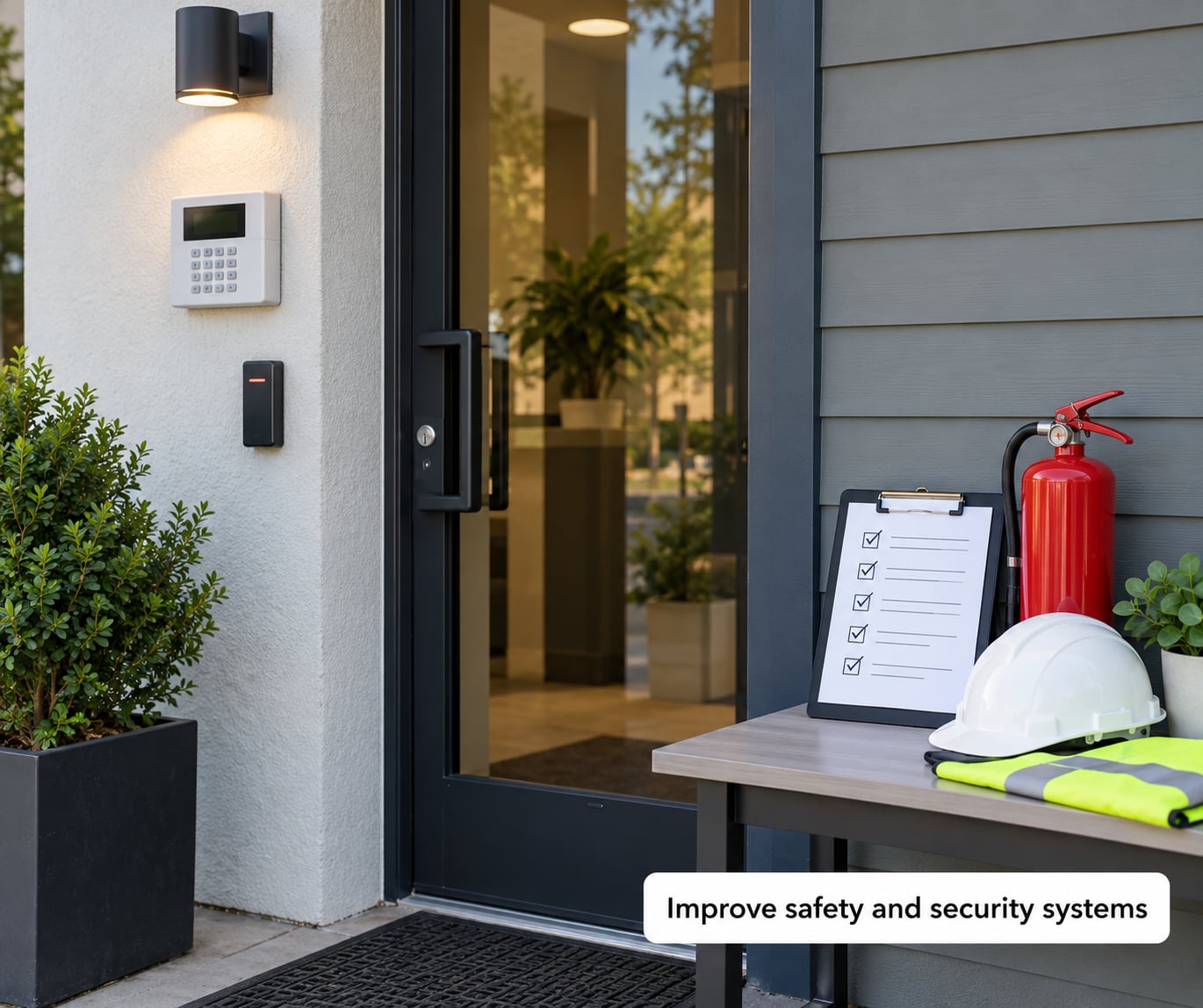
Protective devices earn specific credits that are easy to verify. Sprinklers, fire extinguishers with proper service tags, a monitored alarm with central station response, exterior lighting, secured entry points and monitored video all appear in underwriting checklists for property and general liability.
The pattern owners report back as effective: install the device, get central station monitoring in writing, send the certificate and the contract to the underwriter, and reference it in the renewal conversation. Undocumented equipment earns nothing, and half the benefit of a camera system comes from telling your insurer about it.
Fleet businesses get a similar credit for telematics, dual-facing cameras and documented driver safety policies. One trucking operator reported roughly twenty percent lower premiums after restricting hiring to drivers with two or more years of commercial experience and clean records.
5. Bundle eligible policies or review discounts
Most carriers price a package more cheaply than the same coverages bought separately. A business owner’s policy typically bundles general liability, property and business interruption into one contract with a multi-policy credit, and adding commercial auto or workers’ compensation often extends the discount.
Ask for the credits explicitly by name: multi-policy, claims-free, safety program, protective device, loyalty, annual payment, and new-business or loss-free discount. Owners frequently miss these simply because nobody volunteered them.
To get an accurate quote, give the broker the revenue, payroll by classification, property values, vehicle list and loss history in one pass. A quote built on partial data comes back wrong, and you end up negotiating from a bad number.
6. Shop among suitable insurance options
Compare quotes like-for-like or you will waste a month. Build a spreadsheet with one column per carrier and rows for each coverage: limits, deductibles, exclusions, endorsements, coinsurance percentage, policy form, claims-service terms and total annual cost.
Two cheap-looking quotes often differ exactly where it hurts. One carrier may write general liability as occurrence rather than claims-made, or sublimit a category of exposure, or leave out contractual liability that your customers require. Those differences matter more than a small premium gap.
One small business reported switching to a broker who specialised in its industry and finding roughly twenty-five percent better rates at identical coverage. The lesson is not that specialists always win. It is that a second set of eyes with narrow-market knowledge is worth the two weeks it takes to get one.
7. Ask for documentation and schedule the right renewal
Ask three things in writing: what changed in the quote, which line of the rate movement caused it, and what would need to change to move it back. An underwriter review is a scheduled conversation, not an argument. Send your loss runs, the improvement folder and any certificates before the call rather than after.
Then confirm dates. Most renewal notices arrive 30 to 60 days ahead, and non-payment triggers cancellation rather than a lapse, which can be worse than any rate increase. Put the notice, the quote comparison and the decision deadline in one calendar entry with a two-week buffer.
If a quote jumps sharply, ask whether the rating element changed rather than assuming the market moved. Payroll audit adjustments, classification errors and payroll-based rating surprises show up at renewal more often than owners expect, and they are fixable.
Common mistakes that undo savings
- Dropping coverage purely to hit a number. The premium falls and the exposure grows. Raise the deductible instead, or remove a line you genuinely no longer need.
- Buying improvements you never document. New extinguishers, a training program or a revalued building only earn credits when the carrier can see the invoice, certificate or dated report.
- Comparing quotes on price alone. Different limits and exclusions make the numbers incomparable. Compare form, limits, deductibles and total cost together.
- Missing the renewal deadline. Renewal is the one moment a carrier must compete for the account. After it passes, options narrow fast.
- Treating a discount as a guarantee. Discounts and credits are applied at underwriting and can change year to year. Ask what each one is worth on this quote.
- Misclassifying employees or payroll. Workers’ compensation rating runs on payroll by class code. A contractor who found misclassified employees learned it the expensive way, with roughly thirty percent higher premium.
- Chasing restructuring tricks. Splitting entities to shrink a revenue basis looks clever and can create legal and tax problems, as owners on business forums have pointed out. Ask a professional before doing it.
- Setting a deductible without a reserve. A deductible you cannot pay becomes a coverage problem exactly when you need coverage most.
Frequently Asked Questions
Why is my commercial insurance so high?
Commercial premiums track your industry class code, your loss history, payroll and revenue, and the property you own. Insurance-to-value gaps, alarm and fire protection, employee classification, deductible level and claims frequency all feed the rate. Rates also move with the market in your state and line of coverage, so the same business can see double-digit changes with no change in its own risk.
What can businesses do to decrease their insurance premiums?
Seven moves carry most of the effect: audit coverage and loss history, reduce the risks that drive the rate, set deductibles you can absorb, add documented safety and security systems, bundle eligible policies or claim named discounts, shop the market annually on like-for-like terms, and give the underwriter proof with time to use it before renewal. Most savings land on the next renewal rather than immediately.
What is the best way to lower commercial insurance premiums?
There is no single best move, but the highest-return sequence is consistent. Fix the policy structure first: remove outdated coverage, correct limits, and set a deductible you can actually pay. Then hand the underwriter documented proof of risk improvements and shop the renewal against at least one competing quote with identical limits and deductibles.
Does bundling commercial insurance save money?
Often, yes. A business owner’s policy bundles general liability, property and business interruption, and most carriers apply a multi-policy credit that is larger than the sum of the parts. Adding commercial auto or workers’ compensation usually extends it. The saving is not automatic, so compare the package total against separate policies with the same limits and deductibles before you commit.
How does experience mod affect workers compensation premiums?
The experience modification factor compares your workers’ compensation losses and payroll with similar businesses and turns that comparison into a multiplier applied to the manual rate. A factor above one adds to the premium, below one subtracts from it. It moves slowly, so a single bad year can hold a surcharge in place for several renewal cycles while improved safety works it down.
What is the 80% coinsurance rule for commercial property?
Many commercial property policies carry a coinsurance clause requiring the building to be insured for at least a stated percentage, commonly eighty percent, of its replacement cost. If coverage sits below that threshold, a partial loss is settled proportionally, meaning you absorb part of the damage. Under-insuring to lower the premium is therefore risky even when the saving looks real.
Conclusion
Start with the paperwork, not the phone call. Pull your policy, five years of loss runs and current property values into one folder, write down the two or three risks that worry you most, and document whatever protection you have already paid for. Then ask for an underwriter review and one competing quote built on the same limits and deductibles. Renewal is the only moment the market has to compete for your business, and that is where savings come from.