
A ticket usually keeps affecting your car insurance for roughly three to five years from the date of conviction, and most drivers see the surcharge appear at their next renewal rather than the day the officer hands over the citation. So how long does a ticket affect car insurance for you specifically? The answer sits in three separate timelines that rarely line up: how long the court keeps the record, how long your state holds it on a motor vehicle report, and how long your own carrier counts it when it prices your next policy.
Those three clocks disagree often enough to explain why one driver gets a rate hike and another with the same violation does not. Rules and surcharge practices also change over time and differ a lot from state to state, so treat what follows as a general explanation of how the process works rather than advice about your specific policy. What I can do is walk you through the mechanics clearly enough that you know which question to ask your insurer and when to ask it.
Table of Contents
- How Long Does a Ticket Affect Car Insurance?
- What Does a Ticket Do to Your Car Insurance?
- How Long the Ticket May Stay on Your Record
- How Long Does a Moving Violation, Accident, or Nonmoving Ticket Affect Insurance?
- What Determines the Insurance Increase?
- Why State and Insurer Rules Matter
- How to Check Whether a Ticket Affects Your Premium
- Ways to Limit the Financial Impact
- Frequently Asked Questions
- How long does a ticket affect car insurance after the ticket is dismissed?
- Does every moving violation raise car insurance premiums?
- How long do insurance points stay on a driving record?
- Will a ticket affect my insurance if it was not issued at a traffic stop?
- Can traffic school stop a ticket from affecting insurance?
- What to Do First
How Long Does a Ticket Affect Car Insurance?
The short answer: typically three to five years of insurer scoring, measured from the conviction rather than the stop. Some states and some carriers use shorter windows, and a few use longer ones, so there is no single national timeline you can point to and be right.
The distinction that matters most is between a violation appearing on your driving record and an insurer actually charging you more because of it. The first happens automatically, handled by the court and the motor vehicle report system. The second is a private underwriting decision, made under the carrier’s own rules, and that is where the three-to-five-year window usually comes from.
| Ticket type | Typical treatment on a driving record | Possible insurance impact |
|---|---|---|
| Speeding, failure to stop, red light, lane change | Moving violation, usually kept several years | Most likely to trigger a surcharge or a non-standard rating |
| Reckless driving or DUI | Kept for many years in most states, often the full driving history | Very likely to raise rates sharply and may limit carrier choice |
| At-fault accident reported to your carrier | Not a ticket at all; tracked as a claim | Affects rates through claims history, which persists separately from tickets |
| Registration, license or equipment (nonmoving) | Often dismissible or correctable before it becomes a conviction | Usually no effect once corrected or dismissed |
| Seat belt citation | Points in many states, no points in some | Typically little or no effect on premiums |
| Warning or courtesy citation | Not recorded as a violation on most records | No effect on premiums |
| Parking ticket | Not part of the driving record | No effect on premiums |
What Does a Ticket Do to Your Car Insurance?
Most of the time a ticket affects your premium in one of three ways: a flat surcharge, a move into a higher rating tier, or a loss of discounts. A surcharge adds a set amount to your premium for a set period. A rating tier change is subtler and often bigger, because the carrier recalculates your whole price using a worse base factor that your clean driving record would otherwise have earned you.
Not every ticket moves either needle. Insurers score by violation type, and parking, equipment and paperwork matters are normally given no weight at all. The ticket that pushes you from a good-driver rate to a standard rate is rarely the one people expect.
Claims history is a separate track. An at-fault collision can raise your premium for years without a moving violation ever being issued, and it can outlast the ticket record in some carriers’ scoring models. If you have both, the two often stack rather than overlap.
Reporting also works differently depending on where you drive. Some states feed violation data into a statewide exchange that insurers query routinely. Others leave it to the driver to disclose on the application, which means an omission on a renewal questionnaire can turn a routine ticket into a cancellation risk. Whether your state shares records automatically or asks you directly changes who finds out, and when.
How Long the Ticket May Stay on Your Record
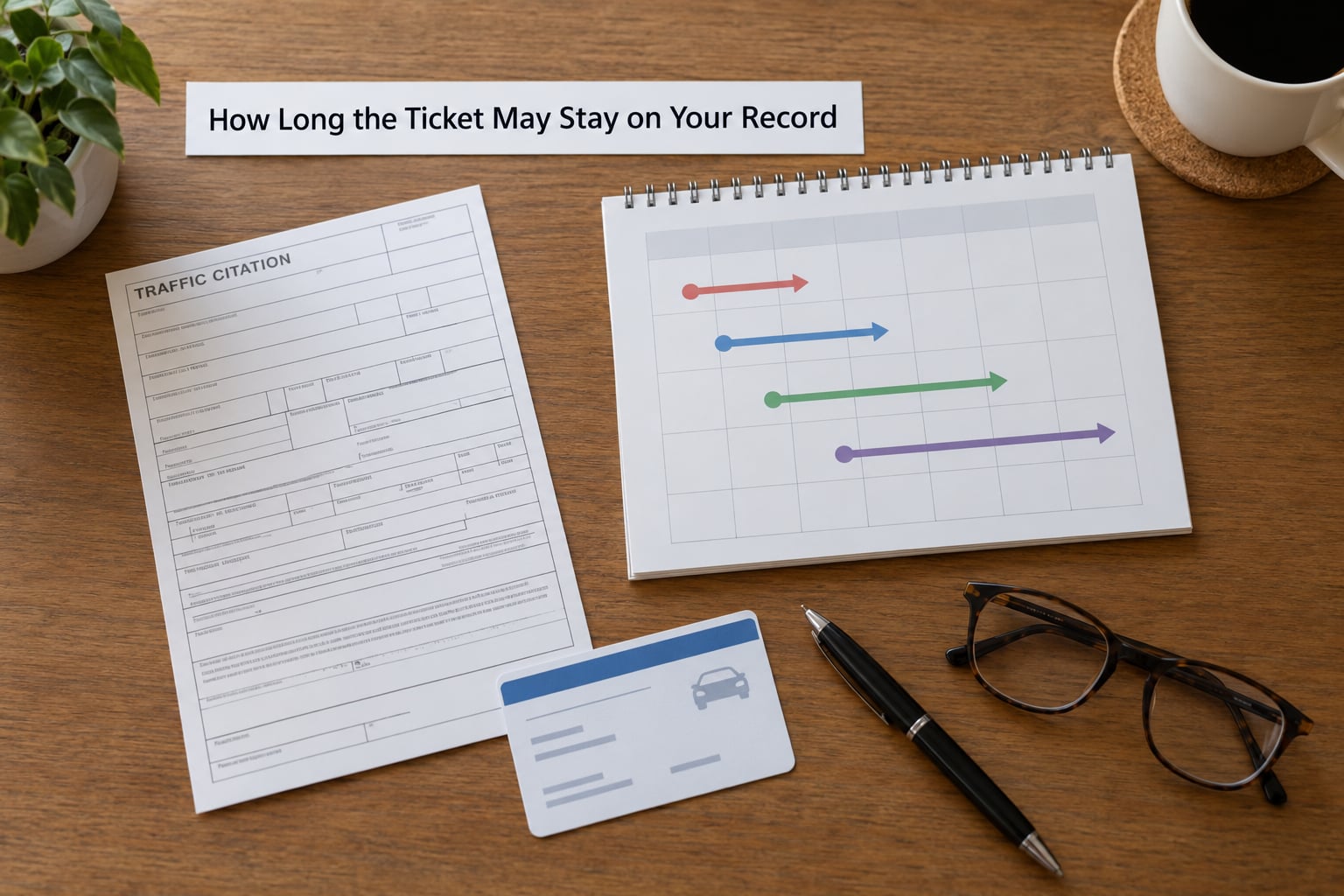
Every answer to the question depends on separating three clocks. None of them is called the insurance record, which is part of why the numbers people repeat online rarely match their own situation.
| Timeline | Controlled by | What it governs |
|---|---|---|
| Court and DMV retention | The court that issued the citation and your state agency | How long the violation stays visible on the official record, and when points are removed |
| Motor vehicle report retention | Your state’s report provider | What an employer or an insurer sees when it pulls your record |
| Insurer scoring period | Your carrier’s underwriting rules | How long your rate is calculated as though the violation happened |
Lawyers in New York, for example, often discuss an eighteen-month lookback when insurers examine driving records there, which is much shorter than the multi-year windows common elsewhere. Illinois court supervision programs have been reported to keep a ticket off the public record when the driver completes six to twelve months with no new violations. Those are two states out of fifty, and the difference between them is the whole point: the answer is not national, it is local.
So when people ask how long does a ticket affect car insurance, the honest answer covers both questions they are really asking. It can stay on the driving record for several years, and it can keep influencing your premium until the carrier’s own scoring period expires, which is often longer than the record itself.
How Long Does a Moving Violation, Accident, or Nonmoving Ticket Affect Insurance?
Moving violations are the ones that matter most. Speeding, failure to stop at a red light or stop sign, and illegal lane changes are all treated as driving behavior, and carriers weight them heavily because they describe how you operate a vehicle.
Nonmoving citations are the paperwork side: expired registration, a broken tail light, missing proof of insurance. These are often correctable for a small fee before the case resolves, and a corrected ticket usually never reaches an insurer at all. Get those handled early and they are effectively harmless.
Warnings are not violations. An officer can issue one instead of a citation, and in that case nothing is recorded that an insurer would score.
Accidents sit outside the ticket system entirely. A collision where you are found at fault is reported to your carrier as a claim, and it is priced on claims history with its own duration that does not shorten because your ticket record has gone clean. This is the single most misunderstood item on the list.
What Determines the Insurance Increase?
Carriers do not apply one flat surcharge to every ticket. The practical rating factors are the ones below, and they rarely carry equal weight.
Violation type comes first. Serious offenses move you further than ordinary ones, and some categories skip straight to a non-standard placement in the file.
Severity and points come next. How far over the limit, how many points the violation assigns, and whether a second offense compounds the first all shape the outcome. Three minor tickets rarely cost what one serious violation costs.
Prior violations and overall driving history set the baseline. A clean record with a single ticket and a record that already has several are scored very differently, which is why drivers on family policies sometimes see a larger percentage jump than they expected.
Claims history sits alongside all of this. Collision and comprehensive claims raise rates on their own timeline, and an accident in the middle of your scoring period can offset a clean ticket record.
State rules and carrier policy decide the window. Your state controls what gets reported and how long it is retained; your carrier controls how it converts that into money.
Deductible and coverage level change the arithmetic. Higher deductibles mean less claim cost, which can offset part of a ticket-driven increase, while lower deductibles do the reverse. Bundling, paperless billing and autopay discounts are also priced in, so an increase can be partly offset by discounts you were already eligible for.
Safe-driver program eligibility matters more than most people expect. Telematics programs, defensive driving courses and accident-forgiveness programs all feed into how a carrier scores you, and dropping out of one can outweigh a ticket.
Why State and Insurer Rules Matter
Two drivers with identical tickets can get very different quotes because they drive in different states and hold different policies. The variables below are the ones that shift behind the scenes.
| Variable | Why it changes your result |
|---|---|
| State reporting rules | Determines whether a violation reaches insurers automatically or only if you disclose it |
| Point schedules | Sets how many points each violation assigns and when they are removed |
| Record retention period | Controls how long a violation stays visible to anyone who pulls your record |
| Cross-state exchange | Decides whether an out-of-state citation surfaces on your home-state record |
| Insurer underwriting criteria | Sets the surcharge amount and how long the carrier counts the violation |
| First-ticket forgiveness | Some carriers discount or waive a surcharge for a first violation after years of clean driving, others do not |
| Accident forgiveness | Whether a past at-fault claim continues to count after a set period |
Out-of-state tickets deserve their own note. Citations issued in one state may or may not be reported to another, depending on whether both states share violation data through a compact agreement. A vacation speeding ticket can still reach your carrier even when your state’s record shows nothing.
And carrier rules are proprietary. Each one decides for itself how much weight a violation carries, and those schedules are reviewed and adjusted over time. A renewal quote from one carrier says little about what another would offer you the same day.
How to Check Whether a Ticket Affects Your Premium
You do not have to guess. There is a clear sequence, and it takes about fifteen minutes plus one phone call.
Start by pulling your own motor vehicle report from your state’s DMV or report provider. Most states let you do this online, and it gives you the exact violation codes, dates and point assignments the insurer will see.
Confirm the case status with the court that handled it. A ticket that is still pending is usually invisible to insurers; a conviction or a default judgment is not. Check whether you signed anything that counts as an admission of guilt, since a signed citation can be treated as a conviction even without a court appearance.
Ask your current insurer directly whether the violation has been coded and how many points or surcharge months it carries on your policy. The rep can usually see this in the system. Ask what end date the carrier is using, since that date answers your real question better than any general rule.
Compare that against the report. If the record shows something different from what your policy shows, request correction before the renewal is written.
Then check the timeline: whether the surcharge begins at the next renewal, whether any part of it applies mid-term, and whether the increase is a fixed surcharge or a tier change.
Before you shop, know your limits. Carriers are not required to hand over their rating formulas, so ask for the specific facts you are owed: the violation as recorded, the points assigned, the surcharge amount, and the end date. Insist on corrections in writing when something is wrong.
Ways to Limit the Financial Impact
Traffic school is the best-known option where the law allows it. In many states, completing an approved course keeps the conviction off your public record, and insurers that pull reports will not see it. That protection is not universal, and in a few jurisdictions a traffic school completion is still reported as a conviction with points, just at a reduced level. Confirm your state’s rules before paying.
Contesting the citation before the deadline is the option with the highest ceiling. If the case is dismissed or you win on appeal, there is nothing for an insurer to score. Pay attention to the deadline and the consequences of defaulting, because a default judgment is usually treated as an admission.
Stay clean for the whole scoring window. Because carriers watch your most recent years, a second violation during the period does more damage than the first one did. This is where drivers who assume the increase is a one-time cost get caught.
Keep coverage continuous. A lapse triggers surcharges on its own and often raises the rate substantially when you return, which can cost far more than the ticket that started it.
Shop at renewal rather than mid-term. Most carriers only re-rate at renewal, and that is when a violation can be priced in. Getting quotes from several carriers around the same date is the single most effective way to close a gap, and drivers who switch after a ticket often find the difference is smaller than they feared.
Ask about forgiveness programs. Several national carriers offer accident forgiveness or safe-driver credits that are not obvious from a quote page. One phone call can reveal a discount that offsets most of the surcharge.
Frequently Asked Questions
How long does a ticket affect car insurance after the ticket is dismissed?
A dismissed ticket generally stops affecting your car insurance once the insurer’s record is updated, usually within a few weeks. How long does a ticket affect car insurance after dismissal is usually a question of timing rather than duration. Until the update posts, carriers working from a stale report may still price it in, so confirm the dismissal in writing and ask your insurer to re-pull the record at the next renewal.
Does every moving violation raise car insurance premiums?
No. Parking tickets, equipment citations and seat belt violations are commonly ignored, and some carriers discount or waive a surcharge for a first violation after several clean years. The violations that reliably raise premiums are the serious ones: speeding, failure to stop, reckless driving and impaired driving. Whether a given ticket applies to you depends on your state’s rules and your carrier’s own scoring schedule.
How long do insurance points stay on a driving record?
Point removal is set by your state, and the timelines range widely, commonly from one to several years depending on the violation. A first minor violation may clear faster than a serious one. Insurers also apply their own separate scoring period, which is what actually drives your premium and is often longer than the state’s point clock. Check both rather than assuming a state timeline settles your rate.
Will a ticket affect my insurance if it was not issued at a traffic stop?
Yes, a citation does not have to come from a stop to reach your insurer. Red-light camera and school-bus-stop-arm violations, for example, are mailed to the registered owner and reported like any other citation. Parking and private-property tickets generally stay out of the driving record entirely. The deciding factors are whether it became a conviction, whether your state reports it, and how your carrier scores that violation type.
Can traffic school stop a ticket from affecting insurance?
Often yes, where the state allows it. Completing an approved course can keep the conviction off your public driving record, which means an insurer pulling your report sees nothing to score. It does not erase the original court record in every jurisdiction, and a few states still report the conviction with reduced points. Confirm your state’s specific rules before paying the fee.
What to Do First
Pull your motor vehicle report and match every line against what your insurer has on file. Then ask your carrier one specific question: what end date are you using to count this violation. Everything else in this guide follows from that answer.
From there, fix anything inaccurate on the record, decide whether traffic school or a court contest is open to you before the deadline, and get renewal quotes from several carriers rather than accepting a single increase. As of 2026, surcharge schedules still vary enough between carriers that one rarely tells you what the others will offer.