Gap insurance explained for financed cars comes down to one number: the difference between what your car is worth and what you still owe on the loan. Gap insurance, short for Guaranteed Asset Protection, pays that shortfall when the vehicle is declared a total loss or stolen. If you financed a car with less than 20% down, this is the coverage that keeps a totaled vehicle from becoming a debt you personally pay off.
It is optional, it is not the same as comprehensive or collision coverage, and it is sold hardest in the finance office of the dealership. Last updated for 2026, this guide walks through how a gap claim actually settles, what it does not pay, what it tends to cost through each channel, and an honest test for whether you need it at all.
Table of Contents
- What Is Gap Insurance and What Does It Cover?
- What Gap Insurance Pays For and What It Skips
- How Does Gap Insurance for Financed Cars Work?
- What Is the Gap Between a Car’s Value and What You Owe?
- How Much Does Gap Insurance Cost?
- How to Get a Quote You Can Actually Compare
- Do I Need Gap Insurance on a Financed Car?
- How to Tell If You Are Upside Down in 60 Seconds
- Does My Auto Loan Include Gap Protection?
- Financed Car or Leased Vehicle: The Math Is Different
- Can a Car Be Totaled but Still Have a Gap?
- How to Decide Whether Gap Insurance Is Worth It
- Frequently Asked Questions
- Should I get gap insurance on a financed car?
- Why didn’t my gap insurance pay off my loan?
- What are the downsides of gap insurance?
- What does Dave Ramsey say about gap insurance?
- Does gap insurance help when trading in a car?
- Is gap insurance worth it on Reddit?
- Conclusion: What to Do First
What Is Gap Insurance and What Does It Cover?
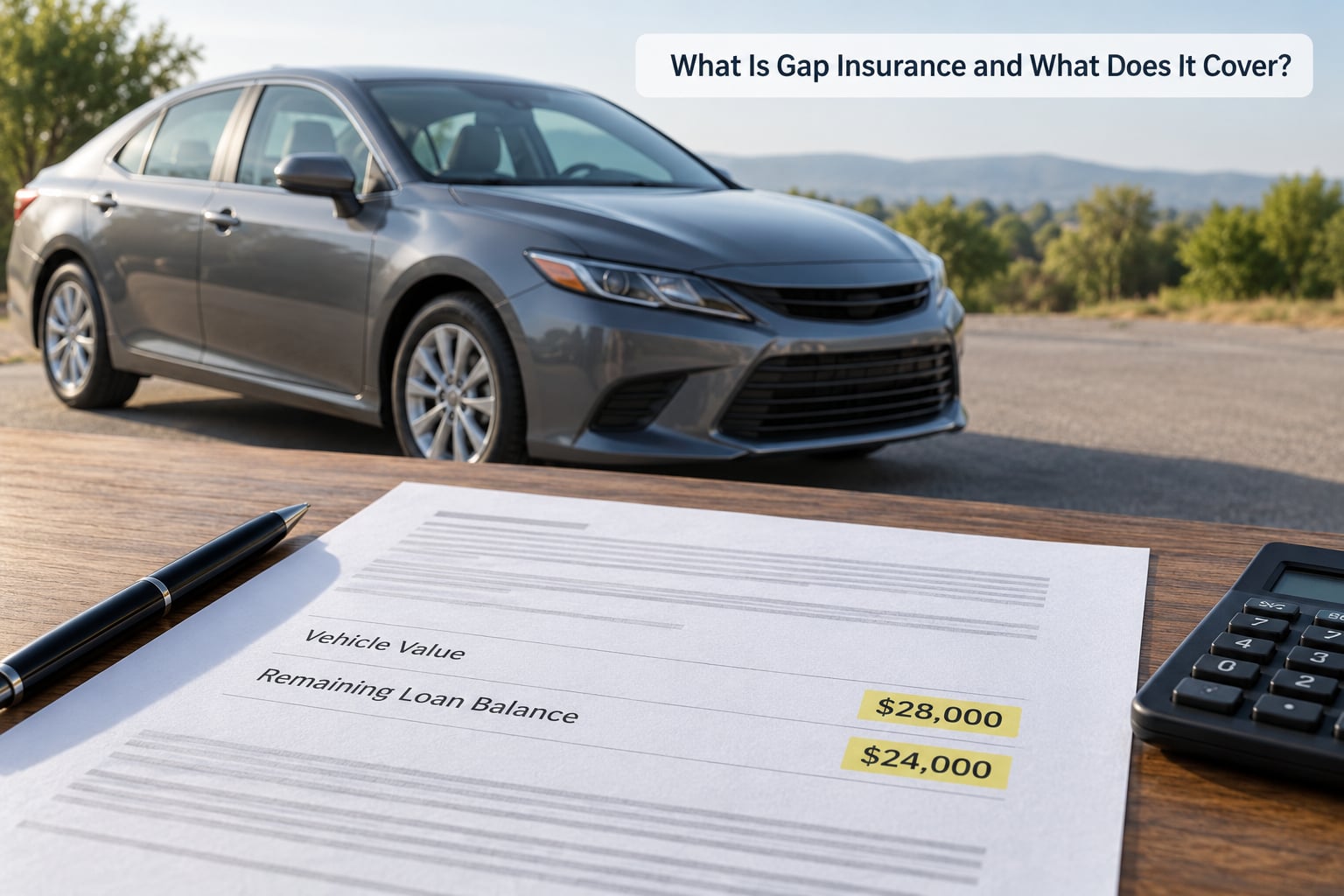
Gap insurance is optional coverage that pays the difference between your vehicle’s actual cash value at the time of a covered loss and the amount still owed to your lender, up to the policy limit. It responds only after your own auto insurer has paid for the vehicle.
The important word in that sentence is after. Gap insurance is not damage insurance. It has no opinions about fender dents, hail, or a fender-bender in the parking lot.
What Gap Insurance Pays For and What It Skips
Covered events, in plain terms:
- The car is declared a total loss after a covered accident
- The car is declared a total loss from fire, vandalism, hail, flooding, or another covered peril
- The car is stolen and not recovered
- A total loss on a leased vehicle, where the shortfall is measured against the end-of-lease residual
What most policies skip, and the details vary by contract:
- Your collision and comprehensive deductibles, unless you buy deductible reimbursement
- Any negative equity rolled over from a trade-in, unless the policy names it specifically
- Overdue or missed loan payments, late fees, and repossession charges
- Service contracts, warranties, and extended maintenance plans
- Mechanical failure, wear and tear, or anything excluded by your underlying auto policy
Read the exclusion list before you sign, not after. Two contracts with the same name can differ on exactly these four points.
How Does Gap Insurance for Financed Cars Work?
A gap claim runs in a fixed order, and knowing the order tells you who pays what and when. Here is the sequence as it typically happens after a serious accident or a theft.
- The loss gets declared. Either your insurance company or the lender decides the vehicle is a total loss, usually when repair costs plus labor exceed the pre-accident value or a percentage threshold set in your policy.
- Your auto insurer pays actual cash value. ACV is an offer, not a negotiation: a market-based estimate of what the car was worth moments before the loss, minus your deductible and minus anything excluded.
- Your lender is paid directly. ACV goes to the finance company first because the lender holds the title, not to you.
- The gap provider sees what is left. The shortfall is the payoff balance, including accrued interest and any fees, minus what your auto insurer already paid.
- The gap provider pays the shortfall, up to the limit. The lender’s lien is satisfied and the file closes. If the shortfall exceeds your limit, the remainder stays with you.
Expect a gap between step two and step five, sometimes weeks long, because two separate companies are processing the same loss. Drivers on forums describe covering a deductible out of pocket while the claim worked through both sides, and one owner described being told they had no gap coverage at all, then receiving a check for the unused portion after the loan was paid off. Budget for that window, and keep paper copies of the payoff amount from the date of loss.
What Is the Gap Between a Car’s Value and What You Owe?
The gap is the payoff balance minus the car’s actual cash value. Loan-to-value, or LTV, expresses the same thing as a percentage: what you owe divided by what the car is worth. Above 100% you are upside down.
Depreciation is the mechanism that creates the gap. Industry trackers such as CarFax commonly report a new vehicle losing more than 20% of its value in the first twelve months. A car financed at 100% of its sticker price is underwater before the first oil change, and the crossover point moves as interest accrues while the value falls.
Two worked examples, using round figures to keep the math visible.
- A new financed car. Purchase price 38,000, no down payment, 72-month loan. Two years and 30,000 miles later, the trade-in guides put it near 24,000 while the payoff balance sits at 31,500. Gap of roughly 7,500. Without gap insurance, that is the balance you owe on a car you can no longer drive.
- A financed used car with a trade-in. Purchase price 22,000, and 2,500 of old loan debt rolled into the new one, so 24,500 was financed. Eighteen months later the car is worth about 17,000 and the balance is 19,600. Gap of roughly 2,600. If the gap policy caps coverage at the financed amount only, the rolled-over portion may never be covered.
The pattern holds across terms: the longer the loan and the fewer miles you drive, the longer you are underwater.
How Much Does Gap Insurance Cost?
Gap insurance cost varies by vehicle value, loan term, deductible, location, and provider, so there is no single price. What you can compare is the channel you buy it through and what each one charges for.
| Where you buy it | Typical structure | What to watch |
|---|---|---|
| Dealership finance office | One-time fee of several hundred dollars, usually added to the financed amount | You pay interest on the fee for the rest of the loan, and it is the hardest product to cancel |
| Your own auto insurance company | An endorsement, often tens of dollars a year for the term of the loan | Coverage may be narrower on negative equity, so ask about the limit in writing |
| Standalone gap provider | A policy bought direct, commonly a few hundred dollars for the loan term | Shop around; limits and eligibility rules vary more than the price does |
These are typical US ranges that vary by region and change over time, so treat them as a framework for comparing quotes rather than a quote.
Dealer gap costs more for two reasons worth knowing. The product is bundled with other add-ons the finance manager wants to sell, and it is financed, meaning interest is charged on the fee for as long as you hold the loan. If you are determined to buy coverage, buying the endorsement from your own auto insurer for a fraction of the dealer fee is the comparison most buyers are never given in that office.
How to Get a Quote You Can Actually Compare
Ask three providers for the same five things: the total premium for your loan term, the maximum benefit, whether negative equity is included, whether your collision deductible is reimbursed, and the cancellation terms. Written answers beat verbal ones, and if a salesperson cannot produce the maximum benefit figure, that alone is an answer.
Timing matters for the price too. Most auto insurers will add a gap endorsement only within a short window after you take delivery, commonly around 30 days, because the risk they are pricing is highest in that first month. Miss the window and options narrow, particularly if the car is already underwater.
Do I Need Gap Insurance on a Financed Car?
Yes if you put down less than 20%, financed over 60 or 72 months, bought a fast-depreciating vehicle, rolled negative equity into the loan, or could not cover a several-thousand-dollar shortfall out of pocket without strain. Probably not if you made a large down payment, are near the end of a short loan, or drive a vehicle with strong resale retention.
How to Tell If You Are Upside Down in 60 Seconds

- Call your lender and ask for the current payoff amount, not the monthly payment. Ask for the figure as of today’s date.
- Look up the car’s value in a current guide such as Kelley Blue Book or NADA, using the mileage on your odometer.
- Subtract. A positive number is your gap; a negative number means you are ahead of the loan.
- Compare that gap with what you could pay from savings in a week without it hurting anything else.
Run that math again at the halfway point of your loan and again near the end. The whole case for gap insurance rests on one idea: if the gap is larger than your comfort zone during the period when you still owe a lot, buy coverage. If the gap has closed or never opened, you are paying a premium for nothing.
Does My Auto Loan Include Gap Protection?
Sometimes, and the answer is in the paperwork rather than the salesperson. Two lender products show up here: a gap rider added to the loan, which is a waiver benefit that cancels part of your debt after a total loss, and a separate gap waiver policy sold by the lender or credit union. Neither is included automatically, and the waiver benefit is usually sold as an add-on to the contract.
Common rules in these products:
- A waiting period, often 30 days after signing, before the coverage starts
- An eligibility limit on how old and how high-mileaged the vehicle can be
- A maximum benefit, sometimes tied to the original financed amount or a stated dollar cap
- Cancellation allowed only with lender approval and proof of the vehicle no longer being at risk
Cancellation is the part most people learn too late. Some contracts let you cancel once the vehicle reaches a certain equity or after a certain number of payments, and some return an unearned premium on a pro-rated basis. Dealer-gap that is financed into the balance often cannot be removed at all. Find the cancellation clause and read it while you are still at the dealership.
Financed Car or Leased Vehicle: The Math Is Different
On a financed car, the gap is measured against a payoff balance that shrinks steadily as you pay it down, so the gap closes at the end of the term. On a lease, the gap is measured against a fixed end-of-lease residual set in the contract, so the exposure stays roughly constant for the life of the lease and ends abruptly when you hand the keys back. Leases usually require liability insurance well above state minimums, and most leaseholders buy a gap product at signing because a total loss mid-lease otherwise leaves a large damage charge. Lenders care more about lease-end damage charges than about the market value of the car.
One more distinction worth remembering: a waiver benefit and a gap policy are not the same contract. A waiver on the finance contract is a debt-cancellation provision, in some states enforceable only with a separate signed addendum that names the amounts. If your paperwork has no such addendum, the coverage you were told about may not exist.
Can a Car Be Totaled but Still Have a Gap?
Yes, and this is the failure mode that drives most of the complaints. A total loss payment equals actual cash value, and actual cash value regularly falls short of the payoff balance for reasons that have nothing to do with how well you drove.
The common causes:
- Fast depreciation. A 72-month loan on a luxury sedan, an electric vehicle, or a performance model leaves you above water for a long stretch.
- High mileage. The value in the guide drops with the odometer, while your balance barely moves.
- Prior damage. A car with a documented accident history is written down harder at valuation.
- Interest and fees. Your payoff includes interest you have paid and, near the end of the term, interest still accruing. Insurers settle on cash value; lenders insist on the balance.
- Rollover negative equity. The old loan came along with you, and a basic gap policy often caps at the new vehicle’s financed amount.
That last one is why buyers end up still owing money on a wrecked car despite paying premiums. It is also why the limit on the policy matters more than the price: ask what the maximum benefit is expressed as, and whether it is based on the amount financed, the payoff, or something else entirely.
How to Decide Whether Gap Insurance Is Worth It
A workable decision takes about an hour and one phone call to your lender. Here is the order I would use.
- Get the payoff number. Ask for the payoff amount as of today and the number for a date 30 days out. Both matter if a loss lands mid-month.
- Estimate current value. Use a current guide with your real mileage. Do not use the original sticker price or what you still owe as a proxy for value.
- Calculate the gap. Payoff minus value. Also do the same projection for six months from now, since the loan gets worse before it gets better.
- Check what you already have. Read the finance contract for a gap rider or waiver benefit, then call your auto insurer to ask whether the lender’s coverage can be waived in favor of an endorsement.
- Compare limits, not just prices. Line up the maximum benefit, whether negative equity is included, whether your deductible is reimbursed, and the cancellation terms.
- Make the call. If the projected shortfall is something you could not absorb, buy the cheapest policy that covers that shortfall without negative-equity limits.
Owners weighing in on forums split into two camps: people glad to have had it when a car was totaled and paid off, and people who bought it and then discovered their car was never underwater. Both groups describe the same purchase decision, and the difference between them is entirely the payoff-to-value math in step three.
Frequently Asked Questions
Should I get gap insurance on a financed car?
Buy it if you put down less than 20%, financed over 60 or 72 months, bought a vehicle that depreciates quickly, or rolled debt from a trade-in into the new loan. Skip it if your down payment was large, you are near the end of a short loan, and the difference between your payoff and the car’s value is money you could cover without strain. The honest test is the difference between those two numbers, not how the product is described to you.
Why didn’t my gap insurance pay off my loan?
Most often the shortfall owed to the lender was larger than what the policy promised to pay. Common reasons: the maximum benefit is capped below the real payoff, negative equity rolled over from a trade-in falls outside the covered amount, missed or overdue loan payments are excluded, the deductible was not reimbursed, or the vehicle exceeded an age or mileage limit. Pull the declarations page and the claim file, then ask the provider in writing which term limited the payment.
What are the downsides of gap insurance?
The three that matter are cost, narrow limits, and hard cancellation. Dealer-sold gap is usually financed, so you pay interest on the fee for the rest of the loan and often cannot cancel it. Policy limits are frequently capped below the true payoff, which leaves you responsible for anything above the cap. And because premiums are charged for months when the car is already worth more than you owe, part of what you paid bought nothing.
What does Dave Ramsey say about gap insurance?
That question usually arrives from readers who have heard that personal-finance personalities treat car insurance as one of the least worthwhile purchases. The argument is a self-insurance one: self-fund the small claims, carry a large deductible, and decline coverage you are unlikely to need. I would not put a precise quote in anyone’s mouth here, so check the original episode or transcript rather than a secondhand summary before deciding.
Does gap insurance help when trading in a car?
Not in the way most buyers expect. Gap insurance responds to a total loss or theft of a vehicle you still owe money on, and when you trade in a car the balance goes with it, ending the protection. The real cost of trading in an upside-down vehicle is the negative equity, which rolls into the next loan. Some policies allow the gap protection to follow you to the replacement vehicle for a fee, and some do not.
Is gap insurance worth it on Reddit?
Two camps, split by whether the buyer’s car was ever underwater. Owners whose cars were totaled and fully paid off tend to call it the best money they spent, some describing thousands of dollars of debt they would otherwise still owe. Owners who bought coverage on a car that was never underwater describe it as a costly habit sold at the finance desk. The recurring complaint is not the price, it is a claim that did not clear the balance in full.
Conclusion: What to Do First
Call your lender and get the payoff amount as of today. Look up what the car is actually worth with today’s mileage, then subtract one from the other and do it again in six months. Read your finance contract for a waiver benefit and ask your auto insurer whether an endorsement is available and cheaper than dealer gap. Only then decide, and make sure any policy you buy names a maximum benefit that actually covers the shortfall you calculated.