Uninsured motorist coverage is the part of your auto policy that pays your medical bills, lost income, and pain and suffering when the at-fault driver has no auto insurance at all, or carries far too little of it. It is second in line to pay, not first, and how much it pays depends on limits you choose in writing.
Most drivers never look at the line on their declarations page that governs it. That is the line you want, because a serious injury can run well past the minimums your state allows. Below is a plain-English walkthrough of what the coverage pays, how UM and UIM differ, how claims actually flow, and where it is reasonable to say no.
Last updated: October 2026. This is general educational information, not insurance advice. UM and UIM rules are set state by state and change often, so confirm your current policy and state rules with a licensed agent or your state Department of Insurance.
Table of Contents
- What Is Uninsured Motorist Coverage?
- The four coverage types you will see on a declarations page
- What uninsured motorist coverage is not
- Uninsured Motorist vs. Underinsured Motorist Coverage
- What Does Uninsured Motorist Coverage Pay For?
- Scenario A: a completely uninsured driver
- Scenario B: an underinsured driver
- How Much Uninsured Motorist Coverage Should You Carry?
- How Does an Uninsured Motorist Claim Work?
- What If the At-Fault Driver Has No Insurance?
- Frequently Asked Questions
- Does uninsured motorist coverage cover hit-and-run accidents?
- Does uninsured motorist coverage follow the driver or the vehicle?
- Can I buy uninsured motorist coverage for a motorcycle or as an umbrella policy?
- Do I need uninsured motorist coverage if I have collision and comprehensive?
- How much uninsured motorist coverage should I carry?
- Conclusion: Check Your Coverage Before an Accident
What Is Uninsured Motorist Coverage?
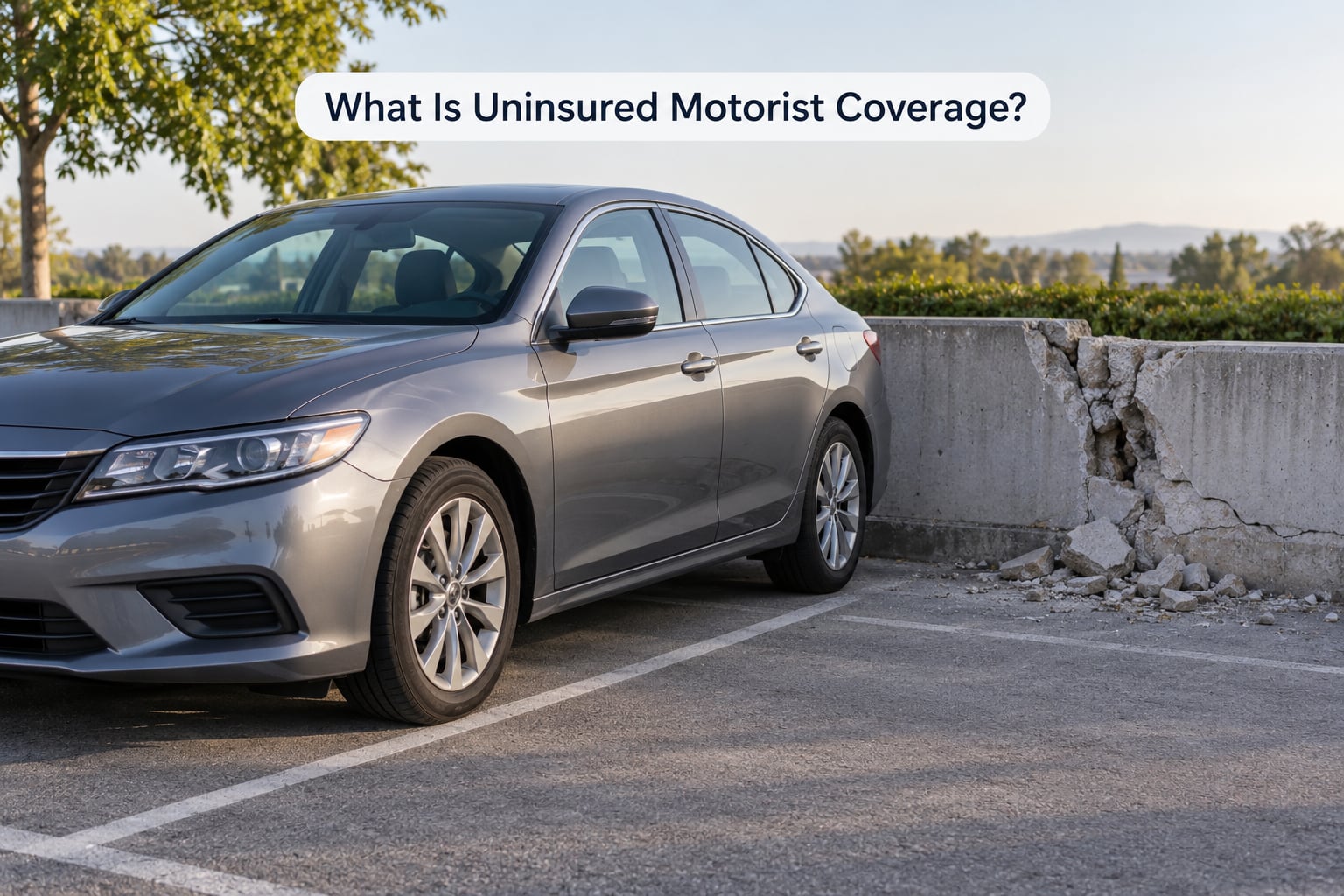
The Insurance Information Institute has put the share of US drivers carrying no auto insurance at roughly 13% nationwide, and higher than that in several states. That is the gap this coverage exists to close. When a driver with no insurance rear-ends you at an intersection, there is no policy behind them to pay your ER bill.
Without UM, three things happen instead. You chase the driver yourself, you wait, or you absorb the loss on your own health insurance and argue about deductibles and lost wages afterward.
Here is what each part of a typical policy does, so the coverage is not confused with its neighbors:
- Liability coverage pays the other driver, and pays you only when you caused the crash.
- Collision coverage repairs your car when you crash into something. It pays for metal, not for injuries.
- Comprehensive coverage pays for hail, theft, glass, animal strikes, and falling objects.
- Personal injury protection (PIP) and medical payments (Med Pay) cover your own injuries and are capped at low limits. PIP is mandatory in a handful of states, including New Jersey, New York, and Pennsylvania.
- Uninsured motorist (UM) and underinsured motorist (UIM) cover the gap left when the other driver has nothing, or too little.
The four coverage types you will see on a declarations page
Insurers split this protection four ways, and the acronyms are worth learning because they are what an adjuster will use on the phone:
- UMBI, Uninsured Motorist Bodily Injury, pays for your injuries when the at-fault driver has no liability coverage at all.
- UMPD, Uninsured Motorist Property Damage, pays for damage to your vehicle and property. It is offered in only about half of US states.
- UIMBI, Underinsured Motorist Bodily Injury, pays when the at-fault driver carries insurance that is inadequate for the harm done.
- UIMPD, Underinsured Motorist Property Damage, fills the same property gap when the other driver’s property damage limits run out.
UMBI and UIMBI are the parts that matter most, because serious injury is where the money goes. UMPD and UIMPD fill a smaller hole, and in many states you simply cannot buy them.
What uninsured motorist coverage is not
It is not health insurance and it does not sit in front of your other coverage. It is also not a deductible-carrying policy like collision. UM claims typically have no deductible on the bodily injury side, which is one reason drivers keep it even with solid health coverage.
It also does not pay for damage to your own car in a single-car crash, and it usually does not pay your own liability when the crash was your fault.
Uninsured Motorist vs. Underinsured Motorist Coverage
The difference comes down to a single question: did the other driver have any insurance at all? That answer decides which half of the coverage pays, and it also decides how long the claim takes to establish.
| What to compare | Uninsured Motorist (UM) | Underinsured Motorist (UIM) |
|---|---|---|
| Trigger | The at-fault driver has no auto liability coverage | The at-fault driver has coverage, but the limits are too low for the damages |
| Hardest part to prove | Proving there is no policy | Proving the available limits are exhausted |
| Common scenarios | Hit-and-run, an uninsured driver at a crosswalk, a car in a pileup with no insurance | A driver carrying state-minimum limits who injures you badly |
| Availability | Required in roughly half of US states, including Connecticut, Illinois, and Maryland | Required in a smaller group of states, and often priced separately |
| Body-injury limit structure | Per person and per accident, same format as bodily injury liability | Per person and per accident, same format as bodily injury liability |
One trap catches people out. Some states define an underinsured driver as one whose limits are equal to or less than your own UM limit, not merely lower. If the other driver carries exactly what you carry, your UIM may pay nothing at all. Ask your agent how your state defines it, because the definition changes the answer.
The practical difference also shows up in timing. An uninsured case often turns on a records search, while an underinsured case turns on billing records and a settlement letter showing the limits are used up. That second one takes longer but is usually easier to prove once the paperwork arrives.
What Does Uninsured Motorist Coverage Pay For?
UMBI pays your medical expenses first, along with funeral expenses in a fatality. It covers lost wages when you cannot work, and it compensates pain and suffering, which health insurance will not touch. It applies to you, to your passengers, and to a family member riding in your vehicle.
UMPD is narrower. It pays for your vehicle’s repair up to actual cash value, the depreciated worth of the car rather than a new-car price. It may reimburse your collision deductible and reasonable rental costs, depending on the policy.
It helps to see the claim with real numbers. All figures below are in US dollars. You carry 50,000 per person and 100,000 per accident in UMBI, plus 50,000 in UMPD on a car worth 40,000.
Scenario A: a completely uninsured driver
A driver with no insurance runs a red light and fractures your wrist. Your medical bills and lost wages total 22,000. You carry UMBI at 50,000 per person, so the claim covers the 22,000, minus the health insurance deductible and copays already paid. UMPD pays your car’s damage up to 50,000, and it also reimburses the 1,000 collision deductible. If the driver is never identified, UMBI still responds; UMPD in many states does not cover unidentified hit-and-run property damage, so that gap is worth checking on your declarations page.
Scenario B: an underinsured driver
This time the driver has insurance, but only the state minimum of 30,000 per person for bodily injury. Your injuries from a spine injury and two months out of work total 180,000 in medical bills, wage loss, and pain and suffering. The other insurer pays 30,000. If you carry UIMBI at 100,000 per person, the balance of your damages up to that ceiling comes from your own policy, and 100,000 still would not cover 180,000. That gap is why people who sell the family business, carry passengers for work, or have a high-income household buy far higher limits than the state minimum.
Two limits, one policy, and per-person versus per-accident is worth remembering: a single injured person can never collect more than the per-person figure, and the per-accident figure is the most the policy pays in total no matter how many people are hurt. Several injured passengers can exhaust a 100,000 per-accident limit quickly, which is exactly the situation that turns a single bad crash into an out-of-pocket bill.
How Much Uninsured Motorist Coverage Should You Carry?
The standard advice is to match your UMBI and UIMBI limits to your bodily injury liability limits. If you carry 250,000 per person in liability, carry the same in UMBI. If your liability is at the bare state minimum, raising UMBI alone is a false economy, because the gap between the minimum and a real claim is where your money disappears.
Raising bodily injury liability is usually the better first move, because that is the coverage that protects everyone else in an accident you cause. Set UMBI to match it afterward. Statistically, most serious claims settle well below the policy ceiling, so the practical effect of a higher limit is the ceiling itself and how much of it is left after other insurance pays.
For UMPD, a common sizing rule is to set the limit near the actual cash value of the vehicle. A 40,000 car does not lose 40,000 in a single impact unless the car is a total loss, and paying premium for a limit far above the vehicle’s worth is money spent on a car you no longer own.
Stacking raises the numbers, but states treat it differently. In Pennsylvania and several other states, you can buy 50,000 per person and 100,000 per accident on one car and stack the same coverage on a second car in your household to reach 100,000 per person and 200,000 per accident. Other states limit stacking or forbid it, so verify the rule where you live rather than assuming.
How Does an Uninsured Motorist Claim Work?
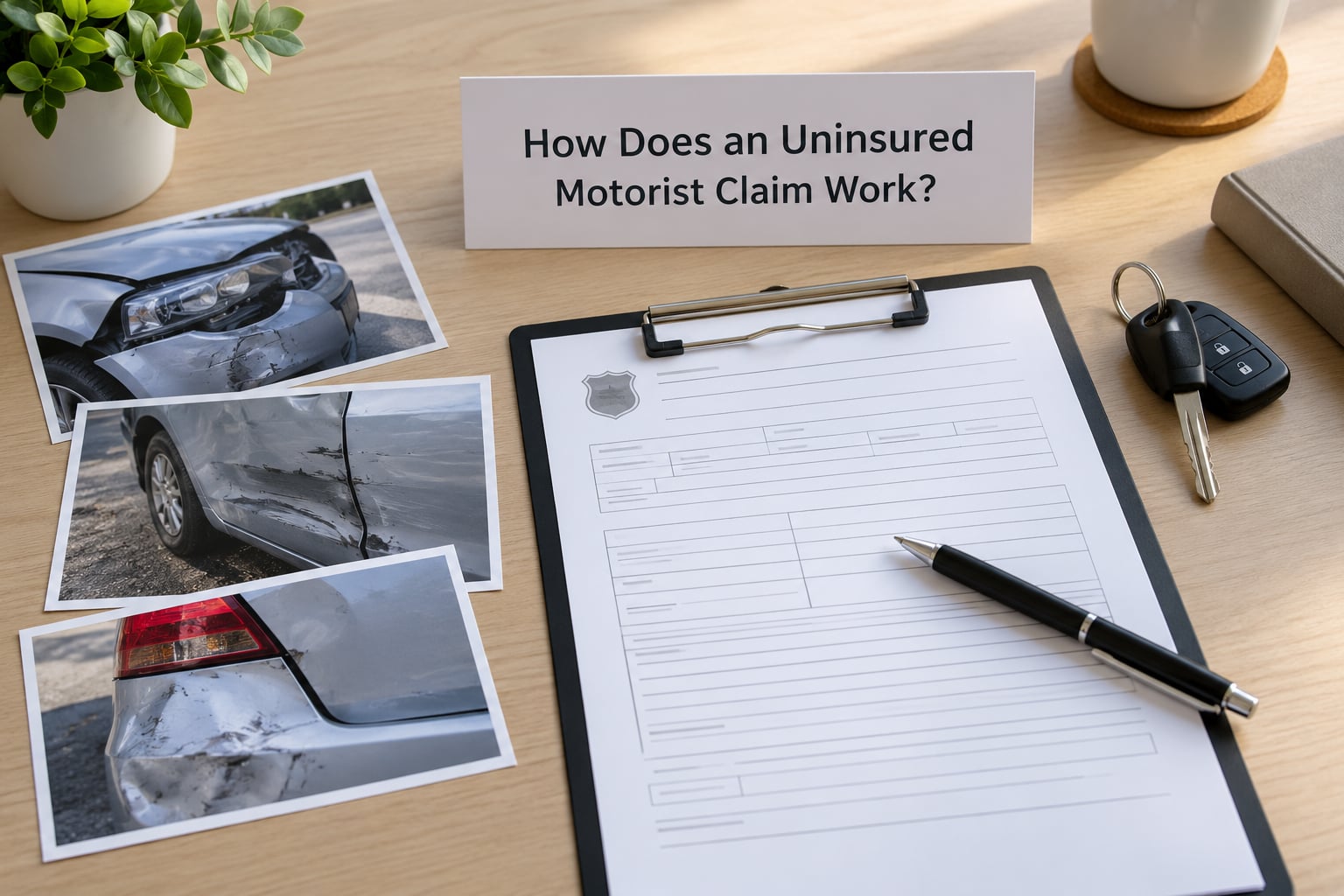
Payment happens in a fixed order, and knowing it saves a lot of argument. The at-fault driver’s liability insurer pays first. Then your own health insurance and, if you have it, PIP or Med Pay. Only what remains comes to your UM or UIM coverage, up to your limits. A common assumption is that UM pays first and PIP later, and PIP is frequently exhausted long before UM or UIM ever becomes relevant.
With that order in mind, here is how the claim actually goes.
- Get medical care and document everything. Keep every bill, and write down the date, time, and location of the crash while it is fresh.
- Report the crash to police and get a report number. A report that names the other driver is the single most useful document in an uninsured claim.
- Notify your own insurer promptly. Most policies require notice within a short window, and late notice is a common reason claims get denied.
- Hand the claim over to a UM adjuster. They open it as a first-party claim under your own policy, which is why it runs on your coverage rather than the other driver’s.
- Prove the other driver is uninsured or underinsured. The insurer runs a records search on the driver, the vehicle, and the registered owner. Underinsured cases additionally require the settlement letter or paid claim showing the limits are exhausted.
- Negotiate or litigate the damages. Adjusters work from medical records, wage verification, and economic impact. If the offer falls short, you can demand a valuation report, and every state gives you a right to appeal a disputed decision or use neutral arbitration, often at no cost.
Claims often take months rather than weeks, particularly when the at-fault driver has to be located. Take a 40,000 medical bill against a 100,000 UM limit and you can see why the arithmetic stays unresolved for a while: the number only settles once the medical record is closed and the wage loss is documented.
What If the At-Fault Driver Has No Insurance?
Your own UM policy is the reliable path, which is the whole reason it exists. The driver with no policy is usually the hardest person in the country to collect from, and in many cases there is nothing to collect.
A driver who is financially judgment-proof, who has filed bankruptcy, or who simply cannot be found may owe you a judgment that is worth very little. If you have UM, that is your insurer’s problem rather than yours. If you do not, you can file a claim against the driver directly, but you should expect a long process with an uncertain outcome. A few practical routes do exist:
- Your health coverage may pay medical bills and then pursue subrogation against the responsible party, which is a common path when UM is absent.
- Certain cities and counties operate victim funds and unclaimed-property or restitution programs for crash victims with no recoverable defendant.
- Ambulance bill charity programs, hospital payment plans, and medical lien negotiation often reduce the balance more than people expect, especially on large unpaid hospital stays.
- If the driver was working at the time, a careful look at their employer can matter, because employers carry their own liability coverage.
One more practical detail: UM and UIM usually have to be carried on each vehicle on the policy rather than on one car for the whole household. Ask for the limits to be confirmed on every vehicle you drive.
Frequently Asked Questions
Does uninsured motorist coverage cover hit-and-run accidents?
Usually yes for injuries. UMBI and UIMBI respond to a hit-and-run where the driver cannot be identified, because a hit-and-run is the clearest case of an at-fault party with no reachable insurance. Property damage is less certain: UMPD is offered in only about half of states, and several of those limit it to identified drivers, so the damage to your car in an unknown-driver crash may be your own problem. Check your declarations page for the UMPD wording.
Does uninsured motorist coverage follow the driver or the vehicle?
It follows the vehicle listed on the policy, not the person. That is why UM and UIM generally have to be carried on each vehicle you insure rather than on one car for the household. It also means coverage does not automatically extend to a vehicle you borrow, a rental you drive for long stretches, or a car you own but left off the policy. The named insured and the listed vehicles are what the contract attaches to.
Can I buy uninsured motorist coverage for a motorcycle or as an umbrella policy?
Motorcycles are written under separate policies, and most insurers offer UM and UIM endorsements for them, though limits and underwriting differ from auto. Personal umbrella liability policies exclude motor vehicles, so an umbrella is not a substitute for UM or UIM on the car itself. If you ride or drive for work, or carry passengers regularly, ask specifically about motorcycle UM limits rather than assuming the auto policy reaches you.
Do I need uninsured motorist coverage if I have collision and comprehensive?
Yes, because collision and comprehensive pay for property and never for your injuries. They cover your car against damage you cause or that weather, theft, and animals cause, and they are silent on medical bills, lost wages, and pain and suffering after someone uninsured hurts you. Those losses are what UMBI and UIMBI exist to pay, which is why dropping UM while keeping collision leaves a hole in exactly the worst scenario.
How much uninsured motorist coverage should I carry?
Match your UMBI and UIMBI limits to your bodily injury liability limits, and raise the liability limits if they are at the state minimum. A driver carrying 250,000 per person in liability should carry the same figure in UMBI. Set UMPD near the actual cash value of your vehicle rather than far above it. Stacking on a second car can raise ceilings in some states, but a few states cap or forbid it.
Conclusion: Check Your Coverage Before an Accident
Do one thing this week: pull out your declarations page and find the uninsured motorist and underinsured motorist limits. Compare them to your bodily injury liability limits, note whether UMPD is present, and save a copy of your proof of insurance somewhere you can reach from your phone. If the numbers are lower than you expected, or the state rule on underinsured drivers is not what you expected, that is a five-minute conversation with a licensed agent or your state Department of Insurance, and a far cheaper one than a medical bill you absorb yourself.