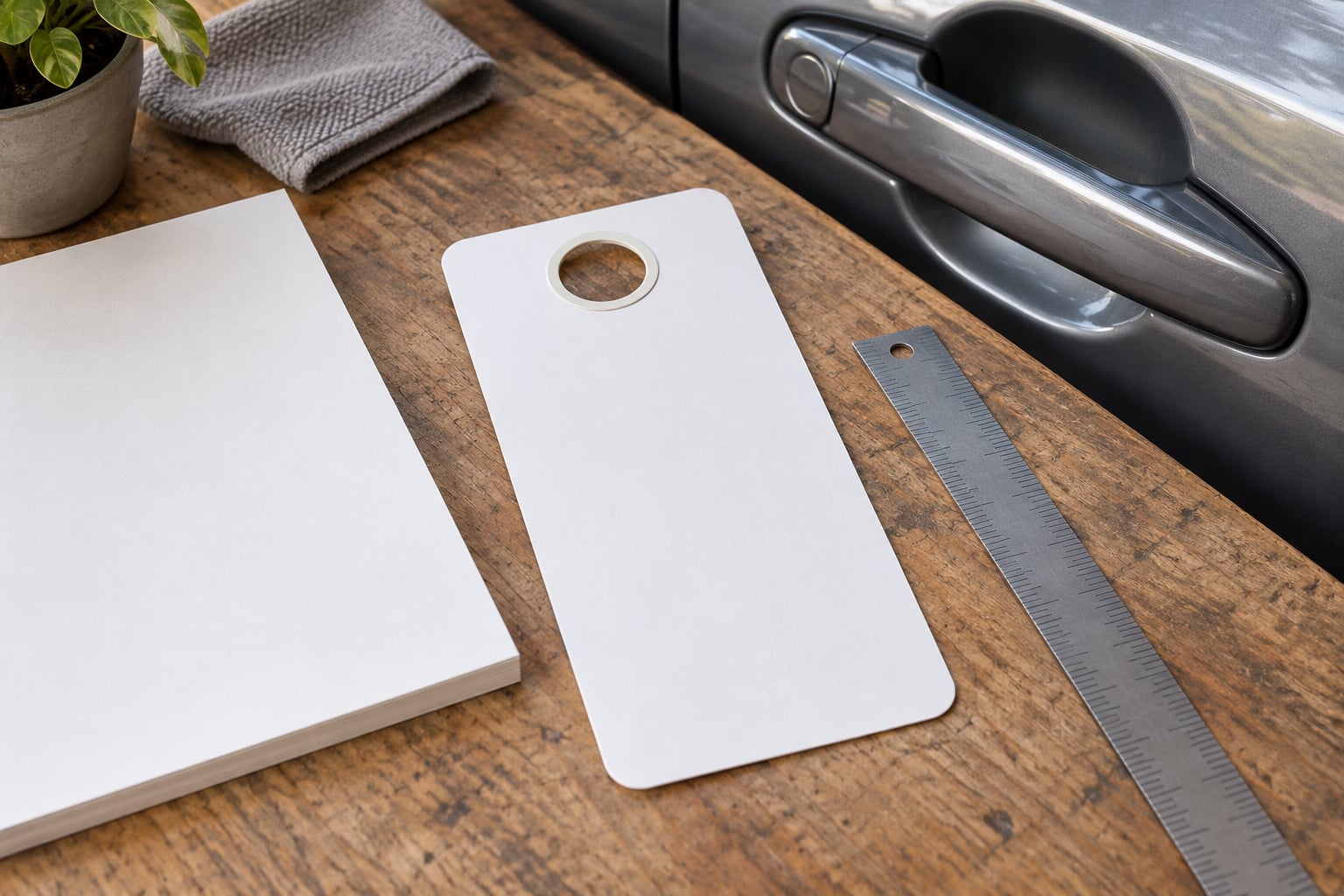
A vehicle hang tag or door hanger is a small printed card that hangs from a rearview mirror, loops over a door knob, or clips to a sun visor to carry a message, a permit, or your branding. To design one that actually gets read, get the trim size right, give it a single message, build a hierarchy that resolves in three seconds, and hand the printer a CMYK file with 300 DPI, 3mm bleed and embedded fonts.
These tags get left on a vehicle rather than handed over, so your name and number stay in front of a driver for as long as the tag stays up. Dealerships and service departments, towing and parking enforcement, lawn and property services, rental fleets, schools issuing pickup authorization, and home-service contractors running a door-to-door route all use them for that reason.
The whole build takes about an hour if you already have a clean logo file. Here is the order I would follow, from message to printed proof.
Table of Contents
- What You Need
- How to Design a Vehicle Hang Tag or Door Hanger, Step by Step
- Define the Message and Intended Use
- Choose the Right Size and Shape for a Vehicle Hang Tag or Door Hanger
- Build a Simple Visual Hierarchy
- Make the Branding Recognizable
- Add Contact Details and a Call to Action
- Prepare Weather-Resistant, Print-Ready Artwork
- Common Mistakes
- Frequently Asked Questions
- What size should a hang tag be?
- What is the standard size of a round door hanger?
- What material is best for a vehicle hang tag?
- How do I create my own hang tag?
- Are hang tags still worth using for local marketing?
- Do I need a license to distribute door hangers?
- Conclusion
What You Need
Gather these before you open a design tool. Almost every frustrating version of this project traces back to one missing item, and it is usually the die line template or a raster logo someone emailed years ago.
- Purpose and one call to action. Decide what should happen because this tag is on the car, then write it as a single sentence.
- Trim size and mounting type. Mirror loop, door knob slit, visor clip or adhesive. The size follows from where it hangs, not the other way around.
- A free dieline from your printer. Most print vendors publish a die-cut template per product. It shows the exact cut size, hole position and safe zone for the stock they actually run, which removes most guesswork.
- Brand assets. A vector logo (AI, EPS, SVG or PDF), two brand colors and one accent color.
- Contact details. Phone number, a short URL or QR destination, and business hours.
- A design tool. Canva for speed, Illustrator or Inkscape for control over cut lines and spot colors.
- A material decision. 16pt cardstock for interior doors, laminated cardstock or synthetic tag stock for anything on a vehicle.
For artwork, vectors win. AI, EPS and SVG scale cleanly, and a print-ready PDF with fonts embedded is the safest thing to hand a vendor. If all you have is a raster file, 300 DPI at final size is the floor, not the goal.
Weather resistance is a separate decision from durability. A tag on a car sees sun through glass, heat in the cabin and constant flutter from airflow, none of which a paper flyer on a doorstep endures. Matte lamination cuts windshield glare and slows fading; synthetic tag stock is the pick when a tag stays outdoors for weeks.
How to Design a Vehicle Hang Tag or Door Hanger, Step by Step
Define the Message and Intended Use
Write one sentence: “This tag is on the car because ______.” Fill in the blank with a real outcome, such as “the customer calls to book a service appointment” or “the driver texts the number to confirm pickup.” If you cannot finish that sentence, the design is not ready yet.
Vehicle tags fall into a handful of jobs, and each one wants different content. A dealership service pickup tag needs a vehicle number and a staff name. A parking permit tag needs the permit holder, the expiry and what to do if it expires. A towing or no-parking notice needs a phone number and a reason. A door-to-door marketing tag needs one offer and one way to respond.
Quality check: if your sentence needs two verbs joined by “and,” you are trying to fit two tags into one. Cut one, and send the other on the back or on a second run.
Choose the Right Size and Shape for a Vehicle Hang Tag or Door Hanger
Size is where most home-printed tags go wrong, because they are designed at screen scale and then read at ten feet in traffic. Start from a standard trim size and adapt from there.
| Format | Trim size | Best for | What comfortably fits |
|---|---|---|---|
| Door knob hanger | 3.5 x 8.5 in | Residential doors, round knobs and lever handles | Headline, one offer, phone number |
| Tall knob hanger | 4.25 x 11 in | Property rules, service notices, pool or resort instructions | A longer message plus a tear-off tab |
| Compact mirror tag | 2 x 3.5 in | Low-profile branding on a rearview mirror | Logo, one short line, phone number |
| Standard retail tag | 2 x 4 in | Parts, inventory and short branding | The most common US retail tag size |
| Round door hanger | About 3.5 to 4 in diameter | Rental rules, welcome notices, do-not-disturb | One centered message |
Round hangers are specified by diameter rather than by width and length, and the common ones land between roughly 3.5 and 4 inches across. Ask your printer for the finished size with the slot included, not the flat sheet size, because that gap catches a surprising number of first-time orders.
A vehicle adds constraints a house door does not. On a rearview mirror, anything much past 3.5 x 8.5 in starts to eat the driver’s sightline or swings into view every time they pull away from a stop. On a door knob, the slit has to fit both round knobs and lever handles, which is why the industry-standard slit is shaped rather than a simple straight cut.
Wind is the other factor. A wide tag on a mirror or handle acts like a sail at highway speed, so lightweight cardstock with a clean edge survives better than a large die-cut shape with deep concaves. Rounded corners also flutter less than sharp points, and a spot-laminated tag is heavier without needing thicker board.
The three formats are not interchangeable. A hang tag is a small tag, usually with a punched hole, meant to loop onto a mirror stem or a lanyard. A door hanger is a taller card with a slit that slides over a handle. An over-door sign is a rigid or folded piece that rests on the top of the door itself, which will not work on a car at all.
Quality check: before ordering, print one at 100% on plain paper, tape it to the real mirror or handle, and sit in the driver’s seat. If it blocks rear visibility, a mirror adjustment, an inspection sticker or a badge, it is too big. That ten-minute test saves an entire production run.
Build a Simple Visual Hierarchy
Three levels, no more. Level one is the business name or the headline instruction. Level two is the single supporting benefit or instruction. Level three is the contact block. Everything else is decoration, and decoration competes with legibility at this size.
Set hard type floors and stick to them: 10pt for primary text, 8pt as an absolute minimum, and no hairline font weights. Below 8pt, a tag read in daylight at arm’s length turns to gray mush, and thin strokes disappear first in print.
Split the two sides deliberately. The front carries who you are and what you want. The back carries supporting detail: a service list, hours, terms, a map or a tear-off tab with the phone number so a driver can take it with them.
Keep white space around the edges. A 3mm margin inside the trim looks intentional and prevents a die cut from clipping a descender. Heavy layouts on a 3.5-inch-wide tag read as cheap even when the printing is excellent.
Quality check: squint at your proof until the words blur. Whatever survives is your hierarchy. If nothing survives, scale the headline up and cut body copy.
Make the Branding Recognizable
Logo size is the fastest fix for an anonymous tag. As a starting point, let the logo occupy around 40 to 50 percent of the front face rather than sitting in a corner beside a paragraph of text. At a distance, people recognize shapes and color blocks long before they read words.
Limit yourself to two brand colors plus one accent, and remember that printing is CMYK. A vivid screen color lands noticeably duller on cardstock, so pick the printed equivalents, not the monitor ones. On a vehicle tag, a matte laminate also reads better through a windshield than gloss, which turns into glare in low sun.
Compare two layouts. The weak version puts a small logo top-left, a heading in a script font, three bullet points in a different typeface and a phone number squeezed underneath. The strong version runs the logo large at the top, one headline in a plain sans serif, a single accent bar as a divider, and the phone number in its own block with room around it. Same information, half the reading time.
Personality does not have to come from another color. Rounded corners, a spot UV on the logo or a small die-cut shape behind the mark all add recognition without crowding the layout.
Add Contact Details and a Call to Action
Pick one primary way to respond and make it unmissable. On vehicle tags that is almost always a phone number, because reading and dialing beats typing a URL into a phone parked at a light.
Test the number before you print: read it aloud from six feet away. If you hesitate on a digit, add spacing between groups. A short URL you can say in one breath beats a long one every time, and a vanity number that spells a word beats a string of digits.
A QR code works as a secondary route, with rules. Print it at least 0.8 inch square, in a dark color on a plain light background, never reversed out of a photo. And never make it the only call to action, because a driver who has to aim a phone at a moving car usually decides not to.
Then name the action: “Call now to book,” “Text this number for pricing,” “Scan for a quote.” Vague invitations waste the space you spent earning attention.
Prepare Weather-Resistant, Print-Ready Artwork
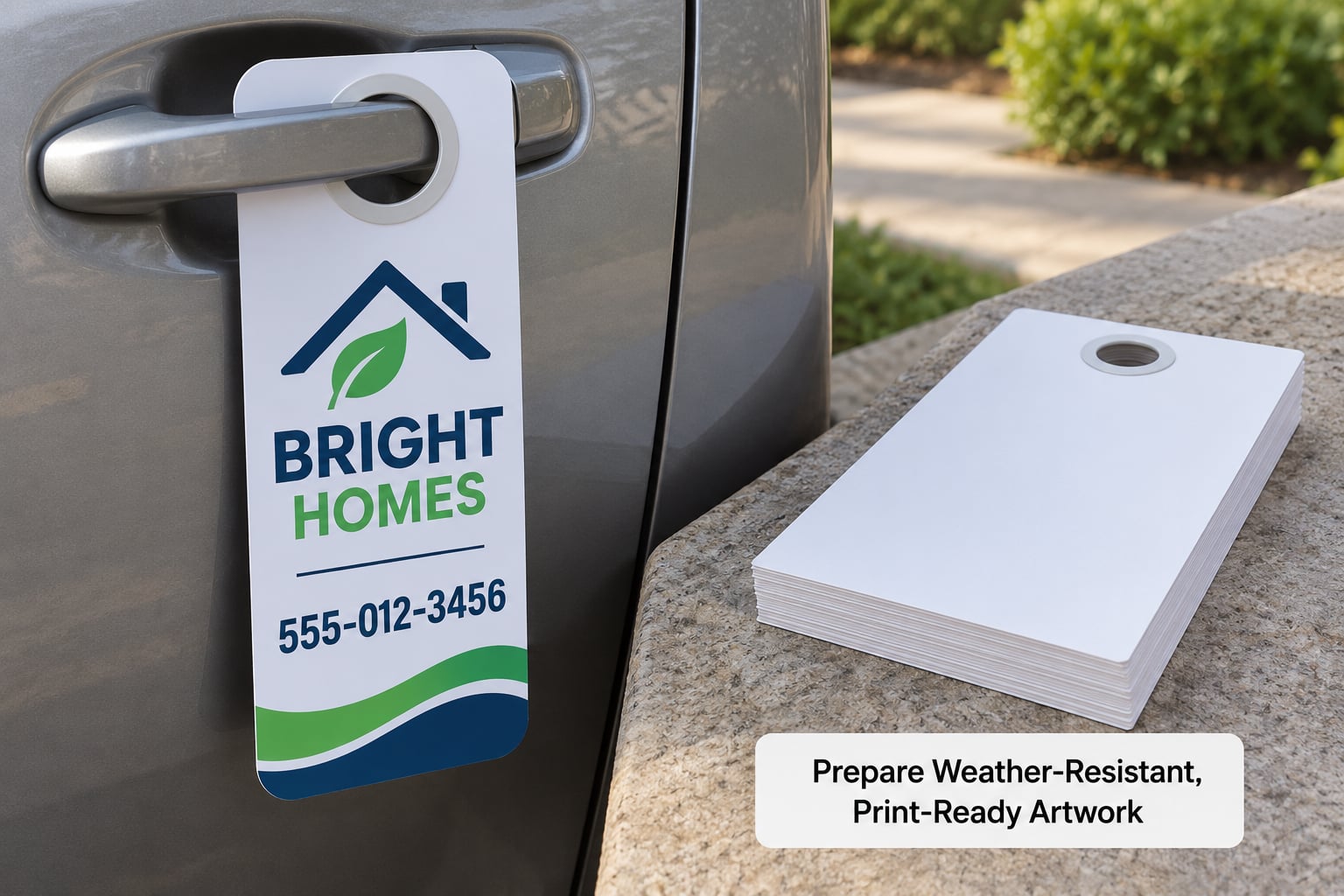
Preflight is the step that separates a clean proof from a reprint, and the spec values are short enough to memorize.
| Setting | Value |
|---|---|
| File format | Print-ready PDF with fonts embedded; AI, EPS or SVG as the source file |
| Color mode | CMYK |
| Resolution | 300 DPI at final print size |
| Canvas | Trim size plus 3mm bleed on every side, which is 6mm per dimension |
| Safe zone | 3mm minimum inside the trim, kept clear of the cut line |
| Hole | 6mm (1/4 in) standard, with a 5mm clear zone around it |
| Cut line | On its own layer in a spot color such as magenta, hairline weight |
| Pages | Two pages, front and back, aligned on the same trim |
Bleed is the artwork that runs past the cut edge so a knife does not leave a white sliver. Safe zone is the margin you keep inside the trim so nothing important sits on the knife line. Clear zone is the empty ring around the hole where nothing but stock may appear, so the punch never clips a letter.
For durability, 16pt cardstock with matte lamination handles most door hangers. On a vehicle, go laminated 18pt to 20pt or step up to synthetic tag stock, which shrugs off water and UV far better than paper. If the tag carries weight, hangs from a string or takes wind on a mirror, reinforce the hole with a fiber patch, an eyelet or a Mylar strip.
Proof properly: order one physical proof, hold it in real daylight at the real distance, then check the back side for upside-down text. A paper proof taped to the actual vehicle, with the front and back checked under a desk lamp, catches more problems than any preview on screen.
Two quick durability tests. Rub a dry cloth firmly across the printed face; if ink lifts, the tag is missing lamination. Leave a sample in direct sun for a day and compare it to the original; if the colors have drifted, move up a grade of stock.
Common Mistakes
Type that is too small. Anything under 8pt turns to gray at reading distance. Fix: set primary text at 10pt or larger and cut the body copy until it fits.
Too many elements. Four bullets, three offers and two phone numbers compete with each other. Fix: keep one message, one offer and one contact route on the front.
Poor contrast. Light text on a light card, or a busy photo behind the message. Fix: dark on light, and finish with matte lamination so sun on the windshield does not erase it.
A low-resolution logo. That 400-pixel-wide PNG from a website header will be visibly soft at 3.5 inches. Fix: get the vector AI, EPS or SVG file, and only then size the logo.
No clear zone around the hole or cut. A punch through the letter “S” is the classic giveaway of an amateur tag. Fix: keep 5mm clear around a 6mm hole, and 3mm inside the trim everywhere else.
Standard cardstock on a car. Paper left on a mirror fades and curls in weeks. Fix: laminated cardstock or synthetic tag stock, and check the color again after a day of sun.
Forgetting the back side. Half-designed backs or a second page printed upside down. Fix: design both pages, confirm the order is double-sided, and check the flip before approving.
Unsafe or unlawful placement. A tag that blocks the driver’s view or covers a license plate is a liability and often illegal. Fix: keep sightlines clear, never cover a plate, and check your local rules on solicitation, litter and the exact wording a tow or no-parking notice must use.
Skipping the proof. Full quantity before anyone has held the piece. Fix: one physical proof, taped to the actual vehicle, approved by eye.
Frequently Asked Questions
What size should a hang tag be?
For a rearview mirror tag, 2 x 3.5 in or 2 x 4 in keeps the tag compact and clear of the driver’s view. A door knob hanger is usually 3.5 x 8.5 in, or 4.25 x 11 in when you need room for rules or a tear-off tab. Pick the size from the mounting point, then confirm the finished size with your printer rather than the flat sheet size.
What is the standard size of a round door hanger?
Round door hangers are specified by diameter and the common ones run about 3.5 to 4 inches across. They suit short, centered messages such as welcome notes, rental rules or do-not-disturb cards. Confirm whether the quoted measurement includes the slot, since that changes the finished size of the piece.
What material is best for a vehicle hang tag?
Laminated 18pt to 20pt cardstock handles most vehicle use, because the laminate slows UV fading and survives flutter at speed. Synthetic tag stock is tougher for anything left outdoors for weeks. Add an eyelet or fiber patch when the tag hangs weight or takes wind on a mirror.
How do I create my own hang tag?
Download the free die-cut template from your print vendor, open it in Canva, Illustrator or Inkscape, and build your artwork inside the dieline. Set the document to the trim size plus 3mm bleed, work in CMYK, keep text at 10pt or larger, then export a two-page PDF with fonts embedded and order a physical proof first.
Are hang tags still worth using for local marketing?
They work when the message fits on one small surface: a single offer, one phone number and one reason to call. They fail when they carry a full brochure. For door-to-door routes, a simple tag with a tear-off tab is cheap to leave behind and stays on the handle long after the person goes inside.
Do I need a license to distribute door hangers?
There is usually no specific license, but local ordinances often regulate unwanted solicitation, litter and signage, and private properties may ban it outright. Towing and no-parking notices usually have wording requirements set locally. Check the ordinances in every area on your route before you print a run.
Conclusion
Start with the message. One sentence, one call to action, one contact route. Then measure the mirror or the door knob, choose the matching trim size, and print one full-scale paper proof before you commit to a run. Most hang tag failures are layout and preflight problems, and both are cheap to fix with a pen.