A retractable banner stand is the better choice for solo exhibitors, small businesses and anyone who shows up at a handful of events a year: one person carries it, one person sets it up in under a minute, and it lives in a closet between shows. A pop-up display wins when you have a real booth, several staff and a bigger message to land. Updated for 2026.
I’ve watched small exhibitors agonise over this choice, and most of the debate comes down to a naming problem rather than a real one. Sellers use “pop-up banner”, “pop-up display”, “hop-up” and “pull-up” as if they are interchangeable, so buyers end up comparing two products they can’t identify. Clear the terminology first and the decision takes about two minutes.
Table of Contents
- Retractable Banner Stand vs Pop Up Display at a Glance
- What Is a Retractable Banner Stand?
- What are the different types of retractable banners?
- What Is a Pop Up Display?
- Portability and Setup Compared
- Transport, storage and the hidden costs
- Graphic Space and Visibility Compared
- Cost, Durability, and Reusability Compared
- Which Should You Choose?
- Frequently Asked Questions
- Is a retractable banner the same thing as a pop-up banner?
- Which is easier to transport, a retractable stand or a pop-up display?
- Which one looks more professional at a trade show?
- How long does it take to set up each one?
- Should I buy a display if I only do a few shows a year?
- The Bottom Line
Retractable Banner Stand vs Pop Up Display at a Glance
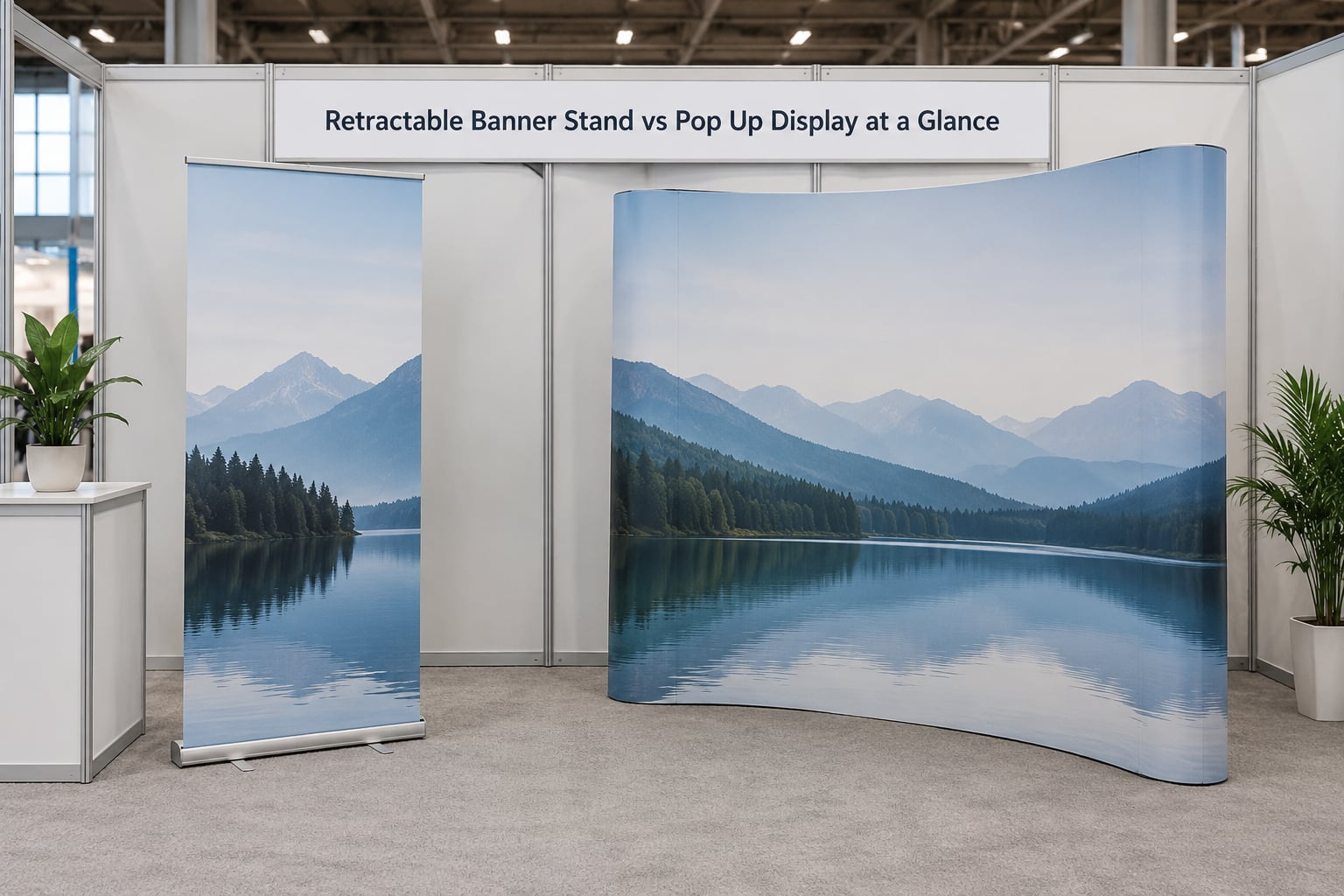
| Criterion | Retractable banner stand | Pop-up display |
|---|---|---|
| Also called | Pull-up, roll-up, roller banner | Hop-up display, pop-up wall, pop-up banner |
| Graphic area | 24×63 in, 33×80 in, 47×80 in, 60×90 in (610×1600 mm to 1520×2300 mm) | 4×4 ft, 6×6 ft, 8×8 ft and larger modular walls |
| Footprint on the floor | A narrow vertical strip, roughly 2 ft deep | A wide wall, commonly 8×8 ft or 10×10 ft of usable face |
| Setup time | Under 60 seconds | Roughly 10 to 30 minutes |
| People needed | One | Two, as standard |
| Transport | Slim tube case, shoulder strap, checked as normal luggage | Wheeled transit case, often awkward for one person to handle |
| Typical packed weight | About 10 to 20 lb | Far heavier in total; plan for two people or a vehicle |
| Relative cost | Entry to mid tier, with cheaper graphic swaps | Several times the cost, usually priced per panel or per square foot |
| Expected service life | About 5 to 7 years for the frame; cheaper units 2 to 3 | Frames last many years, panels get replaced as branding changes |
| Storage between shows | One tube in a closet or the boot of a car | A folded frame and several panels that need real shelf space |
| Best for | Pop-ups, one show a year, mobile services, retail corners, hotel lobbies | 10×10 booths, multi-show schedules, big messages, branded backwalls |
One row deserves emphasis. Setup time and headcount are the practical difference that decides most outcomes, and they compound: ten minutes saved at 7am on show day, for three people, is not a small thing.
What Is a Retractable Banner Stand?
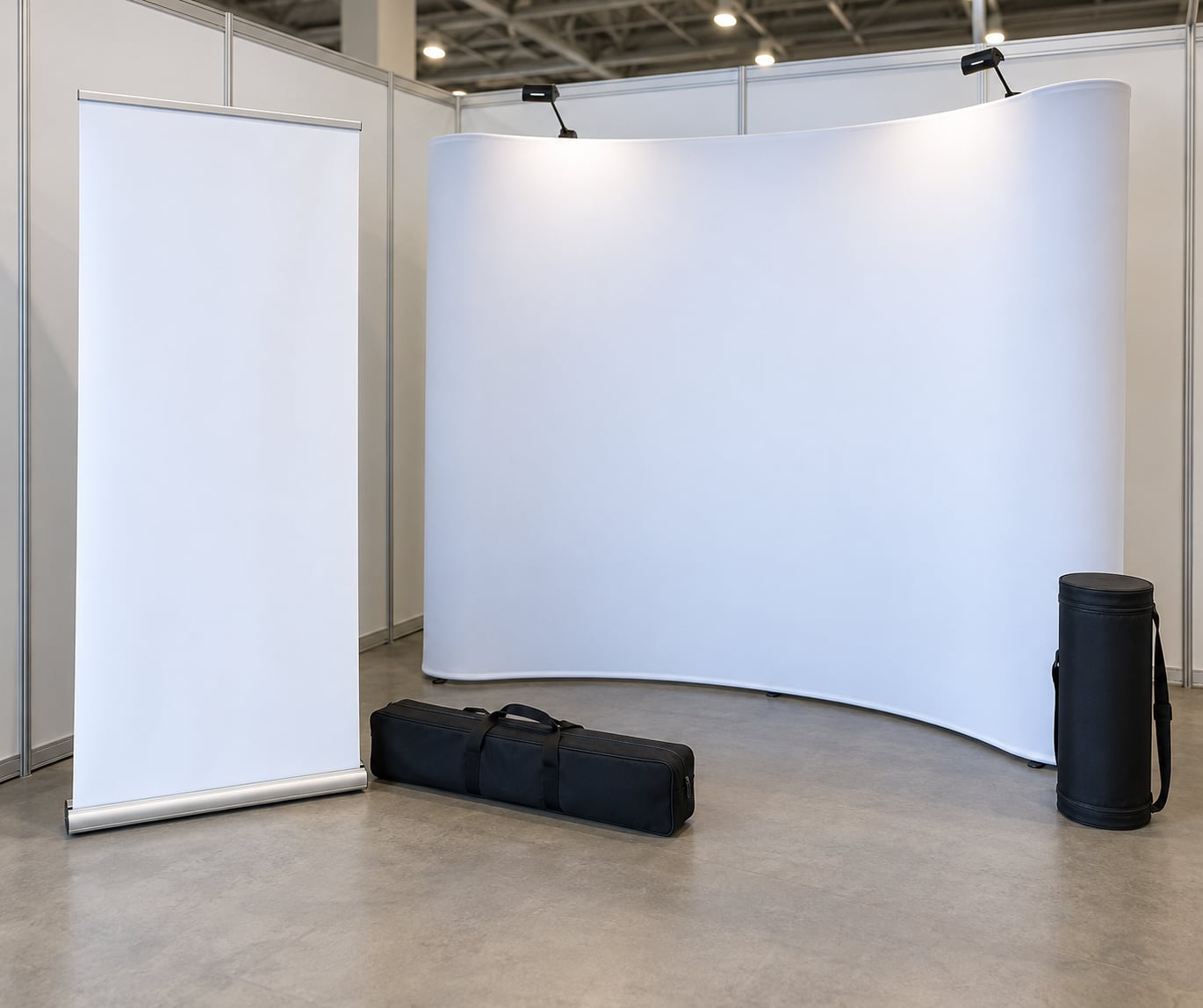
A retractable banner stand is a single printed graphic held at the top of a telescoping pole that sits inside a metal or plastic cassette base, and the whole thing rolls down into that base when you’re finished. You pull the pole up, the graphic unrolls, you lock it at height and the stand is standing. That’s the entire mechanism.
Because the graphic lives inside the base, the packed unit is a tube roughly the height of the banner itself, usually 63 to 90 inches, with a diameter small enough to carry in one hand. A shoulder strap is standard. It goes in a car boot, under a desk or in the corner of a stockroom without anyone rearranging the room.
Standard sizes run 33×80 inches (850×2000 mm) for a compact unit, 47×80 inches for a wide one that reads better across a room, and 60×90 inches for an extra-wide base you can stand on for stability. A 24×63 inch version exists for counters and table-tops.
What are the different types of retractable banners?
There are five families worth knowing, and they differ mostly in base weight, graphic material and whether the graphic prints on both sides.
- Economy and standard — lighter bases, single-sided vinyl, the usual choice for a first purchase.
- Deluxe — heavier bases and sturdier cassettes that hold tension for years of daily use.
- Double-sided — two graphics, so a divider between two booths doesn’t waste half your message. Expect a 20 to 30 percent premium over single-sided.
- Wide and extra-wide base — wider feet for carpeted exhibit hall floors, which is where narrow bases wobble.
- Fabric and tabletop — polyester tension fabric that resists creasing, and small units for counters.
What Is a Pop Up Display?
A pop-up display is a modular frame, straight or curved, built from two to eight connected graphic panels that folds flat for transport and springs open into a wall when you unfold it. Industry buyers usually call it a hop-up display or a pop-up wall, and the frame is a hub-and-spoke or telescoping structure you tension by hand.
Here is where the naming gets messy, and it costs buyers real research time. “Pop-up banner” is used for the physical hop-up wall, for a temporary retail event known as a pop-up shop, and for a rectangular digital ad in a search results page. Those are three different things. When you see “pop-up banner” in a supplier’s listing, check whether the item ships folded in a wheeled case with tensioned fabric panels, which makes it a hop-up display, or whether it is a printed sheet that props against a wall.
The two people required for setup is the part vendors mention least. A curved 8×8 wall is a genuinely awkward object for one person: it does not fold down to a manageable length until the panels are collapsed in the right sequence, and a solo exhibitor who has arranged a lift for two will find out at the loading bay.
What you get in return is a surface big enough to work as a backwall. An 8×8 wall gives roughly 64 square feet of graphic area against the 22 or 27 square feet of a 33×80 or 47×80 retractable, which is the difference between a headline and a full visual story.
Portability and Setup Compared
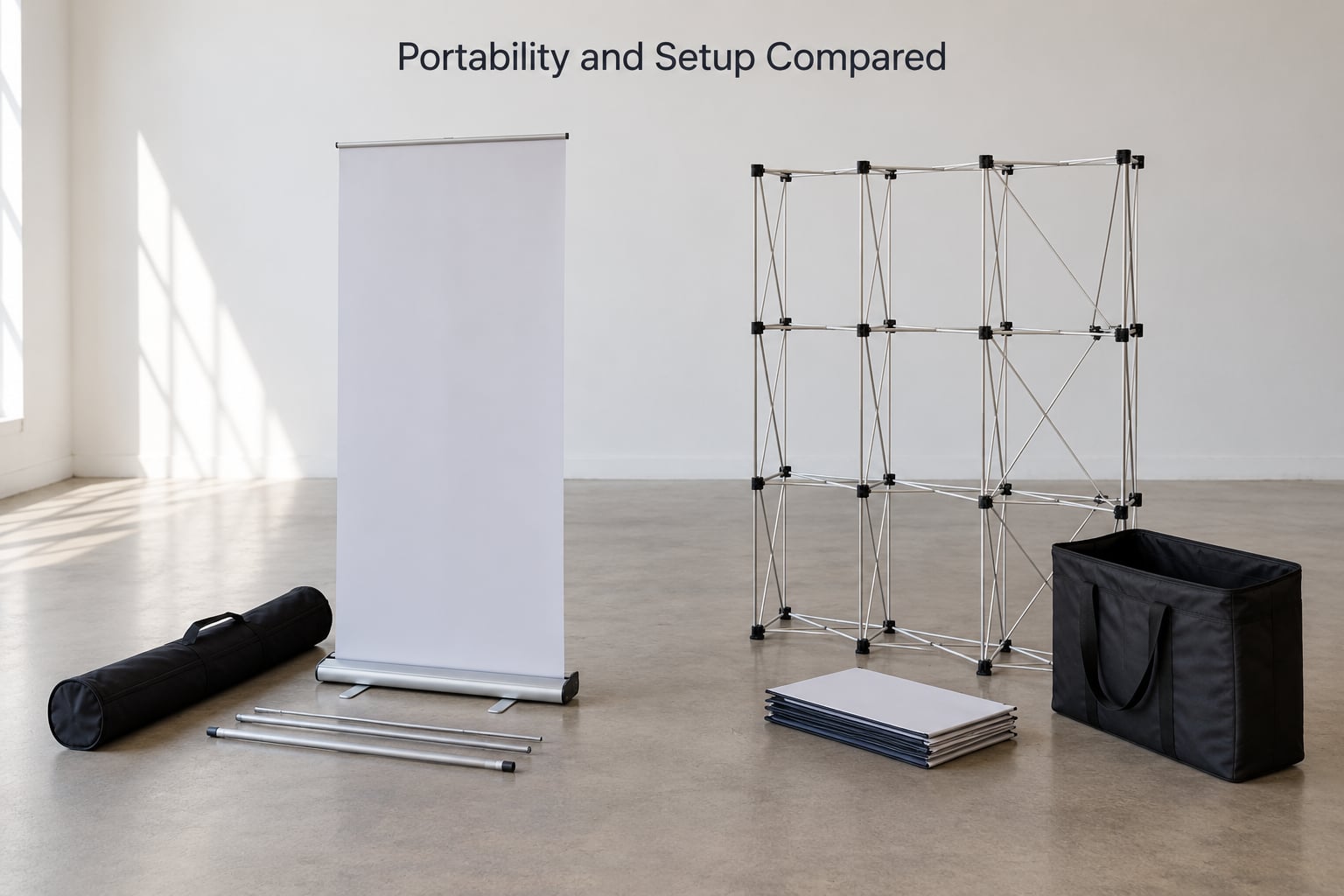
A retractable stand is a one-person job, and a fast one. Unclip the case, set the base on end, pull the pole until it locks, step back to check it’s straight. Regular exhibitors describe the whole sequence as under a minute with no tools, and that number holds up because there is nothing to align.
Pop-up setup is a different activity. Two people unfold the frame in the right order, brace the legs, lock the joints and tension each panel, then walk the length of the wall to square it up. Plan 10 to 30 minutes, and add time for the frames that arrive with a panel slightly out of square, which is common enough that experienced exhibitors check the wall the moment it’s opened rather than after the graphics go up.
Transport, storage and the hidden costs
Weight is the practical difference. A retractable stand with its case sits in the 10 to 20 lb range, which is a normal checked bag and a one-person shoulder carry. A pop-up display travels in a wheeled transit case that often exceeds airline size limits, so oversized baggage fees and freight between shows become real line items nobody mentions on a product page.
Storage matters more than buyers expect. The collapsed retractable is a tube that leans in a corner. A folded 8×8 frame plus a set of panels takes up a genuine chunk of a small office, garage or closet, and if it lives in a vehicle it eats the space you need for samples and stock.
One more thing worth planning for: shipping damage. Pop-up frames arrive bent and panels arrive creased often enough that experienced buyers photograph the shipment on arrival. Polyester tension fabric can usually be steamed flat; printed vinyl creases tend to stay.
Graphic Space and Visibility Compared
A retractable stand wins the narrow-aisle test. Its vertical format stays visible between people and booths, and a 47×80 in graphic is readable at roughly 10 to 15 feet, which matches the distance of someone walking a trade show aisle. Practitioners consistently describe spotting a booth “from across the room” as the reason they keep a stand in the car.
A pop-up display wins everything that happens within 10 feet. The larger surface carries a headline, a product image, proof points and a call to action at once, and a curved wall has no hard edge so the eye travels across it. That matters when you have a table in front of you and someone stops to talk, and it is why pop-ups are the default at 10×10 and 20×20 booths.
Layout rules differ too. Keep a retractable graphic to one idea with generous margins, since the safe zone is small. A pop-up wall is designed to be read in layers: the big visual from the aisle, the detail from two metres away.
Cost, Durability, and Reusability Compared
Retractable hardware is usually sold per unit with a separate graphic charge, so the frame is a one-time buy and the artwork is a small refresh every time your logo, offer or campaign changes. Pop-up displays are more often priced per panel or per square foot of fabric, which means the first order is larger and every rebrand touches more items. Industry buyers quote pop-up fabric by the square foot and overlam adds to the per-foot figure, while retractable hardware is quoted as a single price, stand plus graphic.
Rather than chase sticker numbers, run the arithmetic that actually matters: cost per event. Divide what you paid by the number of events you realistically attend, then add graphic refreshes. If you show up once a year, a rented display can be cheaper in total over three or four years. If you show up monthly, buying wins quickly and the frame is effectively a tool you amortise. Practitioners on marketing forums say this out loud more than sellers do, and it is the most useful test in the whole comparison.
On longevity, both formats reward basic care. Roll a retractable graphic fully into the base rather than folding it, keep the cassette dry, and check tension periodically. Wipe hop-up panels with a damp cloth and never fold a tensioned panel along its crease. Budget retractable frames are the ones that give out first, usually when the spring mechanism loses tension after constant daily use; the frame is what fails, not the print.
Buy versus rent also has a middle path. Rent the wall for the one big show a year, and own a retractable stand for everything else. Many small teams that do exactly this keep the stand in the car permanently.
Which Should You Choose?
Choose a retractable banner stand if you are exhibiting solo, attending one to four events a year, working a small table rather than a booth, or need something that fits in a closet and can be set up before the doors open.
Choose a pop-up display if you have a 10×10 or larger booth, more than one person on the team, a schedule of several shows a year, or a message that genuinely needs a full backwall with product photography on it.
Use both together when you can afford it. A pop-up wall as the backwall with a retractable stand placed a few feet in front, angled toward the aisle, gives you a large visual anchor and an approachable conversation piece at the same time. Printkeg makes a similar layered argument for indoor banner setups, and it holds up in practice.
Skip both in two cases. If your event is outdoors, neither format is stable in wind without a heavy base or ground stakes, and a fabric or mesh wind-weight banner is safer. And if your message is a step-and-repeat, a plain backdrop behind a photo area is the right tool, not a printed sales graphic.
Frequently Asked Questions
Is a retractable banner the same thing as a pop-up banner?
No. A retractable banner, also called a pull-up or roll-up banner, is a single graphic on a telescoping pole that rolls into a slim cassette base. A pop-up banner usually means a hop-up display: a modular frame with several tensioned panels that folds flat and springs open into a wall. Suppliers use both terms loosely, so check whether the item ships folded in a wheeled case before you compare prices.
Which is easier to transport, a retractable stand or a pop-up display?
The retractable stand, by a wide margin. Packed, it is a tube with a shoulder strap, usually in the 10 to 20 lb range, and one person can carry it through an airport, a car park or a hotel lobby. A pop-up display travels in a wheeled case that often exceeds airline size limits, needs two people to load, and can trigger oversized baggage fees. That difference decides most small-exhibitor choices.
Which one looks more professional at a trade show?
A pop-up display looks more substantial because of scale: roughly 64 square feet of graphic on an 8×8 wall against the 22 or 27 square feet of a 33×80 or 47×80 retractable. A large booth with a backwall and product imagery needs that room. In a small or open space, a crisp retractable graphic looks more professional than a half-empty table, because there is nothing visual to judge.
How long does it take to set up each one?
A retractable stand goes up in under a minute with no tools: set the base, pull the pole, lock it, step back. A pop-up display takes roughly 10 to 30 minutes for two people, since the frame has to be unfolded in the right order, the legs braced, the joints locked and each panel tensioned before the wall is squared up. Add more time if panels arrive out of alignment.
Should I buy a display if I only do a few shows a year?
For one or two events a year, renting usually costs less in total than buying once you account for the artwork and shipping. Buy your own once you pass roughly four or five events a year, because the per-event cost drops sharply after that and the frame becomes a tool you keep. A common compromise is to rent the wall for one big annual show and own a retractable stand for everything else.
The Bottom Line
Start with the number of events on your calendar and how many people are coming with you. One person, a handful of shows and a small footprint means a retractable banner stand, and the pop-up display only earns its place once you have a booth and a schedule. If you can only afford one display this year, buy the retractable and rent the wall for the one event that really needs it.