If you run a single-location practice, these are the local marketing ideas for a dental office that tend to produce booked patients instead of just impressions. The list covers the two halves of the job: being findable and well-reviewed on Google, and showing up in person around town.
Every idea below carries a cost level, an effort level and a realistic time to first result, because most marketing advice for dentists skips the part a practice owner actually has to answer: what does this cost in staff hours, and when will I see anything in the schedule?
These are vendor-neutral tactics. Plenty of practices already spend real money on marketing and still cannot say which channel produced last month’s new patients. Start with what matches your budget and your patience, measure it, then add a second thing.
Table of Contents
- Local Marketing Ideas for a Dental Office at a Glance
- 1. Improve Exterior Signage and Wayfinding
- 2. Optimize the Dental Office Website for Local Search
- 3. Strengthen the Google Business Profile
- 4. Build a Consistent Review Process
- 5. Create a Patient Referral Program
- 6. Host Useful Community Education Sessions
- 7. Send Direct Mail to Residents Nearby
- 8. Partner with Nearby Businesses
- 9. Publish Useful Patient Education Content
- 10. Use Branded Vehicles for Local Visibility
- 11. Run a Local Seasonal Promotion
- 12. Sponsor a Specific Community Event
- Frequently Asked Questions
- What is the best local marketing idea for a new dental office?
- How much should a dental office spend on local marketing?
- Which local marketing tactics produce appointments fastest?
- How can a dental office measure whether local marketing works?
- Are Google ads necessary if the practice already focuses on local SEO?
- Conclusion
Local Marketing Ideas for a Dental Office at a Glance
The table below ranks all 12 tactics by cost, effort and speed. Use it to pick a starting pair rather than trying to run everything at once.
| Idea | Cost | Effort | First result | Best for |
|---|---|---|---|---|
| Exterior signage and wayfinding | Low to moderate | Low, mostly one-time | Immediate | Practices near a busy road or in a multi-tenant building |
| Website tuned for local search | Low to moderate | Moderate | 2 to 4 months | Every practice, especially ones with an old or thin site |
| Google Business Profile | Free | Low, then ongoing | 3 to 8 weeks | Any practice ranking below competitors in Maps |
| Consistent review process | Free to low | Low | 4 to 8 weeks | New practices with few reviews, and practices under 20 |
| Patient referral program | Low | Low | 2 to 6 months | Family practices with strong retention |
| Community education sessions | Low | Moderate | 3 to 6 months | Practices near schools, libraries or community centers |
| Direct mail to nearby residents | Moderate | Low | 4 to 10 weeks | Practices within a few miles of specific neighborhoods |
| Partnerships with nearby businesses | Free to low | Moderate | 2 to 6 months | Employers, pharmacies, fitness studios |
| Patient education content | Low | Moderate, ongoing | 4 to 9 months | Practices competing on trust rather than price |
| Branded vehicles | Moderate | Low | 2 to 6 months | Practices with staff running supply or referral runs |
| Seasonal local promotion | Low to moderate | Moderate | Within the campaign window | Practices with gaps in the hygiene schedule |
| Community event sponsorship | Low to moderate | Moderate | 3 to 9 months | Practices in towns where visibility matters more than clicks |
1. Improve Exterior Signage and Wayfinding
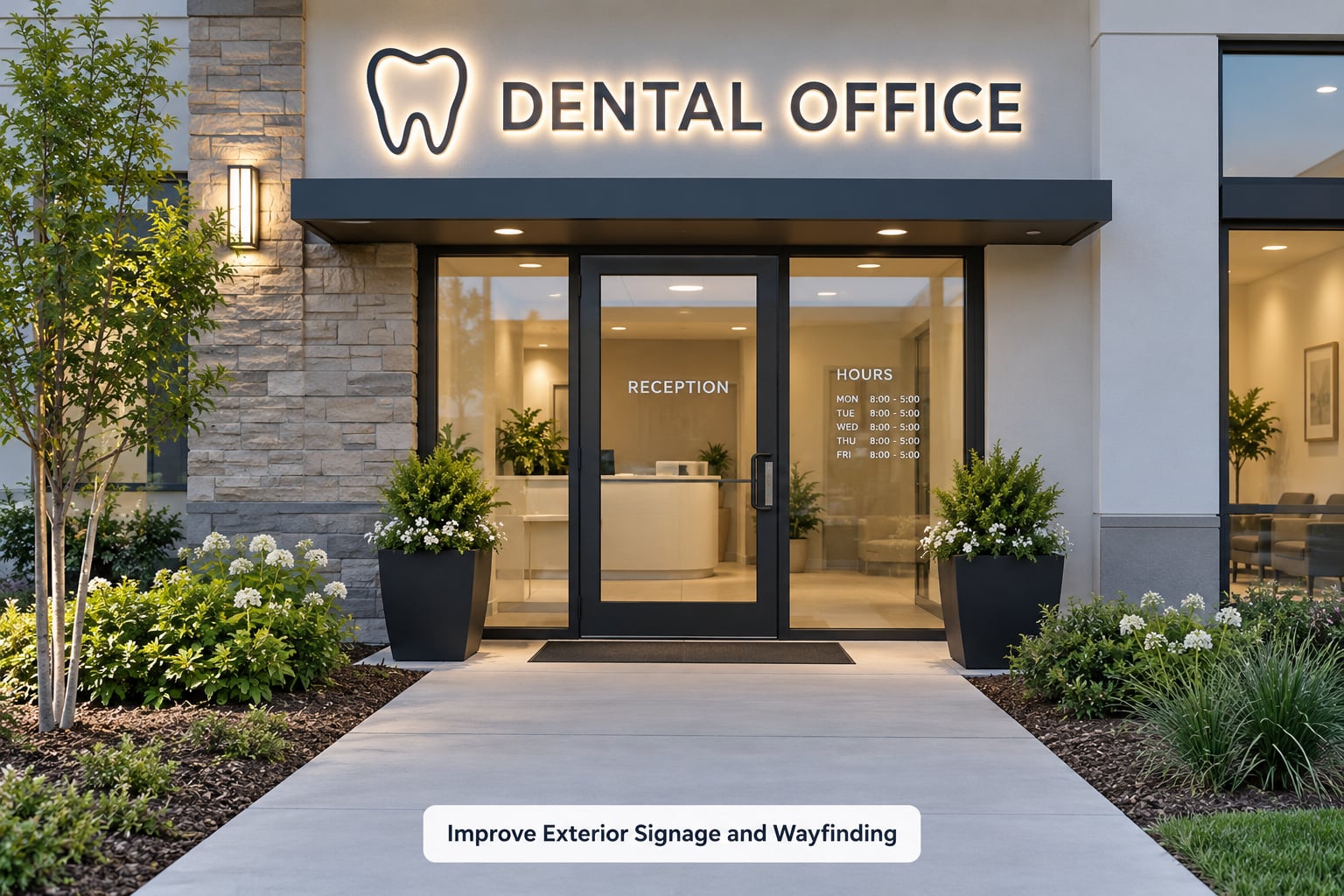
People drive past your office dozens of times a month and often have no idea whether you are there. A sign that is faded, mismatched or blocked by a tree is the cheapest marketing problem in the industry to fix.
Start by walking the approach from the direction most of your patients arrive from, at the time of day they arrive. Can someone identify the practice from 30 feet away? Can they tell which door to use? Is the phone number legible without stopping?
One small practice replaced a faded panel with clean, evenly lit lettering in a single typeface, mounted it at eye level, and moved the posted hours to eye level beside the reception door. The sign contractor’s job took two days. That office had been quietly losing people who circled the block twice and gave up.
Measure it by asking new patients, at check-in, how they found the entrance. Three questions at the front desk give you a real answer within a month and cost nothing.
2. Optimize the Dental Office Website for Local Search
A dental website earns its keep when it turns a nearby searcher into a booked appointment, not when it wins an award. Local SEO for dentists is about making one obvious answer available: which office, which services, how to reach it, and why choose this practice.
Five things move the needle:
- Give each practice location its own page with the full address, phone number and a short description naming the surrounding neighborhoods, not just the city.
- List every service the office actually offers on that page, including the routine ones people search for by name rather than by brand.
- Name the dentists and hygienists on each page with a photo and a line of credentials.
- Make the phone number, text option and booking link reachable with one tap on a phone, no scrolling and no app download.
- Use a plain-language phrase such as “family dentist in Riverbend” where it fits, rather than working a keyword into every heading.
Take a single-location practice whose homepage buries the address and has no page for its own services. Build one page titled around the location and its two or three most requested services, link every other page to it, and add a sticky call button. That is a weekend of work, and it usually takes a few months to show up in search results.
Measure it with calls and booking-form submissions from organic search, segmented by landing page rather than blended into one traffic total.
3. Strengthen the Google Business Profile
Your Google Business Profile is the most-used local listing for dental searches, and most practices set it up once, added six photos years ago, and never touched it again. The practices ranking above you are not doing anything clever. They are keeping the profile current and adding proof that you are real.
Work through this list in order:
- Fill every field, including services, insurance information, appointment links and attributes. Empty fields signal that you stopped paying attention.
- Set hours to match reality, including holiday hours and any reduced summer schedule, and update them the week you decide to change them.
- Post an update every week or two: a team photo, a short patient-education note, a community mention, a new service.
- Add fresh photos regularly, including the exterior sign, the reception area and the team. Old phone photos of a layout you no longer have do nothing.
- Reply to every review within a few days, including the ones that sting. Response rate is part of what prospective patients read.
A practice that posts weekly and answers all reviews inside a week is doing better than one spending real money on ads while its profile still lists old hours and a team member who left two years ago.
Measure it by tracking your position in the Maps pack for a handful of specific searches, such as your top service plus your town, on the same day each month.
4. Build a Consistent Review Process
Reviews are the strongest trust signal for a new patient choosing between three nearby offices, and they arrive or they do not based almost entirely on whether you ask. Most practices ask sometimes, in an uneven way, and get uneven results.
The ethical version is simple: ask everyone, offer no incentive, and never send a negative review somewhere else. Gating, in any form, violates Google’s policies and can cost you the listing that drives most of your local visibility.
Here is a request that works and keeps the ethics clean:
Thanks for coming in today. If we made your visit easy and you feel like leaving a short review, it genuinely helps other families in the neighborhood find us. Here is the link: [short URL]. If something did not go the way you hoped, please tell us directly first so we can fix it.
Send it by text about two hours after the appointment, while the experience is still vivid, and follow up once by email a week later if no review has come in. Then stop. Two contacts is polite, five is harassment and it costs you patients.
Ask your team to note recurring themes in every review, including the critical ones. If three people in a quarter mention long wait times, that is a scheduling problem, not a marketing one.
Measure new reviews per month, your average star rating, and how many reviews mention a specific service.
5. Create a Patient Referral Program
Referrals and word of mouth remain the highest-trust channel a dental practice has, and most offices leave it to chance. A good program does not change what patients say about you. It makes asking, thanking and tracking routine.
Three habits do most of the work. Ask at the moment of satisfaction, usually at check-out after a clean visit, rather than a month later by mail. Make it easy: hand over a card or send a link, and never make a patient fill out a form before passing your name along. Thank people who refer, quickly and without conditions.
A thank-you note that works:
Thanks again for sending your neighbor to us. It means more coming from a patient than from an ad. If they would rather book by phone, they can call [number], or reply to this message.
Track the source with one question at booking: how did you hear about us. When the front desk asks it on every call, you get honest answers. Anything more elaborate gets abandoned.
Measure referred new patients per month as a share of all new patients. If referrals are under 15 percent of intake, the program is not running.
6. Host Useful Community Education Sessions
Free educational sessions build local trust in a way no ad can, because people remember who answered their question for free on a Tuesday evening. They fill the pipeline slowly and cheaply, which suits a practice planning a year out rather than a quarter.
Pick a venue your patients already use: a library meeting room, a community center, a school multipurpose room. Keep it to 30 or 45 minutes on one topic, such as brushing technique for parents of young children, what bleeding gums can mean, or how the frequency of snacking affects enamel.
One family practice runs a free brushing and nutrition session at a nearby library on the first Saturday of each quarter, with a hygienist presenting and a dentist available afterward for individual questions. Nobody is examined and nobody is booked on the spot. It has produced a steady trickle of new-patient calls and takes roughly four hours of staff time per quarter.
Have a dentist review any written material before you hand it out, keep the content general, and remind people that individual advice belongs in an exam chair. Do not diagnose in a community room.
Measure by asking every new patient for a few months whether they heard about you at an event.
7. Send Direct Mail to Residents Nearby
Mail still works for dental offices, but only in a tight geographic area and only when the piece is trackable. A postcard that arrives from an unknown sender in a zip code three counties away teaches people to throw your mail away.
Target households within roughly five miles of the office, in the specific neighborhoods you want. A five-minute drive is the practical limit; beyond that most people will not make the trip for a routine cleaning.
Keep the message to one offer or one useful item: a seasonal new-patient exam and cleaning, a children’s back-to-school check, or a one-page checklist on preparing for a first dental visit. Avoid the toothbrush giveaway and the oversized discount, because both tend to attract people who want the free thing and rarely convert.
Put a unique short URL and a dedicated phone extension on the piece so you can see what came back. A vanity URL per neighborhood works well, and it also tells you which blocks to stop mailing.
One example: a practice mailed 1,500 postcards to a nearby neighborhood, tracked the response for six weeks, then followed up only with households that opened the follow-up email. Two mailings turned into one smart mailing plus a month of email.
Measure cost per booked new patient per neighborhood, and be honest if a neighborhood does not respond after two cycles.
8. Partner with Nearby Businesses
The strongest local partnerships are with businesses whose customers keep the same schedule as yours: an employer with 200 staff nearby, a pharmacy across the street, a fitness studio, a childcare center, a physical therapy practice. Shared audience, no discount, no health promises.
The simplest version is a jointly distributed employee dental-care checklist, printed on both letterheads, with each side’s contact details and a short explanation of what the other does. An employer likes it because it is a benefit for staff at almost no cost. You like it because it reaches 200 households without buying an impression.
Make the arrangement measurable before it starts. Agree one number each: how many checklists go out, and how many new-patient inquiries mention the partner by name in the following 60 days. That is the whole evaluation and it takes one sentence to track.
Keep partnerships free of health claims. A partner cannot promise that your practice improves an outcome, and you cannot promise a result about someone’s teeth. Share educational material and contact details, nothing more.
Measure partner-sourced inquiries and booked patients, then decide which single relationship is worth a second round.
9. Publish Useful Patient Education Content
Patient education content is the slowest tactic on this list and the one that compounds longest. It works because people search real questions late at night with a toothache, and a clear answer brings them to you rather than to a chain three towns over.
Write about what patients actually ask: how to floss properly, whether mouthwash matters, why gums bleed, what to do before a first appointment, what a crown involves. Practitioners on practitioner forums keep saying the same thing, that useful educational posts get shared and promotional posts get scrolled past.
Make one piece visual. A simple guide to your appointment process, showing the steps a new patient goes through from calling to leaving the chair, removes more phone anxiety than most practice websites manage. Short walkthrough videos do the same job faster.
End every piece by directing readers to their own dentist for advice about their specific teeth. General information is fine. Individual diagnosis is not, and describing a specific condition as though you had examined the reader is the line that should not be crossed.
Measure assisted conversions: bookings that mention a specific article or video, and calls that ask a question you already answered on the site.
10. Use Branded Vehicles for Local Visibility
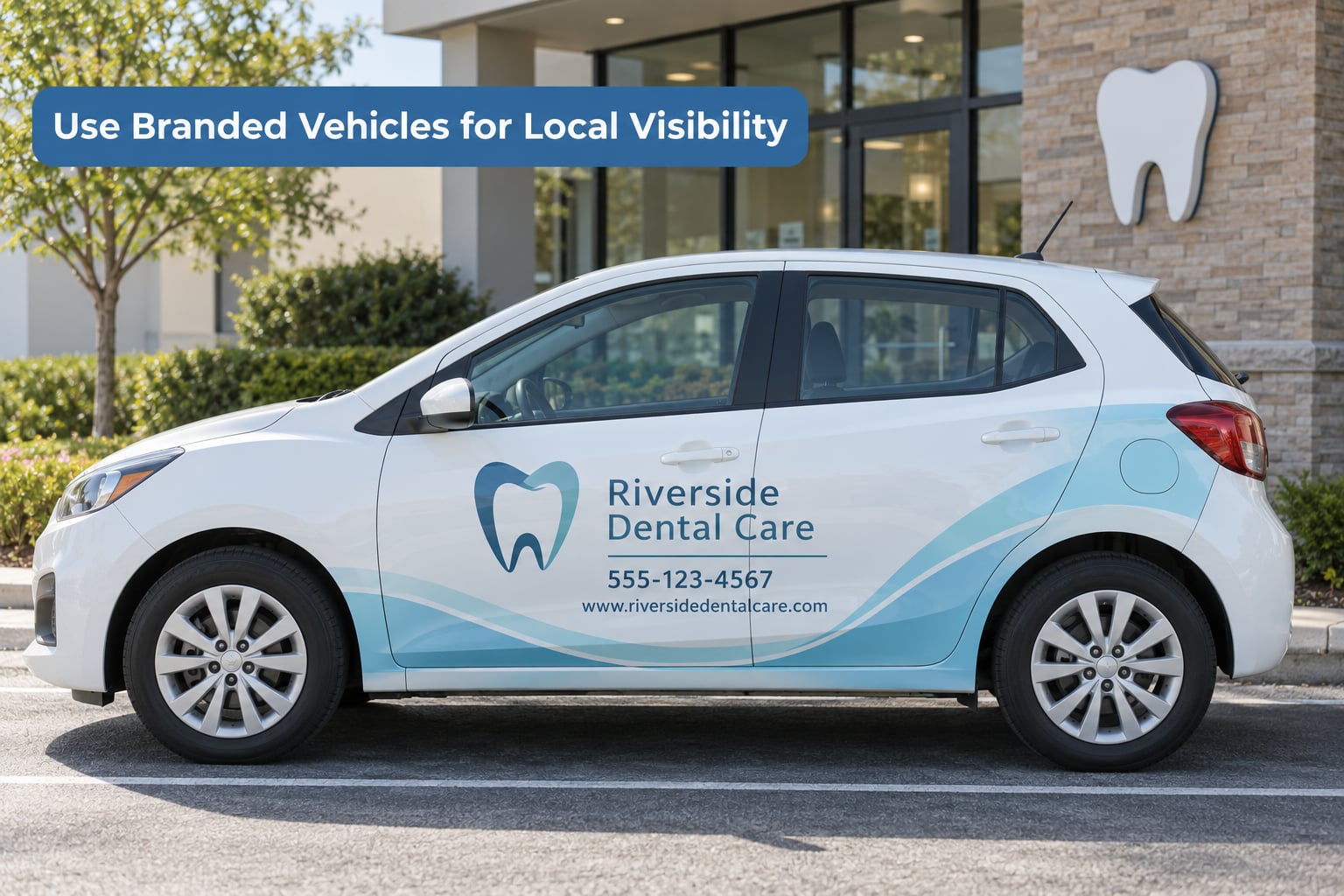
A practice van or car is already driving through the service area every day: supply runs, staff commutes, deliveries. A modest graphic turns that movement into repeated local exposure without adding a single impression to your media budget.
Keep the design simple. One tooth-shaped icon or small tooth outline, the practice name in a plain typeface, a phone number that reads at 30 feet, and a short URL. Skip phone numbers so long the text has to shrink, skip gradients, and skip staged photos of smiling actors, which is the fastest way to look local and disposable at the same time.
The practical failure is unreadability at speed. Have someone stand 50 feet away and confirm the phone number is legible before the vehicle goes to the printer, because a graphic that is elegant at six inches is useless in traffic.
Pair the vehicle with a call to action that names one action, and put the same number on the side panel, the back door and your Google Business Profile so the call path is identical every time.
Measure with a call tracking number unique to the vehicle, and ask new patients how they heard about you during the first-call question.
11. Run a Local Seasonal Promotion
Seasonal campaigns work for dental offices because the underlying demand is seasonal too. People schedule more routine care in January when benefits reset, more pediatric cleanings in late summer, and more cosmetic consultations in spring. A promotion simply puts your office in front of that existing rhythm.
Build the offer around one season and one audience. A limited-time new-patient exam and cleaning for families in a target neighborhood. A children’s exam and cleaning before the school year. A whitening consultation available between two dates. Give the offer an end date and say so, honestly.
Describe eligibility, timing and any financial terms in plain language on every piece. If there are conditions, they belong where the patient sees them, not in fine print. Clarity here is not a formality: patients who feel misled do not return, and in small towns word travels fast.
One office runs a two-week new-patient offer each September, mailed to six nearby neighborhoods, posted on its profile and mentioned in the seasonal email, with a unique code per channel so the front desk can log the source.
Measure the offer’s cost per new patient booked, then compare it with your cost per new patient from referral and organic search. If a campaign costs three times as much as referrals, that can still be fine, as long as you know the number.
12. Sponsor a Specific Community Event
Sponsorship works when it buys a specific, named opportunity rather than vague local advertising. “Supporting the community” buys nothing. A children’s oral-health presentation at a school, or the name on a youth soccer league’s jerseys, buys a recognizable memory in a defined group.
Choose the group that matches your patient base and your geography. A pediatric office sponsoring a soccer league reaches families. A general practice sponsoring a community food drive reaches adults who also make household healthcare decisions.
Make the sponsorship itself educational. Provide the materials, send a hygienist to present a 15-minute brushing session, and set up a table for anyone who wants to ask a question. Bring samples and a clear line about scheduling. Vague logo placement on a banner nobody reads helps no one.
Ask the organization what a useful deliverable looks like: attendance numbers, how many materials went out, a photo of the session. Those figures make the next sponsorship decision easy.
Measure by asking new patients how they heard about you for the following two months, and by counting inquiries that come through the organization’s own channels.
Frequently Asked Questions
What is the best local marketing idea for a new dental office?
Usually the Google Business Profile, followed by a simple, repeated review request and a website page for your location. A new practice has no review history to work with, so those two together are what get you into the Maps pack at all. Improve the signage once reviews are flowing, because a better sign works far better when a passerby can check a rating first.
How much should a dental office spend on local marketing?
Most single-location practices that get a return spend in the low hundreds per month on the fundamentals, then add paid search or direct mail on top when there is room. What matters more than the total is whether you can name the cost per new patient booked for each channel. Practices that cannot name that number cannot tell whether they should spend more, less, or somewhere else entirely.
Which local marketing tactics produce appointments fastest?
Correct hours, service listings and photos on your Google Business Profile, because those can change within days. Signage and wayfinding come close behind, since someone who spots a sign can call the same afternoon. Review volume takes a few weeks. Website changes, community work and seasonal campaigns run on a two-to-six-month clock, so start them early and measure them later.
How can a dental office measure whether local marketing works?
Pick four numbers and review them on the same day each month: calls answered in under fifteen seconds, new patients booked, cost per new patient booked, and booked patients by source. Get the source from one question at booking rather than from guessing. If a channel cannot be traced back to a booked appointment, it is an expense, not a marketing tactic.
Are Google ads necessary if the practice already focuses on local SEO?
Not at the start. If your profile, reviews and location pages are in reasonable shape, paid search mostly buys you position in an auction against practices already doing the basics well. Ads make more sense once your organic listings convert, because then you are paying to send more people to something that already works. Add them later and measure cost per booked patient, not clicks.
Conclusion
Pick one visibility tactic and one trust-building tactic. Fix the Google Business Profile and the signage if you want calls this month. Start the review process plus one community or partnership play if you want a base to grow over the next two quarters.
Write down the appointment and inquiry goal before you start, then review it after 60 to 90 days. Add a second campaign only after you can name what the first one produced. That discipline, more than any single tactic on this list, is what separates a practice whose local marketing works from one that just spends on it.