For flyer vs door hanger for local marketing, the short answer is this: use flyers when you need volume, events, storefront reach or a message with several details, and use door hangers when you have a defined service area and want one piece to sit on a specific door handle for a week. They cost more per delivered impression and they land harder. Neither format wins every campaign, so the useful question is which one your next campaign actually needs.
The mistake that shows up most often with owner-operated businesses is picking a format before picking the route. Someone orders 5,000 flyers, hands out 2,000 at a Saturday market, and wonders why the response was flat. The format was fine. The distribution never got concentrated enough to matter.
This guide breaks down what each format does, what it costs you in effort and money, how to design for each one, and how to test them so you are not guessing next time.
Table of Contents
- Flyer vs Door Hanger for Local Marketing at a Glance
- How Flyers and Door Hangers Reach Local Customers
- Door Hangers for Neighborhood and Route-Based Promotion
- Flyers for Events, Stores, and Wider Distribution
- Design and Message Differences
- Cost, Production, and Distribution Considerations
- Which Is Better for Common Local Marketing Goals
- How to Test Flyers and Door Hangers
- Setting up a clean flyer vs door hanger test
- Which Should You Choose?
- Frequently Asked Questions
- Are flyers or door hangers better for local marketing?
- When should a small business use door hangers instead of flyers?
- What is the most effective way to distribute flyers locally?
- Are door hangers more expensive than flyers?
- Can I use both flyers and door hangers in one campaign?
- How do I know whether the marketing format is working?
Flyer vs Door Hanger for Local Marketing at a Glance
| Criterion | Flyers | Door Hangers |
|---|---|---|
| Best use | Events, storefronts, inserts | Neighborhood routes |
| Distribution reach | Broad, fast, cheap to scale | Narrow, slow, labor-heavy |
| Targeting | Area-level at best | Door-level, address by address |
| Cost per piece | Lower print, higher hand labor | Higher print, higher hang labor |
| Design space | Room for detail and an offer | Tight, one message only |
| Ideal call to action | Offer, QR code, event date | One phone number or code |
| How long it lasts | Hours to days | Several days to a week |
| Measurement | Codes and landing pages | Codes, route-based tracking |
| Main friction | Blends into the sidewalk | Residents see it as junk |
| Legal exposure | Low for hand-to-hand, medium for posted | Medium to high, varies by city |
Two rows in that table matter more than the rest. Flyers win on reach and design flexibility because a sheet of paper carries far more information and moves ten times faster in a pair of hands. Door hangers win on attention and duration because a rigid card hooked over a handle is difficult to ignore and hard to lose.
How Flyers and Door Hangers Reach Local Customers
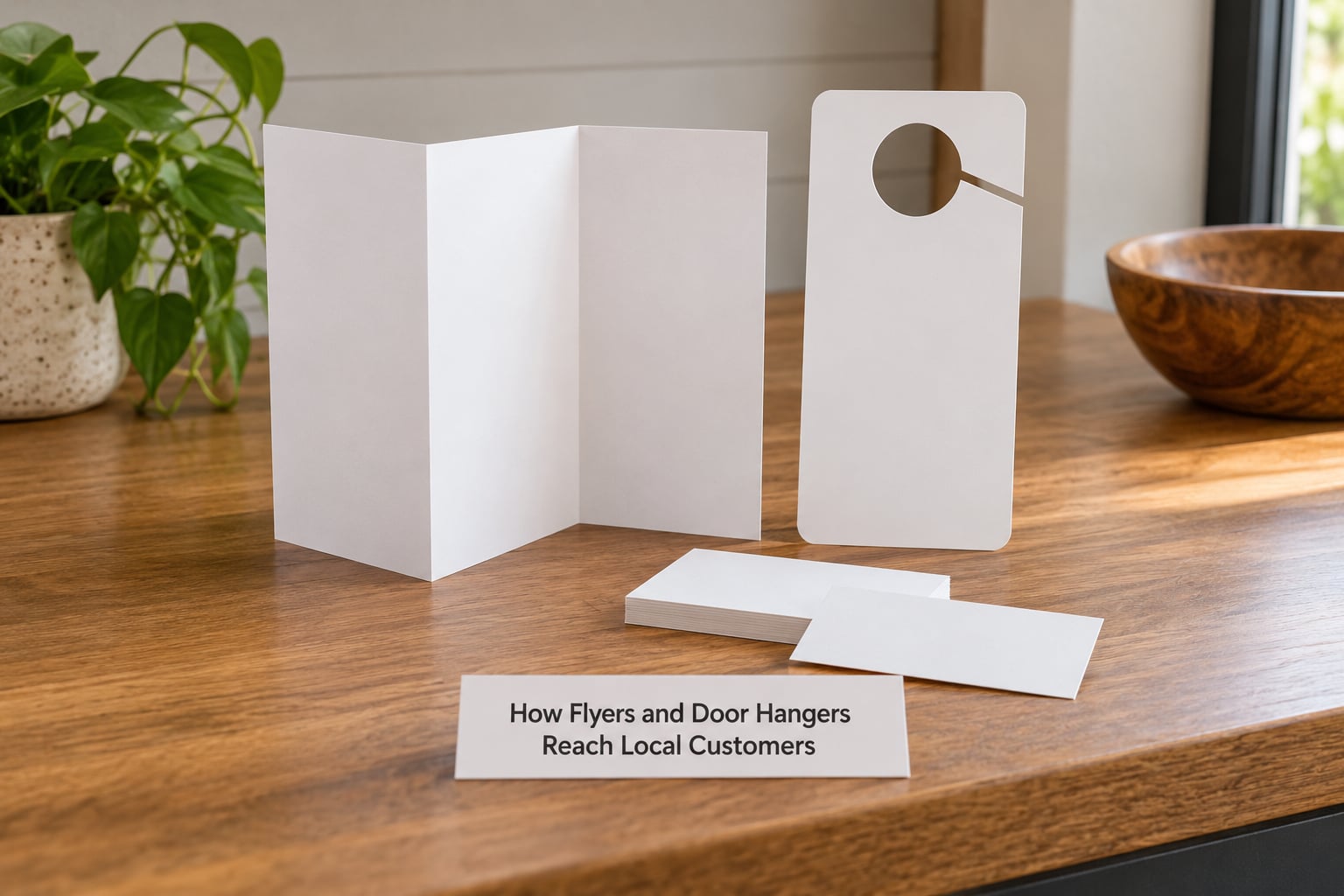
A flyer reaches a household at the moment someone decides to accept it. Hand one to a passerby at an intersection, slide it into a newspaper insert, set it on a counter at your own shop, or post it on a community board. That decision is the weak point. Most people take the piece politely and are gone in two seconds.
A door hanger reaches a household without asking permission. It goes on a handle or knob at a specific address and stays visible every time that door opens until somebody takes it down or weather ruins it. The homeowner never agreed to see it, but they cannot unsee it, which is exactly the point and exactly the problem.
Geographic flexibility is the flyer’s edge. You can hit three towns in an afternoon, fill 2,000 handouts at a street fair, or drop 500 at four community boards. A door hanger campaign is a route: one person walking the same streets in a fixed order, which means a 300-home route and a 3,000-home route behave very differently.
Repeat exposure also separates the two. One flyer is one impression. A door hanger delivers three or four impressions a day for as long as it hangs, so a week of 500 hangers can beat a weekend of 2,000 flyers even though far fewer people see it.
Door Hangers for Neighborhood and Route-Based Promotion
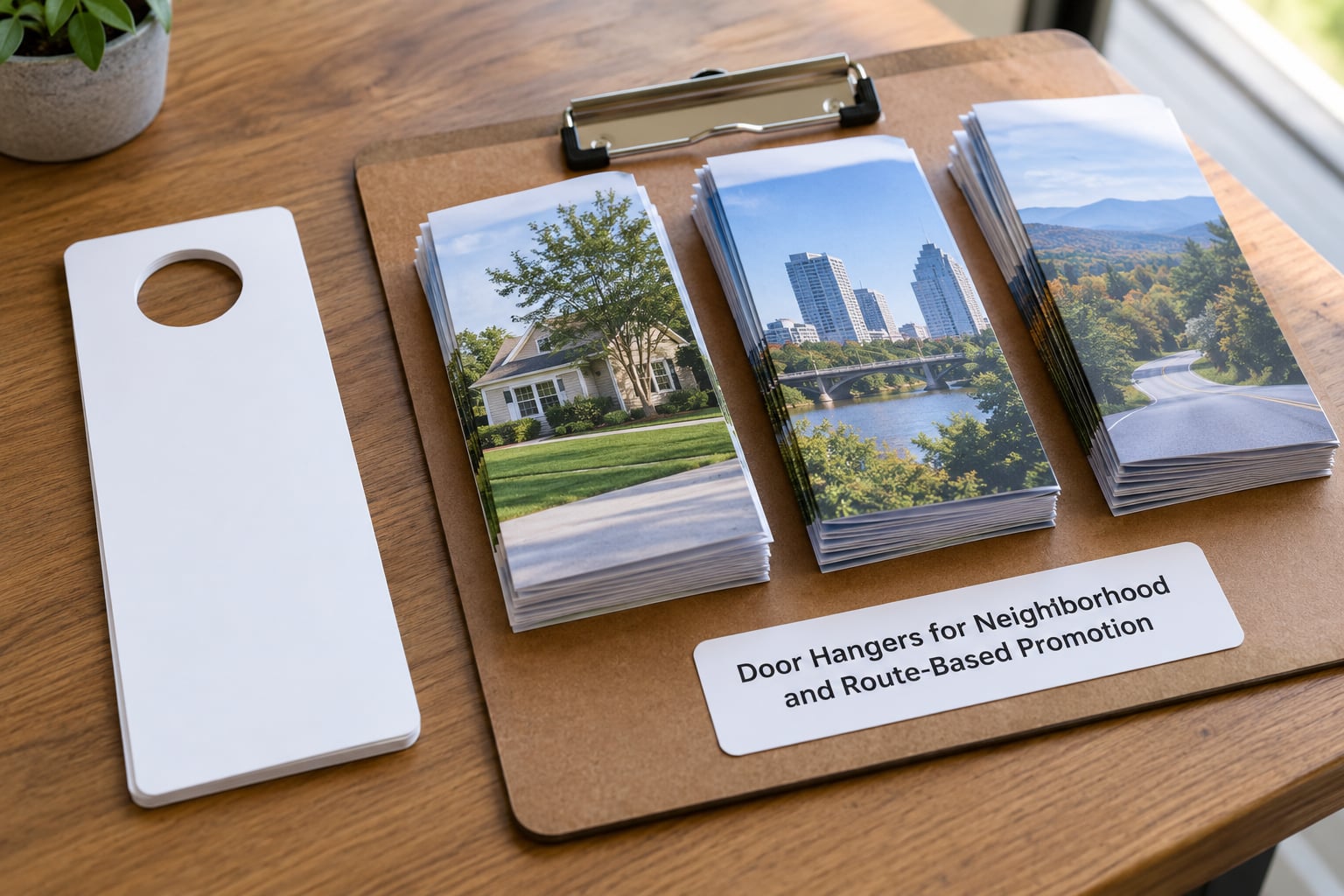
Door hangers work when your customers already live within a walkable or short-drive radius of you. HVAC companies, plumbers, roofers, lawn care, cleaning services, real estate agents and dental practices all fit, because the people who receive the piece are already inside the area you can serve on a Tuesday.
The route is the campaign. Pick a defined area, map it into a fixed number of doors per day, and walk it the same way every time. Operators call this perimeter marketing, and it is the single biggest reason door hangers produce results while random flyer drops do not. Your competitors may be printing the same card, but very few of them are knocking on your exact block on the same morning.
Keep the message to one idea. A hanger has room for a headline, three lines and a phone number, nothing more. If your message needs a menu, a price list and a service breakdown, you are holding the wrong format.
Before the first door, check what is allowed where you plan to hang. Some cities regulate door-to-door distribution, some apartment complexes and gated communities ban anything on a handle for security reasons, and residents with a no-solicitation notice are off limits in most places. Two of those three checks take one phone call each and will save you a ruined drop.
Measure the route like an experiment. Hang 400 cards on one defined route with a unique offer on them, then count responses for two weeks before you print the next batch. Rough planning ranges put a solid door hanger run near one response per 20 doors, while flyers buried in newspapers often land closer to one in 500, a gap of roughly 25 times. Use those as starting points, not promises.
Flyers for Events, Stores, and Wider Distribution
Flyers are the better pick when the message is rich or the moment is short. An open house, a grand opening, a new menu, a seasonal coupon and a yard sale all have details a hanger cannot hold, and all of them expire on a date you can put on the front of a sheet.
Distribution channels make this format hard to beat on volume. Counter handouts catch people already in the mood to buy. Newspaper inserts and mail-slot drops reach a whole ZIP code for one printing run. Community boards, library racks and event tables fill up your message at a cost that barely changes whether you drop 500 or 5,000 pieces.
The weakness is that most of it is forgettable. A paper sheet in a stack of a hundred paper sheets is not an interruption, so the design has to carry the load: one headline readable from ten feet, one offer, one call to action. If your flyer would still make sense printed in a single line of text, you have room to add a second thing.
Flyers also spread risk. If a distribution day falls through because of rain or a scheduling clash, you still have the pieces for a board, a counter or an event the following weekend. Door hangers have nowhere to sit.
Design and Message Differences
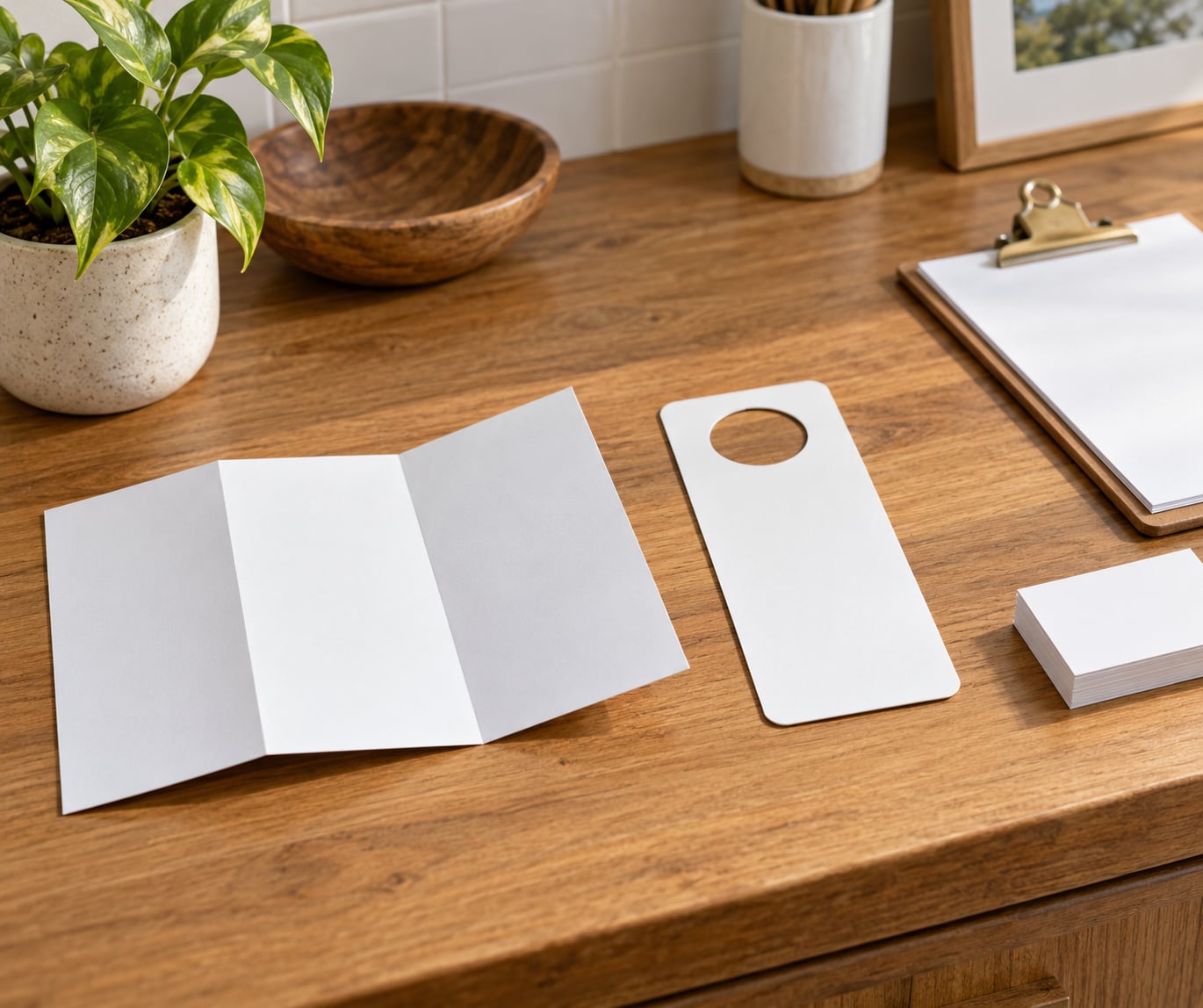
A flyer is a small page. Half-letter and quarter sheets cover most local campaigns, and that space lets you build a hierarchy: headline, two or three supporting lines, an offer, contact details and often a QR code. Someone standing still can read it in ten seconds; someone walking can read the headline and nothing else.
A door hanger is a narrow vertical card, commonly around three and a half inches wide and eight to eleven inches tall, printed on heavier card so it survives a handle and a week of weather. The shape is designed to be read at arm’s length while standing on a porch, so the hierarchy is brutal: one headline, one reason to believe, one action.
Branding works differently. A flyer has room for a logo, color blocks and a short paragraph about why your business exists. A hanger gets a logo, a color that stands out from other cards, and a number big enough to read without squinting.
On paper weight, the practical rule is simple. Flyers print well on standard text stock because they are read once and handed on. Hangers want a heavier card with a matte or gloss finish, since gloss photographs hold up in sunlight and matte finishes resist fingerprints from being taken down and put back.
Both formats suffer from one common error: cramming. One homeowner picks up a hanger, reads it in three seconds and makes a decision. Give them a single reason to call and they will. Give them four and they will take it inside, and most take it inside pieces never make it past the junk drawer.
Cost, Production, and Distribution Considerations
The printed piece is the cheapest part of either campaign. Print runs scale down with volume, and the real driver is what happens after the boxes arrive: the labor to hand out, insert, post or hang every single piece. Compare the two formats on all-in cost per delivered piece, not on the invoice from the printer.
Flyers carry lower unit cost and lower minimums, but hand-to-hand distribution is slow and burns volunteer or staff hours. Operators regularly put all-in cost for a door hanger at roughly ten to fifteen cents, split about evenly between printing and hanging, which is a useful anchor for the gap people usually underestimate.
Door hangers cost more to print and more to place, because hanging is a two-handed job with a doorbell decision attached to it. Third-party distribution services quote scheduled routes with materials bundled in, and the usual arrangement is a fixed weekly fee covering both labor and materials rather than a per-piece price, which suits someone running a consistent route for a month.
Design time runs alongside both. A flyer can be adapted for three channels from one layout. A hanger needs a second design that survives being read at a doorway, and you will want a version for each seasonal offer.
Weather is a hidden variable. Flyers get wet and blow away the same afternoon. Hangers on card survive rain and stay visible for days, which is a practical argument for hangers in spring and fall and for flyers in dry stretches and high-foot-traffic events.
Which Is Better for Common Local Marketing Goals
Announcing an event: flyers. The date, the address and the details all fit on a page, and event promotion needs speed over precision.
Promoting a short-term offer: either works, but a flyer with a coupon and expiry date creates urgency. Hangers work better when the offer is a simple dollar-off or service special that needs one phone call.
Reaching a nearby service area: door hangers. Concentration inside a defined radius is the entire point, and that is the format built for it.
Reminding customers before a deadline: door hangers for residential services such as HVAC tune-ups or lawn treatments before a seasonal cutoff. The piece keeps working for a week without a second touch.
Driving visits to a storefront: flyers. Counter handouts, event tables and mail drops put the message in front of people who are already moving through the area, and hangers do nothing for walk-in traffic.
Filling a slow week with cheap volume: flyers on community boards and in inserts. Low effort per piece, low response per piece, predictable either way.
How to Test Flyers and Door Hangers
The best way to settle flyer vs door hanger for your business is to run a small controlled test with tracking built in before printing anything large.
Setting up a clean flyer vs door hanger test
Pick one offer, not two different ones. Use a unique promotional code on the flyer and a different code on the hanger, so a redemption tells you exactly which format produced it.
Give each format a matching QR code pointing to its own landing page, and put one dedicated tracking number on the hanger rather than your main line. A call that comes in on the campaign number is unambiguous, a call on your main line is not.
Keep the route and the timing equal where you can. One format gets a defined neighborhood over two weeks, the other gets the same number of pieces handed out in the same area. Log every response in one sheet with a date and a channel column, then do the arithmetic per piece.
Ask every inbound customer how they heard about you, and write down the answer before they hang up. This is the least precise method on its own, but it catches what codes miss, such as someone who saw the hanger and searched for you a week later.
Give each format a fair window before judging. A flyer often converts inside two days. A hanger can produce a call on the fifth or sixth day, so closing the file too early is the most common measurement error I see.
Which Should You Choose?
Choose a flyer when your message needs detail, your deadline is close, or your audience is moving rather than staying put. That covers events, storefronts, community boards, inserts and any campaign where you want numbers on a board or a stack by the register.
Choose a door hanger when your customers live within a short radius, your offer needs one phone call, and you can commit to a defined route rather than a single busy afternoon. Home services, lawn care, cleaning and real estate fit this shape best.
Run both when you have the budget and one clear message. The usual sequence is a flyer inside the mail or at an event for broad awareness, followed by door hangers on the same routes two weeks later for the reminder. Same offer, same code structure, so you can still tell which one did the work.
Whichever you pick, spend the first run on a few hundred pieces rather than a few thousand. Print small, track honestly, and let the numbers pick the format for next time.
Frequently Asked Questions
Are flyers or door hangers better for local marketing?
Flyers are better for events, storefront promotions, community boards and any message with more than one detail. Door hangers are better for reaching a defined service area one address at a time, and they stay visible longer because they hang until somebody takes them down. Pick the format that matches the route you can realistically work.
When should a small business use door hangers instead of flyers?
Use door hangers when your customers live close by and your offer needs a single phone call to convert, such as a lawn care visit, a plumbing repair or a free estimate. They also work when you can repeat the same route on the same days, because the consistency is what makes the drop memorable.
What is the most effective way to distribute flyers locally?
Concentrate rather than spread. Handing out a few hundred pieces on one well-defined street beats scattering the same pieces across a whole town. Counter handouts, event tables and community boards add volume cheaply, while mail drops and newspaper inserts reach a full ZIP code in a single run.
Are door hangers more expensive than flyers?
Yes, usually on both print and placement. Hangers use heavier card, are bought in smaller quantities and take longer to place because each one is hung by hand. Flyers print cheaply and move fast, but hand-to-hand distribution burns staff time, so compare all-in cost per delivered piece rather than the printer invoice.
Can I use both flyers and door hangers in one campaign?
You can, and it often works well when the message stays the same. Lead with flyers for broad awareness through boards, inserts or events, then run door hangers on defined routes two weeks later as a reminder. Give each format a different promotional code so you can still tell which one produced the response.
How do I know whether the marketing format is working?
Give each format its own promotional code, QR code and ideally its own tracking number, then log every response with a date and a channel column. Also ask new customers how they heard about you. Wait a full week before judging a hanger campaign, since responses often arrive several days after the drop.