Landscaping is bought within a few miles of home, which means the marketing that works for you is the marketing your neighbors actually see. These local marketing ideas for a landscaping company cover the full path from a stranger searching “landscaping near me” to a signed maintenance contract, and each one comes with a first action you can start this week.
Most owners I talk to do not have a marketing problem so much as a focus problem. They run a truck ad for six months, see nothing, and quit, when the neglected Google Business Profile or the twenty yards of unanswered neighbor requests would have paid better the whole time.
That problem has a shape. Most landscaping work is decided within a short drive of the office, by homeowners who have already looked at a map, read a few reviews, and asked their neighbors. The marketing that wins is not the flashiest one, it is the one that shows up at each of those moments with something true and verifiable to say.
Seasonality also shapes the budget. Revenue swings hard with the weather, so spending should too. Companies that lay the same monthly spend in January and June end up starving their busiest weeks or wasting money in the dead ones.
The order below matters. Reputation comes first because it makes every other channel cheaper. If you are starting from zero, work through ideas 1 to 4 before you spend a cent on ads.
Two things to keep in mind as you read. Every tactic here is local by definition, so each one gets better the tighter you make it to your actual service area. And every tactic produces work you can measure, so write down where each lead came from before you start, not after.
Table of Contents
- Local Marketing Ideas for a Landscaping Company at a Glance
- 1. Build a Google Business Profile That Shows Up Locally
- Start with local marketing ideas for a landscaping company on Google
- 2. Create Service Pages for Every Profitable Local Offer
- 3. Publish Before-and-After Project Examples
- 4. Ask Every Happy Customer for a Review
- 5. Build a Referral Program Customers Can Actually Use
- 6. Market Seasonal Lawn and Landscape Maintenance
- 7. Use Vehicle Wraps to Turn Trucks Into Mobile Billboards
- 8. Get Involved With Neighborhoods and Community Events
- 9. Run Geo-Targeted Search and Social Campaigns
- 10. Turn Free Local Listings Into Accurate Lead Sources
- 11. Add Yard Signs That Earn Their Placement
- 12. Follow Up With Quotes and Estimate Requests Fast
- Frequently Asked Questions
- What local marketing should a new landscaping company prioritize first?
- Which local marketing channel usually gives a landscaping company the best return?
- How can a landscaping company find customers without a large advertising budget?
- What should a landscaping company advertise during its busiest season?
- How many reviews does a local landscaping business need?
- Conclusion
Local Marketing Ideas for a Landscaping Company at a Glance
Here is the whole list in one table, with the goal each tactic serves and the first action worth doing today. Use it to pick two or three ideas that match your budget and your season rather than trying to run all twelve.
| Idea | Primary goal | Best fit | First action |
|---|---|---|---|
| 1. Google Business Profile | Be found on Maps | Any landscaping company | Claim and fully complete the profile |
| 2. Service pages | Rank for specific work | Company with 3+ profitable services | Write one page for your top earner |
| 3. Before-and-after projects | Prove the work is real | Any company doing visible projects | Photograph one finished job this week |
| 4. Review requests | Build trust and local rank | Every company with happy clients | Add a review text to your invoice email |
| 5. Referral program | Steal from word-of-mouth into a system | Companies with a repeat customer base | Define the ask and the reward |
| 6. Seasonal campaigns | Match demand to the calendar | Lawn care and maintenance crews | Build a 12-month campaign map |
| 7. Vehicle wraps | Advertise while you work | Crews visible in traffic daily | Fix the message hierarchy on your main truck |
| 8. Community involvement | Get known and trusted locally | Owners who can invest time | Contact three neighborhood HOAs |
| 9. Geo-targeted ads | Capture high-intent searchers | Companies with ad budget | Build one campaign with a radius and exclusions |
| 10. Local listings | Add accurate map citations | Anyone missing citations | Fix name, address and phone everywhere |
| 11. Yard signs | Turn neighbors into leads | Multi-day and seasonal projects | Design one readable sign |
| 12. Fast quote follow-up | Convert more of the leads you get | Every company | Set a response window and a follow-up sequence |
1. Build a Google Business Profile That Shows Up Locally
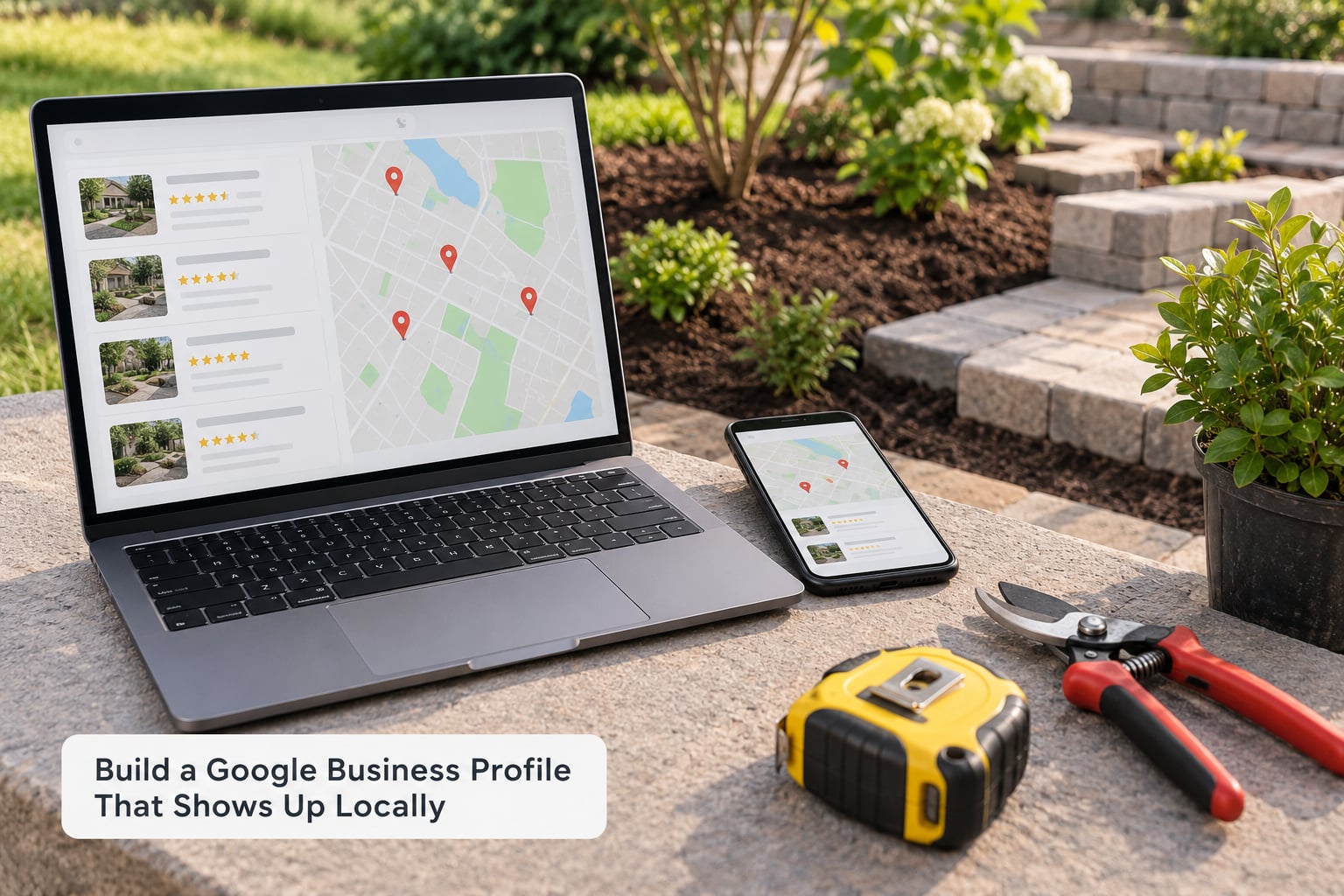
A complete Google Business Profile is the single highest-return item on this list, and most landscaping companies leave half of it empty. Claim it, verify it, then fill in the primary category, every service you sell, the full service area, hours, phone, website, and a description written in plain language.
Incomplete profiles lose map placement to neighbors who did the boring part. Photos are where most owners stop too early, and that is exactly the field that sells mowing and hardscaping.
Start with local marketing ideas for a landscaping company on Google
A short checklist gets the foundation done in an afternoon: claim the profile, pick the primary category, add five to ten services, define the service area, upload ten project photos, set hours including seasonal changes, and link the website.
Then measure what matters. Google Analytics 4 plus Search Console tell you which searches bring people in, and the profile itself reports calls, direction requests, website visits, and messages. Check those numbers monthly rather than daily, because local ranking moves slowly.
Post once a week to the profile. Seasonal availability, completed projects, and a note about what your crew is doing this month all feed the freshness signal without you writing a single blog post.
Category choice is the decision people overthink. Your primary category should describe the work you want most, and additional categories can cover the rest, but a category you cannot service properly is a bad trade because it brings calls you will eventually decline.
The business description field is free real estate that most owners leave blank or fill with keyword stuffing. Write two or three sentences a homeowner would actually want to read: what you do, which neighborhoods you cover, and what makes your work different, such as a family operation, a specific specialty, or licensed and insured status.
Keep the name, address, and phone identical everywhere they appear online. Inconsistent details across your own website and directory listings are one of the most common and most fixable reasons a strong business struggles to show up in map results.
2. Create Service Pages for Every Profitable Local Offer
One page per service lets you match the exact words a homeowner types, and one page per service plus city covers the local combinations that bring design and installation work through. Lawn care, landscape design, irrigation repair, seasonal cleanups, tree trimming, hardscaping, and ongoing maintenance each deserve their own page.
Keep the risk on the other side of that too. Programmatic pages that swap a city name into identical copy read as thin content to search engines and to the homeowners who land on them, and they waste link equity across dozens of near-empty URLs.
Write pages for the services that actually make money, not the full menu you could theoretically offer. A maintenance company that ranks for three strong terms beats one that ranks for nothing across twenty weak pages.
A workable structure for each page: a short opening that names the service and the area, two or three sections covering process, materials, and what the homeowner should expect, a gallery of your own completed work, and one call to action. Add the service to your navigation and link to it from your estimate form, because an orphan page earns nothing.
Write the title and meta description by hand so each page targets its own intent. A page for hardscaping and a page for irrigation repair should not compete for the same words, and each should match the phrase a homeowner would actually type.
If you serve several towns, build genuinely different location pages. Mention local conditions, the projects you have completed there, and the crews that serve it. If you cannot say anything specific, link to the main service page instead and put the effort into one strong page.
3. Publish Before-and-After Project Examples
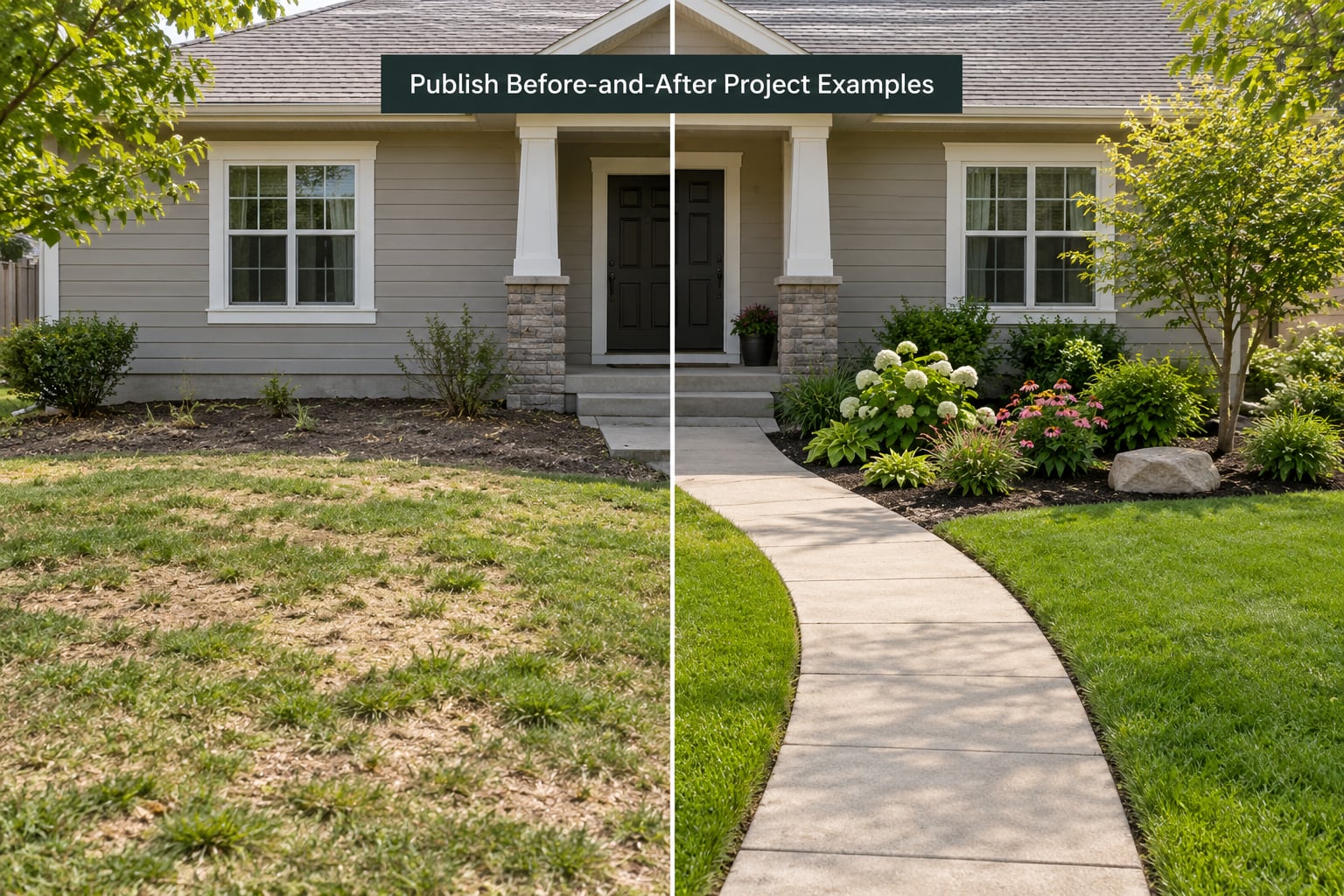
Before-and-after photos are the closest thing landscaping has to a demonstration, because the transformation is the proof. Real project photos consistently outperform stock images in local marketing for this trade, and one honest photo set beats ten polished renders.
Shoot from the same angle on both visits, in similar light, and frame wide enough to show the whole yard. Then write the caption like a small case study: what was wrong, what you did, what materials you used, how long it took, and what changed for the homeowner.
Get written permission before posting anything, and name the neighborhood rather than the street address if the client prefers privacy. Every project post should end with one clear action, usually a request for a free estimate or a link to your service page.
Repurpose one project into several pieces rather than treating each post as a one-off. A single two-week backyard install can become a photo carousel, a short time-lapse clip, a written case study on your site, and a follow-up post a year later showing how the plantings filled in. Clients enjoy seeing their yard again, and the second post costs you nothing but an afternoon.
Keep a project folder on your phone so the crew can add photos as the work happens. Half of all good material gets lost because nobody took the picture on the day.
4. Ask Every Happy Customer for a Review
Ask once, at the right moment, with the right words. Reviews collected immediately after job completion get the highest response rate because the memory of the finished yard is still fresh and the client is still pleased.
Send a short text or email with a direct link to your Google review page, keep it under three sentences, and say what the review means to you. Put the same link on your invoice email and your own website so no request gets lost.
A QR code on the crew’s clipboard or the invoice packet works well for clients who do not click links. It also lets you note the job type, so six months later you know which service brought the review.
Handle bad reviews the way you would handle a bad inspection: reply once, calmly, acknowledge the problem, describe what you changed, and move it into a resolved conversation. Never argue, never offer anything in public, and never buy reviews. The FTC treats incentivized or purchased reviews as deceptive, and Google can remove them or issue a listing warning that costs far more than the review was worth.
5. Build a Referral Program Customers Can Actually Use
Most landscaping referrals already happen informally, so the job is not to create the behavior but to make it easier and to capture it. Tell clients directly that you would be grateful for an introduction, and make the next step obvious.
Give them a simple ask: a neighbor’s name and phone number, or a shared card with your contact details. Some companies use a referral code tied to the customer so you can tell who sent whom.
Choose a reward that complies with the rules that apply to your business and feels generous rather than cheap. A discounted maintenance visit, a free spring cleanup, or a credit toward an annual plan usually fits better than cash, and it keeps the relationship going.
Work two lists: one-time projects like a patio or a drainage fix, and recurring maintenance contracts. Recurring work is where referral value compounds, so track which customers keep sending people and give those relationships more attention.
Timing helps more than persuasion. The best moment to ask is when the crew has just finished something the client is clearly pleased with, ideally while they are still standing in the yard.
Keep the reward straightforward to administer. Credit that appears automatically on the next invoice requires no bookkeeping and no awkward conversation, and it keeps the customer on your schedule rather than pushing them to call a competitor.
Thank people who refer when the job closes, not just when you win it. A quick message that says the referral helped and the yard looks great keeps the source warm for the next one.
6. Market Seasonal Lawn and Landscape Maintenance
Demand for landscaping work is not flat, so your marketing should not be flat either. Build the year in arcs: spring preparation, steady summer mowing, fall cleanup and leaf removal, then winterization, drainage checks, and irrigation shutdown.
Run each campaign in the weeks before the demand starts, not during it. A spring cleanup campaign launched in early March beats the same campaign launched in late April, when everyone in your area is already calling three companies.
Tie each offer to the season and to the service area. Fall leaf removal in a town full of maples is a different message than gutter and drainage checks in a neighborhood with clay soil, and both are easier to write than a generic “we do landscaping.”
End every seasonal push with one call to action and one deadline. Scarcity works here because the weather calendar is real: irrigation shutdowns happen before the first freeze, not whenever you get around to it.
Put the calendar somewhere the whole team can see it, because marketing that lives only in one person’s head never gets run. A simple twelve-row sheet with the campaign, the message, the send date, and the service it promotes is enough to keep a whole year organized.
Winter is where most companies waste their quiet months. It is the only reliable window for drainage work, hardscape repairs, planning next spring’s design jobs, and refreshing the website before demand returns, so budget for it rather than pausing.
Review results after each campaign, not just at year end. A campaign that produced a hundred inquiries and four booked jobs tells you something very different from one that produced four inquiries and four jobs, and you can only see that if you tracked both numbers.
7. Use Vehicle Wraps to Turn Trucks Into Mobile Billboards
Your trucks already drive your service area every day, so wrapping them is local marketing you pay for once and use thousands of times. One landscaper told me in a forum thread that roughly half his clients found him by seeing his truck and trailer, which is a good argument for treating the wrap as a core channel rather than a nicety.
The message on the vehicle has one job: make someone who is stuck in traffic able to remember your name and dial you later. That means company name in large type, two or three core services, and a phone number or website that reads at 40 miles an hour.
Legibility beats decoration. Skip thin fonts, low-contrast color pairs, and phone numbers smaller than the service list. If you use a QR code, make it large and test it from a distance, since most people driving will never scan it.
Wrap the vehicle that spends the most time in residential neighborhoods, since that is where lawn care and cleanup jobs come from. For a crew working commercial properties, the truck is still a directional signal, so make the phone number dominant.
Measure reach roughly by tracking branded phone calls and by asking new clients how they found you during the intake question. Add a line to your estimate form so the answer becomes data instead of a memory.
Ongoing maintenance matters here more than in most trades. Dirt, grass clippings, and sun will flatten a wrap’s colors and lift its edges within a couple of seasons, and a peeling wrap makes the truck look like an advertisement for the wrong company.
Clean soft surfaces gently and hand-wash anything with a printed graphic. Keep a spare set of the core phone number and logo files so a damaged panel can be reprinted alone instead of replacing the whole wrap.
One practical note: if two trucks share the work, split the messaging. Give the neighborhood truck the lawn care and cleanup message, and keep the design and installation truck more image-forward, since those jobs get quoted rather than grabbed.
8. Get Involved With Neighborhoods and Community Events
Community involvement works because it puts your company in front of people who already trust each other. The most productive targets are HOAs, neighborhood associations, property managers, nurseries, hardware stores, local hardware counters, and the chamber of commerce.
HOAs are the shortest route to several neighbors at once. Offer a free walkthrough or a spring cleanup day for the association, and let residents see finished work in the neighborhood rather than in a portfolio of jobs from another town.
Property managers can be a recurring revenue channel on their own, so treat that relationship like a business account with a named contact and a maintenance agreement. Realtors and custom home builders work the same way: be the contractor they can hand a client to without embarrassment.
Events work in small doses. Sponsoring a youth sports team, running a tree giveaway, or teaching a free class on planting for your soil type costs less than a printed flyer and gets you in front of families.
Nurseries and garden centers are underrated because they hand out your information at the exact moment someone is planning a project. Stock sample packets or a small display of your current-season material at the counter and let the counter staff hand out cards with a seasonal offer.
Bring something useful, not just your logo. A free planting consult, a leaf bag giveaway, or a short workshop on irrigation coverage gives people a reason to talk to you that has nothing to do with buying.
Ask each organization you work with whether your company is listed in their newsletter or on their website. Free listings in a chamber newsletter or an HOA bulletin reach an already-trusting audience at almost no cost.
9. Run Geo-Targeted Search and Social Campaigns
Paid campaigns only make sense when they are narrow. Target people inside the area you can actually reach in a reasonable drive, and exclude neighboring towns you have no plans to serve, or you will pay for leads you cannot keep.
Split high-intent search terms from awareness campaigns. Terms like “lawn care service in my area” or specific service plus city belong in one campaign, while broad seasonal awareness belongs somewhere else, with different expectations and a different budget line.
On social, narrow to homeowners in the neighborhoods you serve rather than spraying the metro area. Age targeting and household income filters help in some service areas, but geography does most of the work.
Optimize for the action that pays you, which for most landscaping companies is a phone call or a quote request, not a landing page view. Add call tracking or a distinct number per campaign so you know which one produced booked site visits, and review search terms weekly to add negatives for the wasted phrases.
Set a spending ceiling before you launch and treat it as a monthly number, not a suggestion. Without a cap, the campaigns with the cheapest lead prices keep absorbing everything, and you end up with volume from the wrong side of the map.
Give each campaign its own landing page or at least its own message. An ad for fall cleanup that lands on your general home page converts worse than one that shows fall cleanup photos and a short form, and the cost difference is a page you write once.
Seasonality applies to bidding too. Raise budgets in the weeks before peak season and cut them in the dead months, rather than running flat spend and hoping the algorithm figures it out.
Local Services Ads deserve their own look if you have the budget. They sit above the map results and connect directly to calls and booking, which suits high-intent work like hardscaping or tree service. Test them separately from search ads so you can see which one your budget is better spent on.
10. Turn Free Local Listings Into Accurate Lead Sources
Business directories and map listings are usually free, and most companies fill out two or three of them badly. A consistent name, address, and phone number across every listing is the part that matters most, because mismatches undermine local relevance.
Complete each profile the way you completed your Google Business Profile: correct categories, real hours including seasonal hours, service area, credentials, project photos, and a review response process. Incomplete listings contribute very little beyond a name and a pin.
Prioritize the directories that a homeowner in your area would actually use, along with the trade-specific and regional ones, rather than chasing sheer listing volume. Forty accurate citations in the places customers look beat four hundred stale ones pointing at an old phone number.
Recheck them twice a year. Businesses move, hours change seasonally, and a wrong number on an old listing sends calls to a former owner.
Seasonal hours are the most commonly missed field. A landscaping company that runs January through November and shows open all year in December sends people into a voicemail nobody is watching, and the first impression is wasted.
Photos are the other one. A listing with real project images and no stock art gets chosen more often, because the picture answers the question a homeowner has about whether you do quality work.
If you serve commercial properties, list that too. Property managers searching for grounds maintenance are usually less saturated than homeowners, and the same listing can serve both audiences if you describe both.
11. Add Yard Signs That Earn Their Placement
Yard signs work on projects that last more than a day. A three-hour mulch job sends a neighbor home with nothing to think about, while a two-week hardscape install or a season-long maintenance agreement gives neighbors time to notice and call.
Keep the copy short: company name, one service line, phone number, and a short URL if there is room. Signs seen from the road are read in about two seconds, so anything more is wasted space.
Place the sign where traffic stops, near the curb or an intersection, and never on private property without the owner’s permission. Put signs up at the start of the job and take them down when it ends, or the neighborhood association will notice.
Choose weather-resistant material and check them after storms, since a collapsed sign says something about your workmanship. One sign per street-facing project keeps the message clean; five signs on a single yard reads as clutter.
Signs on completed work in an established neighborhood are worth more than signs on new construction. The first neighbor to see a finished yard in a street of similar yards is a much stronger signal than a crew working on an empty lot.
Ask the client before placing anything, and give them the option to keep the sign permanently. Some homeowners like the sign, some would rather you pull it, and asking avoids a small argument at the end of a job you otherwise did well.
For recurring maintenance, a small sign at the property with your next scheduled visit is less useful than one that stays visible year-round, since your next customer is most likely a neighbor who never called you directly.
12. Follow Up With Quotes and Estimate Requests Fast
The cheapest leads are the ones you already generated and let go of. Set a written response window for estimate requests and treat it as a service standard rather than a hope, because speed is usually the difference between signing and losing a homeowner to whoever answers next.
Make the form easy. Ask for name, contact, address, service needed, property size, and photos of the area, and let people upload a few pictures rather than describing a slope in words.
Qualify before you drive out. Confirm the address is inside your service area, what the client wants done, and roughly when. A five-minute call saves an hour of unpaid travel.
Then run a follow-up sequence: the written estimate, a check-in call before it expires, and a final note. Most lost jobs are lost in the gap between the site visit and the decision, not at the moment of contact.
Track where each lead came from at intake, from the first phone call onward. Over a season that list will tell you which marketing idea deserves next quarter’s money better than any guess about which one feels productive.
Good follow-up also means being honest about timing. If your crew is booked out three weeks, say so on the first call and confirm it in writing. A homeowner who knows the wait is far more likely to hold the appointment than one who finds out the week of the job.
Frequently Asked Questions
What local marketing should a new landscaping company prioritize first?
Start with a fully completed Google Business Profile and a system for asking every finished job for a review. Those two do the most work for owners with no budget and no track record yet, because both are free and both compound over time. Add one service page for the work you most want to book, then come back for vehicle signage and community partnerships once the foundation holds.
Which local marketing channel usually gives a landscaping company the best return?
For most landscaping companies, the combination of a well-maintained Google Business Profile and active review collection returns more for the money spent than paid ads. Searchers who find you on Maps are already close to buying, and reviews answer the trust question that ads cannot. Paid geo-targeted campaigns make more sense once you know which service and neighborhood produce the most profitable work.
How can a landscaping company find customers without a large advertising budget?
You have more options than ads. Ask every satisfied client for a review and an introduction, keep a yard sign up during multi-day projects, make sure your truck reads clearly from the road, and spend one afternoon a month publishing before-and-after photos. Partnerships with HOAs, property managers, nurseries, and local hardware counters cost time rather than money and deliver steady, low-cost work.
What should a landscaping company advertise during its busiest season?
Advertise the service that is hardest to say no to in that month, not the one that pays best. Spring is preparation, cleanup, and mulch; summer is mowing and irrigation checks; fall is leaf removal and cleanup; winter is winterization, drainage, and irrigation shutdown. Lead with the seasonal problem the homeowner is already dealing with, and name a deadline tied to the weather.
How many reviews does a local landscaping business need?
There is no magic number, and chasing a specific count tends to produce rushed or unverified reviews. Ask every customer at the right moment, keep the request simple, and aim for a steady flow rather than a burst. A steady rate of genuine reviews from real jobs matters more than any threshold, and consistent recent activity carries more weight than a large total collected years ago.
Conclusion
Pick one reputation foundation, one service-specific page, and one measurable lead channel, then give each ninety days before you judge it. That sequence is what turns these local marketing ideas for a landscaping company into booked site visits rather than a folder of unused tactics.
If your map listing is thin, fix that first. If it looks fine and leads still feel tight, work down the list until you find the leak.