Aluminum wins for any sign that lives outdoors and stays mounted, holding up 10 to 15 years without rusting or fading. Acrylic wins indoors, for backlit letters, engraved logos, and premium displays where clarity matters more than lifespan. Most buyers pick wrong because they compare appearance instead of how long the sign has to work.
That single question, how many years the sign needs to function, settles the debate faster than any spec sheet. If the answer is a decade or more, you are looking at aluminum. If it is a lobby wall, a backlit channel letter, or a product display that gets handled, you are looking at acrylic.
Fabricators say the same thing in shop conversations: aluminum for signs that are part of the building, acrylic for signs that are part of the brand. Below is a spec-by-spec aluminum vs acrylic signs comparison, updated for 2026, so you can hold two quotes side by side and know which one was quoted for the right reason.
Table of Contents
- Aluminum vs Acrylic Signs at a Glance
- Appearance and Finish
- Aluminum vs Acrylic Signs for Outdoor Durability
- What actually fails first on acrylic
- Mounting and coatings change the lifespan more than the material does
- Coastal and low-contact environments
- Weight, Strength, and Installation
- How each material gets mounted
- Customization and Fabrication
- Lighting and Sign Visibility
- Maintenance and Lifespan
- Cost and Value
- Which Should You Choose?
- When the right answer is a third material
- A 30-second decision checklist
- Frequently Asked Questions
- Which is better for outdoor signs, aluminum or acrylic?
- Are acrylic signs suitable for direct sunlight and rain?
- What is lighter, an aluminum sign or an acrylic sign?
- Can acrylic signs be painted or printed with a logo?
- Which material works better for backlit or channel letters?
- Can a business combine aluminum and acrylic in one sign?
- Conclusion
Aluminum vs Acrylic Signs at a Glance
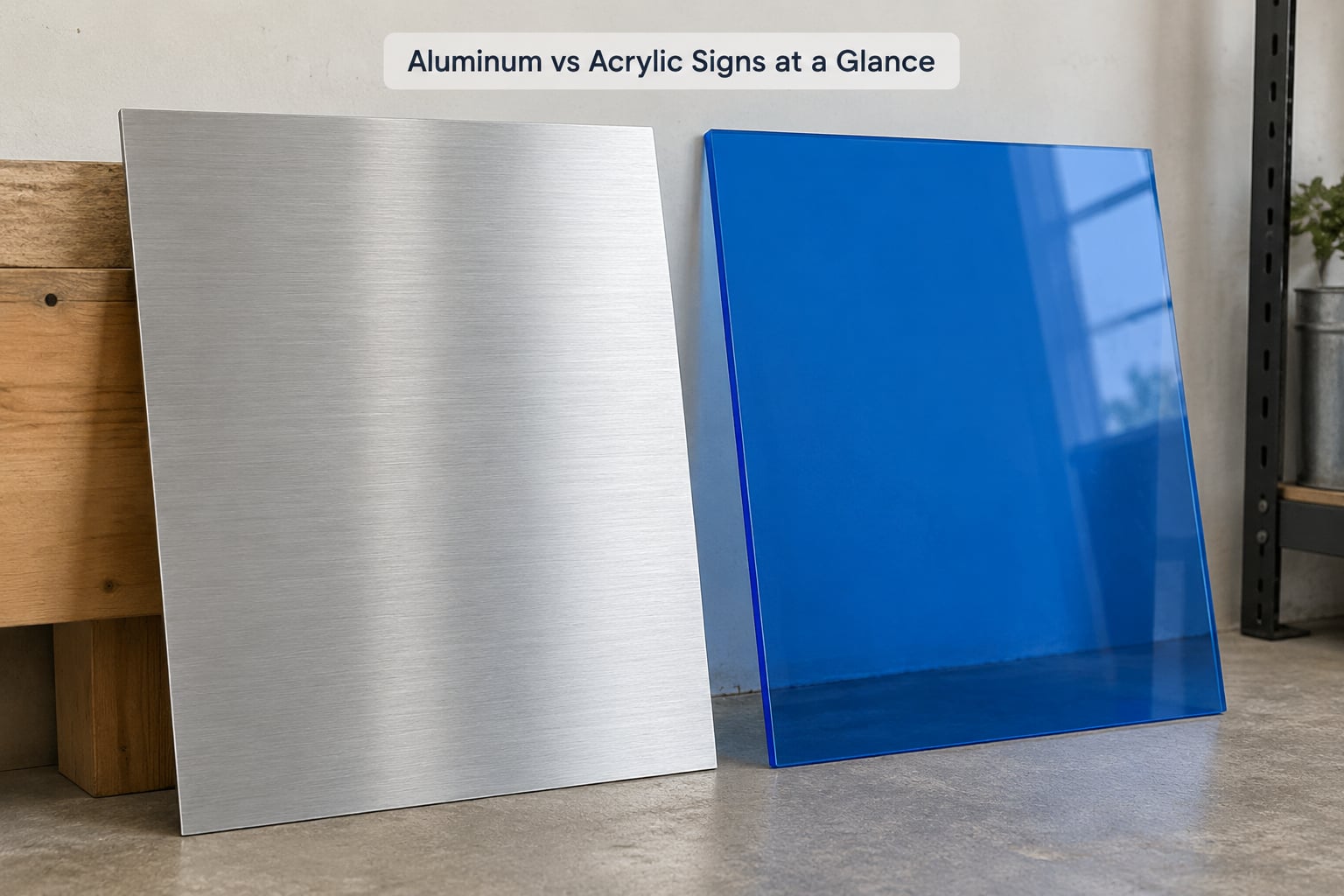
| Factor | Aluminum | Acrylic (PMMA) |
|---|---|---|
| Material | Rigid metal sheet | Rigid thermoplastic, polymethyl methacrylate |
| Typical panel sizes | Up to large wall panels without a frame change | Sheet stock up to 4 by 8 feet, larger panels need seaming |
| Common thicknesses | .040 in for standard signs, 1/8 in for larger or higher-wind panels | 1/8 in, 1/4 in, and 3/8 in cast sheet |
| Expected outdoor lifespan | 10 to 15 years | 5 to 10 years |
| Weight | Light for a metal; heavier than acrylic at equal thickness | Lighter than aluminum at equal thickness |
| Sun exposure | UV-cured inks hold color; the metal itself will not yellow | Color holds, but the sheet can yellow over years of direct sun |
| Scratches | Visible on dark brushed finishes, repairable with touch-up | Shows fine scratches and haze, especially on clear faces |
| Mounting | Standoffs, screws, or frame, standard hardware | Face mount with acrylic-compatible adhesive, or standoffs |
| Best for | Permanent exterior signage, wayfinding, parking and street signs | Backlit and channel letters, engraved logos, interior displays |
| Recycling | Widely recyclable as scrap metal | Harder to recycle; often ends up as waste |
One row deserves emphasis. The lifespan gap is roughly a factor of two, and it is the reason a cheaper material can cost more over the life of a storefront sign. More on that below.
Appearance and Finish
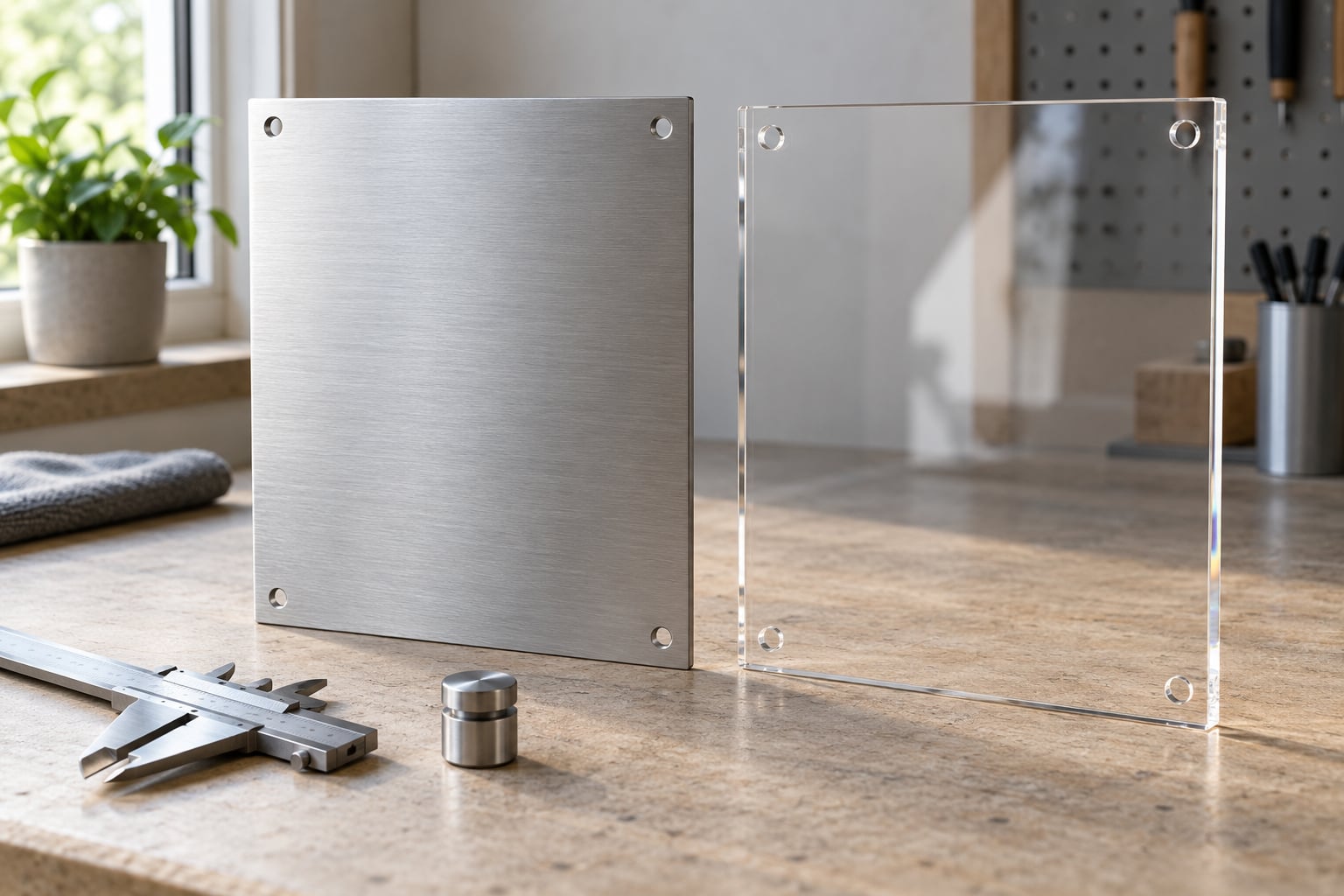
Aluminum reads as engineered and permanent. Brushed finishes soften reflections and hide fingerprints, polished edges catch light and give a sign a machined look, and powder coating gives you a full color without the grain of a raw sheet.
Acrylic reads as premium and optical. Because it is cast PMMA, a clear panel is genuinely transparent, and colors come out saturated and even. Edge polishing is where acrylic separates itself: a flame-polished edge looks like thick glass, and fabricators use it constantly on premium retail and lobby signage.
Color reproduction is close on both, though for different reasons. Aluminum takes a UV-cured direct-to-substrate print onto a hard, flat, matte surface that renders inks evenly. Acrylic can be printed, painted, or coated, and it accepts a deeper gloss because the surface itself is already optical.
For dimensional lettering, acrylic is the more versatile substrate. It routes and fabricates into 3D letters and layered builds easily, and it is the default for channel letters because it forms returns and takes LED lighting cleanly. Aluminum is better suited to rigid, flat, permanent panels and flat-cut letters mounted to a wall.
Edge treatment is the quiet giveaway. Aluminum edges are brushed, folded or capped, and you will feel the metal thickness. Acrylic edges are polished to a gloss, so the panel looks thicker and more expensive than it is.
Aluminum vs Acrylic Signs for Outdoor Durability
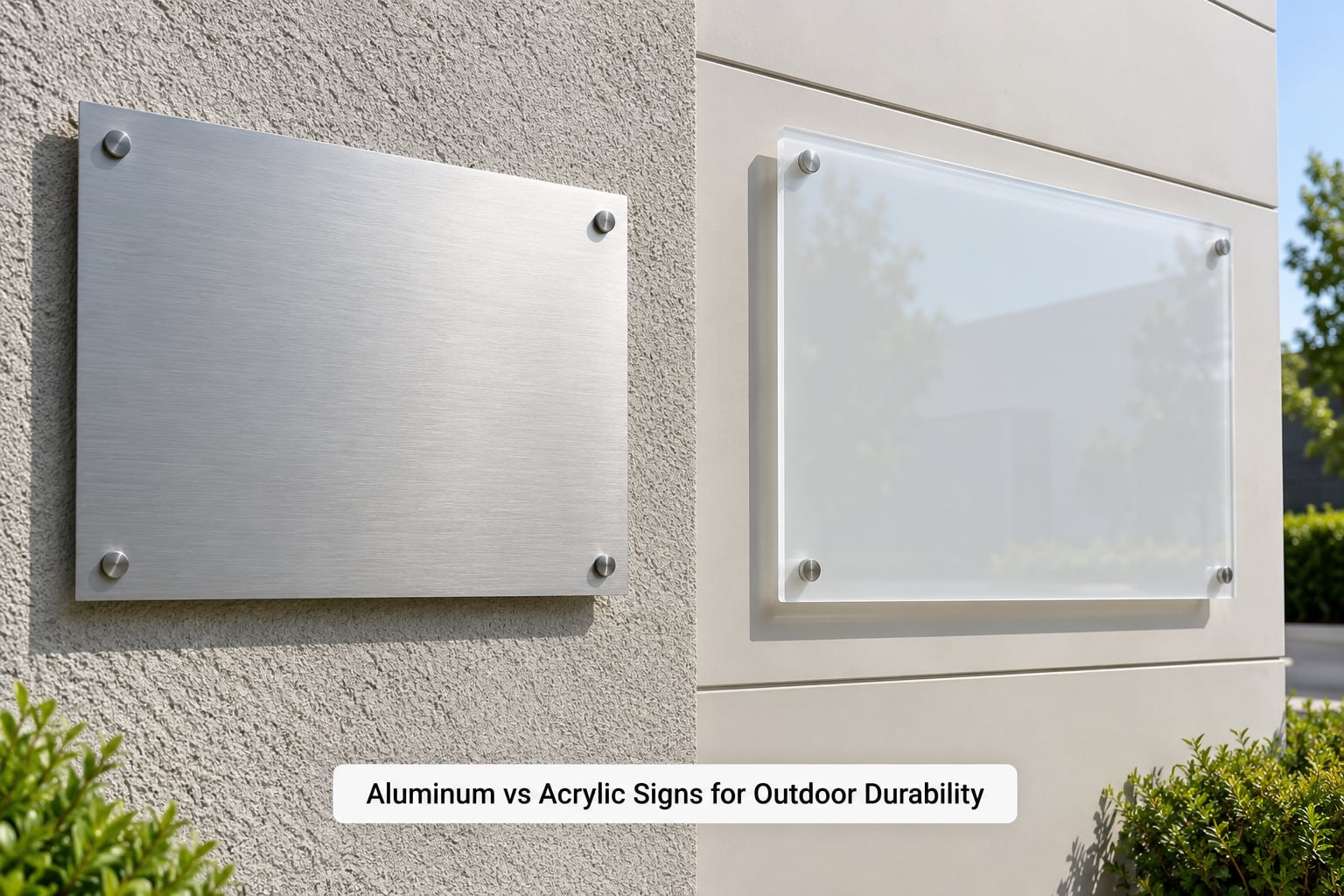
Aluminum is the better outdoor material, and it is not close. It does not rust, it does not corrode in salt air, and it does not soften or warp in summer heat. A well-fabricated UV-cured print on an aluminum panel holds its color for 10 to 15 years before you would even start to think about replacing it.
Acrylic is weatherproof but not immortal. Rain and snow are not the problem. The problem is ultraviolet light and thermal cycling, because PMMA expands and contracts with temperature, and a large face-mounted panel develops stress it eventually relieves in the wrong place.
What actually fails first on acrylic
Fabricators and installers describe four recurring failure modes, and none of them appear in most vendor guides:
- Yellowing. Prolonged direct sun on a southern or western wall degrades the polymer itself, not just the print. Ask specifically for UV-stabilized cast acrylic, and check the warranty language on colorfastness.
- Edge stress cracking. Acrylic carries tension into every cut edge and every drilled hole. A hole placed near a corner or too close to the edge becomes the crack starter. Rounded or polished edges and properly placed fastener holes prevent most of it.
- Thermal bowing. Oversized acrylic panels, especially face-mounted with a rigid adhesive, can bow in sustained heat. Because it cannot flex the way aluminum does, the stress shows up as a visible curve.
- Adhesive bond failure. Face-mounted acrylic panels lose the bond when the panel expands and contracts against a wall that moves differently. Mounting on standoffs, with an air gap, removes this failure almost entirely.
On the aluminum side the failures are physical rather than chemical: dings in shipping and installation, and edge wear where the panel is handled. What fails first on aluminum is usually the finish, not the substrate.
Mounting and coatings change the lifespan more than the material does
A powder-coated or anodized aluminum panel with stainless mounting hardware will outlast an uncoated panel with cheap screws, every time. On acrylic, UV-stabilized sheet, polished edges, and standoff mounting are the difference between a sign that looks good in year three and one that looks tired.
Coastal and low-contact environments
Salt air is the case where aluminum’s advantage grows. Aluminum is the standard answer for coastal, marine and high-humidity installations, and in food-service and medical settings where panels get wiped down with harsh cleaners several times a day, aluminum tolerates the abuse better than a plastic face that can cloud and haze.
Weight, Strength, and Installation
Acrylic is lighter than aluminum at the same thickness. Density is the reason: acrylic is roughly 40 percent lighter per square foot than a comparable aluminum panel, which matters when staff are hanging signage in a lobby or a crew is carrying a set of panels to an install.
Aluminum wins on rigidity and dent behavior. It holds a flat plane across a large span, so a big wall panel will not ripple. It also takes a screw without tearing, which is why exterior aluminum signs are mechanically fastened rather than glued.
How each material gets mounted
Aluminum is usually mounted on standoffs, through drilled and countersunk holes, or into a frame. That hardware is part of the spec, not an accessory. It also means an acrylic-faced adhesive mount is the wrong call for aluminum, because you would be gluing a stiff, rigid, thermally cycling metal to a wall.
Acrylic takes two mounting approaches. Face mounting with a solvent-weld or acrylic-compatible adhesive gives you a clean, hardware-free look and is common for interior panels. Standoff mounting with a visible gap is better outdoors, and it is the fix for the bowing and bond-failure problems described earlier.
For hanging signs, yard signs and portable displays the weight difference dominates, and acrylic or a lightweight foam board such as Sintra or HDU is usually the right pick. For wall signs, parking-lot pylons and anything bolted to a building, rigidity wins and aluminum is the default.
Customization and Fabrication
Flat panels are the easiest job for both materials and come out similarly. The routes diverge as soon as the sign gains dimension.
Routed and dimensional letters favor acrylic. It machines cleanly, edges polish to a glass finish, and it forms the returns you need to hide an LED strip inside a channel letter. If you want a channel letter that is internally illuminated, acrylic is usually the answer, because it diffuses light evenly across the face.
Layered and dimensional builds favor acrylic for the same reason. Aluminum is used for large rigid elements, monument-style panels and cut-metal plates, where flatness and thickness matter more than optical clarity.
Mirrored and metallic finishes are an aluminum strength. A polished or mirror-finish aluminum plate gives a reflective look that acrylic only approximates with film, and film is the element that degrades first outdoors.
Engraving is where the difference shows most clearly. Laser engraving on acrylic produces a bright, frosted, high-contrast mark that reads as a machined detail, and paint-fill on an engraved acrylic face adds a second color inside the cut. Engraving on aluminum cuts the anodized or printed surface to bare metal, which also gives a permanent mark, though the finish depends on how the aluminum was prepared.
Printing favors aluminum for large flat runs. Direct-to-substrate UV print on aluminum is the standard fabrication route for permanent exterior panels, and it holds edge-to-edge color without a lamination layer that can peel.
Lighting and Sign Visibility
Acrylic is the material to choose when a sign has to be lit from inside. It is the industry default for internally illuminated channel letters and lightbox faces because it transmits light evenly, diffuses hot spots, and holds a consistent color across the whole panel.
For halo lighting, the choice is closer. A face-mounted acrylic panel standing off a wall lets light spill around the edges and wash the wall behind the sign, which is the halo effect shops ask for by name. Standoffs are what create it.
Aluminum handles night visibility differently. It is an opaque, rigid panel, so it works well with externally mounted LED fixtures, gooseneck lights, or reflective sheeting for traffic and parking signage where the sign needs to catch headlights rather than emit light.
Reflective vinyl on aluminum is worth calling out for street and parking-lot signs. It needs a flat, rigid, dimensionally stable substrate to lay down cleanly, which is exactly what an aluminum panel provides and what a bowed acrylic face would spoil.
Maintenance and Lifespan
Cleaning is simple for both. Warm water, a microfiber cloth, and a non-abrasive cleaner will do it. The materials that ruin acrylic are the ones people reach for out of habit: ammonia glass cleaner, solvent wipes, and anything abrasive.
Aluminum wants a non-abrasive cleaner too, particularly on dark brushed finishes where grit can scratch. Because aluminum does not yellow or cloud, cleaning restores it fully.
Scratches are the honest difference. Acrylic takes fine scratches and haze that show under bright lobby lighting, and on a clear panel they are the first thing a customer notices. Aluminum scratches too, but on a dark or powder-coated face a small scratch blends in, and touch-up paint handles edges that get knocked during install.
Dents are aluminum’s cosmetic weakness. A panel that gets knocked in transit shows a flat spot that no one will ever sand out. Acrylic will not dent, but it can crack if struck hard at an edge.
Dent repair is essentially a replacement job on aluminum, and crack repair on acrylic is not a real option either. Plan on a replacement cycle of 10 to 15 years for a fabricated aluminum panel and 5 to 10 for a UV-exposed acrylic panel, and budget accordingly.
Cost and Value
Aluminum vs acrylic signs pricing is driven by the same handful of variables: panel area, material thickness, finish, print coverage, fabrication method, mounting hardware, and quantity. Quote comparisons only make sense when all of those match.
Panel size is usually the biggest driver. Above a certain width, acrylic stops being a single sheet and becomes a seamed or reinforced assembly, which changes its cost structure entirely. Aluminum scales more predictably to large panels.
Thickness is the second driver, and it is where buyers under-order. .040 inch aluminum handles standard signage fine; move to 1/8 inch for larger panels, higher wind exposure, or a cantilevered mount, and .063 inch for the largest exterior spans. On the acrylic side, 1/8 inch is for small interior pieces, 1/4 inch is the workhorse for exterior panels and letters, and 3/8 inch is for large panels and premium displays.
Quantity matters as much as size. A short run of one panel carries full setup and fabrication cost per sign. A run of 50 or 100 panels drops the per-sign cost substantially, and at that point the material difference narrows while the fabrication difference widens.
The argument that usually decides it is cost per year of service. If an aluminum sign costs meaningfully more up front but lasts 12 years and an acrylic sign costs less and lasts 7, the annualized numbers get close fast, and the aluminum panel also avoids a reinstall. Buying acrylic for a permanent storefront sign because the first quote was lower is how owners end up paying twice.
The reverse mistake is just as common. Aluminum is overkill for a six-month real estate campaign, an event sign, or a seasonal promotional panel, and that is where acrylic or a corrugated plastic sign wins on value.
Which Should You Choose?
Use these routes as a starting point, then adjust for wind, sun exposure and your budget.
- Permanent exterior building signage: aluminum, powder-coated or with UV-cured direct print, mounted on standoffs.
- Wayfinding, directional and parking-lot signage: aluminum, and reflective sheeting where headlights need to catch it.
- Channel letters and internally illuminated signs: acrylic, since it diffuses light evenly and fabricates into returns.
- Lobby, office and modern branded interiors: acrylic with polished edges, where the premium look is visible up close.
- Laser-engraved logos and nameplates: acrylic with paint-fill for a crisp, detailed, high-contrast mark.
- Temporary promotions, real estate and event signage: acrylic or a lightweight foam board, not aluminum.
- Coastal, marine, food-service and high-cleandown spaces: aluminum, which shrugs off salt and repeated chemical wiping.
When the right answer is a third material
You will often see aluminum composite panel quoted alongside these two. Dibond and similar ACP products are two thin aluminum skins bonded to a plastic core, so they are flat and dimensionally stable like aluminum but much lighter, and they are the right choice for large graphic panels mounted to a building face. It is a different product from solid aluminum and should be priced as its own line.
A 30-second decision checklist
- Decide how many years the sign has to work. Under five, skip aluminum.
- Decide whether light comes from inside the sign. If yes, start with acrylic.
- Decide whether it is bolted to a building or a wall-mounted permanent panel. If yes, start with aluminum.
- Check the sun. A southern or western exposure pushes you toward aluminum or toward UV-stabilized cast acrylic with a written colorfastness warranty.
- Match the thickness to the panel size and the wind load before you compare costs.
- Ask both vendors to quote the same thickness, finish, print coverage and hardware, then compare.
Frequently Asked Questions
Which is better for outdoor signs, aluminum or acrylic?
Aluminum is better for permanent outdoor signage. A fabricated aluminum panel with a UV-cured print typically lasts 10 to 15 years and will not rust, corrode, yellow or warp. Acrylic can work outdoors, but expect a 5 to 10 year life before you consider replacement, especially on a southern or western wall with direct sun.
Are acrylic signs suitable for direct sunlight and rain?
Rain and snow are not the problem for acrylic. UV exposure is. Prolonged direct sunlight degrades the PMMA itself and yellows the sheet over several seasons, while temperature swings make a large face-mounted panel bow. Specify UV-stabilized cast acrylic, keep fasteners away from edges and corners, and use standoff mounting outdoors.
What is lighter, an aluminum sign or an acrylic sign?
Acrylic is lighter. At the same thickness and panel area, acrylic weighs roughly 40 percent less than aluminum, which makes it easier to carry, hang and handle. Aluminum is lighter than steel by a wide margin, so it stays a reasonable choice for building-mounted signs where rigidity matters more than handling weight.
Can acrylic signs be painted or printed with a logo?
Yes, and it is one of the material’s strongest suits. Acrylic can be screen printed, UV printed, spray painted, vinyl wrapped or laser engraved, and engraved areas can be paint-filled with a second color. Acrylic also takes a backing film that creates a raised or frosted logo effect, which is hard to achieve on brushed aluminum.
Which material works better for backlit or channel letters?
Acrylic is the industry default for both. It transmits and diffuses LED light evenly across the face, so internal illumination looks consistent instead of hot-spotted, and it forms the letter returns cleanly. Aluminum is better for externally lit panels, gooseneck-mounted signs and reflective traffic signage where the sign needs to catch light rather than produce it.
Can a business combine aluminum and acrylic in one sign?
Combining them is common and often the best answer. A brushed aluminum panel with polished or engraved acrylic dimensional letters reads as a premium permanent sign, and mounting the acrylic on standoffs lets it be lit or haloed. Just keep the two materials thermally free to move, and avoid bonding a rigid face-mounted acrylic panel directly to metal.
Conclusion
The rule is simple. If the sign is permanent and mounted on a building or a wall, choose aluminum. If it is interior, backlit, engraved or handled, choose acrylic.
Before you request a quote, write down five things: where the sign goes, how many years it needs to last, whether it is lit from the inside, how large the panel is, and what you can spend on it once. Give those five answers to each vendor and you will see immediately which recommendation was made for the job and which was made for the shop’s convenience. For more on how these materials fit into a wider signage plan, browse our business signage guides.