If you are weighing an LED sign against a neon sign for a business, LED usually wins on running cost, durability and how little fuss it creates, while real glass neon wins when the retro glow is the whole point of your brand. Neither is universally better. The deciding factors are how far away people read your sign from, how many hours a day it burns, and whether the look or the numbers matter more to you.
Here is the part most comparison articles skip. When a vendor says “neon sign” in 2026, they may be describing one of three different products: real glass neon, LED neon flex strip, or an LED channel letter sign. Those three behave very differently under a foot traffic count and on an electricity bill, and the naming is where most buyer confusion starts.
The rest of this guide breaks the comparison down the way an owner-operator would want it: appearance, brightness, energy, cost, maintenance, lifespan, and the business types each one suits. No vendor pitch, and no prices quoted here since signage costs swing hard by size, region, and how much electrical work the wall needs.
Table of Contents
- LED Sign vs Neon Sign for a Business at a Glance
- How LED and Neon Signs Look to Customers
- How to tell if a neon sign is real or LED
- LED Sign vs Neon Sign for a Business: Brightness and Visibility
- Which Sign Type Uses Less Energy?
- LED Sign Cost Compared With Neon Sign Cost
- Maintenance, Lifespan, and Outdoor Durability
- Customization, Colors, and Design Flexibility
- Which Sign Is Better for Different Businesses?
- How to Choose the Right Sign for Your Business
- Which Should You Choose?
- Frequently Asked Questions
- LED sign vs neon sign for a business: which should you pick?
- Why don’t businesses use neon signs anymore?
- How can I tell if a neon sign is real or LED?
- Are neon signs energy efficient?
- Do I need a permit for an illuminated business sign?
- How much does a neon sign cost to make?
- Conclusion: Start With Visibility and Brand Goals
LED Sign vs Neon Sign for a Business at a Glance
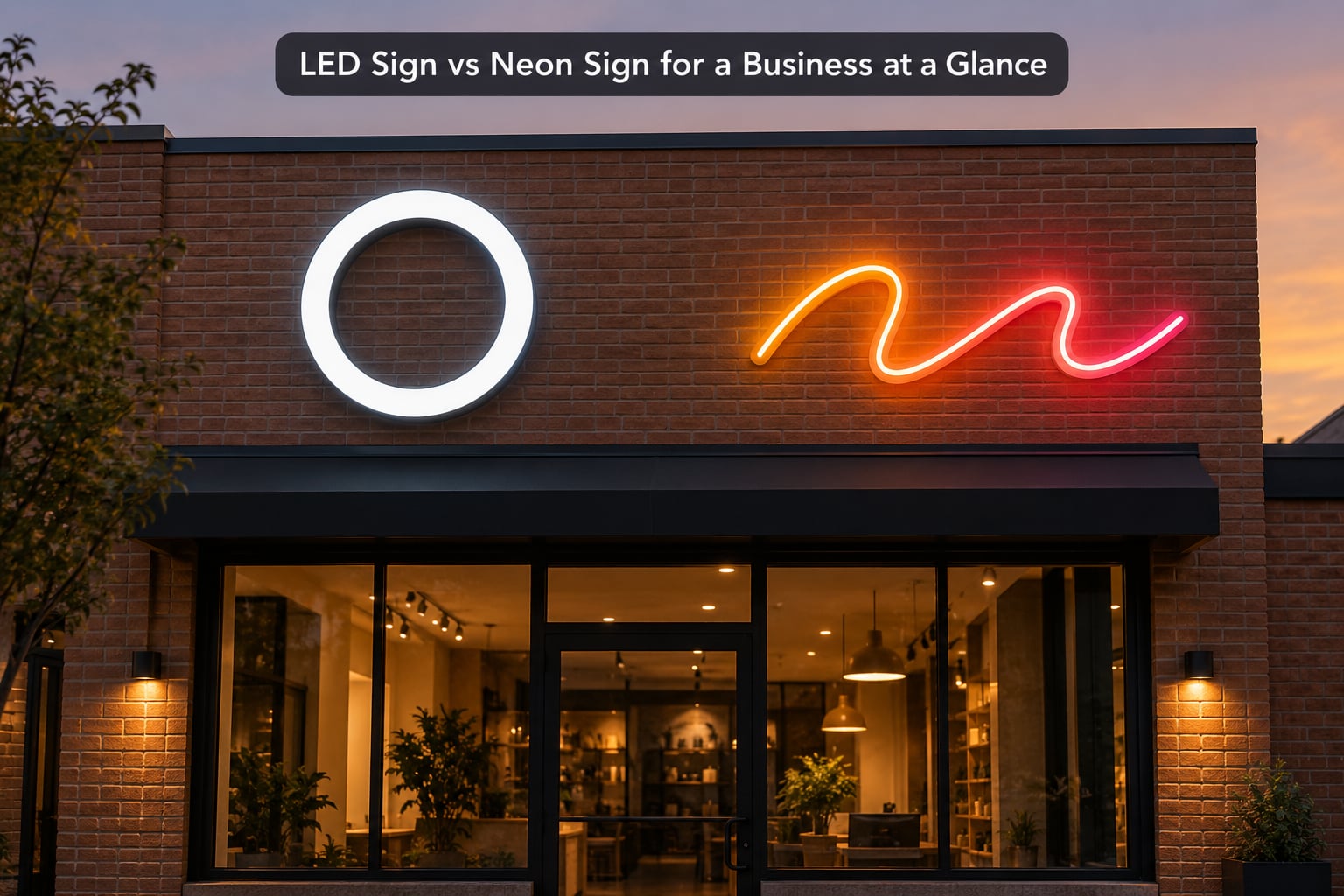
The table below is the short version. LED illumination is a solid-state semiconductor running at low voltage, while real neon is a gas-discharge lamp: high voltage pushed through a hand-bent glass tube filled with an inert gas, which glows a characteristic color. Everything else follows from that difference.
| Factor | LED signage | Real neon signage |
|---|---|---|
| Appearance | Crisp, even illumination across the whole letter face | Saturated glow with a soft halo, strongest at the tube center |
| Daytime visibility | Very strong, since brightness is high and consistent | Depends on ambient light; the glow washes out in direct sun |
| Night brightness | Bright, even, dimmable with a timer or dimmer | Bright core, warm bloom, brightness fixed by the transformer |
| Energy use | Uses up to 80 percent less electricity than comparable neon | Higher draw, and a transformer that idles as a small constant load |
| Upfront cost | Lower, largely driven by fabrication and electrical work | Can run up to three times the cost of a comparable LED sign |
| Rated life | Commonly cited at 20,000 to 50,000 rated hours depending on spec | Quoted anywhere from 3-5 years to 8-15 years by quality and upkeep |
| Maintenance | Low: modular units swap out, no gas, no high voltage | Higher: gas leaks, dimming tubes, electrode burn-out, tube replacement |
| Outdoor suitability | Weatherproofed options, cool to the touch, shatter resistant | Tough glass, but runs hot and needs a weatherproof cabinet outdoors |
| Best business use | Retail, offices, chains, salons, gyms, anything lit long hours | Bars, diners, cocktail lounges, studios, vintage retail |
One more practical point on appearance. A sign shop can build a hybrid: LED channel letters as the primary storefront sign, with a small LED neon flex accent piece behind a window or above a bar. That gives you the readable, efficient main sign and the warm glow in the exact spot where a photo gets taken.
How LED and Neon Signs Look to Customers
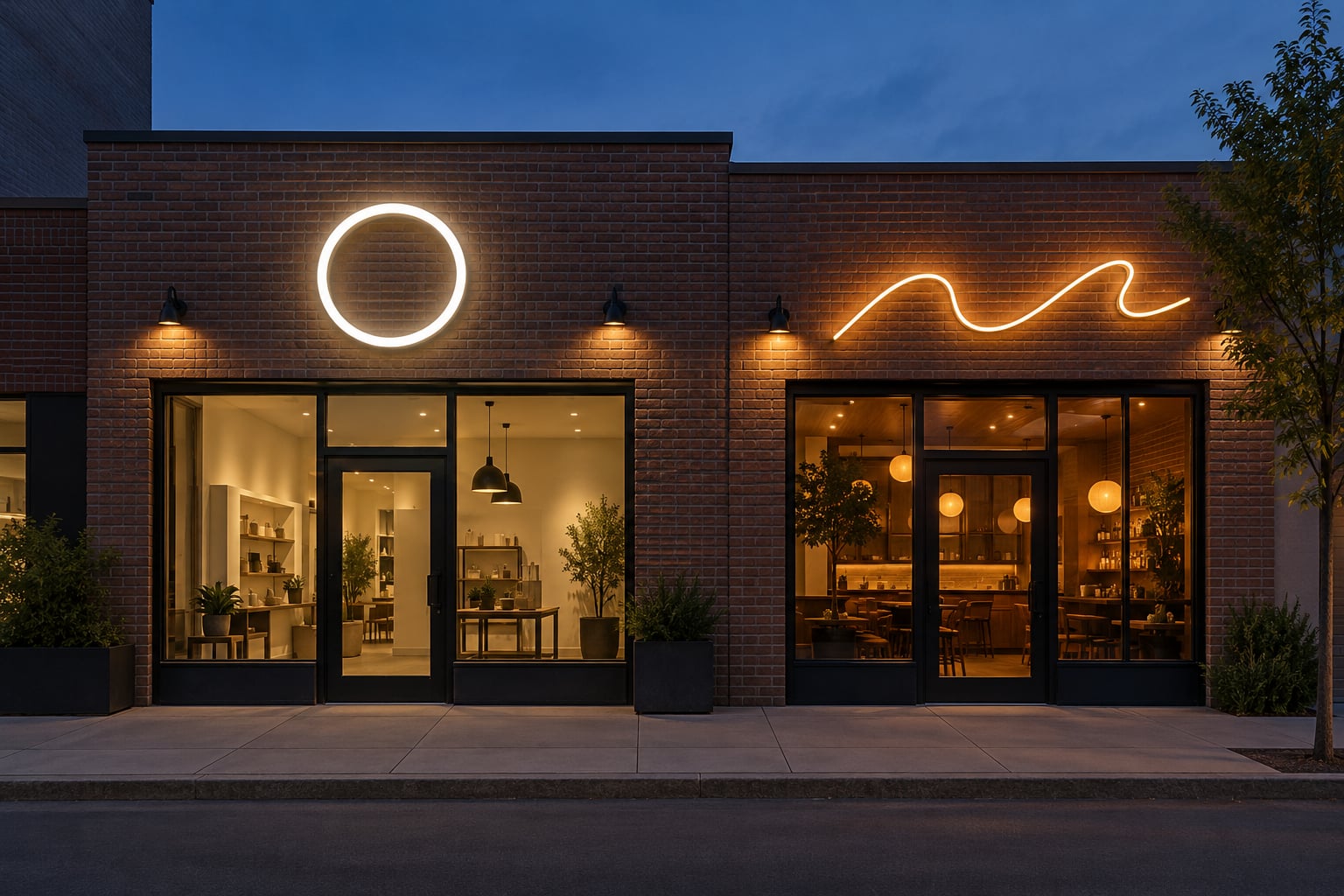
The honest difference is that LEDs fill a letter face evenly, while neon draws a bright line and lets the glass do the talking. Neither reads as more professional in the abstract. What changes the outcome is whether the glow matches what your business sells.
A clinic, an accounting firm, or a warehouse logistics office is asking for one thing: clarity from across the street. Flat, evenly lit channel letters do that without trying to be anything else. A cocktail bar, a 24-hour diner, or a vinyl record shop is selling atmosphere, and a warm halo in a dim room does work a flat white panel cannot.
How to tell if a neon sign is real or LED
Buyers ask this constantly, because plenty of listings labeled “neon” ship a flex strip. Four checks settle it fast.
- Look at the letter edges. Real glass tubing is round, with a visible tube outline and slight irregularities where a bender worked it by hand. Flex strip is flat ribbon tucked into a channel.
- Look for the color and the core. A single gas glows one saturated color, brightest along the tube itself. Flex strip often shows a whiter core with a colored edge, and RGB modules blend several diodes into one hue.
- Ask what powers it and check the plug. A real neon sign needs a high-voltage transformer, usually in a metal cabinet or a can with a thick lead. A low-voltage driver or a plain wall adapter means it is LED.
- Ask for the safety listing. A legitimate fabricator can produce UL listing or the equivalent for the finished sign, along with a written warranty that says what it covers. If a seller goes quiet on that question, the answer is usually already visible.
A coffee cart owner posting on r/SeattleNeonSigns put the real question better than any vendor page does: whether the sign moves foot traffic or just looks good in photos. That distinction matters, and I come back to it in the choosing section below.
LED Sign vs Neon Sign for a Business: Brightness and Visibility
Daytime is where LEDs pull clearly ahead. A channel letter sign lit at a consistent output stays readable in full sun and in an unshaded strip mall parking lot. Neon’s daytime performance depends on the sign having its own dark cabinet or a shaded mounting surface, because ambient light overwhelms the tube glow.
At night the gap narrows and the character difference widens. LED color is consistent across a whole face, which matters for brand colors and for multi-location consistency where a slightly different red on each storefront looks sloppy. Neon runs a little warmer and softer, and that is the quality buyers describe as nostalgic.
Glare works in both directions. An overly bright LED sign on a dark street can wash out its own message from a distance, and a timer or dimmer solves it. Neon brightness is set by the transformer, so the same issue needs a different fix.
Which Sign Type Uses Less Energy?
LED signage uses up to 80 percent less electricity than a comparable neon sign, and the reason is mostly electrical rather than clever engineering. An LED sign runs on a low-voltage driver, typically in the 12 to 24 volt range. A neon sign needs roughly 10,000 volts through the tube. Those two facts explain the efficiency gap, the heat difference, and most of the safety difference.
Here is the arithmetic in kWh rather than currency, so you can plug in your own rate. A medium storefront channel letter sign drawing about 60 watts, lit 12 hours a day, burns around 263 kWh a year. A comparable neon sign of similar output is commonly cited as consuming up to five times the electricity over the same hours, which puts it in the neighborhood of 1,300 kWh. Multiply by your local rate per kWh and by the number of signs on the property.
Two cases widen the gap. Businesses open long hours or around the clock see the difference accumulate fastest, since a diner, a bar, or a convenience counter running 18 hours a day is running the sign through most of its life. Businesses that dim or switch the sign off at closing stop paying entirely.
Neon also carries a hidden standby load. The transformer draws a small amount continuously, and a dimming or failing tube often pushes the whole sign to a higher draw as more of the gas is working. A transformer near end of life is a common reason a customer describes their old sign as suddenly expensive to run.
LED Sign Cost Compared With Neon Sign Cost
Upfront, LED is generally the cheaper of the two, and one industry source puts a comparable neon sign at up to three times the cost of an LED sign. That multiple comes from labor, not from the light source itself, which is why it varies so much between quotes.
What actually drives LED sign cost:
- Letter count and fabrication method. Individual fabricated channel letters, or a routed panel with applied faces, cost very different amounts. A full custom typeface increases the fee further.
- Face material and lighting method. Front-lit faces, halo-lit returns, and backlit translucent panels each price differently, and halo lighting needs the housing depth to be right.
- Electrical work. A new circuit, a longer run from the panel, or a wall that cannot take the surface mount will often cost more than the sign itself. This is the line item that surprises first-time buyers.
- Dimming, timers, and controls. A photocell, timer, or dimmer adds hardware and programming.
- Permitting and code work. A permit submittal and any structural or electrical inspection costs time and fees.
What drives neon sign cost:
- Hand-bending labor. A real tube is bent over a flame by a craftsperson, letter by letter, and complex scripts or logos consume hours that a machine-cut LED face does not.
- Transformer and cabinet hardware. The high-voltage transformer, the electrode housings, and a weatherproof cabinet for outdoor mounting all add parts.
- Tube count and color count. Each separate color needs its own circuit. A two-color piece is a different job than a one-color one.
- Repairability planning. Well-made neon is designed to be serviced, which is a real cost benefit later, but it is not free at the fabrication stage.
Here is where the five-year view changes the picture. A buyer comparing only the sticker price ignores three running costs: electricity, service visits, and replacement. An LED sign that is cheaper to buy and cheaper to run usually stays ahead over any realistic ownership period, which is the argument most vendor pages make.
The nuance is that the comparison stops being about electronics when the sign is small, indoor, and only on during evening hours. In that case the fabrication labor gap on real neon may be the only number that matters much, and the operating cost difference over five years stays modest. The math changes completely for a street-facing sign burning 16 hours a day.
For a business that already owns a working neon sign, ask about a retrofit before you ask about replacement. Converting an existing neon housing to LED is an established service, keeps your cabinet and mounting hardware, and typically costs far less than a new sign of the same footprint.
Maintenance, Lifespan, and Outdoor Durability
The lifespan figures floating around vendor pages contradict each other, so it helps to separate two different claims. Rated hours are a laboratory figure for the light source. Calendar years are a field outcome that includes weather, heat, power surges, and maintenance decisions. A 50,000-hour rating and a 20,000 to 40,000-hour expectation are both common, and neither is dishonest; they measure different things.
Neon figures diverge even more widely, from 3-5 years in the pessimistic telling to 8-15 years for well-made glass with regular tube replacement. Both ends are real. A sign that runs hot, sits in direct sun, and never gets serviced drifts toward the low end. The same sign with a tube changed every few years in a shaded, ventilated mount sits comfortably at the high end.
Failure modes differ sharply. On an LED sign, the usual failure is a power supply or a bank of diodes going out, which on modular signage means a technician replaces a module rather than the whole face. An installer on r/signshop made the related point about cheap panels: a large sign bought online as a single rigid panel is one unit, so one internal failure can take the whole thing dark. Ask whether the sign is modular.
On a neon sign, the common complaints are gas leaks that cause uneven or flickering color, electrodes that burn out, sections that dim, and transformers that fail. Repairs are doable but they need a shop with the right equipment.
Outdoors, both types are affected by climate in ways people forget. Salt air along the coast corrodes hardware and transformer housings. Desert heat drives transformer temperature. Freeze-thaw cycles work sealant joints loose. LEDs still have the easier time outdoors since they run cool, carry no gas, and use shatter-resistant materials, but neither type is maintenance-free and both want a scheduled look at gaskets, connections, and drivers.
One more repairability note, and it runs in neon’s favor. A damaged glass tube can be replaced in place. A bent, weather-cracked LED panel often means replacing a whole section. For a long-lived sign on a hard-to-reach facade, that difference can matter.
Customization, Colors, and Design Flexibility
Where LED is more practical, it wins on flexibility. RGB modules let one sign display a rotating brand palette or an animated message, and any color in any quantity without a new circuit. Logos of nearly any shape can be cut, printed, or routed, and a sign can be replicated exactly across multiple locations, which matters for franchises and retail chains.
Neon is more limited electrically and more capable visually. A script word, an illustration, or a single continuous line drawing is straightforward in glass and awkward in LED, because flex strip has to follow a path without kinking or leaving a dead seam. That hand-made quality is often the reason a bar or a salon pays for it, and it is not a compromise.
Both handle scale well, though large runs of glass need more transformers and more careful tube spacing. For very large monument or pylon signage, LED is usually the only realistic option at a sensible budget.
Which Sign Is Better for Different Businesses?
Matching the sign to the business is more useful than matching it to a technology. Here is how the decision usually lands.
| Business type | Usually the better fit | Why |
|---|---|---|
| Retail storefront | LED channel letters | Daytime legibility, brand color accuracy, multi-location consistency |
| Bar or cocktail lounge | Real neon, or neon-look accent | The glow is part of the room’s atmosphere, not just a wayfinding tool |
| Restaurant or diner | Either, hybrid is common | Readable primary sign, warm accent for the window or entry |
| Coffee shop or mobile cart | LED, weatherproofed | Low power draw, survives being moved and plugged into temporary setups |
| Salon or spa | LED neon flex, either look | Soft curves and script read well, and interior use keeps cost low |
| Gym or fitness studio | LED | Long hours, low maintenance tolerance, bold readable branding |
| Office or lobby | LED, possibly halo-lit | Clean finish, precise brand colors, discreet integration |
| Clothing or record shop | LED neon flex | Stylized look at a manageable cost, easy to change when the brand shifts |
Regional conditions nudge these answers. A coastal business should insist on corrosion-resistant hardware and a sealed transformer. A business in a hot climate gets more fan attention on the enclosure. Anywhere with strong winter temperature swings needs a mounting detail that tolerates expansion.
How to Choose the Right Sign for Your Business
Once you know the product type, the decision is mostly measurement and honesty. Work through it in this order.
- Measure the viewing distance. Stand where your customers actually approach from and look at the wall. Set a viewing distance rule of thumb: roughly 10 feet of readable distance per inch of letter height for a driver, closer to 3 feet for pedestrians near a doorway. If your letters are small and viewed from the street, that pushes you toward LED brightness.
- Decide what job the sign does. Identification and credibility point to LED. Atmosphere and a memorable photo in front of the window point to neon. Both, and the hybrid is the answer.
- Count your hours. Write down when the sign is on. Long hours make the energy difference material. Short hours make it a rounding error against fabrication cost.
- Check the power and the rules. Confirm the circuit can carry the sign, and check your local sign ordinance. Permits are commonly required for illuminated exterior signage, and rules often cover size, brightness, projection, historic districts, and flashing or animated content. Your city or county planning and building department is the authority, and the answer changes by jurisdiction.
- Get two or three written quotes with the same specification. Ask each vendor: Is this real glass or LED flex. Is the sign modular. What is the rated life, with the basis stated. What does the warranty cover, for how long, and who services it. Do you handle the permit. Can you show the safety listing.
On measuring return, be careful what you promise yourself. A sign is first a visibility and brand-consistency play, and no vendor can honestly promise a foot traffic number. What you can do is ask new customers how they found you, keep a simple tally for a quarter, and compare against the same period last year. One r/SeattleNeonSigns poster framed the right question as whether the sign earns its place beyond looking good in photos, and that is the test worth applying.
For a temporary or mobile setup, weight, power access, and weather sealing matter more than anything on this list. A folding table at a market needs a sign that draws little current and survives being moved, which is a very different brief from a permanent facade sign.
Which Should You Choose?
Choose LED if your sign is read at a distance, burns long hours, faces weather, needs to match a brand color precisely, or has to look the same at every location. It gives you the lower purchase cost, the lower running cost, the cooler running temperature, and the smaller number of service visits.
Choose real neon if the glow is part of what you sell, if you have a script word or a one-line drawing that flex strip cannot follow cleanly, or if your brand is built on a retro, handcrafted, or nightlife look. Accept the higher fabrication cost, the transformer, the running heat, and the need for a shop that can service tubes.
And consider both at once. Most sign shops now lead with LED and add a neon-style accent where it earns its keep, and that combination satisfies the readability requirement and the atmosphere requirement without compromise.
Frequently Asked Questions
LED sign vs neon sign for a business: which should you pick?
It depends on three things. For readability from a distance, long operating hours, low electricity use, weather resistance, and consistent brand colors, LED is usually the better choice. For a warm retro glow, hand-bent script, and an atmosphere-driven brand, real neon is often worth the extra cost. Most sign shops now combine them: LED channel letters for the main sign plus a neon-style accent indoors.
Why don’t businesses use neon signs anymore?
Cost and maintenance drive the shift. Real neon needs hand-bending labor, a high-voltage transformer near 10,000 volts, and periodic tube replacement, and it can cost up to three times a comparable LED sign. Many listings sold as neon are LED flex, which is cheaper to buy and simpler to install. That said, genuine neon is having a revival in bars, diners, salons, and studios where the retro look is deliberate.
How can I tell if a neon sign is real or LED?
Check four things. Real glass tubing is round with a visible tube outline and slight hand-bent irregularities. A single gas glows one saturated color brightest along the tube, while flex strip often shows a whiter core. Real neon is powered by a high-voltage transformer in a metal cabinet, not a low-voltage driver or a wall adapter. And a legitimate fabricator will produce a safety listing and a written warranty.
Are neon signs energy efficient?
Compared with LED, no. An LED sign uses up to 80 percent less electricity, and the reason is electrical: LED runs on roughly 12 to 24 volts while real neon needs high voltage to excite the gas in the tube. A neon transformer also draws a small constant load, and a sign with failing tubes can draw more. For a sign lit 12 to 18 hours a day, that gap is worth calculating on your own rate.
Do I need a permit for an illuminated business sign?
Often yes, and rules vary by city, county, and zoning district. Most local authorities regulate illuminated exterior signs for size, brightness, projection into the street, flashing or animated content, and placement, with extra rules in historic districts. Your city or county planning and building department is the authority to ask. Include the permit submittal and any electrical inspection in the quote so you compare vendors on the same scope.
How much does a neon sign cost to make?
The biggest cost driver is hand-bending labor, since a craftsperson forms each letter over a flame, and complex scripts or logos take the longest. Transformer and electrode hardware, cabinet and weatherproofing, and the number of separate colors each add cost. The energy difference is the other half of the picture: over five years, a sign that burns long hours will cost more to run as real neon than as LED.
Conclusion: Start With Visibility and Brand Goals
The LED versus neon decision gets easier once you stop treating it as a technology question. Measure the wall and the viewing distance first, because that sets how much brightness you need. Then decide whether the sign is doing identification or building atmosphere, since those point at different products.
Once those two are settled, compare the total over five years rather than the invoice on day one, add up electricity, service visits, and the value of keeping the sign, and make sure every quote you gather specifies the same product and the same scope including permits and electrical work. If a quote cannot tell you whether it is real glass or LED flex, it is not finished.
Ask two or three qualified sign companies for the same written specification, and read the warranty line closely. That is a short afternoon of work, and it is the difference between a sign that serves the business for a decade and one that becomes a distraction in year three.