
You can learn how to read an insurance policy without a lawyer, and for most situations the contract itself is enough. An insurance policy is a contract: you pay a premium, and the insurer promises to cover specific losses subject to the limits, exclusions and conditions printed in the document. Work through it in a fixed order, starting at the declarations page, and the first pass takes most people under two hours.
The order matters more than the reading speed. Policyholders who get hurt are rarely slow readers. They read the brochure, or they read the coverage summary and stop, and the clause that decides the outcome sits on page 40 under a heading that looks like boilerplate.
One more thing worth saying early: the policy document is the contract, not the sales quote and not what an agent said on the phone. People post on insurance forums again and again that the verbal explanation they got did not match the wording on the page, and the wording is what governs.
Table of Contents
- What You Need
- Step-by-Step: How to Read an Insurance Policy Without a Lawyer
- 1. Start With the Declarations Page
- 2. Identify What the Policy Covers
- 3. Check Exclusions and Limitations
- 4. Understand Deductibles, Limits, and Copayments
- 5. Read Definitions, Conditions, and Endorsements
- 6. Review the Claims and Cancellation Rules
- Common Mistakes
- Frequently Asked Questions
- Do I need a lawyer to understand an insurance policy?
- What is the most important part of an insurance policy to read first?
- What is the difference between a coverage limit and a deductible?
- Can an insurance company deny a claim because of an exclusion?
- How do I know whether an endorsement changes my coverage?
- When should I ask a lawyer or insurance professional for help?
- Conclusion
What You Need
Before you start, gather the full contract. Most people only ever receive the declarations page and a marketing summary, which is like reading the table of contents and skipping the book.
- The complete policy booklet, including every endorsement and rider listed on the declarations page. Ask your insurer or agent in writing for the full contract including all forms and endorsements. If an endorsement named on the dec page is missing from what you receive, ask again, because a missing endorsement is a real problem when a claim happens.
- Your own details to check against: driver licenses, vehicle VINs, the mortgage holder on the property, the names of everyone living in the house, an inventory of high-value items.
- A highlighter or a pencil and about two hours. This is not a skim.
- A phone calculator for the deductible arithmetic.
- The previous year’s declarations page, if this is a renewal. Renewal packets often change limits, deductibles and endorsements without any obvious notice.
- A reference glossary. A decent insurance glossary is more useful than trying to decode the wording cold.
Keep the complete contract somewhere you can reach it in a hurry. People who store a digital copy of the full policy, including endorsements, tend to file claims faster because they are not searching email attachments while the adjuster waits.
Step-by-Step: How to Read an Insurance Policy Without a Lawyer

Here is the read order that works for home, auto, renters, life and disability policies. The names differ by carrier, the sequence does not.
| Section | What it does | What to check | Where it is |
|---|---|---|---|
| Declarations page | Lists the terms specific to your policy: dates, people, property, limits, deductibles, premium | That it matches your current situation and lists every endorsement | Page 1 |
| Insuring agreement | States the broad promise to pay and points to the rest of the form | The form number, since HO-3 and HO-5 behave differently | Early, after the declarations |
| Definitions | Controls what single words mean throughout the policy | Named insured, occurrence, peril, residence premises, business | Before the coverage sections |
| Coverages | Grants coverage and sets the limits | What each coverage pays for and its dollar limit | Property section, auto Part A, life benefit section |
| Exclusions | Removes coverage for listed causes, property and people | Anything matching your situation, and the exceptions to the exclusion | After the coverages |
| Conditions | Your duties and the insurer’s deadlines | Notice requirements, proof of loss, cooperation, suit limitation period | At the back of the property section |
| Endorsements | Add, remove or change the base form | Anything on the dec page list, and anything at the back that overrides coverage | End of the booklet |
1. Start With the Declarations Page
The declarations page is your policy’s index card, and it controls. Everything else in the booklet is generic language that this page personalizes.
Read it line by line and confirm six things. First, the policy period and the effective date. Second, the named insureds, meaning the people or entities covered, because a roommate or a partner is often not a named insured unless the form says so. Third, the insured property or vehicles, matched against what you actually own and drive right now.
Fourth, the coverage limits and deductibles for each coverage. Fifth, the premium and the payment plan. Sixth, the list of forms and endorsements attached, with a number next to each one. That last line is the one people skip, and it is the one that tells you what the base form was changed into.
Result of this step: every line on the declarations page describes your current situation. If a vehicle is missing, a spouse is missing, or an endorsement is listed that you have never seen, stop and get it corrected before you close the packet.
2. Identify What the Policy Covers
Coverages come in two shapes, and telling them apart saves hours. A broad grant describes an entire category, while a specific grant lists precise causes or events. The broad one is easy to read and easy to skim past. The specific one is where the fine print lives.
On a homeowners form, the four main coverages sit in a relationship that catches people. Coverage A is the dwelling, and the other three are usually written as a percentage of it: Coverage B for other structures commonly at ten percent of A, Coverage C for personal property at fifty percent, and Coverage D for loss of use at twenty percent. If Coverage A is 300,000 dollars, that default structure puts you at roughly 30,000, 150,000 and 60,000 dollars.
Then there is the perils question, and it is the biggest technical difference in a home policy. Coverage A and B are typically open perils, which means they respond unless a peril is specifically excluded. Coverage C for personal property is usually named perils, a list of sixteen named causes. If your loss is not on that list, and no additional coverage applies, Coverage C simply does not respond, no matter how generous the limit looks.
The consequence is practical. Open perils put the burden on the insurer to show the loss was excluded. Named perils put it on you to show the loss qualifies. On an auto policy the split is different again: liability coverage responds to an accident for which you are responsible, collision covers physical damage to your vehicle from a collision, and comprehensive covers everything else, mostly theft, glass, hail and animals.
Result of this step: you can name each coverage, its limit, and the trigger that has to happen for it to pay.
3. Check Exclusions and Limitations
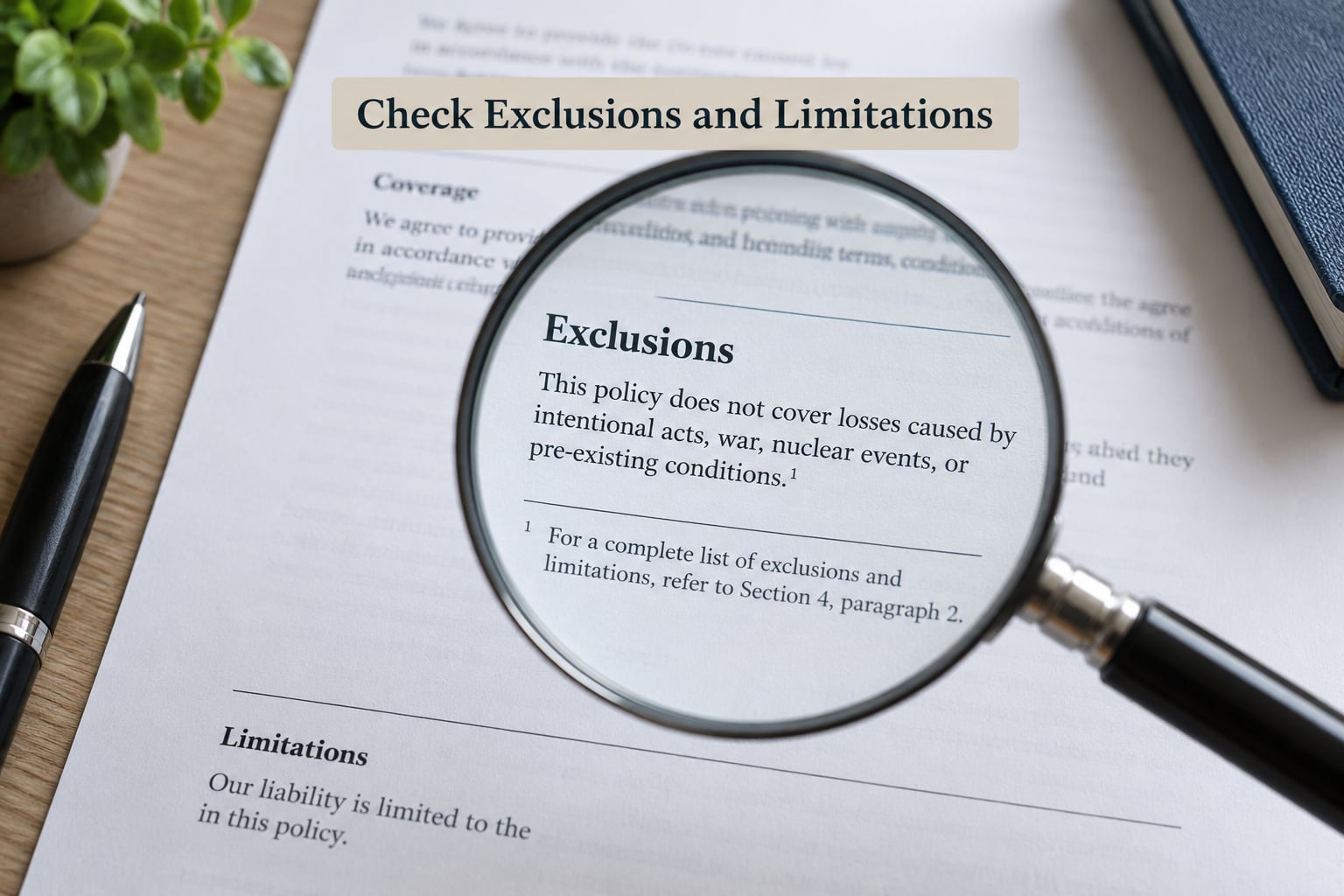
Exclusions are the part of the contract most likely to change a claim outcome, and they are written as long lists of things that sound reasonable until you notice your own situation in the wording.
Read each exclusion heading, then keep reading. After the list of excluded causes there is usually a paragraph of exceptions, which are carve-backs that restore coverage in narrow situations. Here is where claims actually break down: a policy excludes flood damage, so water damage is out, but a separate exception restores coverage when the flood causes a gas line rupture and the resulting explosion damages the house. Stopping at the exclusion heading is how policyholders end up surprised.
Then follow the cross-references. If an exclusion says something is not covered when caused by, maintained in, or occurring on a defined location, the definitions section decides what that phrase means. Home-based business equipment is a classic: Coverage C pays for personal property including business property, but if the policy defines business as any trade or profession, full or part-time, equipment owned by a business is arguably not personal property at all, and the loss is not even reaching the coverage grant.
Limitations work the same way. Special limits of liability cap jewelry, firearms, cash, securities and collectibles far below the overall personal property limit. A 6,000 dollar engagement ring under a 150,000 dollar Coverage C limit can be limited to a jewelry sub-limit of 1,500 dollars, which surprises more policyholders than any other number in the document.
Result of this step: for each exclusion that touches your life, you know the exception, the sub-limit and the defined term it depends on.
4. Understand Deductibles, Limits, and Copayments
A limit is the most the insurer will pay. A deductible is the part of the loss you keep. They do different jobs, and the order they apply in is usually fixed.
Take a 1,000 dollar deductible and a 5,000 dollar covered loss. Under a typical property policy the insurer pays 4,000 dollars and you absorb the first 1,000. Raise the deductible to 2,000 and the same loss costs you 2,000. That is the entire trade, and you can price it yourself by asking what the premium difference is between the two options, then deciding whether the lower premium is worth the extra exposure.
Watch which kind of deductible applies. A per-occurrence or per-incident deductible applies once per loss event. An annual deductible, common in health and auto with a deductible-accumulator endorsement, applies once per policy year no matter how many claims you file.
Coinsurance is the less familiar one. On commercial property and some homeowners forms, you are required to carry insurance equal to a stated percentage of the property’s value, often eighty percent. If you fall below that threshold, some forms reduce the settlement proportionally, which can turn a covered loss into a painful one. The rule is a percentage, not a dollar figure, so it shifts with the value of the property.
Copayments and out-of-pocket maximums show up mostly in health and disability policies, where a plan pays a share of each covered expense up to an annual ceiling. Loss settlement is the term that decides whether a property claim pays replacement cost or actual cash value, and it appears in the coverage section, not the definitions.
Replacement cost pays for a new item of like kind and quality. Actual cash value pays for the item minus depreciation. On a four-year-old sofa, that difference is real money, and the loss settlement provision decides which one applies to your property coverage.
Result of this step: you can calculate your out-of-pocket on a sample loss, and you know whether your coverage pays replacement or depreciated value.
5. Read Definitions, Conditions, and Endorsements
These three parts do the deciding work, and they are where the contract quietly becomes specific.
Definitions control meaning. A word means what the policy says it means, not what it means in a dictionary. Named insured is the person or entity named on the declarations page. An additional insured is a person added by endorsement or by another party’s contract. Occurrence is typically an accident or series of accidents that is neither expected nor intended. Peril is the cause of loss. Insured value is the number in the schedule, which may be very different from what the item is worth today.
Conditions are duties, and a breach can matter. Notice of a loss within a stated period. Proof of loss, a signed statement of the damage, within a stated period. Cooperation, including appearing for an examination under oath. Reasonable steps to prevent further damage. Most policies also carry a suit limitation period, the contract deadline for filing suit, which is short enough that people miss it while they are still gathering documents.
Endorsements sit at the back and they override the base form. That is the rule that catches people most often: a roof surfacing endorsement can reduce roof damage to actual cash value, a water backup endorsement can add coverage that the base form excludes, and an exclusion of business property can be overridden by an endorsement adding it back. When the endorsement and the main form disagree, the endorsement wins.
Result of this step: every endorsement is read against the coverage it changes, and every condition is on a list you can follow.
6. Review the Claims and Cancellation Rules
The conditions section also tells you how the claim actually works, and reading it before a loss is the entire point.
Note the notice deadline and how notice is given, since a phone call may not be what the form requires. Note what documentation you must provide, including whether receipts, repair estimates or a proof of loss form are needed. Note any duty to mitigate, meaning reasonable steps to limit the damage, and that failing to act can reduce what you recover.
Then work out the dispute path in advance. If a claim is denied, ask for the denial in writing with the specific policy provision cited, since a denial letter has to identify the clause or the reasoning behind it. Insurers have an internal appeal process and a regulator complaint process available to you, and a suit limitation period ticking the whole time.
Renewal and cancellation rules live here too. Most policies renew for another term unless notice is given, and nonrenewal and cancellation for a claim are treated differently in the law, which varies by state.
Write this one-page checklist and keep it with the policy: policy period and contacts, named insureds, the limits for each coverage, the deductible for each coverage, the top five exclusions that affect you and their exceptions, the sub-limits for jewelry, cash, firearms and collectibles, every endorsement with its number, the notice deadline and proof of loss deadline, and the suit limitation period.
Result of this step: a single page that tells you what you have, what you do not, and what you owe after a loss.
Common Mistakes
These are the errors that show up again and again, and each one has a straightforward correction.
Reading only the premium. The premium tells you the price, not the coverage. Two policies with identical premiums can carry completely different limits and exclusions. Correction: read the limits and deductibles on the declarations page before you compare anything at renewal.
Assuming a standard form applies to your situation. HO-3 and HO-5 are not the same policy, and personal property is usually on named perils regardless. Correction: check the form number printed on the declarations page, because that number determines the terms.
Skipping the definitions. This is the mistake that decides claims. A single defined term, business or residence premises or usually located, can be the whole reason coverage does not apply. Correction: read the definitions section before the coverage sections, not after.
Confusing a limit with what the insurer will pay. A large personal property limit does not mean the insurer pays the full value of a large loss, because the deductible comes off the top and sub-limits cut specific categories down. Correction: pair every limit with its deductible and its sub-limits on your checklist.
Stopping at an exclusion heading. The exceptions underneath can put the coverage back. Correction: read two paragraphs past every exclusion that concerns you.
Treating an agent’s verbal answer as binding. It is not. The policy wording governs, and coverage differs between carriers enough that generic advice often does not transfer to your form. Correction: get important answers in writing and ask whether the answer matches the wording on the page.
Reviewing the policy only after a loss. At that point nothing can be changed. Correction: review at renewal, photograph the declarations page, and document your possessions and serial numbers while you are well.
Frequently Asked Questions
Do I need a lawyer to understand an insurance policy?
No, not for the first read. The structure is standard across carriers, so a careful non-lawyer can follow the declarations page, coverages, exclusions and endorsements and get a solid understanding. What a general reader cannot do is interpret an ambiguous clause, argue a disputed interpretation, or file suit. Save the professional for those situations.
What is the most important part of an insurance policy to read first?
The declarations page. It is usually one or two pages, it controls the rest of the contract, and it gives you policy dates, named insureds, insured property, limits, deductibles, premium and the list of endorsements. If the declarations page does not describe your situation accurately, nothing after it will matter.
What is the difference between a coverage limit and a deductible?
The limit is the most the insurer will pay for that coverage. The deductible is the portion of a covered loss you pay yourself, and it is subtracted from what the insurer pays. A 1,000 dollar deductible on a 5,000 dollar covered loss with a 300,000 dollar limit means the insurer pays 4,000 dollars, because the limit is never the deciding factor.
Can an insurance company deny a claim because of an exclusion?
Yes, an exclusion is one of the most common reasons a claim is denied, alongside failure to meet a condition or falling outside the coverage trigger. A valid exclusion must actually apply to your loss and must survive any exception that restores coverage. Denial letters have to identify the provision relied on, which is the provision you look up first in the policy.
How do I know whether an endorsement changes my coverage?
Start with the declarations page, which lists every endorsement by number, then find each one at the back of the booklet and read what it adds, removes or changes. Endorsements override the base form wherever the two disagree. If the declarations page names an endorsement you were never given, request the complete policy again before assuming you have full coverage.
When should I ask a lawyer or insurance professional for help?
Get professional help when a large claim is denied, when the interpretation of a clause is genuinely disputed, when the amount in dispute is high relative to your limits, when the suit limitation period is close, or when the policy language is technical in a way you cannot resolve yourself. A public adjuster, who works for you rather than the insurer, is often the more proportionate first step.
Conclusion
Start at the declarations page and confirm it matches your life. Then mark four things as you go: what each coverage covers, what is excluded and what exceptions restore it, what each limit and deductible means in a real loss, and what each endorsement changes.
You can do all of that without a lawyer, and you will understand your coverage better than most policyholders do. When a legal interpretation stays unclear or a large claim is denied, contact the insurer in writing first, then a licensed professional or a public adjuster. Rules and forms vary by state and change over time, so treat this as a reading method rather than legal advice.