Yes, a roof’s age affects home insurance more than most homeowners expect. When you apply and again at each renewal, your carrier pulls the roof’s approximate age and condition and uses it to set the premium, decide whether a physical inspection is required, choose between replacement cost and actual cash value settlement, or decline to write the policy at all. A roof that is simply old is not automatically uninsurable, but it can quietly change what a claim pays out and how much coverage costs you.
The reason is practical rather than technical. The roof is the home’s first line of defense against water and wind, and its age is a fast, objective signal of how likely a large claim is. That makes roof age one of the simplest numbers an underwriter can pull and one of the heaviest weights in the file.
Everything below is general information. Rating rules, age cutoffs and even state law around roof age vary by carrier and by state, so treat the ranges here as a map rather than a quote for your own policy.
Table of Contents
- How a Roof Age Affects Home Insurance
- What Is Considered an Old Roof?
- Visible wear that ages a roof faster than the calendar
- Why Do Insurers Care About a Roof’s Condition?
- How Roof Age Can Change Your Premium and Deductible
- Does a New Roof Lower Home Insurance Costs?
- Will an Old Roof Be Insured?
- What Homeowners Should Do Before Renewing
- How Roof Age Is Related to Claims and Coverage
- Frequently Asked Questions
- Does the age of the roof affect homeowners insurance?
- How does my insurance company know how old my roof is?
- What is the actual cash value of a 20 year old roof?
- Is it better to have replacement cost or actual cash value?
- Is a 13 year old roof considered old?
- Should I buy a house with a 20 year old roof?
- What Homeowners Should Do First
How a Roof Age Affects Home Insurance
An older roof can raise your premium, force an inspection, shift your roof settlement from replacement cost to depreciated actual cash value, and in the worst case trigger a nonrenewal letter. Those four outcomes are the practical answer to how a roof age affects home insurance, and they arrive in roughly that order of severity.
- A higher premium. The underwriter prices in the likelihood of a claim over the next policy term, and a roof near the end of its service life carries more of that likelihood.
- An inspection requirement. Some carriers will take the file only if a licensed roofer or inspector certifies the roof is sound, and the cost of that report comes out of your pocket.
- Replacement cost downgraded to actual cash value. This is the one that hurts most at claim time, and it is covered in detail further down.
- Nonrenewal or cancellation. A carrier can decline to renew at the end of the term, and in some states it can cancel mid-term if the roof is a documented source of loss.
Age and condition are two separate inputs. A ten-year-old metal roof in good shape and a twelve-year-old composition roof with curled edges and bare patches are treated very differently, even though only two years separate them.
What Is Considered an Old Roof?
There is no single legal definition. Insurers work from bands built around a material’s expected service life, then adjust for observable wear.
| Roof age | How insurers typically treat it |
|---|---|
| Under 10 years | Routine underwriting. Usually full replacement cost, often an eligible discount for documented new construction or a reroof. |
| 10 to 15 years | Still comfortable for most carriers, especially with architectural shingles. Inspection requests start appearing in some markets. |
| 15 to 20 years | Borderline for composition shingles. Premiums often move off the preferred rate, and depreciation may start applying to roof losses. |
| 21 to 25 years | Frequently priced on actual cash value, inspected as a condition of renewal, or declined for new business. |
| 25 years and older | Many carriers will not write new policies. Existing policyholders are often nonrenewed, though a documented reroof reverses this quickly. |
Material changes the calendar. A roof being past the average life of its material is not automatically late, but it moves you into the band where underwriters start asking questions.
| Material | Typical service life | Insurance treatment |
|---|---|---|
| 3-tab asphalt shingle | 15 to 20 years | Least favored. The first thing to age visibly and the most common reason for a proof-of-replacement demand. |
| Architectural shingle | 20 to 30 years | More common on newer homes, usually acceptable into the mid-20s. |
| Metal | 40 to 70 years | Favored in hail and wind regions for its impact and uplift resistance. |
| Clay or concrete tile | 50 to 100 years | Long-lived, but weight and repair cost give underwriters pause. |
| Slate | 75 years and beyond | Effectively permanent, replacement cost very high per square foot. |
| Wood shake | 20 to 40 years | Penalized in many markets because of fire risk. |
Visible wear that ages a roof faster than the calendar
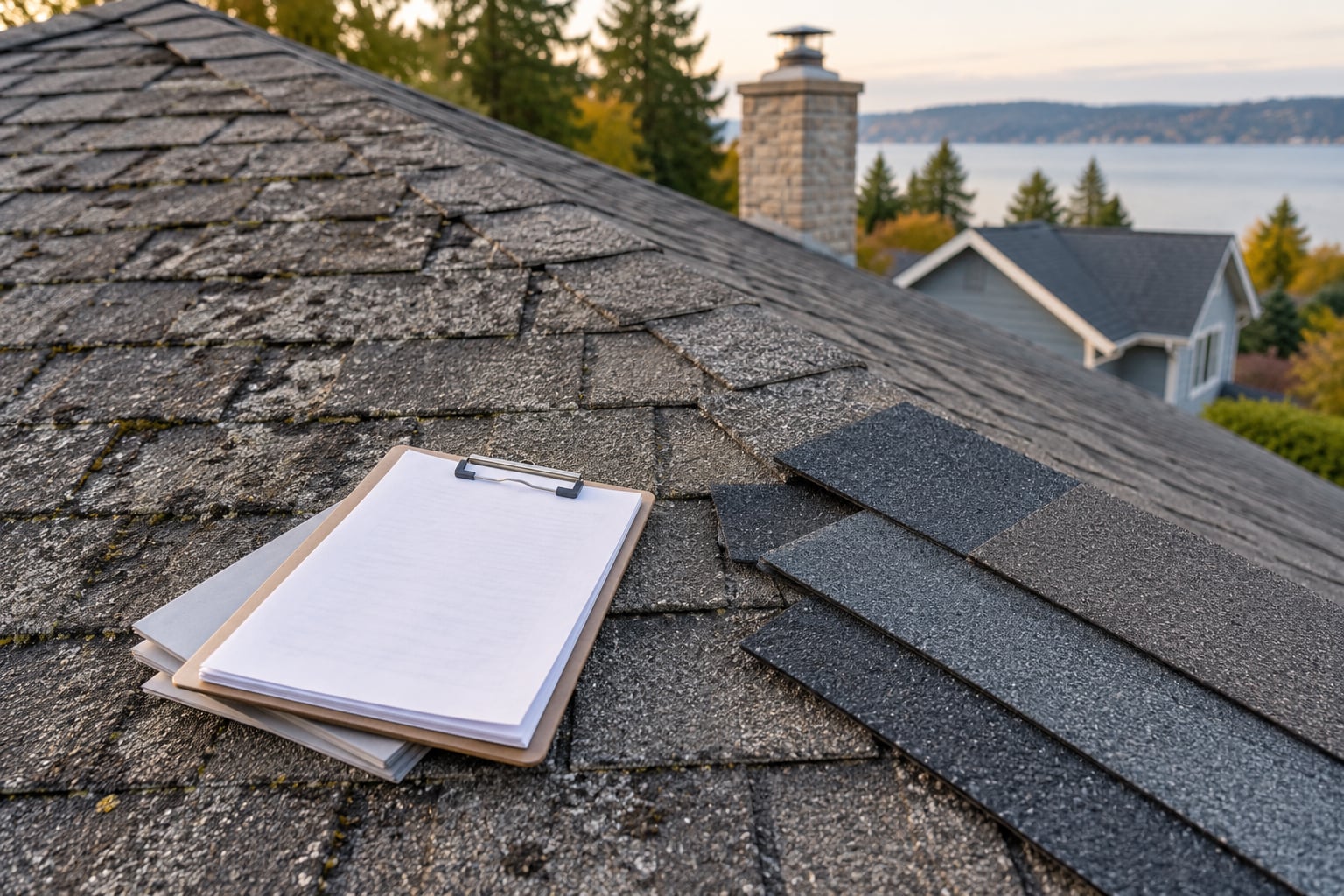
Condition can push a roof into an older band. Inspectors look for curled, cracked or cupped shingles, granule loss exposing the asphalt mat, nail pops, a sagging roofline between rafters, worn flashing around chimneys and vents, and staining on ceilings or rafters that points to past leaks. Any of those is worth a conversation with a roofer before your renewal, not after a denial.
Why Do Insurers Care About a Roof’s Condition?
Because roof failure is expensive, frequent and hard to scope before it happens. Water gets in slowly, damages sheathing and framing, and often shows up as mold and interior finishes long after the entry point. A roof at the end of its life also tends to fail in storms, which is exactly when claims cluster for a whole region at once.
Insurers also weigh how the roof handles specific perils. Impact-rated shingles and metal fare better in hail country. Certain materials and attachment methods perform better against wind uplift. Fire-retardant materials score better in wildfire zones, and that is why wood shake is often priced like a liability rather than an asset.
Maintenance history feeds the same file. A roof with documented inspections, prompt repairs and clear records tells an underwriter a homeowner who notices problems early, and that is a lower expected loss than an untouched roof of the same age.
How Roof Age Can Change Your Premium and Deductible
Roof age usually moves through rating tiers rather than a single surcharge. A carrier may quote a preferred rate for a newer roof, a standard rate once it passes a threshold, and a higher tier or a decline beyond a second one. A one-time fee for a roof inspection is also common at the margin.
Deductibles are where the change is often least obvious. Percentage deductibles are calculated on the covered loss, so a policy written at 2 percent behaves very differently from one at 5 percent on the same house. A carrier moving a roof from replacement cost to actual cash value may adjust the deductible or endorsement structure at the same time, and the two changes together can be worth far more than the premium increase alone.
Your state matters too. Florida law restricts how a carrier can act on roof age alone, and a handful of states run wind-mitigation or inspection programs that feed discounts back into pricing. Ask your agent whether your state has anything like that before you assume the worst from a neighbor’s story.
One thing worth knowing: agents quote different rules for the same roof because the rule belongs to the carrier, not the agency. An agent on r/InsuranceAgent laid out a common underwriting ladder across their book, with replacement cost at roughly nine years or less, actual cash value from 10 to 24 years, declining new business at 15 and up, and nonrenewal for existing business once a roof passes 25. That ladder is one carrier group’s experience, not a rulebook, but it shows how specific these cutoffs get.
Does a New Roof Lower Home Insurance Costs?
Sometimes, and often by less than the roof cost. The reliable benefits are the ones tied to the underwriting file: a documented reroof moves the roof out of the declining band, restores eligibility for full replacement cost settlement and can remove an inspection requirement. Those are worth real money if you ever file a claim.
The premium reduction is the uncertain part. Some carriers apply a modest credit, often in the low single digits as a percentage of the homeowners premium, and only once they see documentation. Others price replacement cost and the dwelling value instead of the roof specifically, in which case a new roof moves very little.
Homeowners on r/Insurance described replacing a roof, notifying the carrier and seeing no premium change at all. The notification still mattered for coverage terms, which is the practical argument for sending it. What to send: the contractor invoice with the date and scope, the building permit if one was pulled, photographs before and after, and a request in writing asking what the underwriter needs to update the file.
Will an Old Roof Be Insured?
Usually yes, at some cost. Roof age on its own rarely makes a home uninsurable in a state that restricts such decisions, and a sound roof can be written with an inspection, a higher premium or an actual cash value endorsement even when it is well past the average life of its material.
The outcomes you may actually face run from mild to severe. The premium moves to a non-preferred tier. The carrier requires a roof inspection before it will bind or renew. The roof is settled at actual cash value instead of replacement cost. Coverage is written with an endorsement that limits what a roof claim pays. Or, at the far end, the carrier issues a nonrenewal notice and the search for replacement coverage begins.
That last one is the real-world pain point. Homeowners on r/homeowners described receiving a letter saying coverage would be cancelled due to roof age unless they could show proof of replacement, sometimes on homes that were objectively not that old. A wrong reading of the records happens, which is why documentation matters, and why the response in the next section is an ordered process rather than a panic.
A nonrenewal is not the same as a cancellation. Nonrenewal happens at the end of the term, and state notice rules set the deadline for finding new coverage. Cancellation happens mid-term and is far more restricted. When a renewal notice arrives, read the date on it first and work backward from there.
What Homeowners Should Do Before Renewing
This is the checklist that changes outcomes most often, in the order I would work through it.
- Find the roof’s real age. Your county assessor record, the original sale disclosure and the building permit history are the three fastest sources. A 2008-built home with a 2016 re-roof permit tells you exactly what you need to know.
- Get the records in writing. Ask the carrier or underwriter which source they used and what age they recorded. Discrepancies are common and easy to fix while you still have time.
- Document maintenance. Inspection reports, repair invoices for leaks and flashing work, and gutter or ventilation upkeep tell an underwriter the roof was cared for.
- Arrange an inspection if one is required. Use a licensed roofer or inspector and ask for the report to name the material, the installation date if visible, the condition grade and the estimated remaining life.
- Get two or three replacement estimates. Having real numbers before you talk to an agent turns a conversation about a repair into a conversation about a budget.
- Ask the carrier how the roof is being evaluated. Which age, which material, which coverage form. The answer belongs in an email.
- Shop carriers before the renewal date, not after. Availability narrows sharply in a hard market, and an existing customer with a payment history is often treated better than a stranger with the same house.
Never misstate the roof’s age or condition to get a policy written or a claim paid. Misrepresentation is one of the few things that can void coverage retroactively, and it turns a bad year into a much worse one.
How Roof Age Is Related to Claims and Coverage
Underwriting and claim handling are separate processes, and keeping them apart removes a lot of confusion. Roof age decides the terms of the contract: the premium, the deductible, the inspection condition and whether the roof settles at replacement cost or actual cash value. It does not decide, on its own, whether a specific loss is covered.
Actual cash value is the value of the roof at the time of the loss, after depreciation. Replacement cost is what it costs to put a comparable roof in place today. The gap is the depreciation the insurer pays out.
Worked example: a composition roof installed 20 years ago at a replacement cost of 14,000. A typical shingle depreciation schedule steps down by age band, and by year 20 a 14,000 roof is often valued near 12,600. If a hail storm destroys it, the settlement is roughly 12,600 plus the deductible rather than the full 14,000 replacement cost. The same loss a year earlier pays materially more. On a reroof that runs 15,000 in a high-cost market, the owner absorbs the difference between what the policy pays and what the contractor charges.
Then there is the roof payment schedule, an endorsement most homeowners do not know they carry. It is exactly what it sounds like: a table that pays progressively less as the covered roof gets older, no matter what condition it is in. If your declarations page lists one, you have already agreed to that curve.
On a claim, age can still matter in a different way. Deterioration is a defense many carriers test, meaning they look for whether the loss came from a sudden covered peril such as wind or hail, or from wear that the policy excludes. Curling shingles and a long history of small leaks are the kind of evidence they use. Sudden storm damage on an otherwise sound roof is the case that pays.
Because that is a factual question about the roof, keeping current photographs and dated repair records is worth more than most people spend on a policy review.
Frequently Asked Questions
Does the age of the roof affect homeowners insurance?
Yes. Insurers treat roof age as a fast, objective signal of claim likelihood. An aging roof can raise the premium, trigger an inspection requirement, move roof settlement from replacement cost to actual cash value, or in the worst case lead to a nonrenewal notice at the end of the term. Cutoffs differ by carrier and state, but a composition roof past 20 years commonly draws closer scrutiny than one under 10.
How does my insurance company know how old my roof is?
Most often from records rather than a site visit. Underwriters check county assessor and building permit history, real estate and MLS sale records that mention a reroof, and aerial or satellite imagery. New business is often inspected, and some renewals get a licensed roofer report. If the record is wrong, ask which source they used and submit the permit or invoice that proves the real date.
What is the actual cash value of a 20 year old roof?
Actual cash value is the roof’s value after depreciation, not the cost of a new one. A composition roof installed 20 years ago at a replacement cost of 14,000 is commonly valued near 12,600, because shingle schedules step down by age band. That gap is what you absorb at settlement. A roof payment schedule endorsement can reduce the payout further, so check your declarations page.
Is it better to have replacement cost or actual cash value?
Replacement cost is better for most homeowners, because it funds a comparable new roof after a covered loss rather than a depreciated one. Actual cash value costs less in premium, and some carriers will not write a roof settlement on any other basis once a roof reaches a certain age. The choice is often made for you by underwriting rules, so ask which basis applies to the roof specifically, not to the whole dwelling.
Is a 13 year old roof considered old?
Generally not. A 13-year-old roof usually sits in the comfortable middle band for most carriers, especially if it is architectural shingles in sound condition. Age bands vary, but a common pattern treats under 10 years as routine, 10 to 15 as still fine, 15 to 20 as borderline, 21 to 25 as actual cash value territory, and past 25 as grounds for nonrenewal. Condition matters as much as the number.
Should I buy a house with a 20 year old roof?
It is a normal purchase, not a dealbreaker, and many owners replace a 20-year roof without incident. Price the remaining life into the offer, ask for the permit history to see whether it was already re-roofed, and get a roofer’s condition report before closing. In high-wind states, confirm you can obtain coverage at a reasonable cost before you are committed, since availability matters more than price there.
What Homeowners Should Do First
Start by establishing two facts: how old the roof actually is, and how your carrier is using that number. The first comes from permit and assessor records, the second from a written question to your agent or underwriter asking which age, which material and which coverage form sit in the file.
With those answers in hand, the repair-versus-replace decision becomes a budget conversation instead of a surprise. Document the maintenance while you are at it, and shop for coverage well before the renewal date so that a tight market does not decide for you.