Personal liability coverage on a home policy usually sits under the label Coverage E, and it pays for two things: bodily injury to another person and damage to somebody else’s property, when you or a covered household member is legally responsible. On top of that, it pays your legal defense costs, and in most policy forms it pays those defense costs whether or not you are ever found at fault.
That is the whole concept in a minute. What trips people up is the boundary around it: which injuries count, which damage counts, what gets excluded, and how far the limit stretches. Below is a plain-English walk through of what the coverage does, what it refuses to do, and how to check the version sitting in your own file.
One caveat before we start. Policy wording is set by state and by the form your insurer uses, so treat this as the general framework rather than a description of your exact contract. Your declarations page and the form’s exclusion section are what actually govern a claim.
Table of Contents
- What Personal Liability Coverage on a Home Policy Does
- What Does Home Liability Protection Usually Cover?
- What Personal Liability Coverage on a Home Policy Does When a Visitor Is Injured
- Does Personal Liability Coverage Pay for Damage to Your Own Home?
- Does Home Liability Coverage Cover Pets and Visitors?
- Does Personal Liability Coverage Cover Damage Caused Off the Property?
- What Personal Liability Coverage on a Home Policy Does Not Cover
- How Much Personal Liability Coverage Should You Have?
- How Does a Personal Liability Claim Work?
- How to Check and Improve Your Coverage
- Frequently Asked Questions
- Is personal liability included in every homeowners policy?
- Does personal liability coverage replace a deductible?
- Can a homeowners policy cover a dog bite?
- Is personal liability the same as umbrella liability coverage?
- What happens if a personal liability claim exceeds the policy limit?
- Does home liability coverage apply while I am renting out part of my property?
- Conclusion
What Personal Liability Coverage on a Home Policy Does
It protects your finances against the cost of being responsible for a visitor’s injury or for damage you cause to someone else’s property. It does not repair your own house. That separation is the part worth holding onto: Coverage A, B and C handle your dwelling and your belongings, and Coverage E handles the claims other people bring against you.
Two ideas sit underneath it. The first is premises and operations. Premises means your insured property, including the yard and anything attached to it. Operations means what you or a covered person does, wherever it happens. A contractor falling off a ladder on your driveway falls under both ideas at once, which is why that kind of claim still lands inside the coverage.
Who counts as covered matters as much as what happened. Usually that includes the named insured, a spouse, and resident relatives who are not separately insured elsewhere. A college student listed on the policy keeps coverage during breaks at home, but an adult child with their own renters policy generally does not.
Your pets are covered too, in a specific way. More on that below.
What Does Home Liability Protection Usually Cover?
Four situations come up again and again: somebody gets hurt while visiting, a pet causes an injury, you damage property that belongs to someone else, and somebody has to sue you. The coverage pays medical bills, lost wages, pain and suffering, death benefits where a person dies, repair or replacement of damaged property, and legal fees. What follows is the honest version, with the catch attached to each one.
| Situation | What the coverage may pay | The catch |
|---|---|---|
| A visitor slips on an icy step or trips on a broken railing | Medical bills, lost wages, pain and suffering, and legal defense | Only if the insurer can tie the injury to a hazard you knew about and failed to fix |
| A dog bites a neighbor or a delivery driver | Medical treatment, lost wages, and sometimes a settlement | Breed exclusions and prior-bite history can remove coverage entirely |
| A child breaks a neighbor’s window with a ball | Cost of replacing the glass | Damage to property you own or that is insured elsewhere never falls here |
| You knock down a neighbor’s fence with your car while parking | Repair costs and legal fees | Many car policies carry their own property damage liability, which is primary |
| A tree on your lot falls onto a parked car next door | Damage to the vehicle and any associated legal costs | The tree’s condition at the moment it fell decides whether negligence exists |
| A guest is injured at a party and demands money | Legal defense, then any settlement up to the limit | Small claims rarely reach a lawsuit, so notice is still worth filing |
| Someone is hurt while you are doing a paid or semi-paid activity | Possibly nothing | Business activity is a standard exclusion unless you bought business coverage |
Alongside Coverage E, most standard policies carry a small coverage called medical payments, usually labeled Coverage F. It pays a set amount to anyone injured at your property or in your care regardless of who was at fault, commonly 1,000 per person, and it exists mainly to handle small claims quickly without proving negligence.
The distinction matters more than it sounds. Coverage F is fault-free but tiny, so it disposes of minor injuries and never touches the big claims. Coverage E is fault-based and expensive, so it exists for the serious cases. Anyone who has only Coverage F in mind is badly underestimating what they have.
What Personal Liability Coverage on a Home Policy Does When a Visitor Is Injured
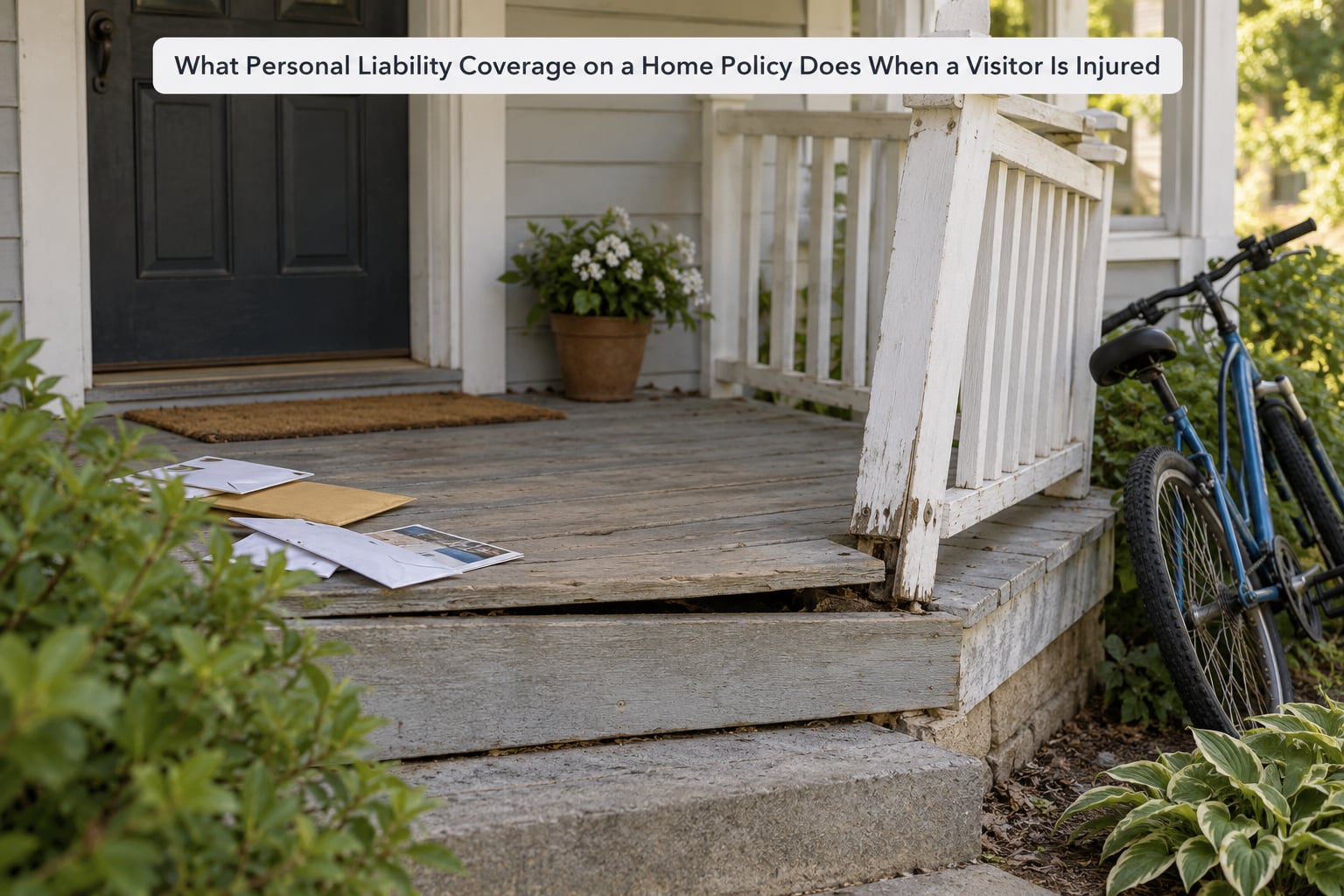
It responds when the visitor was injured by a condition on the property and the insurer decides you were negligent. Liability here turns on a chain of facts: the hazard existed, you knew or should have known about it, and you did not do something reasonable about it. A loose railing you have ignored for a year is a weak position. A railing that a contractor described as needing replacement last spring is a stronger one.
Icy walkways are the classic version. Insurers treat them case by case, and many policy forms set out specific duties about clearing snow and ice. Some forms exclude certain ice-related hazards on a walk area outright. That exclusion language is exactly the kind of detail people never read and then argue about later.
What usually settles these claims is not the law. A visitor with a minor injury will often accept payment for their medical bills, and the matter ends without a lawyer ever being involved. The insurer’s adjuster negotiates, you sign a release, and the claim closes. The damage to your premium history is usually minimal because nobody else saw it.
Proof is the practical issue. Notice of a claim should go to the carrier as soon as you hear about it, with photographs and dates. Write down what you remember while it is fresh. Memory of an incident gets unreliable within months, and a gap in the timeline is the first thing an attorney picks at.
Does Personal Liability Coverage Pay for Damage to Your Own Home?
No. Damage to your own dwelling and your own belongings belongs to the other sections of the policy. Coverage A handles the structure, Coverage B handles your possessions, and Coverage C covers other property on the premises.
The distinction is easy to confuse because two different things are happening in a storm. When a tree on your lot falls on your garage, Coverage A or C pays. When the same tree lands on your neighbor’s car, Coverage E may pay. Same event, same afternoon, two different sections of the policy doing two different jobs.
There is also a sequence to keep clear. If a fire in your kitchen damages your house, Coverage A pays for the repair. If that fire spreads to the house next door, Coverage E pays for your neighbor. Your insurer and your neighbor’s insurer may then both be involved, and the question of who caused the fire becomes a separate conversation between the two carriers.
One more piece worth knowing: the coverage protects you against claims, not against the other party’s insurance. If a visitor is hurt at your home and the visitor carries their own liability coverage, two policies can end up in play, with yours primary if the claim involves your premises.
Does Home Liability Coverage Cover Pets and Visitors?
Pets are covered for liability, but insurers draw careful lines. A dog bite claim is the classic covered event. Most policies cover a bite or a scratch that happens during normal contact, and many treat a dog that attacks or harasses without biting differently or more harshly.
Breed restrictions are the big variable. Some carriers exclude specific breeds outright, some exclude any dog with a bite history regardless of the breed, and some simply charge more for larger dogs. History matters as much as breed here: a single recorded bite report can follow an animal for the rest of its life and can move the owner to a different carrier or to a specialty market at a higher cost.
Off-premises bite coverage is thinner. A dog that bites a jogger on a public trail, or a neighbor’s child while your dog is in your yard, falls into different territory. Some forms extend to those situations, some restrict them, and dogs in boarding, training or daycare arrangements often sit outside the policy entirely.
Visitors fall into three practical groups. Guests and family members who live with you are generally covered when they cause damage elsewhere, but injuries to your own residents are normally excluded because they are covered under medical payments or health coverage instead. Contractors working on your property are covered for claims arising from their work, and you can usually add a named contractor as an additional insured so their own policy does not have to carry the whole loss.
That additional insured status is worth asking about if anyone regularly does substantial work at your house, particularly a general contractor on a remodel.
Does Personal Liability Coverage Cover Damage Caused Off the Property?
Partly, and the boundary is drawn by the phrase premises and operations. Operations extends some coverage to what you do elsewhere, but the situations it reaches are narrower than most people assume.
Damage you cause while renting a snow blower on a rented property, or knocking a marble into a neighbor’s display case while staying at their home, are the kinds of claims that can follow you. So can a recreational activity you do off your property, though the specific language varies.
What the coverage does not do is turn your home policy into an auto policy. If you are driving and cause a wreck, your car liability applies. If you cause damage while doing paid work, business exclusions apply. If you flood a neighbor’s basement from a burst washer hose you were repairing as a favor, the answer depends on whether you were acting as an unpaid helper and what your form says about it.
This is also where the umbrella conversation starts. An umbrella policy is excess coverage that sits on top of your primary limits. It does not replace Coverage E, it layers over it, and it reaches situations the underlying policy never touched, such as a boating accident or an incident on a property you do not own.
What Personal Liability Coverage on a Home Policy Does Not Cover
Here is the list that saves people money. None of the following belong inside Coverage E under a standard form, though a policy endorsement can change any of them.
- Intentional harm. Acts meant to injure or destroy are excluded, and the exclusion survives even when the act looks accidental.
- Auto accidents. Any injury or damage involving your vehicle belongs to your auto policy. Liability from backing out of your own driveway still counts as an auto event.
- Pollution. Fuel, chemicals, asbestos and similar substances are excluded, including a lot that has been contaminated.
- Business and professional activity. Claims from paid services, client work or commercial activity on the premises need a business liability policy.
- Damage to property you own or control. Your own fence, your own shed, or a garage you are responsible for maintaining does not become someone else’s property.
- Injuries to your own household members. Residents of the household are handled elsewhere in the form, so a claim by a family member typically fails on this ground.
- Fines and penalties. Court costs and government fines imposed by a criminal conviction are not liability losses.
- War, nuclear risk and certain contractual obligations such as assuming liability in a private agreement you signed yourself.
Three of these come up most: car accidents, business activity and injury to a member of your own family. Everything else shows up rarely.
Contract language deserves one extra note. If you sign a service contract that makes you responsible for a contractor’s mistakes regardless of fault, the coverage may not follow that promise, because it settles claims based on legal responsibility rather than on private agreements.
How Much Personal Liability Coverage Should You Have?
Match the limit to what you stand to lose, not to the lowest premium. A personal injury claim involving medical costs, several years of lost wages and a serious injury can reach well into six figures, and verdicts above 100,000 are no longer unusual in larger markets.
| Limit | Who it suits | Why |
|---|---|---|
| 100K | Renters and homeowners with no pools, pets of note, or rental income | The traditional standard. Fine for low-exposure homes, thin for anything else |
| 300K | Most owner-occupied homes | The common middle tier and the floor most umbrella carriers want to see underneath |
| 500K | Homes with a pool, trampoline, rentals, a dog in a dense neighborhood, or multiple projects | Reasonable headroom where attractive-nuisance claims are realistic |
| 1M or more through an umbrella | Anyone with substantial net worth, rental units, or a business on the property | Umbrella layers over the home policy, so both limits apply to the same incident |
A common rule of thumb puts your liability limit somewhere near your net worth, with a floor of 300,000 for a primary policy. The reasoning is straightforward: a judgment becomes a lien against your assets, so if your assets sit at 400,000, a 100,000 limit leaves a gap a plaintiff will take.
Attractive-nuisance factors push the other way. A swimming pool, a trampoline without a net, an unfenced retaining wall, a large tree that overhangs the neighbor’s yard and an unfenced wood stove all create conditions a child could exploit. Fencing, repairs and routine inspections cost very little next to a claim, and insurers notice the difference.
Raising the limit is usually the least expensive upgrade available on a home policy, since liability carries no claims history tied to your dwelling and the added premium is typically modest. Raising limits mid-term is easy through a declaration change, and carriers will usually reissue the page the same day. Some will ask for a short phone check on the change.
One trap worth naming: a bigger limit on the home policy is not an umbrella. Umbrella carriers require you to carry a minimum underlying limit on every policy that could generate a liability claim, including auto, renters, boat and RV policies. If your auto liability sits at the state minimum, the umbrella will be declined until you raise that too. This trips people up constantly, and the increase on the auto policy is often the part that surprises them.
How Does a Personal Liability Claim Work?
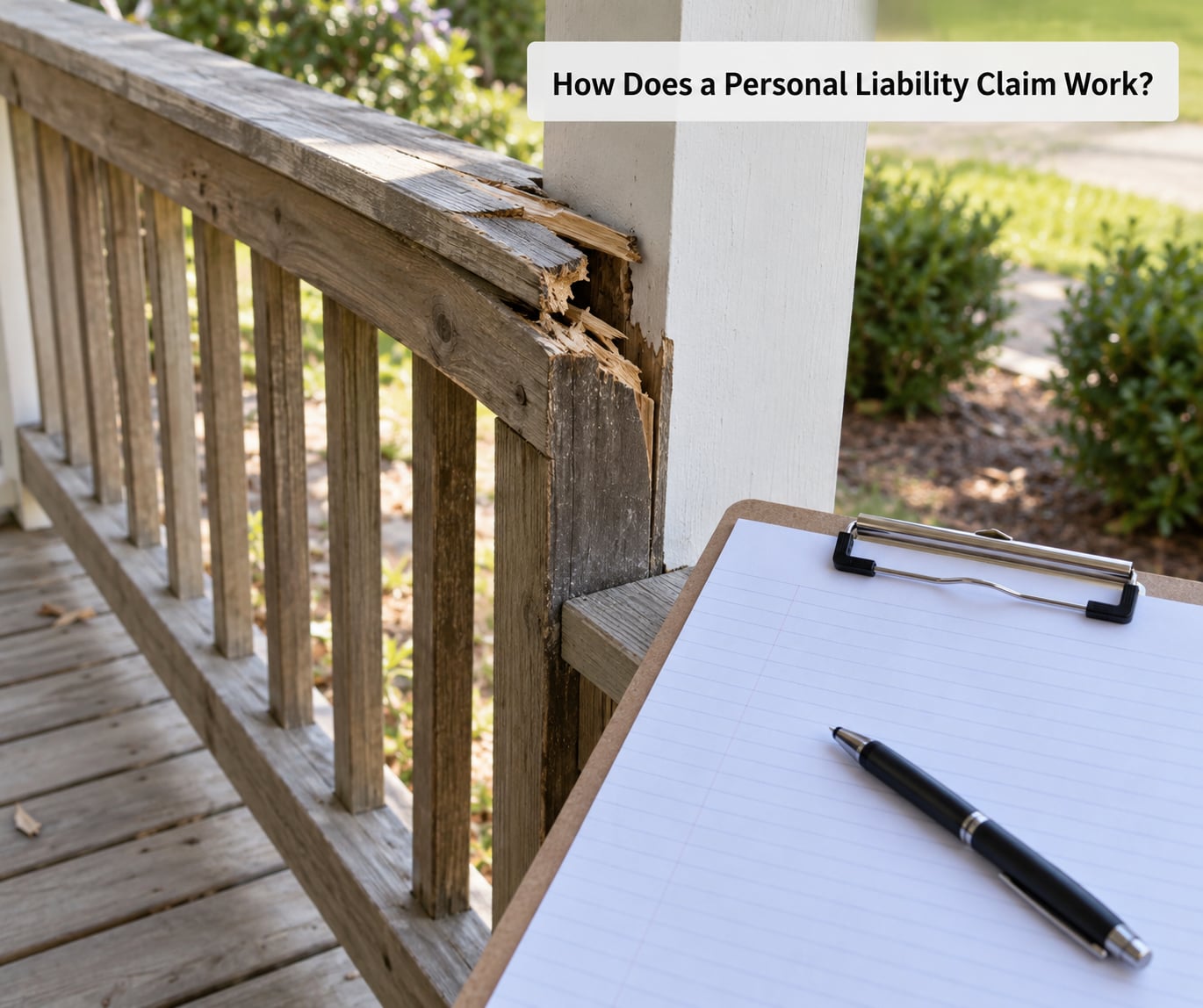
The sequence runs in a fairly predictable order, and knowing it ahead of time removes a lot of the stress from the process.
- Notice. The injured person, their attorney or your own insurer reports the claim. Prompt written notice gives you the chance to document the scene, gather photos and preserve records.
- Investigation. A claims adjuster interviews you, interviews the claimant and looks at the physical conditions. Photographs, witness statements and maintenance history all matter here.
- Liability determination. The insurer decides whether the event falls inside the coverage, whether a negligence element exists, and whether any exclusion applies. Business activity and intentional-acts exclusions are enforced at exactly this stage.
- Duty to defend. If the claim is covered, the insurer provides and pays for a defense attorney, and pays as the bills arrive. This generally happens regardless of the eventual outcome, which is the part people find surprising.
- Negotiation or litigation. The defense attorney negotiates a settlement. Most claims resolve here, because a defense verdict is costly and uncertain for both sides. If no agreement is reached, the case proceeds to trial.
- Payment. Any settlement or judgment is paid up to the per-occurrence limit. Amounts beyond that are yours to cover, unless an umbrella policy is in force, in which case the excess layer picks up the remainder up to its own limit.
The insurer does not simply hand over whatever is demanded. An adjuster who believes the claim is inflated will say so, and defense counsel exists partly to test the demand against the evidence. Settlements signed by you usually have to release the insurer from further liability, so read any release before you sign it.
Keep your own record too. Dates of conversations, names, and what was offered. If a case drags on, that timeline becomes your most useful document.
How to Check and Improve Your Coverage
Six things you can do this week, none of which require a new quote.
- Find Coverage E on the declarations page. The first page of the policy lists each section with its limit. Look for personal liability and write down the per-occurrence figure. Most policies also show medical payments and any excess or umbrella liability.
- Read the exclusion section of the form. This is where the ice, business, intentional-acts and pollution exclusions live. It is dense language and slow reading, but it is the only place these are written down.
- Compare limits against net worth. If your assets exceed your limit, the gap is real and worth closing.
- Check deductibles on the liability side. Liability usually carries no deductible, and some forms offer a higher deductible for a lower premium. Confirm what yours says before assuming.
- Ask about umbrella coverage in the same conversation. Get the underlying-limit requirement and the umbrella premium in writing, so you can see the total picture rather than one number.
- Fix the obvious hazards. Repair the loose railing, fence the pool, trim the tree, clear the walkway in winter. Documentation of the repairs also helps you later.
If you rent out a room, a basement unit or an accessory dwelling, that is a question for the agent rather than for the form. Some policies restrict or exclude rented-property liability, and a landlord policy or an endorsement may be the right structure instead. Running a business from a spare room raises the same concern in a different direction.
Frequently Asked Questions
Is personal liability included in every homeowners policy?
In nearly every standard homeowners, renters and condo form sold in the US, personal liability coverage is built in and you cannot remove it. Most policies place it under Coverage E. It may also appear under Coverage E-Extended or a similar label on less common forms, and condominium policies sometimes push it into the master policy so owners carry only a small share. The limit is what varies, not whether the coverage exists.
Does personal liability coverage replace a deductible?
No, the two do different jobs. A deductible is the amount of a covered loss you pay before coverage applies, and on a home policy it sits mainly on damage to your own dwelling and belongings. Personal liability coverage normally carries no deductible, and the insurer pays qualifying legal costs from the first dollar. So a liability claim is handled differently from a claim about your own damaged roof.
Can a homeowners policy cover a dog bite?
Often yes, since a bite to another person is one of the standard liability events. The exceptions are where it gets complicated. Many carriers exclude specific breeds, and nearly all of them treat a dog with a prior bite history differently. Attacks that happen off your property, or while the dog is in a boarding or daycare setting, can also fall outside the policy. Check the exclusions before you rely on it.
Is personal liability the same as umbrella liability coverage?
No. Personal liability is primary coverage sitting inside your homeowners policy, and it pays the first part of a covered claim up to its limit. An umbrella policy is excess coverage that only activates after the primary limit is exhausted, and it reaches incidents the home policy never covered at all, such as boating or a property you do not own. Carriers also require you to meet a minimum underlying limit before issuing one.
What happens if a personal liability claim exceeds the policy limit?
The insurer pays the covered amount up to the per-occurrence limit and stops there. Whatever remains is your personal responsibility, collected through the same process used for any other judgment against you. An umbrella policy, if you carry one, picks up the remainder up to its own limit. That is exactly why the gap between your liability limit and your net worth matters so much.
Does home liability coverage apply while I am renting out part of my property?
Sometimes, and the wording decides it. Many standard forms restrict or exclude liability arising from rented portions of the property, since a landlord-tenant relationship is a different arrangement from hosting a guest. If you rent a room, a basement unit or an entire building, ask an authorized agent whether your form excludes it and whether a landlord endorsement or separate policy is the better structure.
Conclusion
Start with two pages, not a sales call. Pull out your declarations page, find the personal liability limit, then read the exclusion section of the form so you know exactly where the coverage stops. From there, compare that limit to your net worth and to the hazards on your property, and ask an authorized agent what an umbrella policy would require and cost on top of what you already carry.
What personal liability coverage on a home policy does is narrower than most advertising suggests and more useful than most policyholders realize. It is a primary layer that handles claims against you for injury and property damage, it pays your legal fees as they accrue, and it works best when you have read the exclusions yourself rather than trusting a summary.