
Most local marketing budgets fail the same way. Somebody picks a round number in January, spreads it thin across six channels, and by March nobody can say which half of the money produced customers. Learning how to set a monthly local marketing budget properly takes about an hour, and you do it once a quarter rather than once a year.
The short version: work out what you can afford, choose one measurable outcome, give each channel a monthly limit small enough that you will not miss the number, then cut or scale based on what the last 30 days actually showed. Everything below builds on that loop.
Table of Contents
- What You Need
- Step-by-Step: How to Set a Monthly Local Marketing Budget
- 1. Review recent revenue and profit
- 2. Set a specific monthly marketing goal
- 3. Allocate the budget across priority channels
- 4. Reserve funds for testing and unexpected costs
- 5. Build channel budgets and spending limits
- 6. Track leads, customers, and revenue
- 7. Review and rebalance the budget monthly
- Common Mistakes
- Frequently Asked Questions
- How much should a small business spend on local marketing each month?
- What percentage of revenue should go into a local marketing budget?
- How should I divide my marketing budget by channel?
- How long should I test a local marketing campaign before changing it?
- What is the best way to track local marketing results?
- How do I reduce marketing spending without losing customers?
- Conclusion: Start With a 90-Day Test Budget
What You Need
You can build a workable budget from a shoebox of paperwork. The more of this you gather first, the fewer guesses you make later.
- Twelve months of revenue by month. Pull from your point-of-sale system or bank deposits, not a rough memory. Seasonal businesses need the full year, because one quiet January distorts every percentage you compute afterwards.
- Gross margin per sale. Divide total revenue minus direct costs by revenue. A 30 percent margin business and a 70 percent margin business can spend very different percentages of sales on marketing and still be equally healthy.
- Your last three months of marketing invoices and ad spend. Including agency retainers, software subscriptions, print runs and materials nobody thinks of as marketing.
- Channel performance data. Calls, form fills, direction requests, bookings, coupon redemptions, tracked phone numbers. Empty months are data too, and they tell you which channels never got a fair shot.
- Customer cost numbers. Average ticket, gross profit per customer, roughly how many times a customer comes back. Repeat purchase is the difference between marketing that looks expensive and marketing that pays for itself.
- Competitor reality check. Who else in your area is already visible on maps, in search and on neighborhood social pages, and how obvious are they?
- One written business goal. Not a wish, a number with a date attached. This is the anchor the whole budget hangs from.
If you are missing conversion data for a channel, treat it as unmeasured rather than useless. You will fix that in step six.
Step-by-Step: How to Set a Monthly Local Marketing Budget
Run these seven steps in order. Skipping ahead to allocation is how people end up spending on channels that were never capable of producing the outcome they wanted.
1. Review recent revenue and profit
Start with the number that constrains everything: affordable spend. Take your average monthly revenue over the last twelve months, subtract the costs that stay whether or not you sell another unit, and look at what gross profit is left.
Most owners anchor on a percentage of revenue, and that is a reasonable starting point. A business in its first couple of years usually runs higher, often 12 to 20 percent of gross revenue, because it is still building an audience. An established operation with steady repeat customers can run lower, around 6 to 12 percent, and put the difference into operations. Restaurant owners tend to work with even smaller numbers, closer to 3 to 6 percent of gross, partly because promotions eat margin.
Then apply a safety check that percentage benchmarks never mention. If the marketing number leaves payroll, rent and debt service tight in a slow month, it is too high no matter what the guideline says. For a new local business, the honest ceiling is what you can fund for six months with no revenue growth at all.
Worked example: a service business averaging 40,000 dollars a month with a 55 percent gross margin has roughly 22,000 dollars in gross profit. At 8 percent of revenue, marketing gets 3,200 dollars a month. That is the ceiling the rest of the process divides up.
2. Set a specific monthly marketing goal
Pick one primary outcome for the month. Not three. One primary outcome with a number and a deadline makes every later decision easier, because you can kill anything that is not moving it.
Good primary outcomes for local businesses: qualified leads booked for next month, new customers walking in, appointments kept, or sales dollars attributed to marketing. A useful version sounds like this: 24 qualified calls in November at no more than 90 dollars per call. The more specific the number, the faster you can tell whether the budget worked.
Work backwards from the number instead of forwards from the money. If a call converts to a customer 30 percent of the time and each customer is worth 340 dollars in gross profit, 24 calls is roughly 7 customers and about 2,400 dollars in gross profit. Now the budget has a ceiling it must not exceed, which is a very different conversation from spending whatever is in the account.
How you tell it worked: at the end of the month the target is either met, missed, or partially met, and the channel that produced the result is on record.
3. Allocate the budget across priority channels
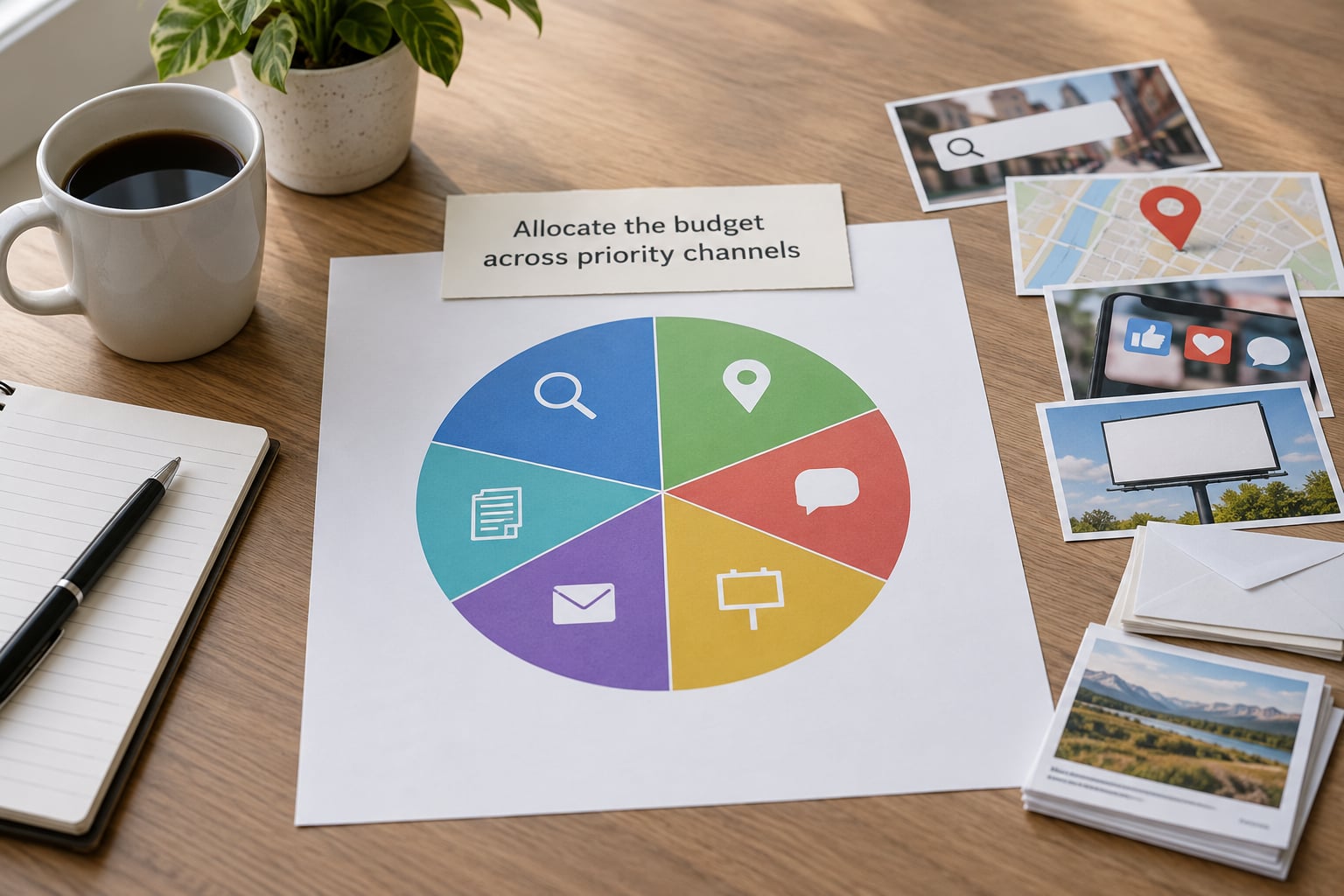
Divide the affordable amount by what each channel has actually done for you, then by how urgently you need it, then set a floor below which the channel cannot work. Equal percentages are the default most owners fall into, and they almost never match how their customers buy.
Think in three tiers. A core channel gets the majority because it already produces customers and you cannot afford to lose it. A growth channel gets a smaller slice and 90 days to prove itself. A test channel gets a token amount, small enough that failure costs nothing.
For a typical local business, the core tier is usually Google Business Profile upkeep plus local search work, and for service businesses Google Local Service Ads. The growth tier is usually paid search or paid social with geo-targeting, plus review generation. The test tier is where direct mail, neighborhood sponsorships, community events and print belong until they prove something.
One caution about minimum viable spend. A few hundred dollars a month spread across four platforms produces four campaigns that never exit the learning phase, which is why results look random. Two channels funded properly beat four funded badly. Local search results in particular compound over six to twelve months, so a channel that needs time deserves money you are not looking at again next month.
Worked example on a 2,000 dollar monthly budget: 600 for Local Service Ads or paid search, 300 for local search and listing work, 250 for geo-targeted social, 300 for a direct mail drop to a defined neighborhood or ZIP code, 150 for review generation, 200 held back as the test budget and 200 as contingency. Every line has a reason a person can defend at the end of the month.
4. Reserve funds for testing and unexpected costs
Set aside a controlled testing allowance, typically 10 to 15 percent of the monthly total, and treat it as its own category rather than borrowing from a working channel. Tests need room, and a budget with nothing spare forces you to raid the channel that is finally starting to work.
The testing allowance pays for a single new ad variation, a different offer, a mailer with a unique offer code, or a sponsorship that has never been tried. Give each test one variable and a fixed end date. Two changes at once tells you nothing about which one mattered.
On top of that, hold a small contingency for quotes that come in higher than expected, rush production fees, seasonal shifts, and opportunities that appear mid-month. A local printing shop quoting a neighborhood mail run can swing a lot on volume. A contingency of 5 to 10 percent absorbs that without making it a crisis.
How you tell it worked: every dollar from the testing allowance has a written hypothesis, a start date and a decision date attached to it.
5. Build channel budgets and spending limits
A monthly number is a suggestion. Weekly limits and approval rules are what actually keep you inside it. Convert each channel allocation into a weekly cap, and set the total monthly cap as a hard number that requires a decision to cross.
For the 2,000 dollar example, 600 dollars of paid search works out to roughly 140 dollars a week, which also gives you a natural pause: if the account burns through four weeks of money in ten days, you get a clean signal rather than an alarming one. For channels with fixed costs, like print or a sponsorship, define the approval threshold in advance. Nobody should be able to add a 400 dollar line item without a written reason and a documented offset.
Also write down what each channel is expected to deliver. A line item with no deliverable attached is a wish. A local search line might carry the outcome of publishing four updated service pages and ten new photos to the business profile. A direct mail line might carry 2,000 pieces to one ZIP code with a unique offer code and a stated redemption target. Deliverables make the monthly review a fact-checking exercise instead of an argument.
If you use an agency, get the management fee in writing as a number. Retainers commonly add 30 to 40 percent on top of ad spend, which changes the arithmetic on every line of the budget.
6. Track leads, customers, and revenue

Decide the tracking method for each channel before the money goes out, not after the invoice arrives. Four numbers do most of the work: cost per lead, lead-to-customer conversion rate, customer acquisition cost, and return on ad spend.
Start with the math. Cost per lead is channel spend divided by leads. Customer acquisition cost is total marketing spend divided by new customers acquired. Return on ad spend is attributed revenue divided by ad spend. Compute them monthly for every channel, including the ones that feel untrackable, because a channel you cannot measure is a channel you can only argue about.
Local marketing makes this harder than online-only businesses, so use the tools that exist. A dedicated tracking number for one channel, a unique offer code on every mailer, a QR code per printed piece, a separate landing page per campaign, and a simple question at checkout about how the customer heard about you. None of these are sophisticated, and all of them give you an answer instead of a shrug.
Ask at checkout anyway. In a business with no online checkout, this question is often the only attribution data you will ever collect, and it takes four seconds. Record the answers in a shared sheet so staff actually fill it in; a form nobody can reach is a form nobody uses.
How you tell it worked: every channel on the budget has a cost per lead and a customer acquisition cost attached to it by the fifth business day of the following month.
7. Review and rebalance the budget monthly
Put the review on a recurring calendar date, ideally within five business days of month end, and give it thirty minutes. Bring the four numbers, the deliverable list from step five, and the prior month’s targets.
Then make three kinds of decisions. Cut anything that spent money and produced no measurable result across a fair test window. Scale anything performing well, in increments of 10 to 20 percent a month, because jumping a winning campaign to triple its budget in one step usually tanks performance and resets the learning. Hold anything that is simply early, especially local search, and write down the date you will judge it instead of re-deciding every month.
Write the changes down with the reason attached. Three months later that log is the only honest record of what actually worked, and it makes next year’s budgeting dramatically faster than starting from memory.
One caution about the review. A single month is a small sample, and weather, holidays and slow weeks move local numbers around. Judge seasonal businesses over a full season before making big cuts.
Common Mistakes
Copying a universal percentage. A guideline is a starting point, not a plan. Ten percent of revenue works for one business and bankrupts another with thin margins or a quiet season. The fix: calculate your affordable number from gross profit and a six-month survival check, then treat percentages as a sanity check on that number.
Spending before tracking exists. Turning on campaigns first and figuring out measurement later means the first month produces no usable data at all. The fix: set up tracking numbers, codes and the reporting sheet in step five, before any money moves.
Changing channels too quickly. Paid search and local search both need time before results settle, and a channel judged after two weeks rarely gets a fair read. The fix: commit to a 90-day test window per channel, written down in advance, and only judge results inside that window.
Ignoring offline results entirely. Signage, neighborhood sponsorships and events get dismissed because they have no dashboard, and then nobody knows whether the renewal was worth it. The fix: attach a unique code, tracking number or QR code to every offline piece, and count redemptions monthly.
Splitting the budget evenly across channels. Five equal slices feel fair and starve every one of them below the minimum spend needed to produce results. The fix: fund two channels properly, keep the rest small, and let the 90 days of data decide the next split.
Choosing tactics nobody can judge. Brand awareness, community presence and engagement are real goals, but as the only measurement they make every channel look identical. The fix: attach a measurable action to each, such as tracked calls, offer code redemptions or profile direction requests.
A few shorter budgeting tips worth stealing. A monthly cap beats an annual budget for any business with seasonality, since the annual number hides a bad December. Email to your existing list is frequently the cheapest channel you have, and repeat customers typically buy far more often than new ones, so keep a line for it. Pay yourself a percentage of new-customer revenue into a separate marketing account on the day it clears, and the budgeting decision stops depending on your mood in the first week of the month. Finally, a 500 dollar monthly budget should run one channel, usually paid search for a service business, rather than four half-funded ones.
Frequently Asked Questions
How much should a small business spend on local marketing each month?
Most small local businesses land between 6 and 12 percent of gross revenue once they have a steady customer base, and 12 to 20 percent during the first couple of years while an audience is still being built. Restaurants often work with less, around 3 to 6 percent. Treat those as starting points, then cap your number at what your gross profit supports through six slow months.
What percentage of revenue should go into a local marketing budget?
Use revenue percentage as a sanity check rather than a formula. Multiply your average monthly revenue by your target percentage, then ask whether the result leaves payroll, rent and debt service comfortable in a slow month. If it does not, lower the percentage. Businesses with thin margins need a smaller share of sales than high-margin ones to fund marketing safely.
How should I divide my marketing budget by channel?
Give the largest share to the channel that already produces customers, a smaller share to one channel you are testing, and set aside 10 to 15 percent for new experiments. Fund two channels properly rather than splitting money across five, since small budgets never exit a platform’s learning phase. Weight the split toward channels where your customers actually search or shop locally.
How long should I test a local marketing campaign before changing it?
Ninety days is a reasonable minimum for most local channels, and local search often needs six to twelve months to show meaningful movement. Paid search can be judged sooner once it has enough data, roughly a few hundred clicks. Write the test window down before you start so you are not tempted to end it early when a slow week shows up.
What is the best way to track local marketing results?
Track cost per lead, lead-to-customer conversion rate, customer acquisition cost and return on ad spend for every channel each month, using a dedicated phone number, unique offer code or QR code for each one. Ask every walk-in how they heard about you and log the answer. That single question often produces better attribution data than any dashboard.
How do I reduce marketing spending without losing customers?
Cut the channels that spent money and produced no measurable result, and protect the ones already producing customers. Hold anything that is still early rather than treating it as a failure, especially local search work. Scaling down in small steps and keeping a written record of results makes it easy to restore spending later without guessing.
Conclusion: Start With a 90-Day Test Budget
Knowing how to set a monthly local marketing budget comes down to four habits: derive the number from your own gross profit, pick one measurable monthly outcome, give every channel a cap and a deliverable, and reallocate at a fixed date each month. The rest is detail.
Do three things this week. Pull twelve months of revenue and last quarter’s marketing invoices, set one numeric goal for next month, and open a separate marketing account funded with a conservative 90-day test budget built from the seven steps above. Run the first review a month from now, and change what the numbers tell you to change.